Russia Ukraine War 2026: Latest Updates & Global Impact
International Affairs• April 07, 2026• Global Edition
The Russia Ukraine war 2026 continues to dominate global headlines as one of the most protracted conflicts of the 21st century. Now entering its fifth year, the Russia Ukraine war update 2026 reveals a grinding war of attrition marked by Ukrainian counteroffensives, relentless Russian missile and drone barrages, and significant energy infrastructure battles. What began as a full-scale invasion in February 2022 amid the lingering effects of the global Corona pandemic has evolved into a multifaceted crisis with profound implications for international security, energy markets, and geopolitical power balances.
This comprehensive article examines the Russia Ukraine war from its Corona-era origins through to the latest Russia Ukraine war news 2026. We explore how leaders and the public in both nations have reacted and clashed, the current status of the Ukraine vs Russia war, its expansion and containment in 2026, the sweeping global impacts, and Russia's strategic pursuit of superpower status. For those searching russia ukraine war energy impact or russia war plans 2026, this analysis provides clear, factual insights drawn from ongoing battlefield realities and diplomatic maneuvers.
The roots of the Russia Ukraine war trace back decades, but the full-scale invasion unfolded against the backdrop of the COVID-19 pandemic—often referred to as the "time of Corona." By early 2022, the world was emerging from lockdowns, vaccine rollouts, and economic disruptions caused by the virus. Global supply chains were strained, inflation was rising, and public attention was split between health crises and recovery efforts.
In this fragile context, Russia massed troops along Ukraine's borders throughout late 2021 and early 2022. The Corona pandemic had already heightened global tensions: supply shortages, energy price volatility, and questions about international cooperation. Ukraine, still recovering from the 2014 annexation of Crimea and the Donbas conflict, faced its own internal challenges, including pandemic-related economic slowdowns. Russia, under President Vladimir Putin, framed the operation as a response to alleged NATO expansion and threats to Russian-speaking populations—narratives amplified amid pandemic-induced uncertainty.
The invasion launched on February 24, 2022, just as many nations were lifting COVID restrictions. This timing amplified the shock: refugee flows overwhelmed European borders already strained by pandemic migration patterns, while energy markets—already volatile from Corona disruptions—spiked dramatically. The russia ukraine conflict thus intersected with the tail end of the global health emergency, diverting resources and media focus from COVID-19 recovery to wartime priorities. Early Russia Ukraine war news highlighted rapid advances toward Kyiv, but Ukrainian resistance, bolstered by Western aid, turned the tide into a prolonged stalemate that persists into the Russia Ukraine war 2026 phase.
How the War Started: Triggers, "In Water" Realities, and Initial Clashes
The phrase "how it is started in water" likely refers to the winter timing and fluid, unpredictable early dynamics—February's harsh conditions on land and sea, combined with information "floods" of propaganda. Putin ordered the "special military operation" after recognizing the Donetsk and Luhansk "people's republics" and citing "genocide" claims against Russian-speakers. Ground forces crossed from multiple directions, with naval and airborne elements targeting key ports and airfields.
Both sides engaged in fierce information warfare from day one. Russian state media portrayed the move as defensive; Ukrainian President Volodymyr Zelenskyy rallied global support via social media, rejecting surrender. Early fighting in the north, east, and south saw Russian forces initially advance but stall due to logistical issues, Ukrainian ambushes, and fierce urban defense. The "water" element extended to Black Sea operations, where naval clashes and grain export blockades quickly affected global food security.
Public reactions erupted immediately. In Ukraine, spontaneous civilian resistance—Molotov cocktails, territorial defense units—embodied national unity. In Russia, initial support gave way to protests, though quickly suppressed. The russia vs ukraine war began not just on battlefields but in hearts and minds, setting the tone for years of mutual animosity.
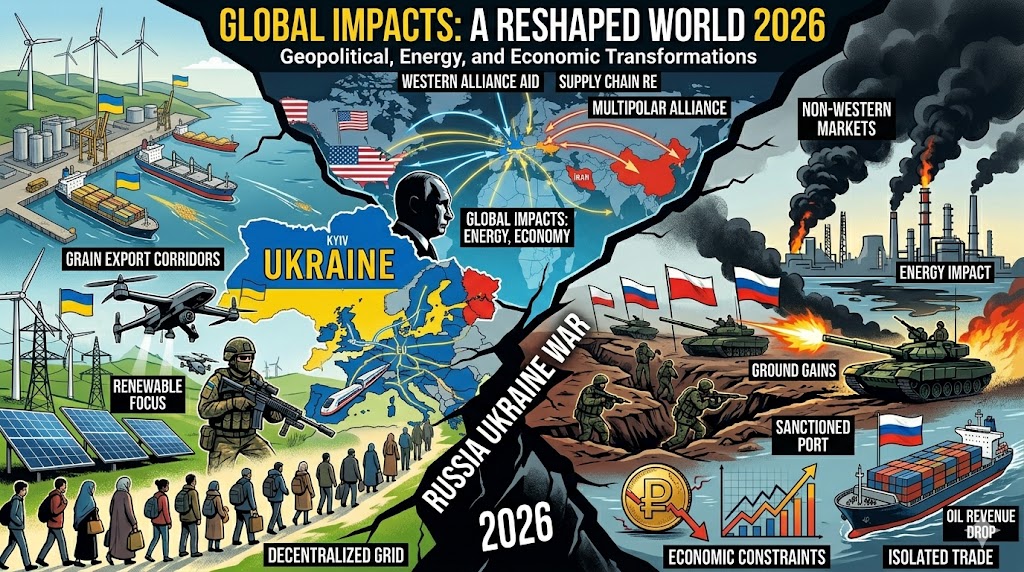
The split landscape depicts a vibrant Western alliance (US, EU, Ukraine) accelerating decentralized energy grids and renewable focus (solar, wind) while managing complex supply chains. Conversely, a sanctioned Russia focuses on multipolar alliances (China, Iran) and war production, facing reduced oil revenues and isolated trade.
Leaders' Reactions and Strategies: Putin, Zelenskyy, and the Public Divide
Leaders on both sides have shaped the Russia Ukraine war update 2026 through contrasting styles. Putin has maintained a resolute posture, framing the conflict as existential for Russian security and civilization. His rhetoric emphasizes "denazification" and protection of Russian speakers, while rejecting ceasefires unless Ukraine withdraws from Donbas. Russian war plans 2026 appear focused on incremental gains in Donetsk, sustained pressure via long-range strikes, and exploiting any Western fatigue.
Zelenskyy, the former comedian turned wartime president, has projected defiance and pragmatism. He has proposed Easter ceasefires and engaged in U.S.-led talks, yet insists on restoring 1991 borders and security guarantees. His frequent addresses to parliaments worldwide have secured billions in aid, while Ukrainian forces under General Oleksandr Syrskyi have executed effective counterattacks.
Public behavior reflects deep polarization. Russian society, fed state narratives, shows war fatigue but limited open dissent due to laws against "discrediting" the military. Many support the "special operation" out of patriotism or fear of consequences; others emigrate or quietly oppose it. Ukrainian public resolve remains remarkably high—polls show overwhelming support for fighting on, with civilians adapting to blackouts, sirens, and mobilization. Families torn apart by the war have fueled personal vendettas, turning the russia ukraine conflict into a societal struggle where civilians on both sides "fight" through resilience, volunteering, or information campaigns.
The Russia Ukraine War in 2026: Containment, Expansion, and Battlefield Realities
As of April 2026, the Ukraine war 2026 remains contained in eastern and southern fronts but shows signs of expansion through long-range strikes. Russian forces have made limited gains—averaging a few square miles weekly in Donetsk—yet Ukrainian counterattacks in Zaporizhzhia and Kharkiv have reclaimed hundreds of square kilometers since January. Russia claims near-total control of Luhansk but faces Ukrainian deep strikes on oil refineries and ports, halving some export capacities.
Russia Ukraine war expansion manifests in drone barrages—nearly 1,000 in single nights—and Ukrainian hits deep into Russia, including chemical plants. Spring 2026 offensives have stalled amid Ukrainian innovations in drones and electronic warfare. Peace talks remain paused; Russia demands Donbas withdrawal, while Zelenskyy pushes for security pacts. The russia vs ukraine war update 2026 indicates no decisive breakthrough, with both sides conserving forces for summer campaigns. Ukrainian energy infrastructure has suffered heavily (losses up to 80% in thermal capacity earlier), but adaptive measures like decentralized generation have mitigated total collapse.
Global Impacts: Energy, Economy, and the "Empire" Reshaped Worldwide
The russia ukraine war energy impact has been seismic. Initial 2022 shocks—gas cutoffs, oil spikes—evolved into chronic volatility. By 2026, Ukrainian strikes on Russian refineries and ports have reduced Moscow's oil revenues by up to 50%, forcing export bans and price surges. Europe accelerated renewables, but lingering effects include higher electricity costs and industrial slowdowns. Global food prices, once spiked by Black Sea blockades, stabilized via alternative routes yet remain vulnerable.
What "empire set" has emerged? The war has redrawn influence spheres. NATO has expanded (Finland, Sweden), while Russia deepened ties with Iran, North Korea, and China. Economic "empires" shifted: BRICS gained momentum, Western sanctions reshaped trade. Refugee crises (millions displaced) strained Europe; developing nations faced food insecurity. The conflict accelerated de-globalization trends, with supply chain "friend-shoring" and energy diversification becoming norms. Overall, the Russia Ukraine war 2026 has entrenched a multipolar world where energy security trumps old alliances.
Russia's Quest for Superpower Status: How the War Fits the Strategy
The Russia Ukraine war is inextricably linked to Moscow's superpower ambitions. Putin views Ukraine as a buffer against NATO and a cultural-historical extension of Russia. Victory—or at least preventing Ukrainian NATO integration—would restore perceived great-power parity lost after the Soviet collapse. Despite battlefield costs (over a million Russian casualties estimated), the war has diversified Russia's economy toward war production and non-Western markets.
In 2026, russia war plans 2026 emphasize attrition to exhaust Ukraine and Western support. Nuclear rhetoric and alliances with anti-Western states signal a broader challenge to U.S.-led order. Success would validate hybrid warfare; failure risks internal instability. The russia ukraine conflict thus serves as a proving ground for Russia's resurgence, even as sanctions and losses constrain conventional power.
Russian and Ukrainian Diaspora Behavior in Israel and the US
Russian and Ukrainian communities abroad have mirrored homeland divisions while adapting uniquely. In the US, the Ukrainian diaspora—politically organized and influential—has lobbied Congress effectively, fundraising billions and shaping aid packages. Protests, cultural events, and voter mobilization amplify Ukraine's voice.
In Israel, the large Russian-speaking population (many post-Soviet immigrants) shows nuanced reactions. Surveys indicate most Ukrainian olim strongly back Kyiv, while Russian olim lean neutral or pro-Ukraine despite family rifts. Early war saw bullying of Russian-heritage children; later, refugee inflows revived cultural hubs. Both groups engage in humanitarian aid, but tensions surface in family disputes and public discourse. Israeli policy balances relations with both nations, with the diaspora influencing quiet diplomacy.
These communities "fight" through advocacy, remittances, and identity preservation, extending the russia ukraine crisis far beyond battle lines.
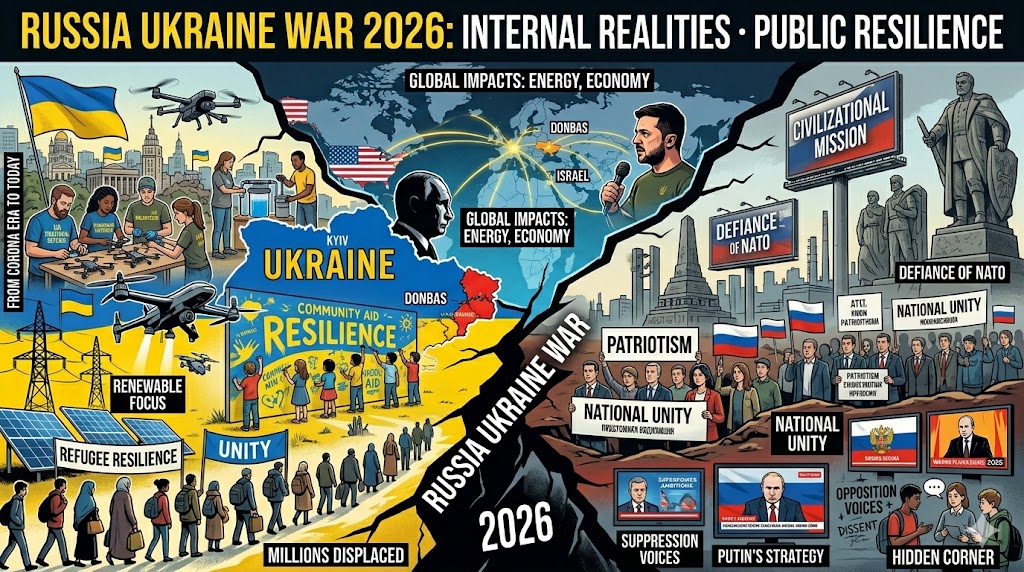
Ukraine's society unites through civilian resistance, volunteer programs, and innovative energy solutions, demonstrating remarkable refugee resilience and a unified spirit and Russian society navigates a highly structured environment with pervasive state propaganda promoting civilizational mission and superpower ambitions, juxtaposed with quiet dissent and suppressed opposition voices
Conclusion: Outlook for the Russia Ukraine War 2026 and Beyond
The Russia Ukraine war 2026 stands as a testament to resilience amid devastation. From Corona-era origins to today's attritional stalemate, the conflict has reshaped leaders, publics, and global systems. While Russian advances continue slowly and Ukrainian innovations yield tactical wins, true resolution hinges on diplomacy, not dominance. Energy impacts, superpower posturing, and diaspora voices underscore the war's enduring legacy.
As russia ukraine war news 2026 evolves, one truth remains: peace requires compromise respecting sovereignty and security. The world watches, hoping the russia vs ukraine war update brings not further expansion but measured containment and eventual stability.
Frequently Asked Questions
What is the primary significance of Russia Ukraine War 2026: Latest Updates & Global Impact?
The Russia Ukraine war 2026 continues to dominate global headlines as one of the most protracted conflicts of the 21st century. Now entering its fifth year, the Russia Ukraine war update 2026 reveals a grinding war of attrition marked by Ukrainian counteroffensives, relentless Russian missile and drone barrages, and significant energy infrastructure battles.
How does this development impact International Affairs?
What began as a full-scale invasion in February 2022 amid the lingering effects of the global Corona pandemic has evolved into a multifaceted crisis with profound implications for international security, energy markets, and geopolitical power balances.This comprehensive article examines the Russia Ukraine war from its Corona-era origins through to the latest Russia Ukraine war news 2026. We explore how leaders and the public in both nations have reacted and clashed, the current status of the Ukraine vs Russia war, its expansion and containment in 2026, the sweeping global impacts, and Russia's strategic pursuit of superpower status.
What are the key future projections to monitor?
For those searching russia ukraine war energy impact or russia war plans 2026, this analysis provides clear, factual insights drawn from ongoing battlefield realities and diplomatic maneuvers.Historical Background: The Russia-Ukraine Conflict in the Time of CoronaThe roots of the Russia Ukraine war trace back decades, but the full-scale invasion unfolded against the backdrop of the COVID-19 pandemic—often referred to as the "time of Corona." By early 2022, the world was emerging from lockdowns, vaccine rollouts, and economic disruptions caused by the virus.