Trump Iran 8PM Deadline: Civilization on the Brink
International Affairs• April 07, 2026• Global Edition
The Clock Ticks Down to Trump’s Fateful Deadline
As the sun sets on Tuesday, April 7, 2026, the world holds its breath. President Donald Trump’s self-imposed 8:00 p.m. Eastern Time deadline for Iran looms large—a hard line drawn in the sand amid the ongoing U.S.-Israel-Iran war that erupted on February 28. At stake is nothing less than the reopening of the Strait of Hormuz, the vital artery through which one-fifth of global oil flows. Trump has made it crystal clear: comply or face devastating consequences.
In a series of blistering Truth Social posts and public statements, the president has warned that failure to strike a deal will trigger “Power Plant Day, and Bridge Day, all wrapped up in one.” He has gone further, declaring that “a whole civilization will die tonight, never to be brought back again” if Iran does not yield. The rhetoric is not subtle. It is a direct threat to obliterate Iran’s critical infrastructure—power plants, bridges, and energy facilities—potentially plunging the nation into darkness and economic collapse.
Yet Iran is not backing down. In a stunning move reported just hours ago, Tehran has closed all diplomatic and indirect channels of communication with the United States, suspending every exchange of messages through mediators. The Islamic Republic insists it will not surrender. Instead, it stands ready to sacrifice everything in defense of its sovereignty. This escalation comes against a backdrop of mutual surveillance: both leaders and their administrations are obsessively monitoring every comment, every post, every troop movement from the other side.
Russia has thrown its weight behind Iran, issuing fiery condemnations of U.S. and Israeli actions and pledging support. Israel, already deeply embedded in the conflict, continues precision strikes. The question on everyone’s mind: if conventional fighting intensifies—or worse, spirals into nuclear exchange—what happens? And how will tomorrow morning look for the rest of the world?
This article examines the high-stakes drama unfolding today, the responses from all parties, and the potential ramifications of full-scale war.
President Trump has turned the Strait of Hormuz into the central battleground of his Middle East policy. The waterway’s closure, enforced by Iran since the war’s early days, has already sent shockwaves through global energy markets. Trump’s latest ultimatum—reopen it by 8 p.m. tonight or suffer irreversible damage—builds on weeks of escalating warnings.
His Truth Social activity has been relentless. One post bluntly states: “Tuesday will be Power Plant Day, and Bridge Day, all wrapped up in one, in Iran. There will be nothing like it!!! Open the F—-in’ Strait, you crazy bastards, or you’ll be living in Hell – JUST WATCH!” Another warns of an entire civilization vanishing overnight. These are not idle threats. Trump has repeatedly signaled that U.S. forces are prepared to strike civilian infrastructure, a move some legal experts have flagged as potentially crossing into war-crime territory.
The administration’s strategy appears twofold: maximum pressure to force Iran’s hand while keeping open a narrow window for last-minute diplomacy. Yet with the deadline now upon us, Trump’s tone has hardened. He has extended previous deadlines before, citing “good chance” of deals, but today’s rhetoric suggests this one may be final. Every American action—troop deployments, naval maneuvers in the Gulf—is watched in Tehran, and vice versa. The two sides are locked in a tense game of cat and mouse, where a single misread signal could ignite catastrophe.
Iran’s response has been equally uncompromising. Hours before the deadline, the government announced the complete closure of all diplomatic and indirect communication channels with the U.S. No more messages through Pakistani, Egyptian, or Turkish mediators. Tehran has dismissed ongoing negotiations as futile and rejected multiple ceasefire proposals, insisting instead on a permanent end to the war, full sanctions relief, reparations, and guaranteed safe passage protocols for the Strait.
Officials in Tehran have mobilized civilians, calling on young people to form human chains around power plants and key infrastructure. The message is clear: Iran will not surrender. It is prepared to sacrifice everything—lives, economy, stability—rather than capitulate to what it calls American and Israeli aggression. “We are determined to defend our national security and sovereignty with all might,” a Foreign Ministry spokesperson declared.
This closure of channels marks a dangerous turning point. While indirect talks had flickered on and off, Iran now signals it will not negotiate under duress. Yet even in defiance, Iranian leaders continue to monitor Trump’s every move, every social media post, every Pentagon briefing. The regime understands the stakes: destruction of its infrastructure could set the country back decades, but yielding might embolden further demands.
Russia’s Commitment: Standing Firm with Iran
Russia has emerged as a vocal and active backer of Iran. The Kremlin has condemned U.S. and Israeli strikes as “illegal and unprovoked aggression.” President Vladimir Putin and Foreign Minister Sergey Lavrov have issued strong warnings to both Trump and Israeli Prime Minister Benjamin Netanyahu. Moscow has pledged to stand by Tehran, providing diplomatic cover, intelligence support, and—according to longstanding patterns—military aid including drones and satellite reconnaissance.
Russian officials have criticized Trump’s “language of ultimatums” and called for a return to diplomacy. Yet their support is not unconditional; Russia has also offered to help mediate a resolution. Still, the alliance strengthens Iran’s resolve. With Moscow’s backing, Tehran feels less isolated, knowing it has a powerful partner watching its back as the deadline expires.
Both Trump and Iranian Supreme Leader successors (following the reported death of Ali Khamenei earlier in the conflict) are acutely aware of Russia’s moves. Every Kremlin statement is dissected in Washington and Tehran, adding another layer to this high-wire act of real-time observation.
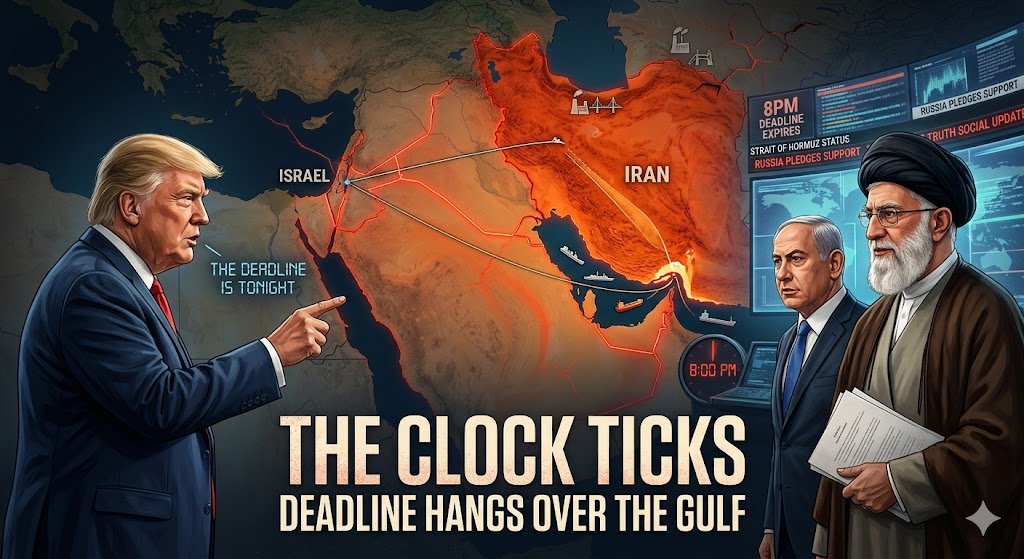
A dramatic editorial illustration depicting the key figures and the region as the 8:00 PM deadline approaches. From left to right: US, Israeli, and Iranian leaders stand before a glowing strategic map of the Middle East, with red lines highlighting the tension points and the vital Strait of Hormuz waterway, illustrating the high-stakes diplomatic and military standoff
Leaders in Real-Time Watch: Every Comment, Every Action Scrutinized
In an era of instant global communication, the leaders of the United States, Iran, Russia, and Israel are engaged in unprecedented mutual surveillance. Trump’s Truth Social posts are pored over in Tehran within minutes. Iranian state media statements and IRGC movements are analyzed in real time by U.S. intelligence. Russian diplomatic cables and Israeli airstrikes are cross-checked against open-source reports.
This constant monitoring creates a hair-trigger environment. A single provocative comment can escalate tensions; a misinterpreted military maneuver can spark retaliation. Today’s events—Trump’s final warnings, Iran’s channel closures, Russian condemnations—have all been watched with intense focus. The result is a feedback loop of suspicion and posturing that makes de-escalation extraordinarily difficult.
Predicting the Battle: Conventional War, Nuclear Risks, and Mutual Destruction
If both sides press forward without compromise, the immediate battle would likely center on U.S. and Israeli strikes against Iranian infrastructure. Trump has promised to render power plants “burning, exploding and never to be used again” and destroy bridges across the country. Iran has vowed retaliation against Gulf energy facilities and shipping.
Analysts warn that such conventional escalation could quickly spiral. Iran’s ballistic missile arsenal and proxy networks (Houthis, Hezbollah remnants) give it asymmetric tools to strike back. The Strait of Hormuz would remain closed longer, driving oil prices to record highs and triggering global shortages.
But the ultimate nightmare scenario is nuclear. Iran does not possess confirmed nuclear weapons, though its enrichment program has advanced dramatically amid the war. The United States and Israel do. If conventional strikes target Iranian nuclear sites or leadership bunkers, Tehran could race toward weaponization or launch massive conventional barrages that invite nuclear response. A full nuclear exchange—however unlikely today—would be catastrophic. Neither side “wins.” Mutually assured destruction would leave millions dead, radiation spreading across the region, and economies in ruins. Cities from Tel Aviv to Tehran could be devastated; fallout would reach Europe and Asia.
Military experts assess that U.S. conventional superiority would overwhelm Iran in a prolonged fight, but at immense human and economic cost. Iran’s strategy of endurance and asymmetric warfare could prolong the conflict, bleeding American resources and public support. Russia’s involvement might deter all-out U.S. commitment. In short, no clear victor emerges—only shared tragedy.
Israel’s Entry and the Risk of Wider War
Israel is already a full participant. Recent strikes on Iranian gas fields, rail bridges, and commanders underscore its determination to degrade Tehran’s capabilities. Israeli leaders have opposed any deal that leaves Iran’s nuclear program intact or its regional influence unchecked. If the U.S. launches major infrastructure attacks tonight, Israel is poised to join with its own precision campaign.
A multi-front war involving the U.S., Israel, Iran, and potentially Russian-backed proxies would engulf the Middle East. Gulf states, already reeling from Iranian retaliation, could face refugee crises and energy blackouts. NATO allies have so far declined direct involvement, but spillover—missile strikes on bases in Turkey or Jordan—could draw them in.
Tomorrow Morning’s World: Global Shockwaves from One Night of Decision
By Wednesday morning, the consequences could be immediate and far-reaching. If Trump orders strikes, expect:
Energy Markets in Chaos: Oil prices could surge past $200 per barrel as Hormuz remains blocked and Iranian facilities burn. Gas shortages in Asia and Europe would follow.
Humanitarian Crisis: Blackouts across Iran would disrupt hospitals, water treatment, and food supply. Civilian casualties from infrastructure collapse would mount rapidly.
Financial Turmoil: Stock markets worldwide would open in freefall. Shipping insurance rates would skyrocket; supply chains for everything from electronics to food would fracture.
Geopolitical Realignment: Russia and China might accelerate support for Iran. Europe could face energy rationing. Global public opinion would turn sharply against further escalation.
Nuclear Shadow: Even without launches, the mere risk would trigger panic evacuations and diplomatic frenzy in capitals from Moscow to Beijing.
The world would wake to a transformed landscape: higher prices at the pump, fear of wider war, and a Middle East in flames. Recovery could take years, if not decades.
Conclusion: A Narrow Path Remains—But Time Is Up
As 8:00 p.m. approaches, the choice rests with Tehran—and Washington’s willingness to follow through. Iran shows no sign of surrender. Russia stands ready to bolster its ally. Israel watches closely. Leaders on all sides track every development in real time.
Trump’s Iran deadline has brought the region—and the world—to a precipice. Whether tonight ends in destruction or a last-minute breakthrough remains unknown. One thing is certain: the decisions made in the next few hours will echo for generations. The stakes could not be higher. Civilization itself, as Trump starkly warned, hangs in the balance.
Frequently Asked Questions
What is the primary significance of Trump Iran 8PM Deadline: Civilization on the Brink?
The Clock Ticks Down to Trump’s Fateful DeadlineAs the sun sets on Tuesday, April 7, 2026, the world holds its breath. President Donald Trump’s self-imposed 8:00 p.m.
How does this development impact International Affairs?
Eastern Time deadline for Iran looms large—a hard line drawn in the sand amid the ongoing U.S.-Israel-Iran war that erupted on February 28. At stake is nothing less than the reopening of the Strait of Hormuz, the vital artery through which one-fifth of global oil flows.
What are the key future projections to monitor?
Trump has made it crystal clear: comply or face devastating consequences.In a series of blistering Truth Social posts and public statements, the president has warned that failure to strike a deal will trigger “Power Plant Day, and Bridge Day, all wrapped up in one.” He has gone further, declaring that “a whole civilization will die tonight, never to be brought back again” if Iran does not yield.