US-Israel-Iran War: 2026 Asia Economic Crisis Deepens
Current Affairs• April 04, 2026• Global Edition
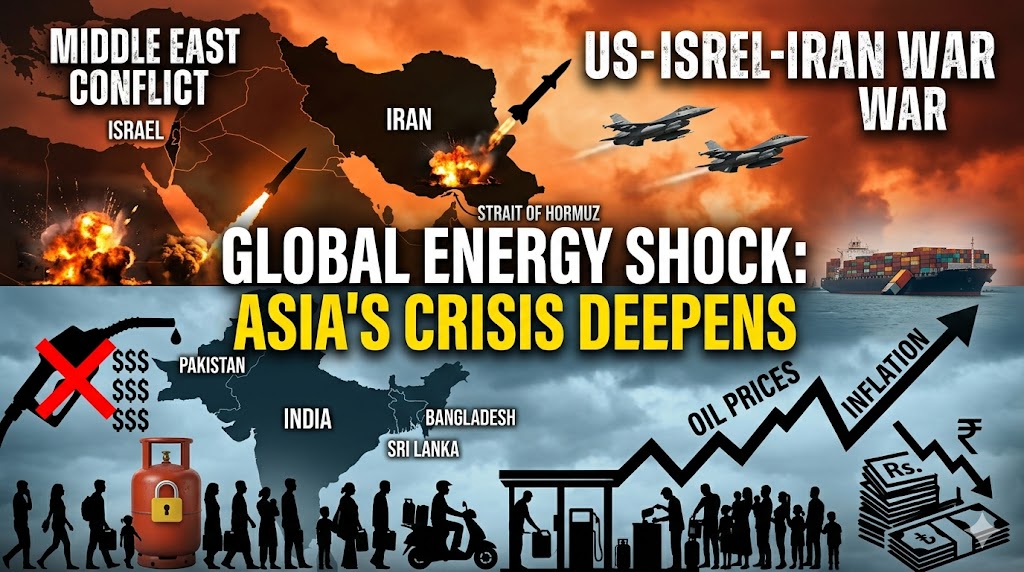
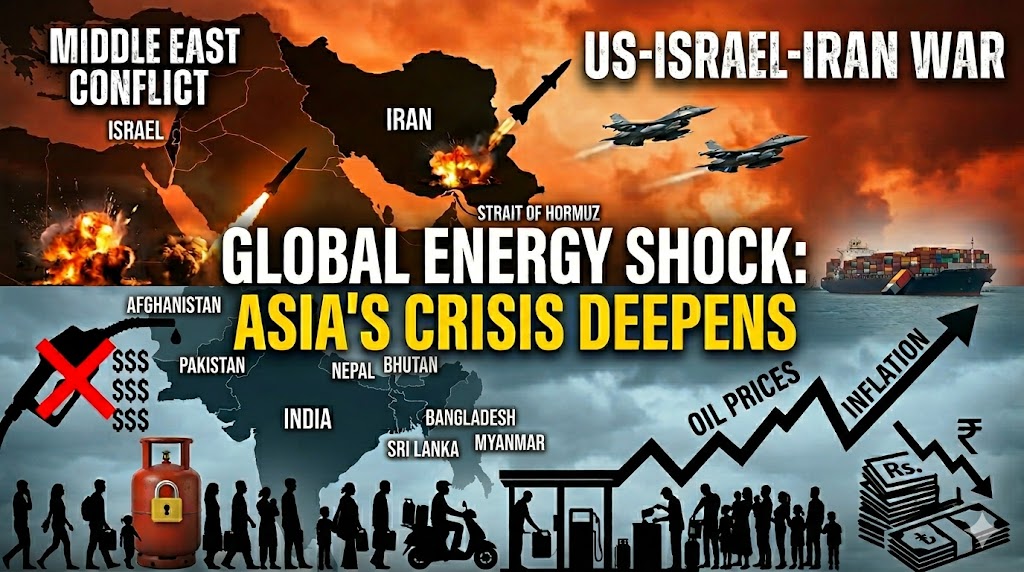
The 2026 US-Israel-Iran war, which erupted on February 28 with surprise US-Israeli airstrikes on Iranian targets, has rapidly transformed from a regional confrontation into a global economic threat. What began as targeted strikes has escalated into missile exchanges, drone attacks across the Middle East, and Iran’s effective closure of the Strait of Hormuz—the critical chokepoint for 20% of the world’s oil and nearly as much liquefied natural gas (LNG).
Oil prices have surged past $100 per barrel, with some analysts warning of sustained levels near $130 if the conflict drags on. For energy-import-dependent nations in South and Southeast Asia, this is not abstract geopolitics; it is a daily struggle for survival. Pakistan faces unprecedented petrol price hikes and LPG shortages. Bangladesh and Sri Lanka, already scarred by recent crises, are sliding back into fuel rationing and inflation spirals. Afghanistan’s fragile economy buckles under additional pressures, while India grapples with higher import bills that threaten its growth trajectory.
Even China, a major player in the region, has adopted a conspicuously neutral stance, prioritizing diplomacy over direct involvement. This article examines how the US-Israel-Iran war is reshaping Asia’s economic landscape, with a sharp focus on India’s immediate neighbors and the broader continent. Through detailed analysis of fuel crises, class impacts, and policy responses, it reveals why this conflict may define the decade’s economic fault lines.
The Escalation: How a Regional Strike Became a Global War
The war’s origins trace back to years of simmering tensions, but the February 28 strikes marked a decisive turning point. US and Israeli forces assassinated Iran’s Supreme Leader Ali Khamenei and key officials, prompting Iranian retaliation with missiles and drones targeting Israel and US bases in Bahrain, Jordan, Kuwait, and beyond. Iran’s subsequent control over the Strait of Hormuz—demanding tolls in Chinese yuan for oil shipments—has choked global energy flows.
This is no longer a contained Middle East conflict. Disruptions have cascaded into supply chain breakdowns, freight cost spikes, and fertilizer shortages that threaten food security from Pakistan’s farms to Bangladesh’s rice fields. Global GDP forecasts are being revised downward, with emerging Asian markets bearing the brunt. For countries that import 80-95% of their energy needs, the war has become an existential economic challenge rather than a distant headline.
The Strait of Hormuz Crisis and Surging Energy Costs
At the heart of Asia’s pain lies the Strait of Hormuz. With shipping traffic plummeting and insurance premiums skyrocketing, oil and gas exports from the Gulf have been severely curtailed. Brent crude has risen 45% since late February, while LNG and fertilizer prices have climbed 55% and 35%, respectively.
These increases are not temporary blips. Developing Asian economies, which rely on Middle Eastern crude for the majority of their imports, face a perfect storm: higher production costs, transport inflation, and eroded foreign exchange reserves. The result is a vicious cycle where fuel shortages lead to factory slowdowns, job losses, and reduced consumer spending—particularly devastating for middle- and lower-income households who spend a disproportionate share of their income on energy and food.
Pakistan’s Fuel Nightmare: LPG Shortages and Unaffordable Petrol
Pakistan, which imports roughly 80% of its energy from the Gulf, has been hit hardest among India’s neighbors. In early April 2026, the government announced a staggering 43% hike in petrol prices and 55% in high-speed diesel, the second major increase in weeks. Retail petrol now exceeds 321 rupees per liter, with diesel close behind. Officials, including Prime Minister’s Adviser Rana Sanaullah, have openly blamed the Middle East war, stating the government “has nothing to do with it.”
LPG shortages compound the misery. Households across Punjab and Sindh report long queues and black-market prices, forcing families to revert to costly and hazardous alternatives like wood or charcoal for cooking. Public transport fares have risen sharply, hitting daily wage earners who commute for work. The middle class—small business owners, teachers, and private-sector employees—now faces impossible choices: skip meals, delay medical care, or cut children’s education expenses.
To conserve fuel, authorities have imposed a four-day workweek for government offices, closed schools on certain days, and mandated work-from-home for half the public sector. Petrol stations frequently run dry, with panic buying reported in Karachi and Lahore. Economists warn that sustained high prices could push Pakistan’s inflation above 20%, derailing its fragile recovery from previous balance-of-payments crises. For the lower class, the war’s economic fallout is existential—transport costs now consume up to 30% of daily earnings in urban slums.
Bangladesh: A Nation Sliding Back into Economic Crisis
Bangladesh, reliant on imports for 95% of its energy, is experiencing a textbook fuel shock. Petrol pumps in districts nationwide see serpentine queues despite eased Eid-related rationing. Universities have been shuttered to save power, and the government is scrambling for over $2 billion in emergency funding from international lenders to secure LNG and fuel cargoes bought at spot-market premiums.
The war has inflated Bangladesh’s annual fossil-fuel import bill by an estimated $4.8 billion—a 40% jump that equates to 1.1% of GDP. Foreign exchange reserves, already strained, could drop to just 4.9 months of import cover. Panic buying has worsened shortages, while higher transport and fertilizer costs are driving up food prices. Garment workers and rickshaw pullers—the backbone of the lower class—struggle as bus fares climb and informal sector incomes stagnate.
Middle-class families in Dhaka report cutting back on protein and private tuition. The new government under Prime Minister Tarique Rahman faces a delicate balancing act: subsidizing fuel risks ballooning the fiscal deficit, while passing costs to consumers risks social unrest. Energy analysts note Bangladesh’s high exposure makes it potentially the worst-affected Asian nation outside the Middle East.
Sri Lanka: Fragile Post-2022 Recovery Under Fresh Threat
Memories of the 2022 economic meltdown—marked by debt default and widespread protests—are still raw in Sri Lanka. The US-Israel-Iran war has delivered a cruel setback. Fuel prices surged 25% in late March, with a further 33% cumulative increase since the conflict began. Regular petrol now costs 398 rupees per liter; diesel, critical for public buses, has risen similarly. LPG prices are up 8%, squeezing household budgets.
The government has reintroduced petrol rationing, shifted schools to remote learning on certain days, and enforced a four-day workweek. Bus fares have jumped over 12%, disproportionately burdening lower-income commuters in Kandy and Colombo suburbs. Tourism, a key recovery driver, faces higher aviation fuel costs and canceled flights due to disrupted Middle East routes.
Sri Lanka’s central bank has held policy rates steady at 7.75%, citing oil-price risks, but analysts fear renewed stagflation. The middle class, which bore the brunt of 2022’s hardships, now worries about depleted savings and job losses in export-oriented sectors. For a nation still negotiating debt restructuring, the war’s energy shock could erase years of painstaking progress.
Navigating the Brink: The Human and Economic Cost of the 2026 Energy Shock
Afghanistan: Compounded Crises in an Already Fragile State
Afghanistan’s economy, one of the world’s most vulnerable, faces a double blow. The US-Israel-Iran war has disrupted regional trade routes, while parallel tensions with Pakistan—including border closures and deportations—have strangled cross-border commerce. Large-scale returns of Afghan refugees add pressure on an already overstretched labor market.
Fuel and fertilizer shortages threaten spring planting, risking food insecurity for millions. With limited foreign reserves and reliance on aid, Kabul struggles to buffer price shocks. The war’s ripple effects exacerbate existing humanitarian challenges, turning a regional conflict into a catalyst for deeper instability along India’s western flank.
Spillover Effects on India’s Other Neighbors and Broader Asia
The crisis extends beyond Pakistan, Bangladesh, Sri Lanka, and Afghanistan. Nepal and Bhutan, landlocked and import-dependent, face higher costs for goods transiting through Indian ports. Myanmar and parts of Southeast Asia report elevated freight charges and fertilizer scarcity, threatening agricultural output.
Middle East Asia’s energy exporters may gain short-term revenue, but prolonged disruption risks global recession that would eventually hurt them too. For India’s eastern neighbors, the war underscores the fragility of just-in-time supply chains in an interconnected Asia.
India’s Economy: Resilience Tested by Rising Oil Imports
India, importing nearly 90% of its crude (over half from the Middle East), is particularly exposed. Oil prices near $100 per barrel could shave GDP growth to 6.6% or lower, with inflation climbing toward 4.1%. The rupee faces depreciation pressure, inflating the import bill and subsidy requirements for cooking gas and diesel.
Flight cancellations and rerouting due to Middle East airspace risks have disrupted aviation and exports. Basmati rice shipments—75% destined for the Gulf—sit idle at ports. Goldman Sachs and State Bank of India reports highlight risks to remittances and UAE trade ties. While India’s strategic reserves and diversified diplomacy provide some buffer, sustained high energy costs threaten to widen fiscal deficits and slow post-pandemic momentum.
Middle- and lower-income Indians feel the pinch through higher transport fares, utility bills, and grocery prices. Rural farmers face costlier diesel for irrigation pumps, while urban workers contend with pricier commuting.
China’s Neutral Stance: Diplomacy Over Direct Involvement
Amid the chaos, China has maintained a measured, neutral position. Beijing has called for de-escalation, supported mediation efforts, and reiterated its Five Principles of Peaceful Coexistence. While condemning “might makes right,” Chinese officials have avoided naming the US or Israel directly as aggressors and have not offered military or economic guarantees to Iran despite their comprehensive strategic partnership.
Analysts attribute this caution to energy security priorities—China imports vast quantities of Middle Eastern oil—and a desire to avoid entanglement in great-power conflict. Beijing has coordinated quietly with partners like Pakistan and expressed willingness to host talks, yet it stops short of binding commitments. This calculated neutrality positions China as a potential peacemaker without alienating key trading partners, contrasting sharply with more vocal Western alignments. For Asia’s smaller economies, China’s restraint offers little immediate relief but underscores the multipolar reality of today’s global order.
Across Asia, the US-Israel-Iran war has amplified pre-existing vulnerabilities. Higher global inflation, currency volatility, and supply-chain disruptions threaten stagflation in import-dependent markets. Fertilizer shortages risk lower crop yields, compounding food-price pressures for billions.
The middle and lower classes across the region bear the heaviest burden: reduced mobility limits job access, while higher cooking and heating costs erode living standards. Governments face impossible trade-offs between subsidies and fiscal prudence. Long-term, the crisis may accelerate diversification away from Middle Eastern energy—toward renewables and alternative suppliers—but the transition will be painful and protracted.
Conclusion: Navigating Uncertainty in a Fractured World
The US-Israel-Iran war is no longer a distant Middle Eastern affair; it is a global economic force reshaping lives from Islamabad to Dhaka and Colombo to New Delhi. Pakistan’s LPG queues, Bangladesh’s university closures, Sri Lanka’s ration cards, and Afghanistan’s trade paralysis illustrate how energy shocks cascade into human suffering. India, too, confronts higher costs that test its growth ambitions, while China’s diplomatic balancing act highlights the limits of neutrality in an interdependent world.
As the conflict enters its second month with no clear end in sight, Asian policymakers must prioritize fuel conservation, strategic reserves, and regional cooperation. For the millions of middle- and lower-class families struggling to afford petrol or cook a meal, the war’s true cost is measured not in barrels of oil but in daily hardships. Only sustained diplomacy and diversified energy strategies can mitigate the damage and prevent this global war from entrenching Asia’s economic divides for years to come.
Frequently Asked Questions
What is the primary significance of US-Israel-Iran War: 2026 Asia Economic Crisis Deepens?
The 2026 US-Israel-Iran war, which erupted on February 28 with surprise US-Israeli airstrikes on Iranian targets, has rapidly transformed from a regional confrontation into a global economic threat. What began as targeted strikes has escalated into missile exchanges, drone attacks across the Middle East, and Iran’s effective closure of the Strait of Hormuz—the critical chokepoint for 20% of the world’s oil and nearly as much liquefied natural gas (LNG). Oil prices have surged past $100 per barrel, with some analysts warning of sustained levels near $130 if the conflict drags on.
How does this development impact Current Affairs?
For energy-import-dependent nations in South and Southeast Asia, this is not abstract geopolitics; it is a daily struggle for survival. Pakistan faces unprecedented petrol price hikes and LPG shortages.
What are the key future projections to monitor?
Bangladesh and Sri Lanka, already scarred by recent crises, are sliding back into fuel rationing and inflation spirals.