Delhi Pollution: Govt Vehicle Rules, Bans & Control Steps
News• April 04, 2026• Global Edition
Introduction: Delhi's Enduring Battle with Air Pollution
Delhi, India's national capital, stands as a symbol of progress yet grapples with one of the world's most persistent environmental crises: severe air pollution. Throughout the year, the city chokes under a toxic blanket of particulate matter, nitrogen oxides, and other pollutants. While winter brings the infamous smog that makes headlines globally, pollution levels remain alarmingly high even in summer and monsoon months. This is no seasonal anomaly but a year-round challenge driven by a complex mix of local emissions, regional factors, and the city's unique geography.
The Delhi government has responded with decisive action. Under Chief Minister Arvind Kejriwal's leadership, the Aam Aadmi Party (AAP) government rolled out multifaceted strategies to curb emissions, with a strong focus on vehicular pollution—the single largest contributor in the capital. From enforcing strict delhi vehicle rules to implementing innovative measures like work-from-home during peak pollution periods, these efforts aim to safeguard public health and set a precedent for other Indian cities. This article delves deep into the history of Delhi pollution, its causes and impacts, the role of neighboring states' agricultural practices, and the comprehensive steps taken by the Kejriwal government, including the delhi government vehicle ban on older models, BS6 vehicle rule Delhi enforcement, and more.
The History of Delhi Pollution: From the 1990s to Today
Air pollution in Delhi is not a recent phenomenon. Studies from the early 1990s already highlighted alarming levels of total suspended particulates (TSP), often five times above World Health Organization standards. By the mid-1990s, daily emissions reached around 3,000 metric tons, with vehicles accounting for nearly 67% of the load, followed by power plants and industries.
The 2000s marked a turning point when the Supreme Court mandated a shift to compressed natural gas (CNG) for public transport, dramatically reducing some emissions. However, rapid urbanization, a surge in private vehicles, and industrial growth reversed many gains. By 2015, Delhi had earned the dubious distinction of being one of the world's most polluted capitals. The Kejriwal government, assuming power in 2015, inherited this legacy and prioritized it as a core governance issue.
Winter episodes intensified public awareness. In November 2016, a severe smog event—exacerbated by crop residue burning—pushed air quality into "severe plus" categories, with PM2.5 levels spiking dangerously. Since then, the city has implemented the Graded Response Action Plan (GRAP), a dynamic framework that escalates restrictions based on Air Quality Index (AQI) levels. Despite progress, Delhi pollution continues to dominate global rankings, underscoring the need for sustained delhi government pollution rules.
Why Pollution Hits Delhi Harder: Limited Land, High Population Density, and National Capital Status
Delhi's National Capital Territory spans just 1,484 square kilometers yet houses over 21 million people as of recent estimates, yielding a population density exceeding 11,300 people per square kilometer. This compact footprint means pollutants from vehicles, construction dust, and industries have nowhere to disperse easily. Unlike larger metropolises with open spaces or favorable wind patterns, Delhi's land-locked position traps emissions, especially during winter temperature inversions when cold air traps pollutants near the ground.
As India's national capital, Delhi bears an outsized burden. It serves as the political, economic, and administrative hub, attracting millions of migrants, daily commuters, and heavy commercial traffic. This influx amplifies vehicular emissions—the backbone of delhi vehicle rules discussions. The city's role also draws national scrutiny; any policy lapse here reverberates across India, influencing everything from public health campaigns to economic productivity. High density ensures that even moderate pollution spikes affect far more lives per square kilometer than in less crowded regions, making delhi new vehicle rule implementations critical for both local residents and the nation's image.
Major Causes of Pollution in Delhi: A Year-Round Menace
Vehicular emissions top the list, contributing up to 40-50% of PM2.5 in many analyses. With millions of cars, trucks, and two-wheelers on narrow roads, congestion leads to idling and higher exhaust output. Industries, construction dust, waste burning, and power plants add to the mix. Diwali firecrackers cause short-term spikes, while road dust from unpaved areas and ongoing infrastructure projects remains a constant irritant.
What sets Delhi apart is the interplay of these local sources with regional ones. Pollution levels rarely dip below "moderate" even in cleaner months, and "poor" to "severe" becomes the norm from October to February. This year-round exposure has turned delhi pollution into a public health emergency, prompting aggressive delhi government vehicle ban measures targeting the most controllable source: outdated and high-emission vehicles.
The Role of Punjab and Haryana's Agricultural Stubble Burning
Every post-monsoon season, farmers in Punjab and Haryana burn paddy stubble to quickly clear fields for wheat sowing. This practice releases massive plumes of smoke containing PM2.5, carbon monoxide, and volatile organics. Winds carry these pollutants straight into Delhi-NCR, where they combine with local emissions and meteorological traps to create toxic smog.
Studies estimate stubble burning's contribution at 14-40% of Delhi's PM2.5 during peak October-November periods, though it is episodic rather than constant. Recent data shows encouraging declines—up to 90% reduction in incidents by 2025 compared to earlier years—thanks to central and state incentives for crop residue management machinery. However, even reduced burning events can tip AQI scales when aligned with adverse weather. The Kejriwal government has consistently advocated for inter-state coordination, highlighting how Punjab and Haryana's agricultural practices directly fuel Delhi's winter crises. This regional dimension underscores why delhi border vehicle checking rules extend beyond city limits to curb incoming polluted air indirectly through transport restrictions.
How Delhi's Residents Suffer: Health, Economy, and Daily Life Impacts
The human cost of Delhi pollution is staggering. Respiratory illnesses, cardiovascular problems, and aggravated asthma cases surge during high AQI periods. Children and the elderly are most vulnerable, with schools often shifting to hybrid modes or closing entirely. Long-term exposure links to reduced lung function, premature deaths (estimated in thousands annually), and even impacts on cognitive development.
Economically, pollution hampers productivity through lost workdays, healthcare costs, and reduced tourism. Families face constant anxiety over air purifiers, masks, and indoor confinement. The national capital status amplifies this: decisions made here affect policy nationwide, yet residents bear the immediate brunt. This suffering has driven public demand for stricter delhi old vehicle rule enforcement and other delhi government pollution rules.
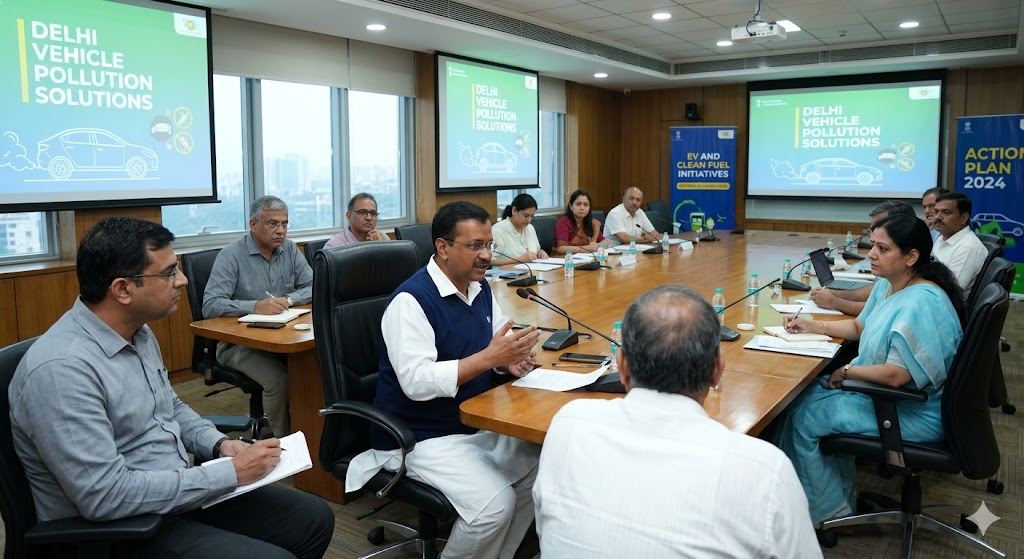
As air quality remains a top priority, Chief Minister Arvind Kejriwal chairs a high-level meeting to review the implementation of strict vehicle bans. With 10-year-old diesel and 15-year-old petrol vehicles facing a total phase-out, the focus shifts toward BS6 compliance and the rapid adoption of EVs and CNG
Kejriwal Government's Proactive Steps: A Multi-Pronged War on Pollution
The Delhi government under Arvind Kejriwal transformed pollution control from reactive to strategic. Recognizing vehicles as a primary culprit, the administration pushed comprehensive delhi vehicle rules that balance mobility with environmental protection.
• Vehicle-Centric Measures: Bans, BS6 Norms, and CNG Promotion
Central to the strategy is the delhi government vehicle ban on end-of-life vehicles (ELVs). Diesel vehicles older than 10 years and petrol vehicles exceeding 15 years face strict scrutiny under the delhi 15 year old vehicle rule. The government has enforced impounding and scrappage of non-compliant BS-III and older models, with Supreme Court backing. Owners must obtain No Objection Certificates for transfer outside NCR or face action. This delhi new rule for old vehicles has removed millions of polluting vehicles from roads, directly addressing vehicular emissions.
BS6 vehicle rule Delhi implementation has been rigorous. Nationwide BS-VI norms (effective 2020) were aggressively adopted, but Delhi went further. From November 1, 2025, only BS6, CNG, or electric commercial goods vehicles are permitted entry into the city (except Delhi-registered ones in some cases). This delhi bs6 vehicle rule targets heavy polluters at borders using Automatic Number Plate Recognition (ANPR) cameras for delhi border vehicle checking rules. Non-compliant trucks and goods carriers face bans, with grace periods for essentials phased out progressively.
CNG vehicle rule Delhi has expanded dramatically. Building on the early 2000s mandate, the Kejriwal government accelerated CNG adoption for taxis, autos, and buses while incentivizing retrofitting. Electric vehicle (EV) policies complement this, with subsidies and charging infrastructure to reduce reliance on fossil fuels.
Odd-even vehicle rationing, first introduced in 2016, remains a tool during GRAP Stage III/IV. It restricts private cars based on number plates, exempting essentials like two-wheelers, women-driven vehicles, and emergencies. Combined with "No PUC, No Fuel" rules, these ensure only roadworthy, low-emission vehicles operate.
Broader Initiatives: Work-from-Home, GRAP, and Infrastructure
During severe pollution, the government mandates 50% work-from-home in offices—both public and private—reducing commuting emissions. Schools shift to hybrid learning, and construction halts under GRAP escalations.
The Kejriwal government expanded public transport with more CNG and electric buses, metro extensions, and last-mile connectivity to discourage private vehicles. Air quality monitoring stations increased, and public awareness campaigns educated citizens on delhi cm vehicle rule compliance.
These steps form an integrated approach. While challenges persist—enforcement logistics, inter-state coordination on stubble burning, and economic pushback—the delhi government policy has yielded measurable improvements, including more "good" AQI days in recent years.
Challenges Ahead and the Road to Cleaner Air
Despite progress, Delhi pollution requires ongoing vigilance. Vehicular growth continues, and climate factors like delayed monsoons complicate dispersion. The Kejriwal government's legacy lies in institutionalizing delhi government vehicle ban review processes and data-driven responses.
Future success hinges on sustained enforcement of delhi vehicle rules, farmer support in Punjab-Haryana to eliminate stubble burning entirely, and green urban planning. As the national capital, Delhi's model can inspire nationwide change.
Delhi's pollution story is one of resilience and reform. From historical highs to targeted delhi government pollution rules under the Kejriwal administration, the city demonstrates that bold policy—centered on BS6 vehicle rule Delhi, old vehicle phase-outs, CNG promotion, border checks, and work-from-home—can bend the curve. Residents continue to suffer, but collective action offers hope. By addressing local density issues, regional agricultural impacts, and vehicular sources head-on, Delhi is paving the way for a cleaner, healthier future—not just for itself, but for India as a whole.
Frequently Asked Questions
What is the primary significance of Delhi Pollution: Govt Vehicle Rules, Bans & Control Steps?
Introduction: Delhi's Enduring Battle with Air PollutionDelhi, India's national capital, stands as a symbol of progress yet grapples with one of the world's most persistent environmental crises: severe air pollution. Throughout the year, the city chokes under a toxic blanket of particulate matter, nitrogen oxides, and other pollutants.
How does this development impact News?
While winter brings the infamous smog that makes headlines globally, pollution levels remain alarmingly high even in summer and monsoon months. This is no seasonal anomaly but a year-round challenge driven by a complex mix of local emissions, regional factors, and the city's unique geography.The Delhi government has responded with decisive action.
What are the key future projections to monitor?
Under Chief Minister Arvind Kejriwal's leadership, the Aam Aadmi Party (AAP) government rolled out multifaceted strategies to curb emissions, with a strong focus on vehicular pollution—the single largest contributor in the capital.