Unification of Rajasthan: History, Stages & Lasting Impact
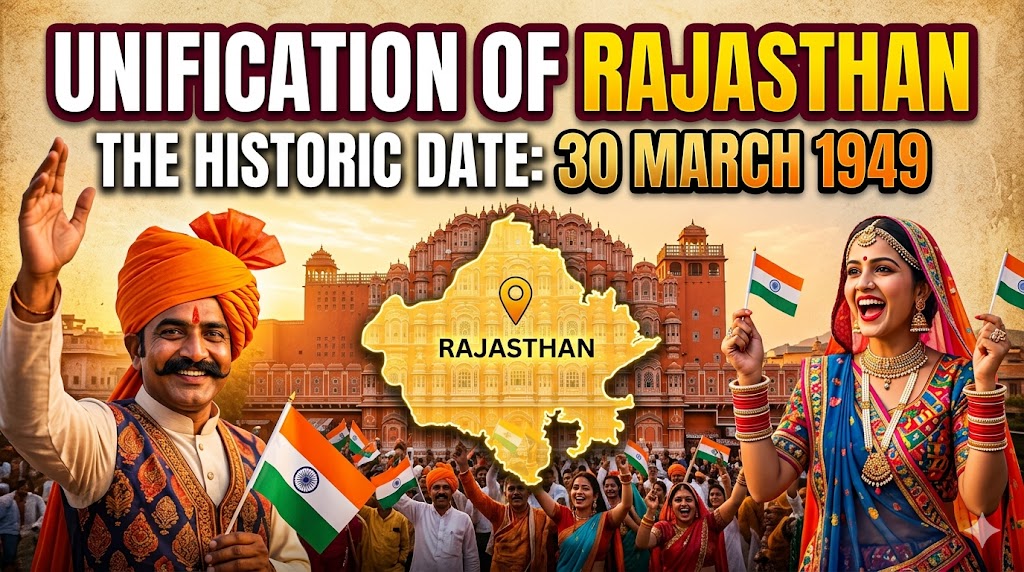
The unification of Rajasthan stands as one of the most inspiring chapters in post-independence Indian history. Before 1947, the region known as Rajputana comprised 22 princely states and chiefships, each ruled by its own Maharaja or ruler under British paramountcy. These states, steeped in Rajput valor and feudal traditions, lacked a unified administrative structure. The integration process, completed through seven meticulous stages between 1948 and 1956, transformed this patchwork into modern Rajasthan—India’s largest state by area.
This unification was not merely a political merger; it reshaped the geographical landscape, boosted economic prospects, and strengthened national unity. Led by national icons like Sardar Vallabhbhai Patel and supported by visionary local leaders, it exemplified the spirit of “Ek Bharat, Shreshtha Bharat.” Today, Rajasthan’s vast deserts, mineral wealth, and cultural heritage make it indispensable to India’s progress at both national and societal levels. This article explores the complete history, stages, leaders, transformations, and why Rajasthan remains the heart of India.
The Pre-Unification Era: Rajputana Under British Rule
Prior to independence, the British referred to the region as Rajputana, a term first appearing in George Thomas’s 1800 memoirs and later popularized in colonial records. It encompassed diverse terrains—from the arid Thar Desert in the west to the Aravalli hills in the east, fertile plains in the north, and tribal-dominated southern hills. The 22 princely states included major powers like Mewar (Udaipur), Marwar (Jodhpur), Amber (Jaipur), Bikaner, and smaller ones such as Bharatpur, Alwar, and Tonk.
These states enjoyed internal autonomy but were bound by subsidiary alliances with the British East India Company. Rulers maintained armies, collected taxes, and upheld Rajput customs, yet fragmentation hindered development. Infrastructure was uneven, education limited to elites, and economic activities revolved around agriculture, handicrafts, and limited trade. The people’s movements, through Praja Mandals (people’s assemblies), began demanding democratic reforms and integration with the Indian freedom struggle.
The 1947 partition and independence changed everything. With the lapse of British paramountcy, princely states could theoretically remain independent or accede to India or Pakistan. Sardar Patel, India’s Deputy Prime Minister and Home Minister, recognized the strategic risks—especially Rajasthan’s long border with the newly formed Pakistan. Unification became essential for national security, administrative efficiency, and equitable development.
How Rajasthan Got Its Name: From Rajputana to Rajasthan
The name “Rajasthan” predates the modern state but gained prominence through colonial scholarship. British officer Colonel James Tod, Political Agent in Rajputana (1818–1822), coined and popularized it in his seminal 1829–1832 work, *Annals and Antiquities of Rajast’han*. Drawing from local dialects and Sanskrit roots—“Raja” (king) and “Sthana” (land)—Tod described it as the “Land of Kings,” honoring the valor of Rajput clans.
Earlier, the region was simply called Rajputana (“abode of Rajputs”) in British usage. Local terms like “Raythan” may have inspired Tod. The name “Rajasthan” resonated culturally even before formal adoption. On 30 March 1949, with the formation of Greater Rajasthan, it became the official designation. The Constitution of India on 26 January 1950 cemented it. This shift symbolized a break from colonial nomenclature to a proud indigenous identity, uniting diverse communities under one banner.
The Seven Stages of Unification: A Step-by-Step Journey
The unification of Rajasthan unfolded in seven deliberate stages from March 1948 to November 1956, blending diplomacy, public pressure, and strategic mergers.
Stage 1:
Formation of Matsya Union (18 March 1948)
Alwar, Bharatpur, Dholpur, and Karauli merged into the Matsya Union (named after the ancient Matsya kingdom). Capital: Alwar. Chief Minister: Shobha Ram. This eastern grouping laid the foundation.
Stage 2:
Formation of Rajasthan Union (25 March 1948)
Nine states—Banswara, Bundi, Dungarpur, Jhalawar, Kishangarh, Kota, Pratapgarh, Shahpura, and Tonk—formed the Rajasthan Union. Capital: Kota. Rajpramukh: Maharao Bhim Singh of Kota. Chief Minister: Gokul Lal Asawa.
Stage 3:
United State of Rajasthan (18 April 1948)
Mewar (Udaipur), the most prestigious Rajput state, joined, creating the United State of Rajasthan. Capital: Udaipur. Rajpramukh: Maharana Bhupal Singh of Mewar. Chief Minister: Manikya Lal Verma. This strengthened southern integration.
Stage 4:
Greater Rajasthan (30 March 1949)
The four largest states—Jaipur, Jodhpur, Bikaner, and Jaisalmer—merged with the United State. Capital shifted to Jaipur. Rajpramukh: Maharana Bhupal Singh. Sardar Patel personally inaugurated it in Jaipur, calling it a “historic day.” Chief Minister: Hiralal Shastri. This marked the core of modern Rajasthan.
Stage 5:
Merger of Matsya Union (15 May 1949)
Matsya Union integrated fully, expanding eastern territories.
Stage 6:
Sirohi Merger (26 January 1950)
Sirohi state joined, with parts later adjusted. This coincided with Republic Day.
Stage 7:
Final Reorganization (1 November 1956)
Under the States Reorganisation Act, Ajmer-Merwara (former British district) and minor adjustments completed the map. Rajasthan achieved its present form.
Each stage involved negotiations, public campaigns, and assurances of privy purses and titles to rulers. The process avoided violence, unlike some other integrations.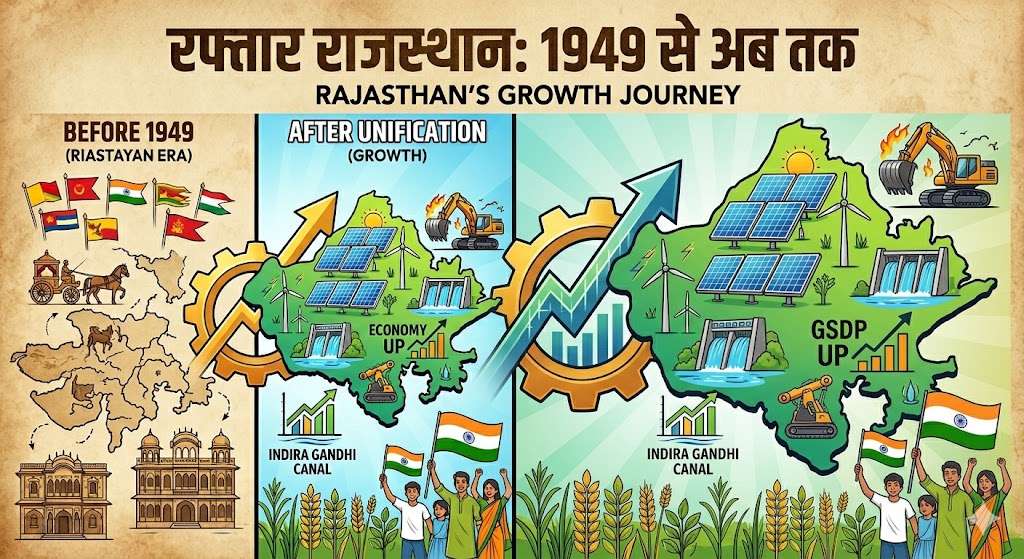
This image details the state's transformation from the fragmented "Riastayan Era" before 1949 to a unified and developed region. Key milestones shown include the establishment of the Indira Gandhi Canal, agricultural expansion, and the rise of renewable energy through solar panels and wind turbines.
Sardar Vallabhbhai Patel earned the title “Iron Man of India” for orchestrating the integration of 562 princely states nationwide, including Rajasthan. With V.P. Menon, he used persuasion, incentives, and firmness. Patel inaugurated Greater Rajasthan and emphasized unity over division.
Local leaders played equally vital roles. Maharana Bhupal Singh of Mewar provided prestige and cooperation. Maharaja Man Singh of Jaipur, Maharaja Hanwant Singh of Jodhpur, and Maharao Bhim Singh of Kota lent support despite initial hesitations. Praja Mandal activists like Manikya Lal Verma, Gokul Lal Asawa, Hiralal Shastri, and Jai Narayan Vyas mobilized public opinion through democratic movements. These leaders bridged royal traditions with modern democracy, ensuring smooth transition.
Geographical and Economic Transformation After Unification
Pre-unification, fragmented governance stifled progress. Post-1949, a single administration enabled coordinated development. Geographically, Rajasthan spans 342,239 sq km—10.4% of India’s landmass—encompassing the Thar Desert (60% of state area), Aravalli ranges, and fertile eastern plains. Unification facilitated border security, irrigation projects like the Indira Gandhi Canal, and infrastructure linking remote areas.
Economically, the shift was profound. Feudal systems gave way to planned development. Agriculture expanded through canals and high-yield seeds, making Rajasthan a leader in oilseeds, mustard, and spices despite aridity. Mining boomed: the state became India’s sole producer of lead-zinc ores, selenite, and wollastonite, and top producer of silver, gypsum, marble, and limestone. These resources fueled national industries—cement, ceramics, and solar panels.
Tourism flourished with unified promotion of forts, palaces, and desert safaris, generating massive revenue and jobs. Renewable energy surged; Rajasthan leads in solar power with the world’s largest parks like Bhadla, contributing clean energy to the national grid. Industries in Jaipur, Kota, and Alwar diversified the economy. From a backward, fragmented region, Rajasthan now ranks among India’s top-10 economies, with GSDP exceeding ₹15 lakh crore and growing at impressive rates. Unification unlocked resources, attracted investment, and reduced disparities.
Unification as a Pivotal Moment in Indian History
Rajasthan’s integration was crucial for India’s unity. It prevented potential Balkanization in a strategically sensitive border region. By incorporating 22 states peacefully, it set a model for other mergers and reinforced the federal structure. It integrated Rajput martial traditions into the national fabric while advancing democracy. Culturally, it preserved heritage while fostering a shared identity. Politically, it strengthened Congress’s base initially and later shaped national electoral trends. Without this unification, India’s map and security would have looked vastly different.
Rajasthan's Enduring Importance to India: Geographical, Political, and Economic Perspectives
Geographically, Rajasthan forms India’s northwestern bulwark, sharing a 1,070 km border with Pakistan. Its vast land acts as a buffer and connectivity hub via highways and the Delhi-Mumbai Industrial Corridor.
Politically, with 25 Lok Sabha seats and 200 Assembly seats, Rajasthan influences national politics. It serves as an electoral bellwether, reflecting broader voter sentiments.
Economically and societally, Rajasthan drives national development. Its minerals support critical industries: zinc for galvanizing, silver for solar cells, limestone for cement. As India’s solar leader, it powers the renewable transition, aiding net-zero goals. Tourism employs millions and promotes cultural diplomacy. Agriculture feeds national markets, while industries create jobs for migrants.
At the societal level, post-unification investments in education, health, and rural development have uplifted millions, including tribal communities. Schemes for women’s empowerment and skill development foster inclusive growth. Rajasthan’s diversity—Rajputs, Jats, tribals, Muslims—exemplifies India’s unity in diversity.
Why Rajasthan Remains the Indispensable Heart of India
Rajasthan could never be separated from India’s map. It is the heart in terms of land and mineral resources. Covering one-tenth of the country’s area, its strategic location, mineral wealth (22% of national production value), and renewable potential make it vital. Losing it would cripple supply chains for zinc, marble, solar energy, and more. Its people’s resilience, cultural pride, and contributions to the armed forces further bind it. Unification ensured this heart beats strongly within the Indian Union, powering national progress.
Conclusion
The unification of Rajasthan was a triumph of vision, diplomacy, and determination. From Rajputana’s princely mosaic to a unified powerhouse, it transformed geography, economy, and society. Leaders like Sardar Patel and local visionaries made it possible. Today, Rajasthan’s importance—geographical vastness, political influence, economic muscle, and societal vibrancy—cements its place as India’s indispensable heart. As the state marches toward greater heights in renewable energy, tourism, and industry, its story reminds us that unity truly creates strength.