First Johar of Rajasthan: Hammir Dev & Rani Rangadevi
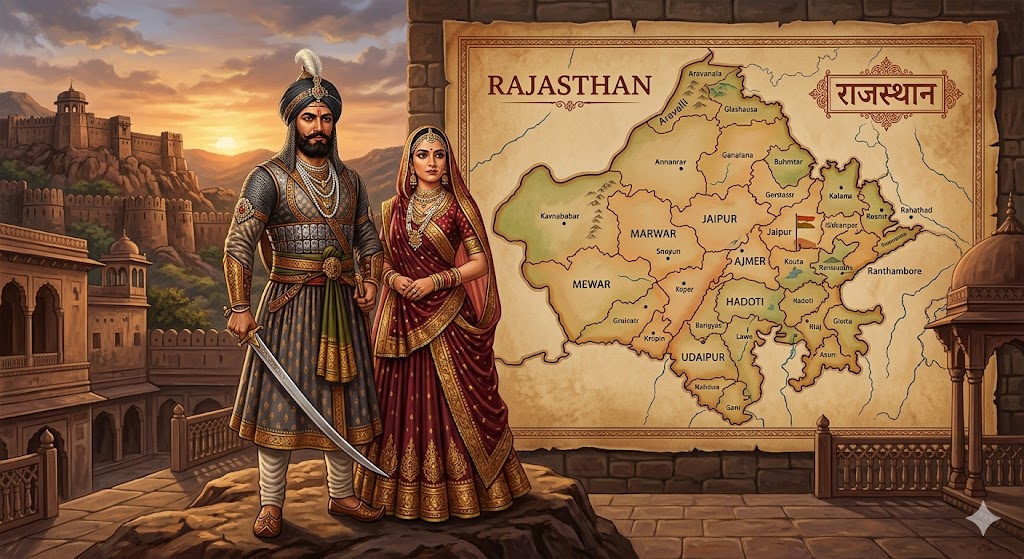
First Johar of Rajasthan: Hammir Dev's Sacrifice
In the rugged landscapes of Rajasthan, where towering forts stand as silent witnesses to centuries of valor, the story of the first Johar unfolds not in the famed halls of Chittorgarh, but within the formidable walls of Ranthambore. Long before Rani Padmavati's legendary act of defiance captured the imagination of generations, it was Rani Rangadevi, the queen of Maharav Hammir Dev Chauhan, who led Rajasthan's inaugural Jal Johar in 1301 CE. This profound sacrifice, performed by thousands of Rajput women to preserve their honor amid invasion, marks a defining chapter in the state's history of unyielding resistance against Muslim rulers. Far from the fiery pyres often associated with later Jauhars, this event at Padmala Talab involved a mass immersion in water—a unique "Jal Johar" born of urgency and unbreakable spirit.
This article delves deep into the life of Hammir Dev Chauhan, his kingdom's strategic importance, his epic battles against invaders from the Delhi Sultanate, and the ultimate sacrifice that echoed through Rajasthan's annals. We also explore the broader tradition of Johar among Rajput wives, the legendary tale of Rani Padmavati at Chittorgarh (which, while iconic, was not Rajasthan's first), and how these acts of courage shaped the region's identity. Through detailed historical context and vivid narratives drawn from chronicles and local legends, we uncover why such sacrifices defined the Rajput ethos against overwhelming odds.
Rajasthan's Rajput Heritage: A Land Forged in Fire and Valor
Rajasthan, literally the "Land of Kings," has been a crucible of warrior traditions since ancient times. Its arid deserts, Aravalli hills, and impregnable forts like Ranthambore, Chittorgarh, and Jaisalmer became bastions of Hindu Rajput kingdoms resisting successive waves of invasions. The Rajputs, tracing their lineage to legendary solar and lunar dynasties (Suryavanshi and Chandravanshi), embodied dharma, courage, and honor. From the 8th century onward, as Islamic forces from the northwest pressed into India, Rajasthan's rulers—Chauhans, Sisodias, Rathores, and others—stood as the frontline defenders of Indic civilization.
The Chauhan dynasty, in particular, played a pivotal role. Prithviraj Chauhan's heroic stand against Muhammad Ghori in the late 12th century (Battles of Tarain, 1191–1192) set a precedent for fierce resistance. Though Ghori ultimately prevailed, the Chauhan spirit endured through cadet branches, including the rulers of Ranthambore. Hammir Dev Chauhan, a direct descendant in this line, inherited not just a throne but a legacy of defiance. His kingdom centered on Ranthambore Fort, a massive hilltop citadel near modern Sawai Madhopur, strategically controlling trade routes between Delhi, Malwa, and Gujarat. Built in the 10th century and expanded over generations, it symbolized Rajput military ingenuity with its sheer cliffs, triple moats, and layered defenses.
Rajput society emphasized Veer Ras—the sentiment of heroism. Women were not passive; they were trained in martial arts, archery, and strategy, often joining battles or inspiring troops. Yet, when defeat loomed, the practice of Johar emerged as the ultimate assertion of agency. Johar (or Jauhar) involved mass self-immolation or, in rare cases like Ranthambore, immersion to evade capture, rape, and enslavement by victorious armies. It was not despair but a calculated, collective vow: death with dignity over dishonor. Historians note that while Johar predates the Sultanate era in isolated forms, it became emblematic during the 13th–16th centuries as Delhi's Muslim rulers—Khiljis, Tughlaqs, and later Mughals—sought to expand into Rajputana.
Rajasthan's history is laced with such tales. From early clashes with Ghori's forces to prolonged struggles under Alauddin Khilji and beyond, Rajput wives and daughters embodied resilience. Their sacrifices preserved family honor and inspired future generations, weaving into ballads, folk songs, and temple inscriptions across the state.
.jpg)
Who Was Hammir Dev Chauhan? The Last Chauhan Lion of Ranthambore
Hammir Dev Chauhan, also known as Hammiradeva or Maharav Hammir, ascended the throne of Ranthambore around 1283 CE after his father, Jaitrasimha (Jaitra Singh). Born to Queen Hira Devi, he was a warrior-king in the truest sense—bold, just, and fiercely independent. Vernacular legends and texts like the Hammira Mahakavya by Jain scholar Nayachandra Suri portray him as a digvijaya conqueror who conducted raids deep into neighboring territories in the 1280s, subduing rulers in Malwa, extracting tributes, and even performing the grand Koti-yajna ritual twice to affirm sovereignty.
His kingdom thrived on agriculture, trade, and military prowess. Ranthambore's forests provided resources, while its fort deterred invaders. Hammir sheltered rebels and upheld Rajput ideals of atithi devo bhava (guest as god). This generosity proved fateful. In the 1290s, he granted asylum to Mongol generals Muhammad Shah (also called Mahim Shah) and Kabhru, who had rebelled against Delhi's Sultanate. These Mongols became loyal allies, fighting alongside his forces.
Hammir's early victories included repelling Jalaluddin Khilji's incursions. In 1290 and 1292, Jalaluddin's armies targeted Jhain and Ranthambore but were beaten back, with Hammir recapturing lost territories. His generals, including Gurdan Saini and later Mongol contingents, showcased tactical brilliance. Yet, internal politics simmered: heavy taxation to fund defenses alienated some nobles, and betrayals loomed.
By 1299–1301, Alauddin Khilji—Jalaluddin's ambitious nephew and successor—set his sights on Ranthambore. Khilji, known for centralizing power through brutal efficiency, viewed the fort as a gateway to western India. Hammir's refusal to submit, coupled with his protection of the Mongol rebels, ignited a full-scale war. What followed was not just a battle but a saga of loyalty, treachery, and sacrifice that cemented Hammir Dev as one of Rajasthan's greatest unsung heroes.
Battles with Muslim Rulers: From Ghori's Shadow to Khilji's Siege
The Chauhan resistance against Muslim invaders traces back to Prithviraj Chauhan's clashes with Muhammad Ghori. Though Ghori's victory at the Second Battle of Tarain in 1192 CE ended Prithviraj's reign, it did not extinguish the dynasty's flame. Scattered branches, including Ranthambore's, carried forward the fight. Hammir Dev, as a proud descendant, embodied this unbroken chain. While he never faced Ghori directly—separated by over a century—his wars against the Khiljis represented the same ethos: refusal to bow before Delhi's sultans.
Hammir's campaigns began defensively. Jalaluddin Khilji's 1290 invasion ended in failure at Ranthambore's gates, bolstered by manjaniqs (catapults) that proved ineffective against the fort's elevation. Hammir's counter-raids and alliances kept the kingdom autonomous.
Alauddin Khilji's rise changed everything. A ruthless strategist who murdered his uncle to seize power, Alauddin launched multiple expeditions. Initial probes under Ulugh Khan and Nusrat Khan faltered; Hammir's forces, augmented by the sheltered Mongols, inflicted heavy losses. Nusrat Khan himself died from a catapult stone in one clash. Hammir even defeated a larger army sent in 1299.
The decisive siege began in late 1300 or early 1301. Alauddin personally marched with a massive force, assembling troops from across his empire at Tilpat. The siege lasted months—some accounts say up to 11. Starvation gripped the fort as supplies dwindled. Treachery struck from within: disgruntled officers like Ratipala, Ranamalla (Ranmal), and Bhoja defected, leaking intelligence and weakening defenses. Despite this, Hammir's loyalists, including Virama (his brother) and minister Jaja, fought on.
Hammir offered safe passage to allies like Muhammad Shah, but they refused, choosing to die honorably. The final stand came on July 10, 1301. As the walls crumbled under assault, Hammir led a desperate sally. Legends recount him severing his own head before Lord Shiva's idol in a final act of devotion, offering it as tribute rather than surrender. His companions fell beside him. The fort fell, but not the spirit.
The First Jal Johar: Rani Rangadevi's Courage at Padmala Talab
As Hammir's warriors prepared for their last charge, the women inside the fort faced an existential choice. Led by chief queen Rani Rangadevi, they gathered in solemn council. Traditional Agni Johar—self-immolation on pyres—required time and fuel they lacked amid the chaos. Instead, they turned to Padmala Talab, a serene reservoir within the fort's precincts.
Rani Rangadevi addressed the assembled women—queens, princesses, noble ladies, and commoners alike, numbering around 12,000 according to popular accounts. "It is better to die with pride than to live in shame," she declared, invoking the Rajput code. Dressed in their finest attire, adorned as brides ready for union with eternity, they lit lamps, chanted prayers, and walked in procession to the talab under cover of night.
This was Rajasthan's first recorded Jal Johar—a mass drowning to evade the invaders' grasp. Among them was Hammir's young daughter, Devaldeh (also called Padmala or Deval Devi), just 16 and unmarried. Tradition barred unmarried girls from Johar, creating a heart-wrenching dilemma for the king. Devaldeh resolved it herself. In some legends, she tied boulders to her body and leapt into the pond, ensuring her honor remained intact. Her sacrifice, alongside her mother's and thousands of others, transformed grief into resolve for the men outside.
The waters of Padmala Talab, still visible today within Ranthambore National Park, whisper this tale. It was no mere suicide but a deliberate assertion of agency. The invaders found no captives to parade or violate; only echoes of defiance.
.jpg)
Hammir Dev's Daughters and the Lingering Shadow of Ghori
Hammir's daughters, particularly Devaldeh, exemplified the Chauhan women's martial legacy. While no historical record places them in direct combat with Muhammad Ghori—whose era predated Hammir by generations—the family's lineage forged an unbreakable link. Prithviraj Chauhan's stand against Ghori inspired descendants like Hammir to view every invasion as a continuation of that primordial struggle. Devaldeh's role in the Jal Johar was not passive; legends portray her as resolute, choosing death over subjugation, much like the warrior-princesses of yore.
In folk retellings, the daughters embodied the same fire that fueled Rajput resistance from Ghori's time onward. Their story underscores how Rajput families raised women as equals in valor, ready to fight or forfeit life for izzat (honor).
Rani Padmavati and the Chittorgarh Johar: Not Rajasthan's First
Two years later, in 1303 CE, the same Alauddin Khilji turned his gaze to Chittorgarh, ruled by Rawal Ratan Singh. The legendary Rani Padmavati (or Padmini), his queen of ethereal beauty, became the focal point of the siege. Immortalized in Malik Muhammad Jayasi's 16th-century epic Padmavat, the tale—blending history and poetry—recounts Khilji's obsession, a deceptive visit to view her reflection in a mirror, the capture of Ratan Singh, and the ensuing battle.
As defeat became inevitable, Padmavati led the women in a grand Agni Johar. Thousands perished in flames rather than face the sultan's zenana. This fiery spectacle at Chittorgarh's Jauhar Kund is Rajasthan's most celebrated Johar, inspiring poems, films, and festivals. Yet, as local historians and chronicles affirm, it was not the first. Ranthambore's Jal Johar in 1301 preceded it, making Hammir Dev's queen the pioneer of this ultimate sacrifice in the region.
Padmavati's story, though partly legendary, amplified the Johar tradition's cultural resonance. It highlighted Rajput women's strategic intellect—Padmavati reportedly advised defenses—and their willingness to embrace death over dishonor.
The Enduring Tradition: How Rajput Wives Protected Honor from Invaders
Johar was no isolated ritual but a recurring response to existential threats. Rajput wives across Rajasthan performed it to safeguard purity amid invasions by Khiljis, Tughlaqs, and later Mughals. Under Mughal rule (16th century onward), outright Jauhars waned as alliances formed—many Rajput houses married daughters into the imperial family for peace. Yet, the spirit persisted in smaller acts of defiance and in folklore.
Examples abound: Jaisalmer saw Jauhars in 1295 and 1326 against invaders; Chittorgarh endured two more (1535 under Bahadur Shah of Gujarat, led by Rani Karnavati; 1568 under Akbar). Each time, women chose pyres or blades, their cries mingling with battle hymns. These acts deterred total subjugation, preserving Rajput identity even in defeat.
Why did they do it? In a patriarchal warrior society, honor (maan) defined existence. Capture meant concubinage or worse in enemy harems—a fate worse than death for women raised on tales of Sita and Draupadi. Johar was empowerment: a final victory where the body perished but the soul and legacy endured. It inspired men to fight without fear of family dishonor and became a rallying cry in later resistances.
Historians debate its origins—some link it to ancient Scythian or Central Asian customs adopted by Rajputs—but in Rajasthan, it became synonymous with anti-invader resolve. Even under Mughals like Akbar, who sought integration, isolated Jauhar-like incidents occurred during rebellions. The practice underscored a profound truth: for Rajput women, freedom was non-negotiable.
.jpg)
Legacy of Sacrifice: Echoes in Modern Rajasthan
Today, Ranthambore Fort and Padmala Talab stand as living monuments. Tourists and pilgrims visit, feeling the weight of history amid tiger roars in the surrounding national park. Local bards sing of Hammir and Rangadevi; school curricula in Rajasthan highlight these as the "first Saka-Johar." Chittorgarh's Jauhar Kund draws millions annually, but awareness of Ranthambore's precedence grows through heritage walks and digital storytelling.
Hammir Dev's sacrifice ended independent Chauhan rule at Ranthambore, but it ignited a flame that burned through Mewar, Marwar, and beyond. His lineage's descendants continued fighting, allying strategically with Mughals while guarding cultural autonomy. The daughters' and wives' bravery reminds us that Rajasthan's history is not solely of kings but of queens who matched them in fortitude.
In an era of modern challenges, these stories foster pride in resilience, unity, and the cost of freedom. They teach that true victory lies not in survival alone but in upholding values against all odds.
Rajasthan's first Johar was more than a tragic end—it was a thunderous beginning. Hammir Dev Chauhan, Rani Rangadevi, Devaldeh, and the women of Ranthambore etched an indelible mark on history, proving that even in defeat, honor triumphs. As Padmala Talab's waters reflect the fort's ramparts, they mirror the eternal spirit of a land where sacrifice forged an unbreakable legacy.