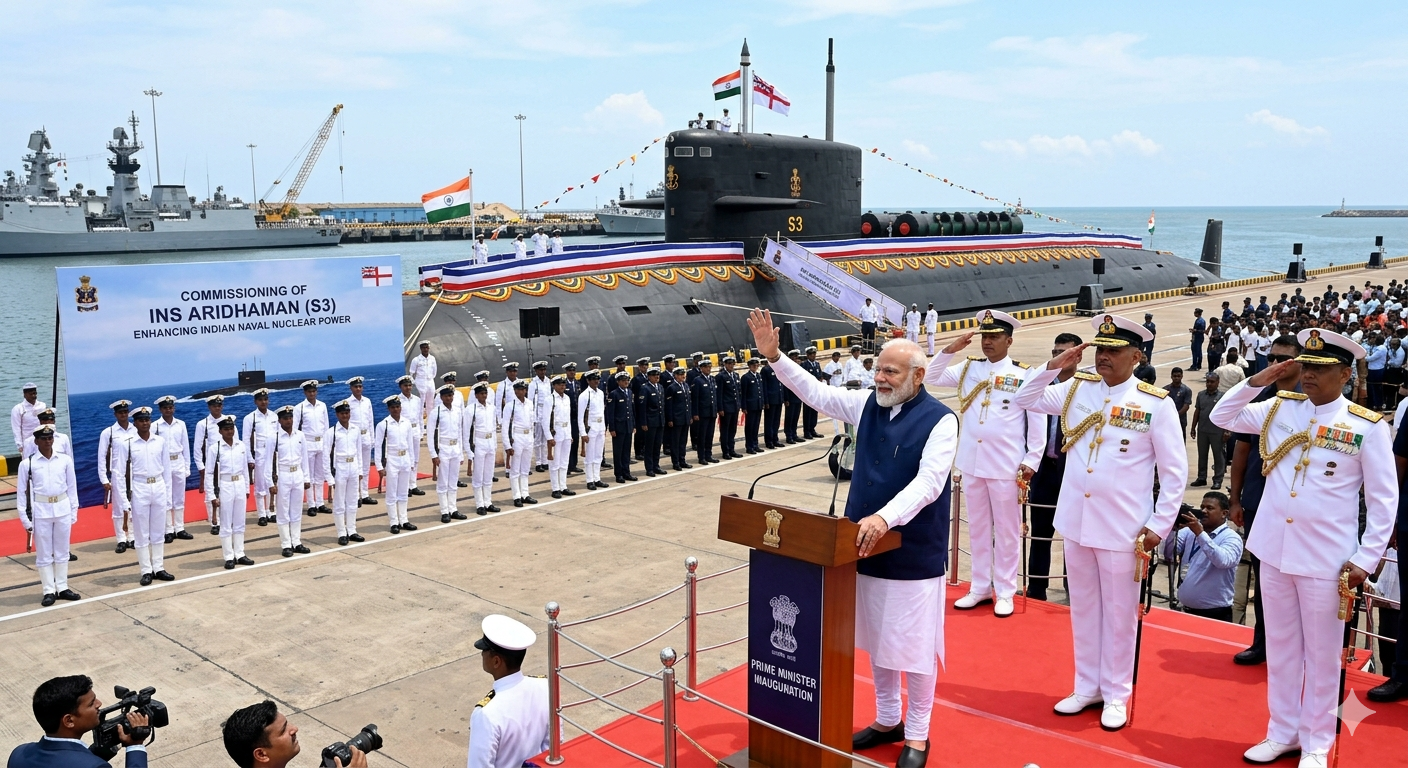
INS Aridhaman: Enhancing Indian Naval Nuclear Power
Current Affairs• April 04, 2026• Global Edition
In a landmark development that underscores India's growing self-reliance in defence technology, the Indian Navy commissioned INS Aridhaman on April 3, 2026. This nuclear-powered ballistic missile submarine (SSBN), designated S4 in the Arihant class, represents a significant leap forward in the country's underwater strategic capabilities. As the third vessel in its class following INS Arihant and INS Arighat, INS Aridhaman nuclear submarine joins the fleet at a time when maritime security in the Indo-Pacific demands robust deterrence.
The induction of INS Aridhaman comes just days after Defence Minister Rajnath Singh presided over a low-key ceremony at Visakhapatnam, highlighting the quiet professionalism that defines India's nuclear submarine programme. With a displacement of approximately 7,000 tonnes and advanced features that make it larger, quieter, and more lethal than its predecessors, this submarine is not merely an addition to the fleet—it is a strategic game-changer. Through INS Aridhaman, India bolsters its nuclear triad, enhances the Indian Navy's blue-water ambitions, and sends a clear message of resolve to potential adversaries.
This article explores the current status of INS Aridhaman nuclear submarine, its technical prowess, and the multifaceted ways in which it elevates India's naval and overall defence posture. From operational effectiveness to its implications in regional security dynamics, we examine how this indigenous marvel contributes to continuous naval strengthening while shaping responses to contemporary geopolitical challenges.
INS Aridhaman was formally commissioned into the Indian Navy on April 3, 2026, following extensive sea trials that concluded in late 2025. Built under the Advanced Technology Vessel (ATV) project at the Ship Building Centre in Visakhapatnam, the submarine reflects years of meticulous indigenous effort involving the Defence Research and Development Organisation (DRDO), the Bhabha Atomic Research Centre (BARC), and private sector partners like Larsen & Toubro.
Unlike the somewhat secretive commissioning of earlier vessels, the event coincided with heightened focus on naval modernisation. INS Aridhaman (S4) is the third operational SSBN, bringing India's underwater nuclear deterrent to three boats for the first time. INS Arihant, the pioneer commissioned in 2016, and INS Arighat, which entered service in August 2024, paved the way. Now, with INS Aridhaman nuclear submarine active, the Strategic Forces Command gains greater flexibility for patrols.
This achievement is rooted in India's nuclear doctrine of credible minimum deterrence and No First Use. Sea-based assets like INS Aridhaman provide the most survivable leg of the triad—air, land, and sea—because submarines can remain undetected for extended periods, ensuring a reliable second-strike capability even in the most adverse scenarios.
Technical Specifications and Design Advancements of INS Aridhaman
What sets INS Aridhaman apart is its refined design, tailored for enhanced performance in the demanding underwater environment. Measuring about 130 metres in length with a beam of 11 metres and a draft of 9.5 metres, the submarine displaces around 7,000 tonnes—roughly 1,000 tonnes more than the 6,000-tonne INS Arihant and INS Arighat. This increased size translates to greater internal volume for missiles, crew comfort, and advanced systems.
At its heart lies the Compact Light Water Reactor (CLWR-B1), an 83 MW pressurised light-water reactor developed indigenously. This propulsion system allows the submarine to operate submerged for months without surfacing, limited only by crew endurance and supplies. The reactor's improved acoustic signature makes INS Aridhaman quieter than its predecessors, a critical advantage in evading enemy sonar.
Armament is where INS Aridhaman truly shines. It features eight vertical launch system (VLS) tubes—double the four tubes on earlier Arihant-class boats. This configuration enables it to carry up to 24 K-15 Sagarika submarine-launched ballistic missiles (SLBMs) with a range of approximately 750 km or eight K-4 SLBMs capable of striking targets 3,500 km away. Future integration of the longer-range K-5 missile (5,000–6,000 km) is also anticipated, extending reach to cover vast swathes of potential threat areas.
Complementing the strategic weapons are six 533 mm torpedo tubes for conventional defence, along with advanced sonar suites such as the Panchendriya and USHUS systems for multi-mode surveillance, targeting, and underwater communication. Anechoic coatings and a double-hull design further reduce detectability, earning INS Aridhaman descriptions as a "deep sea predator" in naval circles.
Crewed by approximately 95 highly trained personnel, the submarine incorporates ergonomic improvements and life-support systems suited for prolonged patrols. These enhancements ensure that INS Aridhaman can maintain high operational readiness while minimising logistical demands.
How INS Aridhaman Boosts the Indian Navy's Power and Overall Defence Posture
The arrival of INS Aridhaman nuclear submarine markedly amplifies the Indian Navy's underwater strike potential and strategic depth. Traditionally, the Navy has focused on surface fleets and conventional submarines, but nuclear-powered assets shift the paradigm toward true blue-water operations. With three SSBNs now available, India moves closer to achieving continuous at-sea deterrence (CASD), a goal where at least one nuclear submarine remains on patrol at all times.
This capability directly bolsters the Navy by providing a stealthy, long-endurance platform that can operate far from home bases, safeguarding sea lines of communication (SLOCs) critical for India's energy imports and trade. In coordination with aircraft carriers like INS Vikrant and INS Vikramaditya, INS Aridhaman creates layered deterrence that complicates enemy planning.
Beyond the Navy, the submarine contributes to broader defence synergy. By securing the maritime domain, it indirectly supports the Army and Air Force in conventional scenarios. Nuclear deterrence reduces the risk of escalation in border conflicts, allowing land forces to concentrate on territorial integrity without the immediate shadow of nuclear threats. Joint operations under integrated theatre commands benefit from the submarine's intelligence-gathering potential and its ability to tie down adversary assets.
Economically and technologically, INS Aridhaman exemplifies Atmanirbhar Bharat. Over 70-80% indigenous content in systems like the reactor, missiles, and sensors fosters domestic industry growth, creates skilled jobs, and reduces reliance on foreign suppliers. This self-reliance strengthens not just military power but national resilience.
The commissioning of INS Aridhaman (S3), India’s second Arihant-class nuclear-powered ballistic missile submarine (SSBN), marks a definitive leap in the nation's maritime strike capability.
Operational Effectiveness of INS Aridhaman for the Indian Navy
In practical terms, INS Aridhaman enhances the Navy's effectiveness across multiple domains. Its extended range and stealth enable persistent presence in the Indian Ocean Region (IOR), where it can monitor chokepoints like the Strait of Malacca or respond to incursions in the Bay of Bengal and Arabian Sea.
During peacetime, the submarine supports training, deterrence patrols, and technology validation for future platforms. In conflict, it serves as a survivable launch platform for nuclear or conventional precision strikes, complicating enemy anti-submarine warfare (ASW) efforts. The doubled missile capacity means greater salvo potential, increasing the credibility of deterrence.
Comparisons with global peers highlight its significance. While not matching the size of U.S. Ohio-class or Russian Borei-class SSBNs, INS Aridhaman aligns with the needs of a regional power facing asymmetric threats from China’s expanding nuclear submarine fleet and Pakistan’s conventional boats. Its quiet operation and advanced sensors give it an edge in contested waters.
Integration with the Navy's growing network-centric warfare doctrine—linking with P-8I maritime patrol aircraft, destroyers, and satellites—multiplies its combat value. Maintenance and operational doctrines refined through earlier Arihant-class experience ensure high availability rates.
Impact on Current and Potential War Situations
In today's geopolitical landscape, marked by tensions in the Indo-Pacific, INS Aridhaman nuclear submarine introduces a stabilising yet assertive element. Against China, which operates a larger submarine force and asserts claims in the South China Sea and IOR, the submarine bolsters India's ability to deny sea control and protect vital interests. Its K-4 missiles can reach deep into adversary territory from safe patrol areas, raising the threshold for aggression.
For Pakistan, the enhanced second-strike capability reinforces deterrence amid ongoing proxy threats and naval modernisation backed by Chinese technology. In a hypothetical escalation, INS Aridhaman could neutralise surface fleets or impose costs on blockading attempts, protecting India's coastline and economic lifelines.
The submarine's presence influences crisis dynamics by complicating adversary calculations. In scenarios involving hybrid warfare or grey-zone tactics, the mere knowledge of an undetected SSBN alters risk assessments. It also supports India's role in multilateral forums like the Quad, where maritime domain awareness and freedom of navigation are priorities.
By contributing to a credible nuclear posture, INS Aridhaman helps prevent conflicts from escalating to nuclear levels, allowing conventional forces greater operational freedom. This strategic impact extends to non-traditional threats like piracy or terrorism at sea, where persistent underwater surveillance adds another layer of security.
India's Continuous Strengthening of Naval Power
The commissioning of INS Aridhaman is part of a broader, sustained push to modernise the Indian Navy. Plans for the fourth Arihant-class boat (S4*) are advancing, while the larger S5-class SSBNs—displacing 13,000–14,000 tonnes—are under construction at Visakhapatnam. These future platforms will carry even more advanced missiles and offer greater endurance.
On the conventional front, Project 75I aims to acquire six next-generation diesel-electric submarines with air-independent propulsion (AIP) through partnerships, such as with Germany's ThyssenKrupp Marine Systems. Negotiations have progressed, promising enhanced stealth and submerged endurance for littoral operations.
Surface capabilities are expanding rapidly with indigenous frigates, destroyers, and corvettes under programmes like Project 17A and Project 15B. The Navy's aircraft carrier fleet, anchored by INS Vikrant, provides power projection, while unmanned systems and anti-submarine helicopters round out the multi-domain approach.
Nuclear attack submarines (SSNs) under Project 77, with initial approvals for construction, will complement the SSBN fleet by offering hunter-killer roles. Overall, the Indian Navy targets a fleet of over 200 platforms by the 2030s, emphasising indigenisation rates above 70%.
This holistic modernisation addresses capability gaps, counters regional naval build-ups, and aligns with India's vision of becoming a net security provider in the IOR. Budgetary allocations, policy reforms, and private sector involvement ensure momentum, making naval power a cornerstone of national strategy.
Future Prospects and Strategic Outlook
Looking ahead, INS Aridhaman sets the stage for further evolution. Lessons from its operations will inform subsequent designs, accelerating the transition to more potent S5 and SSN classes. International collaborations, while maintaining core indigenous technologies, may enhance specific systems like sensors or combat management.
For India, the submarine programme is more than hardware—it symbolises technological maturity and strategic autonomy. As global maritime competition intensifies, platforms like INS Aridhaman ensure that the Indian Navy remains a formidable force capable of safeguarding sovereignty and contributing to regional stability.
In conclusion, the commissioning of INS Aridhaman nuclear submarine marks a proud chapter in India's defence journey. By enhancing naval power, enabling effective deterrence, and influencing war scenarios through credible second-strike options, it reinforces the nation's commitment to peace through strength. As India continues to strengthen its naval forces, INS Aridhaman stands as a testament to innovation, resilience, and forward-thinking strategy that will define the Indian Ocean's security architecture for decades to come.
Frequently Asked Questions
What is the primary significance of INS Aridhaman: Enhancing Indian Naval Nuclear Power?
In a landmark development that underscores India's growing self-reliance in defence technology, the Indian Navy commissioned INS Aridhaman on April 3, 2026. This nuclear-powered ballistic missile submarine (SSBN), designated S4 in the Arihant class, represents a significant leap forward in the country's underwater strategic capabilities.
How does this development impact Current Affairs?
As the third vessel in its class following INS Arihant and INS Arighat, INS Aridhaman nuclear submarine joins the fleet at a time when maritime security in the Indo-Pacific demands robust deterrence.The induction of INS Aridhaman comes just days after Defence Minister Rajnath Singh presided over a low-key ceremony at Visakhapatnam, highlighting the quiet professionalism that defines India's nuclear submarine programme. With a displacement of approximately 7,000 tonnes and advanced features that make it larger, quieter, and more lethal than its predecessors, this submarine is not merely an addition to the fleet—it is a strategic game-changer.
What are the key future projections to monitor?
Through INS Aridhaman, India bolsters its nuclear triad, enhances the Indian Navy's blue-water ambitions, and sends a clear message of resolve to potential adversaries.This article explores the current status of INS Aridhaman nuclear submarine, its technical prowess, and the multifaceted ways in which it elevates India's naval and overall defence posture.