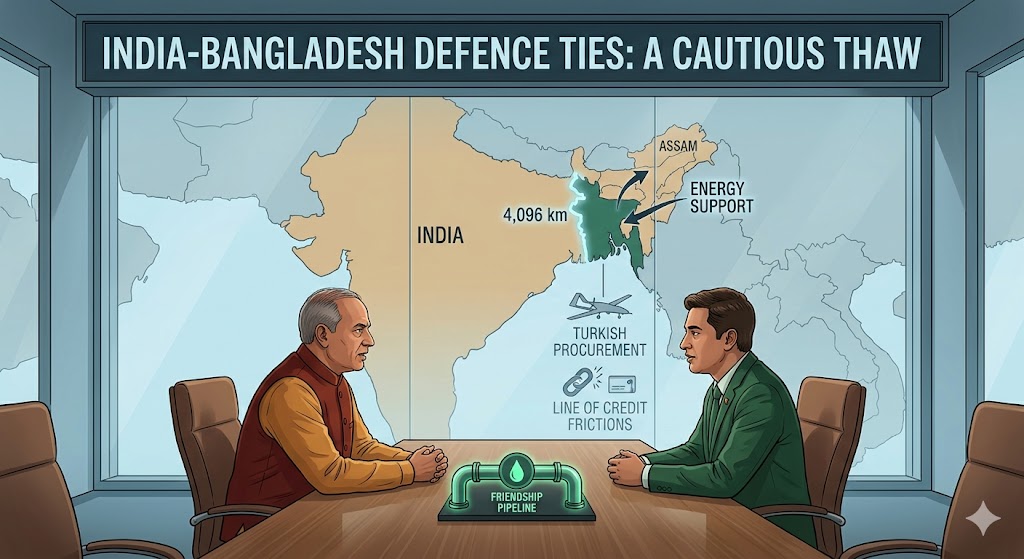
The relationship between India and Bangladesh has always been complex—rooted in shared history, a 4,096-kilometre border, and deep economic interdependence—yet frequently tested by politics, security concerns, and shifting regional dynamics. In 2026, defence cooperation stands at a crossroads. After months of strain following the 2024 political changes in Dhaka, signs of a cautious thaw have emerged. High-level intelligence visits, army-to-army engagements, and pragmatic energy support amid the Israel-Iran-US conflict illustrate a relationship that is neither fully restored nor irreparably broken.
This article examines the current state of India-Bangladesh defence ties, the pivot toward Turkish (and Chinese) defence partnerships, lingering border and aid-related frictions, and how the ongoing Middle East war has unexpectedly created space for renewed bilateral engagement. Far from abstract geopolitics, these developments carry real implications for regional stability, energy security, and the balance of power in South Asia.
Historical Context and the Post-2024 Strain
For decades, defence and security cooperation formed a quiet but vital pillar of India-Bangladesh relations. Under the long tenure of Sheikh Hasina, the two countries maintained steady military training exchanges, intelligence sharing against insurgent groups, and a $500 million Indian line of credit dedicated to defence procurements from India. Border management improved significantly after the 2015 Land Boundary Agreement, and joint exercises helped address cross-border threats.
That foundation cracked after August 2024. The ouster of Hasina’s government led to a BNP-led administration taking charge in February 2026. Early signals were concerning: reports of heightened anti-India sentiment, violence against minorities, and a reorientation of Dhaka’s foreign policy. India responded with measures that Dhaka perceived as punitive—halving development aid in the 2026-27 Union Budget (from ₹120 crore to ₹60 crore) and restricting certain visas.
Defence ties suffered tangible setbacks. In May 2025, Bangladesh cancelled a $21 million contract with Kolkata-based Garden Reach Shipbuilders & Engineers (GRSE) for an advanced ocean-going tug. The deal, the first major order under India’s defence line of credit, was seen by analysts as retaliation amid broader trade and trans-shipment disputes. Border fencing disputes also resurfaced, with occasional flag meetings required to de-escalate tensions along unfenced stretches.
Yet even during this difficult phase, complete rupture was avoided. Indian Navy and Army training slots for Bangladeshi officers continued, and both sides maintained quiet back-channel contacts.
One of the most striking shifts has been Dhaka’s deepening defence partnership with Turkey. By late 2025, Bangladesh had become the fourth-largest importer of Turkish defence equipment. High-profile acquisitions and negotiations include:
- Hisar-O+ medium-range and Siper long-range surface-to-air missile (SAM) systems — A landmark air-defence deal reportedly nearing finalisation that would significantly upgrade Bangladesh’s layered defence capabilities.
- T129 ATAK attack helicopters — Reports of a $600 million package for six units, marking Dhaka’s first major rotary-wing acquisition from Ankara.
- Combat drones and joint production talks — Discussions on Bayraktar UAVs and potential co-production facilities.
A broader “Defence Framework for Cooperation” is under final review, expected to consolidate earlier MoUs into a strategic roadmap. Turkish firms such as MKE, ASFAT, and STM are actively involved, supported by Bangladesh’s Investment Development Authority.
This pivot has raised eyebrows in New Delhi. Turkey’s “Asia Anew” policy aligns with Dhaka’s desire for diversified partnerships, but India views the influx of advanced Turkish systems—especially air-defence assets near the border—through a security lens. Compounding concerns is Bangladesh’s parallel engagement with China, including a defence pact and plans for a drone factory close to the Indian frontier.
These moves reflect classic strategic hedging. Bangladesh seeks modern capabilities without over-reliance on any single partner. For India, they underscore the need to rebuild trust if it wishes to remain a preferred defence supplier.
Signs of a Cautious Thaw in Defence and Security Ties
Despite the headwinds, 2026 has brought tangible signs of reset. In early March, Bangladesh’s Directorate General of Forces Intelligence (DGFI) chief visited New Delhi and held meetings with National Security Adviser Ajit Doval, RAW chief Parag Jain, and senior military intelligence officials. Though no official readout was issued, the visit signalled reopening of intelligence channels—critical for border security and countering extremism.
Bangladesh’s High Commissioner to India, M Riaz Hamidullah, met Indian Army Chief General Upendra Dwivedi to discuss boosting defence ties, with emphasis on joint training, capacity building, and regional cooperation. These interactions come against the backdrop of resumed visa services on both sides and renewed people-to-people contacts.
Defence engagement, though scaled back, never fully stopped. Bangladeshi cadets continue to train at Indian academies, including the National Defence Academy. Senior Indian officers have publicly described Bangladesh as a “friend” whose current phase is “temporary and transitory.”
Friendship Pipeline" for energy support, and other key geopolitical elements like Turkish military procurement to provide a complete context of the current bilateral defense ties.
The Israel-Iran-US War as an Unexpected Catalyst
The escalating conflict in West Asia—marked by direct US-Israeli strikes on Iranian targets and Iranian retaliation—has disrupted global energy flows, particularly through the Strait of Hormuz. For energy-import-dependent Bangladesh, the impact has been severe: fuel shortages, power outages, long queues at petrol stations, and threats to the garment industry that powers its economy.
In a pragmatic and timely move, Dhaka turned to New Delhi for emergency diesel supplies. In March 2026, India dispatched an initial 5,000 tonnes of high-speed diesel through the India-Bangladesh Friendship Pipeline from the Numaligarh refinery in Assam. Additional consignments—potentially totalling 45,000 tonnes by April—are under discussion as part of the long-standing annual commitment of around 180,000 tonnes.
This energy cooperation, while rooted in an existing agreement, carries deeper significance. It demonstrates India’s willingness to act as a “first responder” for neighbours during crises. For Bangladesh, it provides immediate relief and reinforces the mutual benefits of stable ties with India. Analysts note that the timing—amid broader diplomatic overtures—has helped accelerate the thaw in bilateral relations.
The war has also prompted quiet discussions on energy security and regional stability. While no formal India-Bangladesh “talks” on the Israel-Iran-US conflict have been publicly announced, the practical fallout has forced both capitals to coordinate responses. Bangladesh has sought safe passage for its fuel tankers through the Strait of Hormuz and waivers to import Russian fuel, while India has ramped up diesel exports to several neighbours. These parallel efforts highlight how distant conflicts can reshape neighbourhood dynamics.
Broader Geopolitical Implications
The interplay of defence diversification, border management, and crisis-driven cooperation reveals three key trends:
1. Strategic Autonomy vs. Neighbourhood Realism — Bangladesh is determined to pursue diversified defence partnerships. Yet geography and economics ensure India remains indispensable for trade, transit, and energy security.
2. China-Turkey Axis and India’s Response — The growing presence of Turkish and Chinese defence systems near India’s eastern flank adds a layer of complexity. New Delhi’s counter-approach appears to combine quiet diplomacy, continued training support, and leveraging its refining capacity during global shocks.
3. US Interest in Regional Stability — Washington has signalled interest in mending India-Bangladesh ties and offering American or allied defence systems as alternatives to Chinese platforms. This external dynamic may encourage both sides to prioritise pragmatism over rhetoric.
Border issues remain sensitive. Unfenced segments and occasional construction disputes require sustained flag-level and DG-level meetings between the Border Security Force (BSF) and Border Guard Bangladesh (BGB). Intelligence sharing on insurgent movements and smuggling is equally vital.
Looking Ahead: Opportunities and Challenges
The path forward is not linear. A planned visit by Bangladesh’s Prime Minister to New Delhi could provide momentum, provided both sides address core concerns—minority security, border management, and trade reciprocity. India’s neighbourhood-first policy and Bangladesh’s need for stable development partnerships create fertile ground for progress.
Defence cooperation could expand in non-controversial areas: joint disaster response, maritime security in the Bay of Bengal, and cyber-threat exchanges. The $500 million defence line of credit remains available if trust is rebuilt. Meanwhile, the Turkey-Bangladesh framework will likely proceed, forcing India to compete on technology transfer and cost-effectiveness rather than exclusivity.
The Israel-Iran-US war, while tragic in its human cost, has inadvertently underscored the value of regional solidarity. Energy assistance during the Hormuz disruptions may prove a turning point—reminding both capitals that pragmatic cooperation delivers tangible benefits when grand ideological differences are set aside.
Conclusion
India-Bangladesh defence relations in 2026 reflect a mature realism. Strains from cancelled deals, aid cuts, and defence diversification toward Turkey have not erased the underlying logic of partnership. Recent intelligence engagements, army-level dialogue, and diesel supplies amid the Middle East conflict signal a gradual rebuilding of trust.
The relationship will continue to be tested—by domestic politics in Dhaka, border frictions, and great-power competition. Yet the events of early 2026 suggest both nations recognise that geography and shared interests outweigh temporary divergences. As the Israel-Iran-US war reshapes global energy flows, the quiet delivery of Indian diesel through the Friendship Pipeline stands as a reminder: in South Asia, neighbourhood cooperation remains the most reliable insurance against external shocks.
For policymakers in New Delhi and Dhaka, the message is clear. Sustained dialogue on defence, border security, and economic resilience—anchored in mutual respect—offers the best path forward. The coming months will determine whether 2026 marks the beginning of a durable reset or merely a pause in a longer cycle of friction and reconciliation.
Frequently Asked Questions
What is the primary significance of "India-Bangladesh Defence Relations: 2026 Updates"?
The relationship between India and Bangladesh has always been complex—rooted in shared history, a 4,096-kilometre border, and deep economic interdependence—yet frequently tested by politics, security concerns, and shifting regional dynamics. In 2026, defence cooperation stands at a crossroads.
How does this development impact Current Affairs?
After months of strain following the 2024 political changes in Dhaka, signs of a cautious thaw have emerged. High-level intelligence visits, army-to-army engagements, and pragmatic energy support amid the Israel-Iran-US conflict illustrate a relationship that is neither fully restored nor irreparably broken.This article examines the current state of India-Bangladesh defence ties, the pivot toward Turkish (and Chinese) defence partnerships, lingering border and aid-related frictions, and how the ongoing Middle East war has unexpectedly created space for renewed bilateral engagement.
What are the key future projections to monitor?
Far from abstract geopolitics, these developments carry real implications for regional stability, energy security, and the balance of power in South Asia.Historical Context and the Post-2024 StrainFor decades, defence and security cooperation formed a quiet but vital pillar of India-Bangladesh relations.