Jan Vishwas Bill 2026: Revolutionizing Ease of business
Current Affairs • April 02, 2026 • Global Edition

Jan Vishwas Bill 2026: Redefining India’s Regulatory Landscape for a Trust-Based Economy
In a landmark move toward administrative reform, the Indian Parliament recently passed the Jan Vishwas (Amendment of Provisions) Bill, 2026. Introduced by Jitin Prasada, Minister of State for Commerce and Industry, and supported by key cabinet members, this legislative masterpiece aims to further the "Minimum Government, Maximum Governance" vision. By shifting the focus from fear-based compliance to trust-based regulation, the Jan Vishwas Bill 2026 is set to become the cornerstone of a developed India (Viksit Bharat).
The socio-economic landscape of India has undergone a sea change over the last decade. As the nation marches toward becoming the world's third-largest economy, the burden of colonial-era regulations has often been cited as a major hurdle. The Jan Vishwas Bill 2026 addresses these legacy issues by modernizing the legal framework. It is not just an amendment but a cultural shift in how the state views its citizens and businesses. For far too long, minor procedural errors were met with the threat of imprisonment, creating an environment of apprehension. This Bill seeks to replace that fear with a foundation of mutual trust.
What is the Jan Vishwas Bill 2026?
The Jan Vishwas (Amendment of Provisions) Bill, 2026 is the second iteration of the regulatory overhaul that began in 2023. Often referred to as Jan Vishwas 2.0, it proposes amendments to 784 provisions across 79 Central Acts administered by 23 different ministries. These acts range from the colonial-era Cattle Trespass Act of 1871 to modern legislations like the Information Technology Act and the Real Estate (Regulation and Development) Act.
The primary objective is twofold:
Ease of Doing Business (EoDB): Decriminalizing 717 provisions to reduce the compliance burden on startups and industries. By removing the criminal tag from technical violations, the government aims to encourage entrepreneurship and risk-taking.
Ease of Living (EoL): Amending 67 provisions to simplify the lives of common citizens by removing the threat of imprisonment for minor, technical, or procedural lapses. This ensures that a common man is not harassed by local officials for administrative oversights that have no criminal intent.
Historical Evolution: From 2023 to 2026
The journey of the Jan Vishwas Adhiniyam began in late 2022 when the first version was introduced. Following its introduction, it was referred to a Joint Parliamentary Committee (JPC) which held extensive deliberations with various stakeholders, including legal experts, industry bodies, and civil society. The 2023 version was a successful proof of concept, decriminalizing over 180 provisions across 42 acts.
Building on that success, the Jan Vishwas (Amendment of Provisions) Bill 2026 takes a much more aggressive approach. While the first version focused on low-hanging fruit, the 2026 Bill tackles more complex regulatory frameworks. The Department for Promotion of Industry and Internal Trade (DPIIT) led the coordination efforts, ensuring that every ministry reviewed their respective laws to identify provisions that had become obsolete or unnecessarily punitive.
Key Features of the Jan Vishwas (Amendment of Pr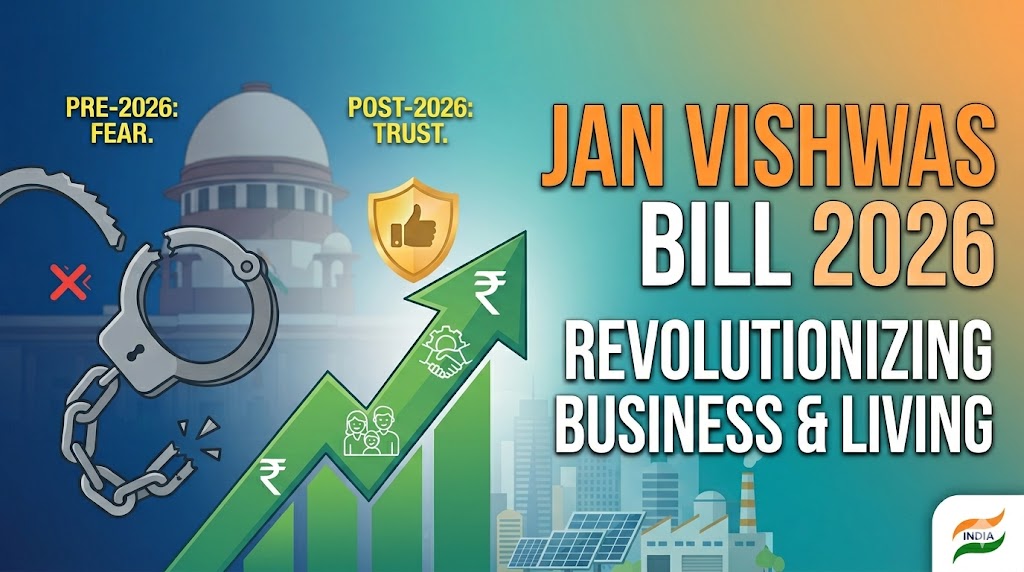 India is officially ending the 'Inspector Raj.' The Jan Vishwas Bill 2026 is here to decriminalize 717 provisions across 79 Acts, shifting the nation toward a trust-based economyovisions) Bill
The 2026 Act is more comprehensive than its predecessor, reflecting extensive stakeholder consultations and recommendations from a Select Committee.
Frequently Asked Questions
What is the primary significance of Jan Vishwas Bill 2026: Revolutionizing Ease of business?
Pythontext = """ Title: Jan Vishwas Bill 2026: Revolutionizing Ease of Doing Business Meta Summary: Explore the Jan Vishwas (Amendment of Provisions) Bill 2026. Learn how decriminalizing 717 provisions across 79 Acts boosts India's Ease of Doing Business and Living.
How does this development impact Current Affairs?
--- ## Jan Vishwas Bill 2026: Redefining India’s Regulatory Landscape for a Trust-Based Economy In a landmark move toward administrative reform, the Indian Parliament recently passed the Jan Vishwas (Amendment of Provisions) Bill, 2026. Introduced by Jitin Prasada, Minister of State for Commerce and Industry, and supported by key cabinet members, this legislative masterpiece aims to further the "Minimum Government, Maximum Governance" vision.
What are the key future projections to monitor?
By shifting the focus from fear-based compliance to trust-based regulation, the Jan Vishwas Bill 2026 is set to become the cornerstone of a developed India (Viksit Bharat).
Discussion & Reader Insights (0)
No comments yet. Share your thoughts first!