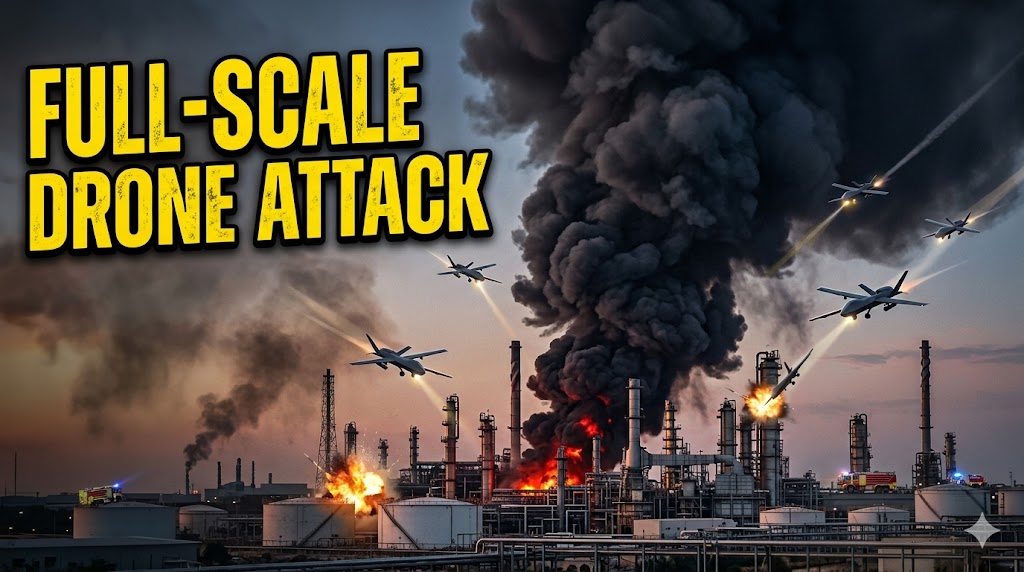
In the early hours of April 3, 2026, a significant kuwait oil refinery drone attack sent shockwaves through the global energy sector. Iranian drones targeted Kuwait’s strategic Mina Al-Ahmadi facility, igniting fires across multiple operational units. Kuwait Petroleum Corporation (KPC) quickly confirmed the incident, emphasizing that emergency response teams were on site and no injuries had been reported. This mina al ahmadi drone attack marks yet another escalation in the ongoing regional conflict, drawing immediate international attention to the vulnerability of Gulf oil infrastructure.
The strike comes amid a broader Iran-led campaign against perceived adversaries in the Gulf. As tensions between Iran, the United States, and Israel continue to spiral, this kuwait refinery drone attack underscores how energy assets have become central to the battlefield. Kuwait, a key OPEC producer and longtime US ally, now finds itself directly caught in the crossfire. The event not only disrupts local production but also raises alarms about supply chain stability worldwide.
What makes this drone strike kuwait oil refinery particularly concerning is its timing. Just hours earlier, US President Donald Trump issued pointed threats against Iranian infrastructure. In a Truth Social post, Trump warned that the United States “hasn’t even started destroying what’s left in Iran,” explicitly naming bridges and electric power plants as potential next targets. This rhetoric set the stage for Tehran’s retaliatory actions, including the kuwait oil refinery drone attack that unfolded shortly afterward.
Background on Mina Al-Ahmadi: Kuwait’s Critical Energy Hub
The Mina Al-Ahmadi refinery stands as one of Kuwait’s most vital industrial assets. Operated by the state-owned Kuwait National Petroleum Company under KPC oversight, the facility processes approximately 346,000 barrels per day. It plays a pivotal role in refining crude oil into essential products such as gasoline, diesel, and jet fuel, supporting both domestic needs and export markets across Asia and Europe.
Historically, the ahmadi oil refinery has faced threats during periods of regional instability. Past incidents during the Gulf War and subsequent tensions highlighted its strategic importance. Located along the Persian Gulf coast, the complex includes advanced processing units, storage tanks, and export terminals linked directly to Kuwait’s oil fields. Any disruption here ripples far beyond Kuwait’s borders, affecting global oil pricing and energy security.
In the context of the current kuwait oil refinery drone attack, experts note that refineries like Mina Al-Ahmadi are uniquely vulnerable. Unlike crude production sites, they require continuous operation for safety and efficiency. Shutting down units—even temporarily—can lead to prolonged restarts that take weeks or months. KPC’s decision to close several units as a precaution following the mina al ahmadi drone attack reflects standard emergency protocols designed to protect workers and prevent secondary explosions.
Timeline and Details of the Kuwait Refinery Drone Attack
According to official statements from KPC and Kuwaiti state media, the kuwait refinery drone attack occurred in the pre-dawn hours of April 3. Multiple drones, attributed to Iranian forces, breached air defenses and struck key operational sections of the Mina Al-Ahmadi facility. Fires erupted almost immediately, visible in footage shared across regional networks.
KPC’s swift response included deploying specialized firefighting teams equipped for petrochemical blazes. Preliminary assessments confirmed no casualties, a relief given the high-risk environment. However, the drone strike kuwait oil refinery forced partial shutdowns to ensure safety. As of the latest updates, containment efforts continue, with authorities monitoring air quality and environmental impact near the Gulf coastline.
This incident follows a pattern of similar strikes earlier in the week. Reports indicate the refinery had experienced prior probing attacks, but April 3’s event represents the most direct hit yet. Analysts link the iran kuwait refinery strike to Iran’s strategy of targeting Gulf energy infrastructure in response to ongoing US and Israeli operations against Iranian targets.
Eyewitness accounts and satellite imagery (circulating on verified channels) show plumes of smoke rising from the facility. While KPC has withheld granular technical details to avoid compromising security, the message is clear: no Gulf state is immune from the widening conflict.
US Threats to Iran: The Spark Before the Strike
The kuwait oil refinery drone attack did not occur in isolation. Late on April 2, President Trump escalated verbal pressure on Tehran. In unambiguous terms, he threatened to target Iranian bridges and power plants, stating the US campaign against Iran’s remaining capabilities was far from over. Trump’s comments framed these potential strikes as necessary to force compliance, particularly regarding the Strait of Hormuz, a critical chokepoint for global oil transit.
This rhetoric aligned with broader US objectives in the five-week-old conflict. Washington has repeatedly claimed that Iran’s military infrastructure has been significantly degraded. Yet Tehran’s ability to launch coordinated drone operations, as seen in the mina al ahmadi drone attack, suggests otherwise. Defense observers note that such threats often serve dual purposes: signaling resolve to allies while pressuring adversaries to negotiate.
Kuwait, home to thousands of US troops and a major non-NATO partner, viewed the timing as deeply provocative. The kuwait refinery drone attack appears to be Iran’s direct reply, demonstrating reach and willingness to strike economic targets in allied nations.
Iran’s Response: Warnings, Retaliation, and Defiance
Iran wasted no time in issuing its own warnings following Trump’s statements. Military spokespersons vowed “crushing” and “more destructive” attacks if the US proceeded with infrastructure strikes. Tehran explicitly signaled that any assault on its power plants or bridges would trigger expanded operations across the region, targeting US-linked assets and energy facilities.
In the hours leading up to the kuwait oil refinery drone attack , Iranian state media highlighted the country’s resolve. Officials rejected any notion of surrender, framing the conflict as a fight for sovereignty. The strike on Mina Al-Ahmadi fits this narrative: a calibrated response showing Iran can project power without direct confrontation on its soil.
Further statements from Iran’s central command warned of broader retaliation. Should US actions intensify, Tehran indicated readiness to hit additional Gulf targets, disrupt shipping, and even target technology firms operating in the region. This “first of all” approach—prioritizing high-impact economic hits—mirrors Iran’s asymmetric warfare doctrine, designed to impose costs disproportionate to its conventional military limitations.
The iran kuwait refinery strike thus serves as both retaliation and deterrent. By hitting Kuwait, Iran sends a message to Washington and its Gulf partners: continued pressure will carry a steep price for global energy markets.
Kuwait's oil infrastructure targeted in sophisticated drone attack.
How the Kuwait Oil Refinery Drone Attack Fuels the Middle East Crisis
The kuwait oil refinery drone attack exemplifies how localized incidents can ignite wider regional instability. What began as a bilateral US-Israel campaign against Iran has evolved into a multi-front conflict involving Gulf states, proxy militias, and international shipping lanes.
Analysts describe the current situation as a “cascading crisis.” Attacks on Kuwaiti and Emirati facilities, combined with Iranian claims over the Strait of Hormuz, have already driven Brent crude prices above $109 per barrel—a 50% surge since late February. Restarting damaged refineries like Mina Al-Ahmadi could take weeks, further tightening supply and inflating costs for consumers worldwide.
This drone strike kuwait oil refinery also complicates diplomatic efforts. The UN Security Council is scheduled to discuss Strait of Hormuz security, yet divisions among permanent members hinder consensus. France and others caution against military solutions, advocating coordinated negotiations with Iran—advice seemingly at odds with current US policy.
Moreover, the incident risks drawing in more actors. Kuwait’s invocation of collective defense pacts could pull additional Arab states deeper into the fray. Meanwhile, non-state groups aligned with Tehran may view the kuwait oil refinery drone attack as a green light for similar operations elsewhere.
Economic and Global Implications of the Escalation
Beyond immediate fires at Mina Al-Ahmadi, the kuwait refinery drone attack carries profound economic consequences. Kuwait’s oil sector contributes roughly 40% of GDP; disruptions here threaten fiscal stability and investment confidence. Global supply chains, already strained by Red Sea shipping issues, now face compounded risks in the Gulf.
Insurance premiums for energy shipments have spiked. Asian buyers, heavily dependent on Gulf crude, are scrambling for alternatives. The “one day don’t attack” de-escalation hopes voiced by some diplomats now appear naïve as each side matches the other’s moves.
Longer term, this crisis could reshape energy geopolitics. Nations may accelerate diversification away from Gulf oil, boosting renewables and alternative suppliers. Yet in the short term, the kuwait oil refinery drone attack exacerbates inflation pressures and slows post-pandemic recovery.
International Reactions and the Path Forward
Reactions poured in swiftly. The United States condemned the mina al ahmadi drone attack as “unprovoked aggression,” pledging support for Kuwait’s defense. Israel echoed these sentiments, linking the strike to Iran’s broader destabilization campaign.
Gulf Cooperation Council members expressed solidarity with Kuwait while urging restraint. European leaders called for urgent de-escalation talks, warning that further infrastructure strikes could trigger uncontrollable spillover.
Iran, for its part, continues to frame its actions as defensive. The kuwait oil refinery drone attack, in Tehran’s view, balances the scales against US and Israeli operations.
Looking ahead, the trajectory remains uncertain. Will Trump follow through on power plant threats, or will backchannel diplomacy prevail? Can the kuwait oil refinery drone attack serve as a wake-up call for renewed negotiations, or will it mark the beginning of a prolonged energy war?
One thing is certain: the Mina Al-Ahmadi incident has elevated the stakes. As firefighters battle lingering blazes and markets digest the news, the world watches closely. The kuwait oil refinery drone attack is not merely a headline—it is a pivotal chapter in a crisis whose full consequences are still unfolding.
This kuwait oil refinery drone attack reminds us that in today’s interconnected world, a single drone strike on a distant refinery can reshape global security and economic landscapes overnight. Stakeholders across industries must now prepare for prolonged volatility while diplomats seek any opening for dialogue.
Frequently Asked Questions
What is the primary significance of Drone Attack Hits Kuwait Oil Refinery amid us -iran- Israel?
Drone Attack Hits Kuwait Oil RefineryIn the early hours of April 3, 2026, a significant kuwait oil refinery drone attack sent shockwaves through the global energy sector. Iranian drones targeted Kuwait’s strategic Mina Al-Ahmadi facility, igniting fires across multiple operational units.
How does this development impact International Affairs?
Kuwait Petroleum Corporation (KPC) quickly confirmed the incident, emphasizing that emergency response teams were on site and no injuries had been reported. This mina al ahmadi drone attack marks yet another escalation in the ongoing regional conflict, drawing immediate international attention to the vulnerability of Gulf oil infrastructure.The strike comes amid a broader Iran-led campaign against perceived adversaries in the Gulf.
What are the key future projections to monitor?
As tensions between Iran, the United States, and Israel continue to spiral, this kuwait refinery drone attack underscores how energy assets have become central to the battlefield.