Indian Stock Market Correction: $115B NSE Wipeout Explained
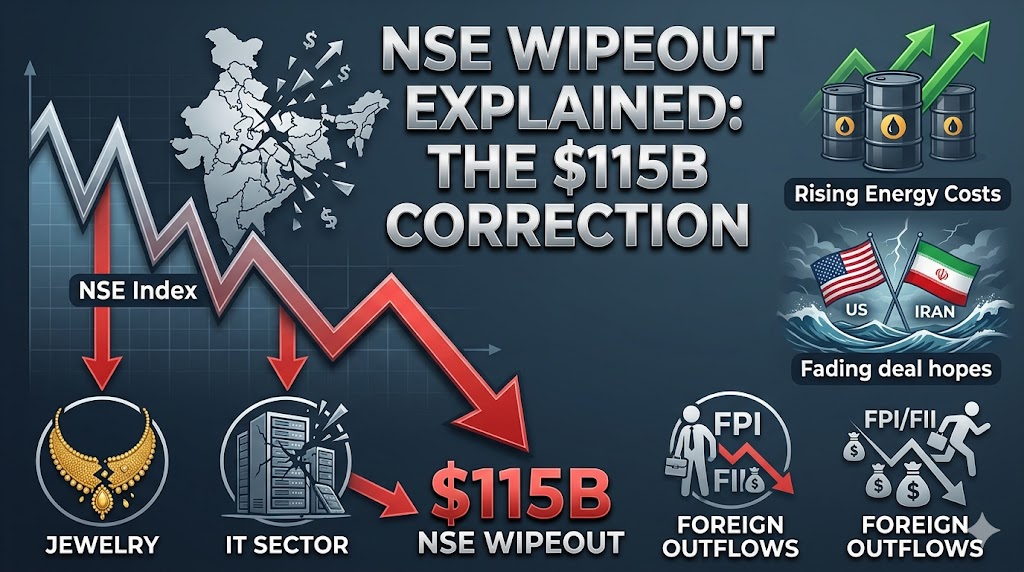
The Indian stock market experienced a sharp correction on May 12, 2026, as investors reacted to escalating global uncertainties. In a single session, roughly $115 billion in market capitalization was wiped off companies listed on the National Stock Exchange (NSE). This downturn reflects growing concerns over surging energy prices triggered by fragile hopes for a US-Iran agreement, combined with heavy selling by foreign investors.
Jewelry and information technology (IT) stocks bore the brunt of the selling pressure. While domestic institutional investors provided some support through buying, the overall sentiment turned cautious. This article delves into the causes, immediate impacts, sector-specific effects, broader economic implications, and what investors might expect in the coming weeks and months.
The primary catalyst for this correction stems from developments in the Middle East. Hopes for a diplomatic resolution between the US and Iran have dimmed, leading to renewed fears of supply disruptions in global oil markets. India, which imports nearly 85-90% of its crude oil requirements, is particularly vulnerable to spikes in energy costs.
Crude oil prices have climbed significantly, with Brent hovering at elevated levels. Higher fuel costs not only increase import bills but also feed into inflation, potentially pressuring the Reserve Bank of India's monetary policy stance. Prime Minister Narendra Modi’s recent appeal to citizens for fuel conservation and reduced gold purchases has further signaled the seriousness of the situation, amplifying market jitters.
Foreign portfolio investors (FPIs), sensitive to global risk appetite, responded by offloading Indian equities. On recent trading days, FIIs sold shares worth hundreds of millions of dollars, contributing to the sharp decline in benchmark indices.
Market Performance: Key Numbers and Statistics
On the day of the major correction:
The NSE saw an approximate $115 billion erosion in total market value.
The Nifty 50 index declined notably, with GIFT Nifty futures indicating continued weakness in early trading.
Broader market participation showed heavy selling in mid and small-cap segments alongside large-caps.
This move marks one of the worst single-day performances in recent weeks. Volatility, as measured by India VIX, surged, reflecting heightened uncertainty among participants.
Domestic institutional investors (DIIs) stepped in as net buyers, absorbing some of the supply from foreign sellers. However, the scale of FII outflows proved too significant to fully offset in the short term.
Sectoral Impact: Jewelry and IT Stocks Hit Hardest
Jewelry Sector:
Jewelry stocks suffered significant losses due to their sensitivity to gold prices and consumer discretionary spending. Rising energy costs and potential inflationary pressures could dampen household consumption. Companies like Titan and Kalyan Jewellers saw sharp declines as investors factored in lower demand prospects amid economic caution.
Gold, often viewed as a safe-haven asset during geopolitical turmoil, may see increased demand, but for listed jewelry retailers, higher input costs and subdued consumer sentiment create a challenging environment.
IT Sector:
The IT index also faced substantial pressure. Global economic uncertainties linked to energy shocks can delay client spending on technology services. Indian IT giants, with significant exposure to US and European markets, are navigating a period of cautious deal-making. Recent earnings seasons have already highlighted growth concerns, and this macro overlay has compounded the selling.
Stocks in this space experienced percentage declines that outpaced the broader market, contributing heavily to the overall market value loss.
Other sectors like metals, automobiles, and consumer goods also felt the heat due to expected margin pressures from higher input costs.
Why Foreign Investors Are Turning Cautious
Foreign investors have been net sellers in Indian equities for an extended period in 2026, with cumulative outflows reaching record levels. Several factors drive this:
1. Energy Price Sensitivity: India’s heavy reliance on imported oil makes its economy susceptible to external shocks.
2. Currency Pressures: The rupee has weakened against the dollar, approaching levels that raise concerns about imported inflation.
3. Global Risk-Off Mood: Fading hopes for US-Iran de-escalation have led to a broader sell-off in emerging markets.
4. Valuation Concerns: After previous rallies, some segments of the Indian market appeared richly valued relative to growth prospects under stress scenarios.
Despite this, India’s long-term growth story remains intact, supported by strong domestic fundamentals, digital economy expansion, and structural reforms.
Jwellery sector correction
Broader Economic Implications
This stock market correction occurs against a backdrop of moderating inflation that had been approaching the RBI’s 4% target. However, higher fuel costs could reverse some gains, influencing interest rate decisions.
The government’s emphasis on austerity measures, including possible work-from-home policies to reduce fuel consumption, indicates proactive steps to manage the energy shock. While these may support macroeconomic stability, they could temporarily weigh on certain sectors like real estate, consumer durables, and transportation.
On the positive side, strong foreign exchange reserves and a resilient services sector provide buffers. Rural recovery and government capex could also offer support in the medium term.
Historical Context: How India Has Navigated Past Oil Shocks
India has faced similar situations before, notably during the 2008 global financial crisis and earlier geopolitical events in the Middle East. In each case, initial market corrections were followed by recovery once clarity emerged on oil supplies or diplomatic resolutions.
Key lessons from history include the importance of diversified energy sources, strategic petroleum reserves, and fiscal prudence. Current policy focus on renewable energy and domestic oil exploration aligns with building long-term resilience.
Investment Strategies During Market Corrections
For investors navigating this environment:
Focus on Quality: Companies with strong balance sheets, low debt, and pricing power are better positioned to weather cost pressures.
Diversification: Balance exposure across defensives (FMCG, pharma) and cyclicals.
Long-Term Perspective: Corrections often create entry opportunities for fundamentally strong businesses.
Monitor Key Indicators: Track crude oil prices, rupee movement, FII flows, and inflation data closely.
Sector Rotation: Consider shifting toward sectors less sensitive to oil, such as technology (selectively), renewables, or defense.
Retail investors should avoid panic selling and consider systematic investment plans (SIPs) to average costs over time.
Expert Views and Analyst Commentary
Market analysts highlight that while near-term challenges persist, India’s growth differential versus other economies remains attractive. Some view the current dip as a healthy correction that could pave the way for a more sustainable uptrend once geopolitical risks ease.
Others caution that prolonged high oil prices above $100-110 per barrel could shave off GDP growth estimates and pressure corporate earnings.
What Lies Ahead: Near-Term Outlook
In the immediate future, markets will likely remain volatile, driven by developments in US-Iran negotiations, oil price trajectories, and upcoming inflation and earnings data.
Support levels for major indices will be tested, with potential technical rebounds on any positive news flow. However, a sustained recovery may require cooling of energy prices and resumption of FII buying.
Longer term, structural positives like demographic dividend, urbanization, and policy continuity should support Indian equities, provided external shocks are managed effectively.
Conclusion
The $115 billion wipeout in NSE market value serves as a reminder of the interconnectedness of global events and local markets. Rising energy costs and geopolitical uncertainties have created short-term headwinds, particularly for jewelry and IT stocks. Yet, India’s underlying economic resilience offers hope for recovery.
Investors are advised to stay informed, maintain a balanced portfolio, and focus on quality amid volatility. As the situation evolves, opportunities may emerge for those with patience and a long-term horizon.
This correction, while painful, could ultimately strengthen market foundations by weeding out excesses and rewarding disciplined investing.