Garuda Purana: Insights on Afterlife, Karma, and Death

Among the eighteen Mahapuranas of Hinduism, the Garuda Purana holds a unique and revered place. Named after Garuda, the divine eagle and vehicle of Lord Vishnu, this ancient text is a profound dialogue between Garuda and his lord on the mysteries of existence. While it covers diverse subjects such as cosmology, temple architecture, medicine, and ethics, its most famous and impactful section focuses on death, the afterlife, karma, and the soul’s journey beyond the physical realm.
Often called the “book of the dead” in popular discourse, the Garuda Purana provides detailed guidance on funeral rites, the experiences of the soul after leaving the body, the consequences of actions (karma), and the ultimate pursuit of moksha or liberation. It is traditionally recited during the mourning period and shraddha ceremonies to bring peace to the departed and comfort to the living.
This comprehensive exploration delves into the structure and teachings of the Garuda Purana, with special emphasis on its insights into afterlife, karma, death, and the cycle of several births. Through its narratives and prescriptions, the text offers timeless wisdom that continues to guide Hindu beliefs and practices surrounding life’s final transition and the continuity of the soul.
The Garuda Purana is attributed to the sage Vyasa, the legendary compiler of the Vedas and Mahabharata. It is presented as a conversation where Garuda seeks knowledge from Lord Vishnu on various aspects of dharma, creation, and the afterlife. The text has evolved over centuries, with surviving manuscripts containing around 8,000 to 19,000 verses depending on the recension.
It is broadly divided into two main sections:
Purva Khanda (First Section): This larger portion covers a wide array of topics including cosmology, mythology, deity worship, ethics, yoga, gemology, and daily conduct. It lays the philosophical foundation for understanding karma and dharma.
Uttara Khanda or Pretakhanda (Later Section):Also known as the Pretakalpa, this section is specifically dedicated to death, funeral rituals, the soul’s journey, descriptions of various hells (naraka), heavens, and the process of rebirth. It is this part that has made the Garuda Purana particularly significant in Hindu funerary traditions.
Some versions include an additional Brahmakhanda. The Pretakhanda’s detailed treatment of post-death rites and metaphysical realities distinguishes it from other Puranas.
Core Philosophy: Karma and Its Role in the Soul’s Destiny
At the heart of the Garuda Purana lies the doctrine of karma — the universal law of cause and effect. Every thought, word, and deed leaves an imprint on the subtle body, influencing the soul’s experiences in this life and the next. The text emphasizes that actions, not wealth or social status, determine one’s fate after death.
Karma is categorized into different types, including accumulated karma from past lives (sanchita), karma being experienced in the current life (prarabdha), and new karma being created (kriyamana). The Garuda Purana explains how unresolved karma leads the soul through cycles of birth and death (samsara) until it attains liberation through self-realization and divine grace.
The scripture stresses ethical living, devotion to Vishnu, and performance of righteous duties as ways to accumulate positive karma. It warns against sins such as harming others, dishonesty, and neglecting dharma, which can lead to suffering in various hells.
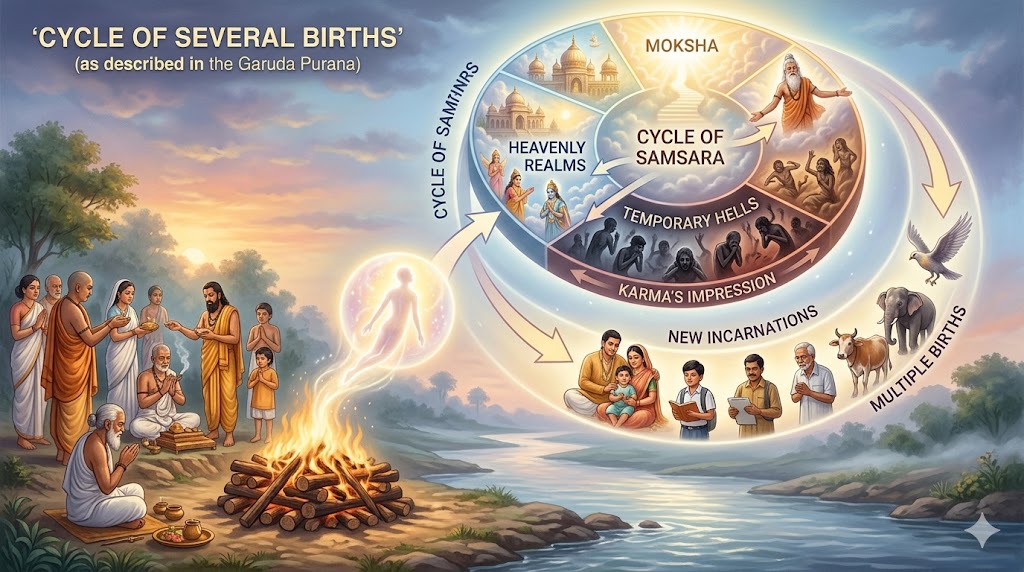
: A conceptual illustration of the soul’s journey through multiple births as detailed in the Garuda Purana.
The Cycle of Several Births: Samsara and Reincarnation
One of the most profound contributions of the Garuda Purana is its detailed explanation of the cycle of several births, known as samsara. The text makes it clear that death is not the end but a transition to another form of existence. The soul, being eternal, takes on new bodies repeatedly based on the balance of its karma accumulated across lifetimes.
According to the Purana, after the soul completes its time in Yamaloka or temporary heavens and hells, it is reborn in a new physical form. The nature of this rebirth — whether as a human, animal, plant, or even in higher or lower realms — depends entirely on past actions. Virtuous deeds may lead to birth in prosperous families, with good health and opportunities for spiritual growth. Conversely, negative karma can result in births filled with hardship, disease, or lower species where spiritual progress is slower.
The Garuda Purana describes how the soul carries subtle impressions (samskaras) from previous births. These impressions influence personality traits, inclinations, and life circumstances in the new incarnation. This concept underscores the importance of several births: each life offers a fresh opportunity to resolve karmic debts, learn lessons, and move closer to liberation. It also explains seemingly unexplained events in life — sudden fortunes, inexplicable sufferings, or innate talents — as outcomes of actions from prior existences.
The text highlights that human birth is particularly precious because it provides the intellect and free will necessary for conscious spiritual evolution. Wasting this rare opportunity through ignorance or indulgence prolongs the cycle of rebirths, subjecting the soul to repeated rounds of joy and sorrow.
The Moment of Death and Departure of the Soul
According to the Garuda Purana, death occurs when the soul separates from the physical body due to the exhaustion of prarabdha karma. The process involves the gradual withdrawal of vital energies. The soul, accompanied by its subtle body (consisting of mind, intellect, and senses), experiences a transition that can be disorienting.
The text describes specific rituals to be performed immediately after death to ease this transition. These include placing the body on the ground, using sacred items like tulsi leaves, gold pieces in the body’s orifices, and śālagrāma stone. The body is carried out through the back door and cremated with the head facing north. Such practices are believed to help the soul detach peacefully and prevent it from lingering as a preta (restless spirit).
The soul is said to hover near its former home for some time, observing the mourning and rituals performed by relatives. It feels hunger, thirst, and emotions until the appropriate offerings sustain its subtle form.
The Journey of the Soul: From Preta to Pitru
The Garuda Purana outlines the soul’s path after cremation. For the first thirteen days, the departed is considered a preta. Family members offer pindas (rice balls) daily to help form a new subtle body for the soul’s journey. These offerings, along with water libations (tarpana), provide nourishment and reduce the soul’s suffering.
On the thirteenth day, the sapindikarana ritual integrates the soul with the ancestors (pitrus). This marks the transition from preta to pitru status. The soul then proceeds toward Yamaloka, the realm of Yama, the god of death. Messengers of Yama (yamadutas) guide virtuous souls gently, while they drag sinners harshly based on their deeds.
The journey involves crossing the terrifying Vaitarani River, filled with blood and impurities, which can only be navigated with the help of merits earned through charity and rituals performed on earth.
Hells and Punishments in the Garuda Purana
One of the most vivid sections of the Pretakhanda describes various narakas or hells, each designed for specific sins. These are temporary realms of intense suffering meant to purify the soul rather than eternal damnation. The experiences in these hells further shape the quality of future births once the karmic sentence is served.
The text details the torments in graphic terms to serve as moral warnings. However, it also notes that good deeds, prayers, and shraddha performed by descendants can alleviate or shorten these sufferings, thereby improving conditions in subsequent births.
Heavens, Rebirth, and the Path to Moksha
Virtuous souls, after judgment by Yama, proceed to svarga (heaven) for enjoyment of merits. These realms offer pleasures but are temporary, as karma eventually exhausts and leads to rebirth in the cycle of several births.
The Garuda Purana discusses the cycle of reincarnation in depth, where the soul takes new bodies based on residual karma. It highlights auspicious death circumstances — such as dying in sacred places like Varanasi or during holy periods — that facilitate easier transitions or direct liberation, potentially ending the chain of multiple births.
Ultimately, the highest goal is moksha — freedom from the cycle of birth and death. This is achieved through knowledge of the self (atman), devotion (bhakti), and realization of unity with the divine. The text affirms that sincere recitation and understanding of the Garuda Purana itself can bestow blessings and aid the soul’s progress toward breaking the wheel of samsara.
Importance of Understanding Several Births
The teachings on multiple births in the Garuda Purana carry deep practical importance. Recognizing the continuity of consciousness across lifetimes encourages individuals to live with greater responsibility and foresight. It fosters patience during difficulties, knowing they may be results of past actions, and motivates ethical conduct to secure better future births or ultimate freedom.
This perspective also promotes compassion toward all living beings, as any creature could be a soul connected through previous relationships. It discourages harm and cultivates virtues like charity, truthfulness, and non-violence, which generate positive karma for smoother journeys across births.
Furthermore, awareness of several births reduces the fear of death by framing it as a temporary phase in a longer spiritual evolution. It inspires seekers to pursue spiritual practices early in life rather than postponing them, maximizing the rare advantage of human incarnation.
Death Rituals and Their Significance
The Garuda Purana provides meticulous instructions on antyeshti (last rites) and subsequent ceremonies. Key elements include:
Daily pinda offerings for 13 days.
Use of sesame seeds, cow dung, and sacred herbs for purification.
Charity of cows, gold, and other items to generate merit transferable to the departed.
Observance of pollution periods and purification for relatives.
These rituals are not mere formalities but karmic aids that support the soul, reduce its debts, and improve conditions for its next birth or progress toward liberation. The text underscores the duty of sons and descendants in performing these rites diligently.
Broader Teachings and Relevance Today
Beyond death and rebirth, the Garuda Purana encourages a balanced life integrating dharma, artha, kama, and moksha. It promotes compassion, truthfulness, and devotion while warning against materialism and harm.
In contemporary times, its teachings on karma, multiple births, and the afterlife offer comfort amid grief, ethical guidance, and philosophical depth. Many families arrange recitations during mourning periods, finding solace in its explanations of life’s continuity and the opportunities presented across several births.
The scripture reminds readers that death is not an end but a transition, and that conscious living can transform the entire trajectory of the soul’s journey through samsara.
Challenges in Interpretation and Practice
While immensely valuable, some descriptions in the Garuda Purana are symbolic or contextual to its era. Modern interpreters emphasize its moral and spiritual essence over literal readings of torments. Scholars note variations across manuscripts, highlighting the living, adaptive nature of Puranic traditions.
It is advisable to approach the text under guidance from knowledgeable priests or scholars to appreciate its deeper meanings without undue fear, especially regarding concepts of multiple births and karmic consequences.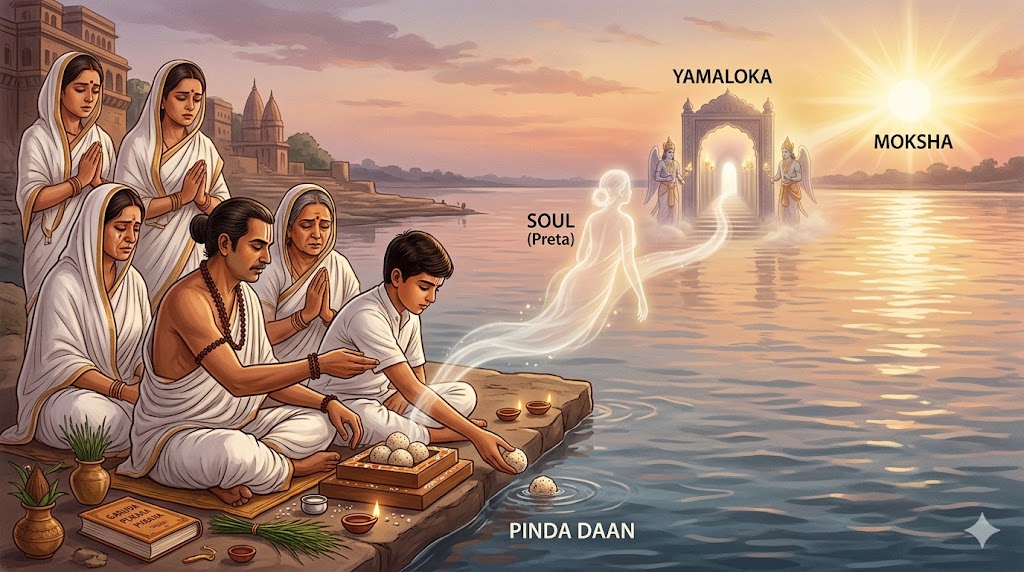
A scene depicting the performance of the critical 13-day Hindu death rituals. A son and a priest offer pinda (rice balls) by a sacred river
Conclusion: Timeless Wisdom for Life and Beyond
The Garuda Purana stands as a profound guide on the interconnected realities of karma, death, the afterlife, and the cycle of several births. Through its dialogue between Vishnu and Garuda, it illuminates the soul’s eternal journey and the importance of righteous living across lifetimes.
Its detailed accounts of rituals, hells, heavens, rebirths, and liberation continue to shape Hindu practices and beliefs. By studying and applying its teachings, one gains not only preparation for life’s inevitable end but also inspiration for a more meaningful existence and eventual freedom from samsara.
In an age often detached from spiritual perspectives on mortality and reincarnation, the Garuda Purana offers a compassionate framework that honors the departed, consoles the living, and points toward ultimate freedom. Its message remains clear: our actions in this birth shape destinies across many, and through knowledge, devotion, and dharma, the soul can transcend the cycle of repeated births and deaths.