Matsya Purana: Vishnu’s Fish Avatar and Ancient Wisdom
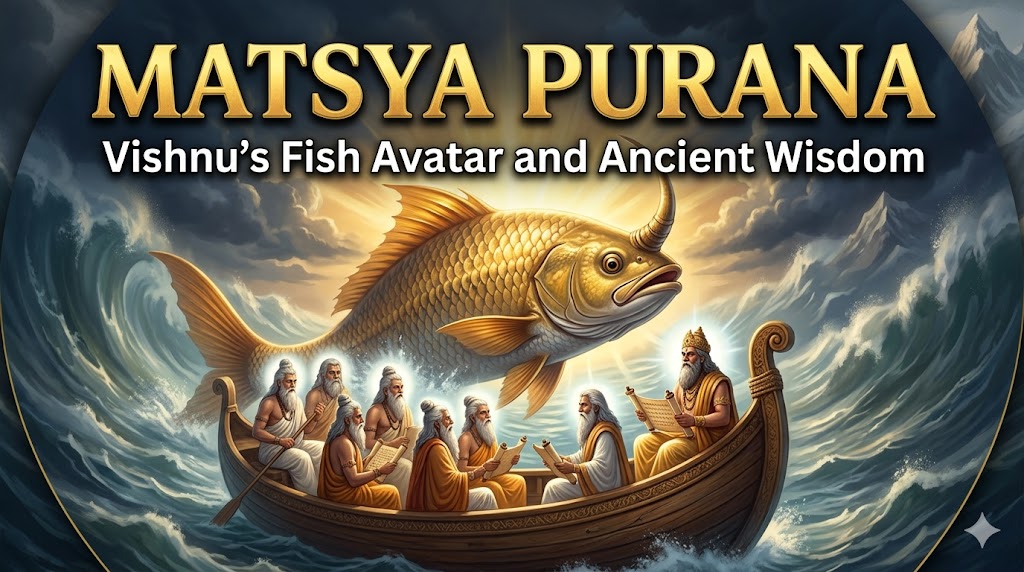
The Matsya Purana occupies a unique and foundational position among the eighteen Mahapuranas of Hinduism. As one of the oldest surviving Puranic texts, it is traditionally understood to have been narrated directly by Lord Vishnu in his first avatar as Matsya, the divine fish. This sacred scripture weaves together profound mythological narratives, cosmological insights, genealogical records, and practical guidance on dharma, temple construction, and righteous living.
At its core lies the dramatic story of the great deluge, where Vishnu assumes the form of a fish to save humanity’s progenitor, Manu, and preserve the Vedas from destruction. Beyond this central legend, the Matsya Purana offers a comprehensive worldview that has influenced Hindu thought, art, and culture for centuries. This article provides a detailed exploration of its origins, key stories, philosophical teachings, and lasting relevance in contemporary times.
Historical and Literary Context of the Matsya Purana
Scholars generally date the Matsya Purana to the early centuries of the Common Era, with some portions possibly tracing back even earlier. Like other Puranas, it is attributed to the legendary sage Vyasa, though the text evolved through oral transmission and later compilations. It contains roughly 14,000 verses organized into chapters that blend narrative excellence with instructional content.
The Purana belongs to the Vaishnava tradition while showing respect to other deities, reflecting the inclusive nature of Hindu theology. Its style is both poetic and didactic, making complex philosophical concepts accessible through engaging stories. The Matsya Purana is particularly valued for its early references to temple architecture, iconography, and ritual practices that later shaped Hindu temple traditions across India.
The Divine Fish Avatar: Context and Purpose
According to Hindu cosmology, the universe undergoes cycles of creation, preservation, and dissolution. At the end of one such cycle, a great flood threatened to destroy all life. It was during this critical juncture that Lord Vishnu incarnated as Matsya to protect dharma and ensure the continuity of creation.
The incarnation was not merely an act of rescue but a profound demonstration of divine compassion and order. By appearing as a small fish that gradually grew into a mighty creature, Vishnu taught lessons about humility, gradual spiritual growth, and the importance of heeding divine warnings. This avatar established the precedent for Vishnu’s subsequent incarnations, each addressing specific challenges to cosmic balance.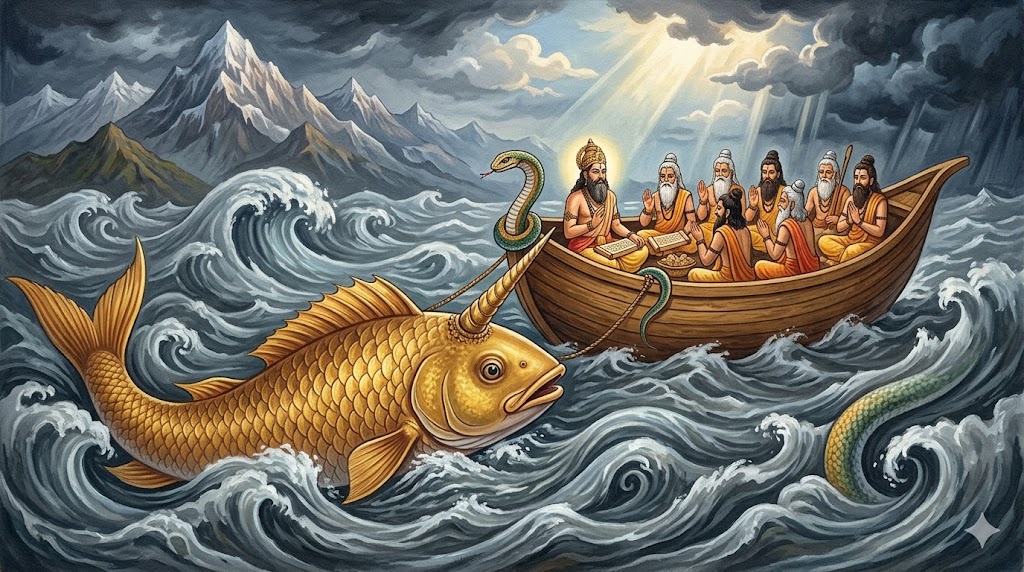
The Great Deluge Narrated in the Matsya Purana
The Story of King Manu and the Great Flood
The central narrative of the Matsya Purana revolves around Satyavrata, also known as Manu, the righteous king and progenitor of humanity in the current cycle. One day, while performing his morning ablutions in a river, Manu discovered a small, shining fish that begged for protection from larger predators.
Moved by compassion, Manu placed the fish in a jar, then a tank, and eventually a river as it continued to grow at an astonishing rate. Eventually, the fish revealed its true identity as Lord Vishnu and warned Manu of the impending cosmic flood that would submerge the earth.
Vishnu instructed Manu to build a sturdy boat and gather the seeds of all living creatures, along with the Saptarishis (seven sages) and the Vedas. When the deluge arrived, the giant Matsya avatar appeared with a horn on its head. Manu tethered his boat to the horn using the divine serpent Vasuki as a rope, and the fish guided the vessel safely through the turbulent waters to the highest peak of the Himalayas.
After the waters receded, Manu performed sacrifices and repopulated the earth, thus ensuring the continuation of human civilization and sacred knowledge. This powerful story symbolizes divine intervention, the cyclical nature of time, and the preservation of dharma amid chaos.
Preservation of the Vedas and Sacred Knowledge
A particularly significant aspect highlighted in the Matsya Purana is the rescue of the Vedas from the floodwaters. The demon Hayagriva had stolen the sacred texts, threatening the very foundation of cosmic order. Vishnu, in his Matsya form, not only saved Manu but also slayed the demon and restored the Vedas.
This episode underscores the Purana’s emphasis on knowledge as the bedrock of civilization. The text itself serves as a repository of ancient wisdom, preserving genealogies of kings and sages, details of yugas (cosmic ages), and guidelines for virtuous living that continue to guide devotees today.
Cosmology and Creation Myths
The Matsya Purana provides detailed accounts of the universe’s creation, the structure of the cosmos, and the roles of various deities. It describes the emergence of Brahma from the lotus navel of Vishnu and the subsequent creation of the worlds. These cosmological sections integrate scientific-like observations of the time with spiritual interpretations, offering readers a holistic understanding of existence.
Discussions on the nature of time, the fourteen worlds (lokas), and the cycles of creation and dissolution enrich the text’s philosophical depth. These elements connect the Matsya avatar story to broader Hindu metaphysical concepts.
Temple Architecture and Iconography
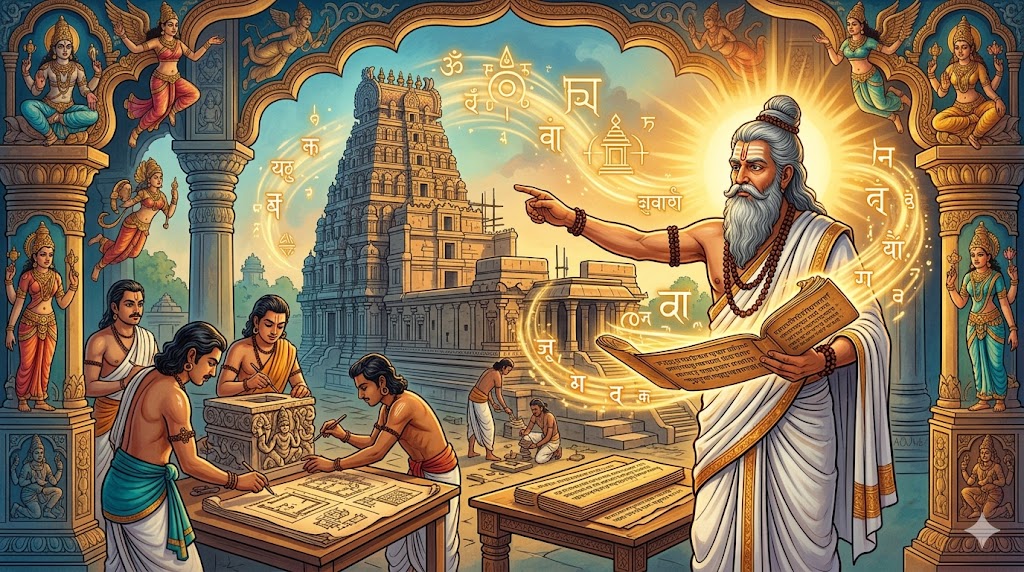
One of the most practical contributions of the Matsya Purana lies in its chapters on temple construction, known as Vastu Shastra and Shilpa Shastra. It provides guidelines for building temples, selecting sites, creating deity images, and performing installation rituals. These instructions influenced temple architecture across India, from ancient stone carvings to grand Dravidian and Nagara styles.
The Purana describes proportions, materials, and symbolic elements that ensure temples become proper abodes for the divine. Such details make the text invaluable for architects, sculptors, and priests even in modern times.
Teachings on Dharma, Ethics, and Devotion
Beyond mythology and technical knowledge, the Matsya Purana emphasizes the core values of Hindu dharma. It promotes truthfulness, charity, non-violence, and devotion to God as essential qualities for a fulfilling life. Stories within the text illustrate consequences of adharma and rewards of righteous conduct.
The Purana also discusses varnashrama dharma (social duties according to stages of life) and the importance of performing one’s responsibilities with sincerity. Bhakti (devotion) is presented as an accessible path to salvation, particularly suited for the current age.
Pilgrimage Sites and Sacred Geography
Like many Puranas, the Matsya Purana glorifies numerous tirthas (pilgrimage sites) across the Indian subcontinent. It describes the spiritual merits of visiting holy rivers, mountains, and temples, encouraging devotees to undertake pilgrimages as acts of purification and devotion. These sections function as ancient travel guides, linking physical journeys with spiritual transformation.
Festivals and Ritual Practices
The text outlines various festivals, vratas (observances), and rituals dedicated to Vishnu and other deities. It explains the significance of offerings, mantras, and ceremonies that strengthen the bond between devotees and the divine. Many of these practices continue in Hindu households and temples today.
Literary Style and Structure
The Matsya Purana is organized into chapters that flow logically from cosmology to specific avatar stories, genealogies, and practical instructions. Its narrative style is vivid and engaging, using dialogue and descriptive passages to bring ancient events to life. This accessibility has contributed to its enduring popularity among scholars and general readers alike.
Relevance in Contemporary Times
In the modern world, the Matsya Purana offers valuable perspectives on environmental stewardship, the preservation of knowledge, and ethical leadership. The flood narrative resonates with contemporary discussions on climate change and natural disasters, reminding humanity of the need for humility before nature’s power and respect for divine cosmic order.
Its teachings on balanced living and devotion provide spiritual solace amid technological advancement and material pursuits. The detailed architectural guidelines continue to inspire temple construction and heritage conservation projects globally.
Comparative Perspective with Other Puranas
While sharing common themes with texts like the Bhagavata Purana and Vishnu Purana, the Matsya Purana stands out for its detailed treatment of the fish avatar and practical sections on temple building. Its relatively early composition makes it an important source for understanding the development of Puranic literature and Vaishnava traditions.
Transmission of Vastu Shastra Teachings
Conclusion
The Matsya Purana, narrated by Lord Vishnu in his glorious fish incarnation, remains a timeless repository of Hindu wisdom, mythology, and practical knowledge. Through the inspiring story of Manu’s salvation and the preservation of dharma during the great flood, it teaches profound lessons about divine protection, resilience, and the cyclical nature of existence.
Its comprehensive coverage of cosmology, ethics, temple architecture, and pilgrimage continues to guide spiritual seekers and cultural practitioners. As devotees recite its verses and reflect on its teachings, the Matsya Purana reinforces faith in the eternal principles of truth, devotion, and cosmic harmony.
In an ever-changing world, this ancient scripture offers enduring guidance, reminding us that even in the face of overwhelming challenges, divine grace and righteous action ultimately prevail. The wisdom contained within its pages continues to illuminate the path for millions, bridging ancient tradition with contemporary spiritual aspirations.