Mahavir Swami: The Light of Ahimsa and Eternal Dharma
News• March 31, 2026• Global Edition
THE LORD MAHAVIR SWAMI: The spiritual landscape of India has always been a fertile ground for the birth of great souls who have redirected the course of human history. Among these luminaries, Lord Mahavir, the 24th Tirthankara of Jainism, stands as a colossus of compassion and wisdom. Born in 599 BCE as Prince Vardhaman in Kundagrama, Bihar, his life was a journey from the opulence of a palace to the profound silence of spiritual realization. Today, as we celebrate Mahavir Jayanti 2026 on March 31, his message of Ahimsa (non-violence) and Anekantavada (multiplicity of viewpoints) resonates more powerfully than ever in a world seeking balance and responsibility.
While Jainism and Hinduism are distinct philosophical streams, they are inextricably linked by the concept of Dharma. In the Indian context, Dharma is the "Rta" or the cosmic order that sustains the universe. Mahavir Swami’s teachings provided a specialized lens through which to view this order.
He shared the Hindu concepts of Karma and Moksha, yet he introduced a rigorous ethical framework that democratized spirituality. He taught that divinity is not a distant favor granted by a creator, but an inherent quality within every soul (Atman) that can be realized through self-effort. This synergy created a "Dharma Policy" in ancient India that emphasized social non-violence and the rejection of animal sacrifices, a shift that eventually influenced mainstream Hindu practices and vegetarianism across the subcontinent.
The Early Life and Renunciation of Vardhaman
Lord Mahavir was born into the Ikshvaku dynasty, the same lineage associated with Lord Rama in Hinduism, highlighting the deep-rooted cultural and spiritual synergy between different strands of Indian thought. Despite being a prince, the call of the soul was louder than the allure of the throne. At the age of 30, following the death of his parents, he renounced his kingdom, family, and even his clothes to embark on a path of intense asceticism.
For twelve and a half years, he practiced rigorous meditation and silence, enduring hardships that would break an ordinary man. He conquered his senses, earning him the title "Mahavir" (the Great Warrior). This victory was not over external enemies but over the "internal enemies"—anger, ego, greed, and attachment.
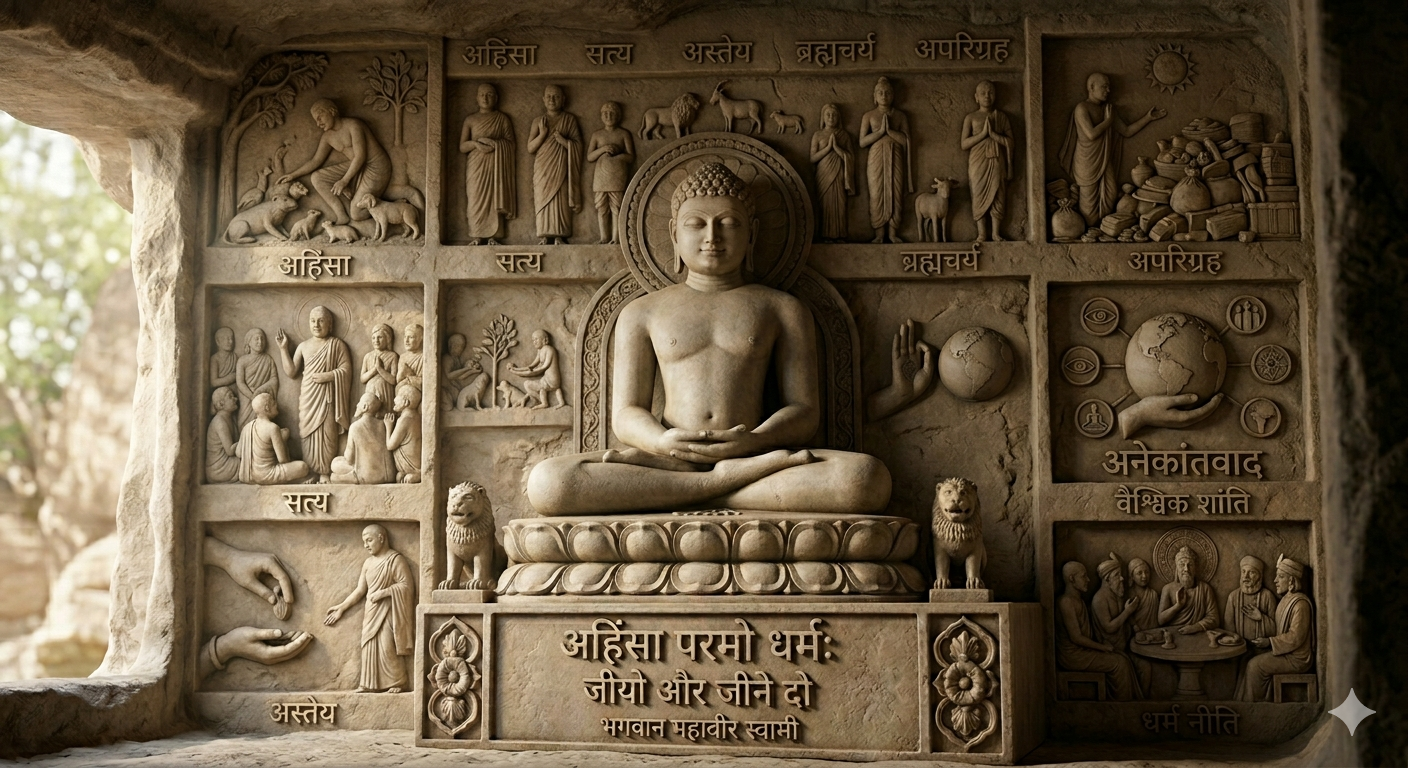
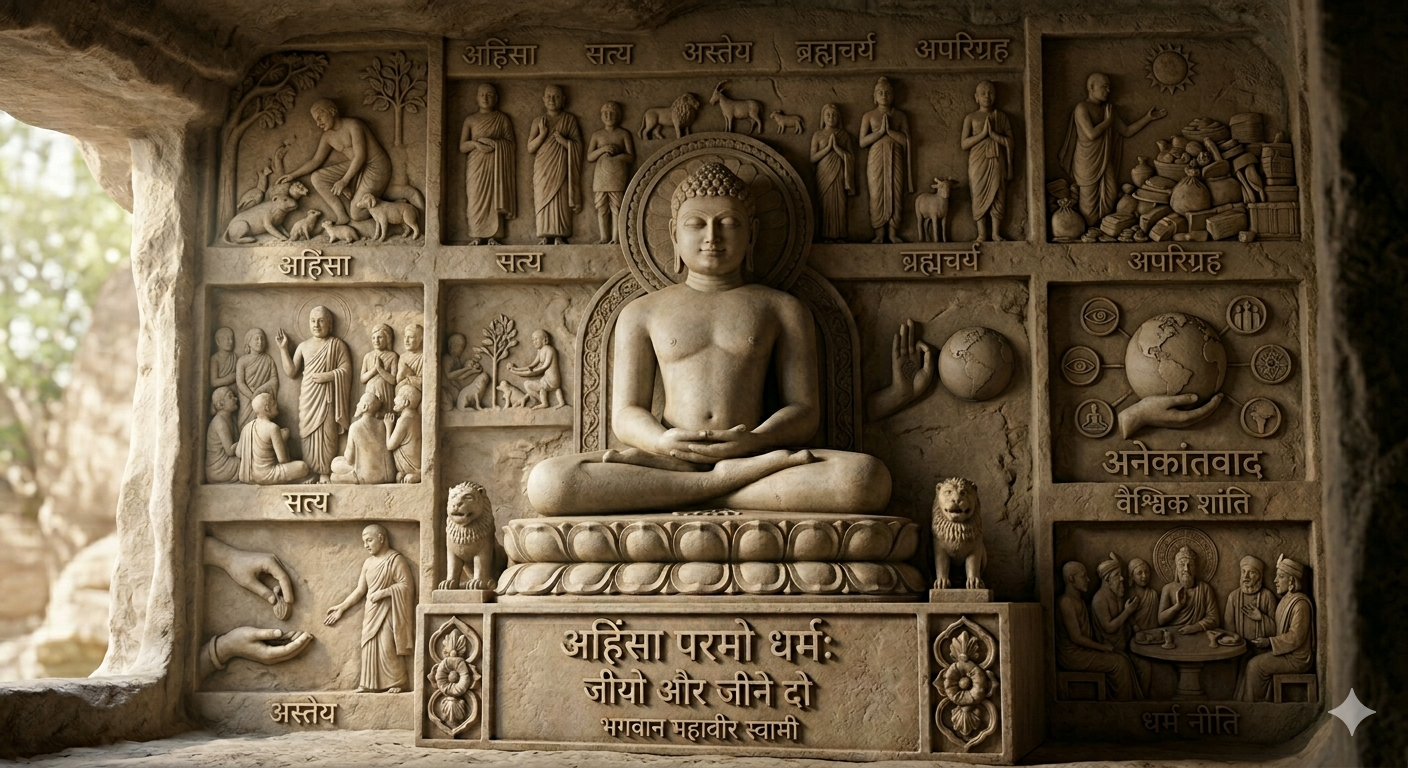
Visualizing the Universal School of Dharma: Mahavir Swami’s Living Principles
The Global Propagation: From Bihar to the World Stage
The journey of Mahavir Swami’s teachings from a localized ascetic tradition to a global ethical framework is a testament to the universal nature of his message.
1. The Historical Footprint
The propagation began with the establishment of the Chaturvidha Sangha (the four-fold order). Historical records suggest that the seeds of Jain thought traveled via the Silk Road to regions as far as Afghanistan, Iran, and Greece as early as the 8th century BCE. The southern expansion took these principles to Sri Lanka, where Jainism flourished long before the medieval era.
2. The 1893 Chicago Breakthrough
The modern global "re-introduction" occurred at the 1893 Parliament of the World's Religions. Virachand Gandhi, a brilliant disciple, represented Jainism, fascinating Western thinkers with the logic of Anekantavada. This laid the groundwork for the first Jain libraries and centers in the United Kingdom and the United States.
3. The Power of the Diaspora
Today, the propagation is fueled by a vibrant diaspora. North America is home to over 100 Jain centers, while communities in Kenya, Singapore, and the UK have integrated Mahavir’s ethical business practices into local economies, emphasizing integrity and social welfare.
4. Influencing Global Icons
Mahatma Gandhi’s strategy of Satyagraha was deeply shaped by Jain teachings. This thread of non-violence was later picked up by Martin Luther King Jr., moving Mahavir’s ancient Indian wisdom into the heart of the American Civil Rights Movement.
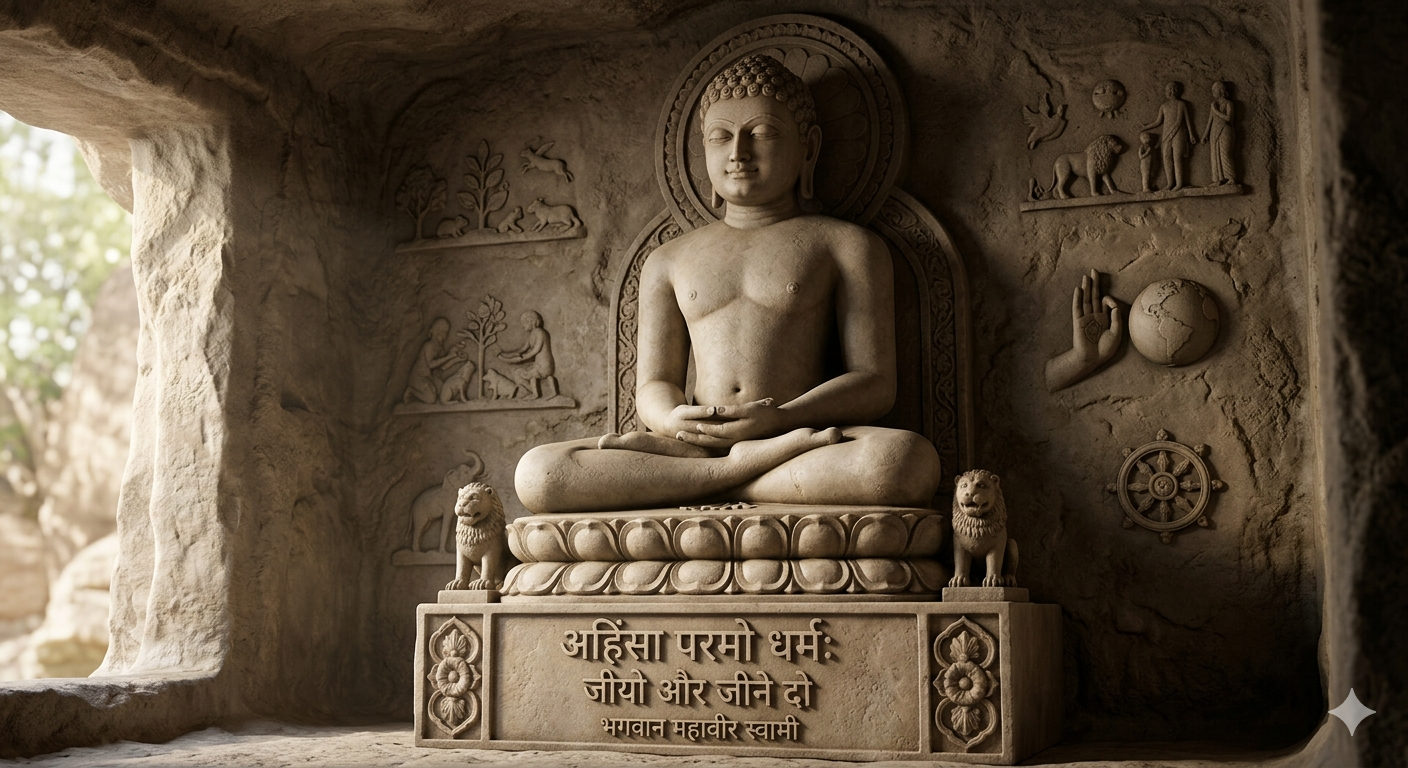
A Symbol of Eternal Peace: Lord Mahavir in Deep Contemplation
The Core Principles: Five Great Vows
Mahavir Swami did not just preach; he lived a philosophy that provided a roadmap for ethical living. These are distilled into the Pancha Mahavratas (Five Great Vows):
Ahimsa (Non-violence): The supreme duty. It is not merely the absence of physical harm but the active practice of compassion in thought, word, and deed.
Satya (Truthfulness): Speaking the truth that is beneficial and harmless.
Asteya (Non-stealing): Not taking anything that is not given freely.
Brahmacharya (Chastity): Control over sensual desires.
Aparigraha (Non-attachment): Limiting one's possessions to avoid the trap of materialism.
Mahavir Swami and the Fabric of Indian Dharma
In the Indian context, "Dharma" is not just religion; it is the "law of being" or the "right path." Mahavir Swami’s teachings were revolutionary because they emphasized that Dharma is accessible to everyone, regardless of caste or gender. He challenged the rigid rituals of the time and replaced them with internal purification.
His relationship with Hinduism is one of profound mutual influence. While Jainism maintained a distinct philosophical identity (especially regarding the concept of a creator God), it shared the foundational Indian values of Karma, Samsara (the cycle of birth and death), and Moksha (liberation). Many of Mahavir’s principles, like vegetarianism and the sanctity of all life, became deeply embedded in the broader Hindu social fabric, illustrating a shared "Dharma Policy" aimed at social harmony and spiritual growth.
Ahimsa: A Global Lesson in Responsibility
The concept of Ahimsa Paramo Dharma (Non-violence is the supreme religion) is Mahavir’s greatest gift to the world. He taught that every living being—from the smallest microorganism to the largest mammal—possesses a soul that is equal in potential.
In the modern era, this translates into a profound sense of Global Responsibility. If we view all life as an extension of ourselves, we cannot justify war, environmental destruction, or the exploitation of others. Mahavir taught that violence begins in the mind; therefore, peace must also begin there. His teaching of Anekantavada is equally crucial today—it is the philosophy of intellectual non-violence, encouraging us to respect the truths held by others, fostering tolerance in a polarized world.
Why We Celebrate Mahavir Jayanti
Mahavir Jayanti is more than a religious ritual; it is a day of introspection. It is a time to ask ourselves: Are we living responsibly? Are we contributing to the peace of the world? In India, the day is marked by Rath Yatra (chariot processions), the singing of Mahavir Jayanti Bhajans, and acts of charity. Devotees visit temples to reflect on his life and take vows to reduce their ecological footprint, embodying the principle of Live and Let Live.
Legacy and Modern Relevance
Lord Mahavir’s influence is visible in the movements led by Mahatma Gandhi and the global shift toward sustainable living and animal rights. His life teaches us that true power lies in self-control, and true wealth lies in detachment.
As we share Mahavir Jayanti status updates and watch Mahavir Jayanti shorts on social media today, let us not forget the depth behind the digital celebrations. The real tribute to Mahavir Swami is to integrate even a fraction of his compassion into our daily lives. By practicing truth, avoiding greed, and respecting all forms of life, we honor the legacy of the man who showed us that the soul is its own greatest friend—or its own greatest enemy.
Frequently Asked Questions
What is the primary significance of Mahavir Swami: The Light of Ahimsa and Eternal Dharma?
THE LORD MAHAVIR SWAMI: The spiritual landscape of India has always been a fertile ground for the birth of great souls who have redirected the course of human history. Among these luminaries, Lord Mahavir, the 24th Tirthankara of Jainism, stands as a colossus of compassion and wisdom.
How does this development impact News?
Born in 599 BCE as Prince Vardhaman in Kundagrama, Bihar, his life was a journey from the opulence of a palace to the profound silence of spiritual realization. Today, as we celebrate Mahavir Jayanti 2026 on March 31, his message of Ahimsa (non-violence) and Anekantavada (multiplicity of viewpoints) resonates more powerfully than ever in a world seeking balance and responsibility.The Synthesis of Jainism and Hindu DharmaWhile Jainism and Hinduism are distinct philosophical streams, they are inextricably linked by the concept of Dharma.
What are the key future projections to monitor?
In the Indian context, Dharma is the "Rta" or the cosmic order that sustains the universe.