Green Hydrogen Policies 2026: Maharashtra and Gujarat
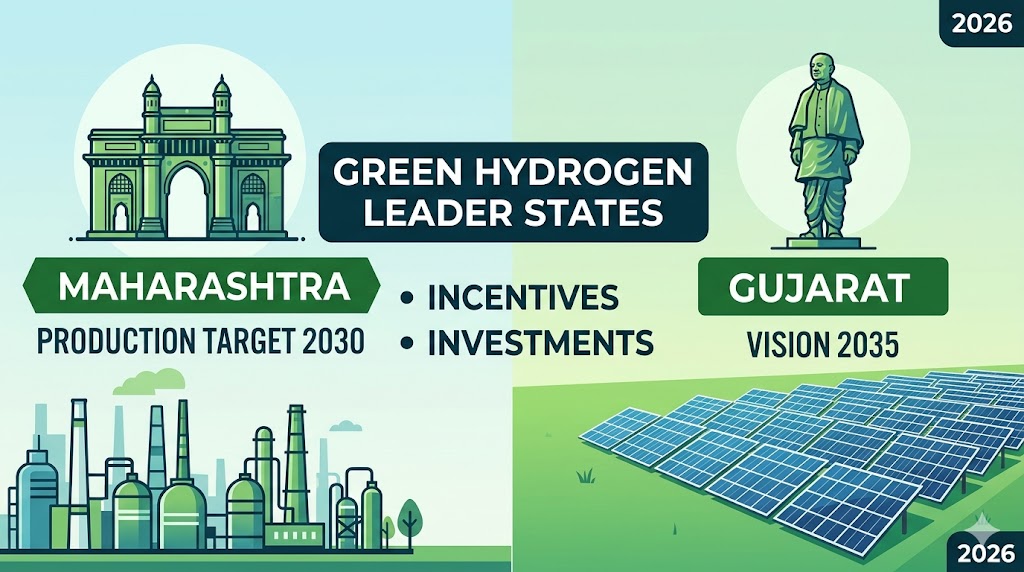
As India accelerates its journey toward net-zero emissions, green hydrogen has emerged as a cornerstone of the country’s clean energy strategy. In 2026, two leading states—Maharashtra and Gujarat—stand out for their proactive and comprehensive policies that are shaping the national green hydrogen ecosystem. Maharashtra’s pioneering Maha Green Hydrogen Policy and Gujarat’s ambitious Green Hydrogen Policy 2025 are not only attracting massive investments but also positioning these states as critical hubs for production, innovation, and export.
These state-level initiatives complement the National Green Hydrogen Mission and address the dual challenges of industrial decarbonization and energy security. This article provides a detailed examination of both policies, their objectives, incentives, implementation progress in 2026, challenges, and the broader implications for India’s energy transition.
National Context: India’s Green Hydrogen Ambitions
India’s National Green Hydrogen Mission, launched in 2023, sets ambitious targets including 5 million metric tonnes per annum (MMTPA) of green hydrogen production by 2030. The mission emphasizes electrolysis powered by renewable energy, with significant financial support through the Strategic Interventions for Green Hydrogen Transition (SIGHT) programme.
State policies play a vital role in translating national goals into actionable outcomes. Maharashtra and Gujarat, with their strong industrial bases, renewable energy potential, and port infrastructure, are at the forefront. Their policies focus on the entire value chain—from renewable energy generation and electrolyser manufacturing to storage, transportation, and end-use applications in fertilizers, refining, steel, and mobility.
Maharashtra Green Hydrogen Policy: Pioneering State Leadership
Maharashtra became the first state in India to notify a dedicated green hydrogen policy in July 2023. The
Maharashtra Harit Hydrogen Policy aims to establish the state as a national leader with a production target of 500 kilotonnes per annum (KTPA) by 2030. This policy reflects the state’s commitment to decarbonizing its robust industrial sector while leveraging its significant renewable energy capacity.
Key objectives include promoting green hydrogen and its derivatives for domestic use and export, fostering research and innovation, and creating employment opportunities. The policy received substantial budgetary support, with an outlay of approximately ₹8,562 crore for implementation.
Incentives under the policy are attractive:
Capital cost subsidy of up to 30% for the first few anchor projects (capped at ₹50 crore).
Support for hydrogen-based fuel cell vehicles.
Waivers and concessions on electricity charges, open access, and transmission for renewable energy used in green hydrogen production.
Land facilitation and infrastructure support.
By early 2026, the policy has already yielded results. In January 2024, the state signed MoUs worth ₹2.76 lakh crore with major players including NTPC Green Energy, JSW, L&T, and Renew E-Fuels, targeting over 910 KTPA capacity and creating around 64,000 jobs. Early projects, such as the Hygenco facility in Chhatrapati Sambhaji Nagar, are supplying green hydrogen to industrial users.
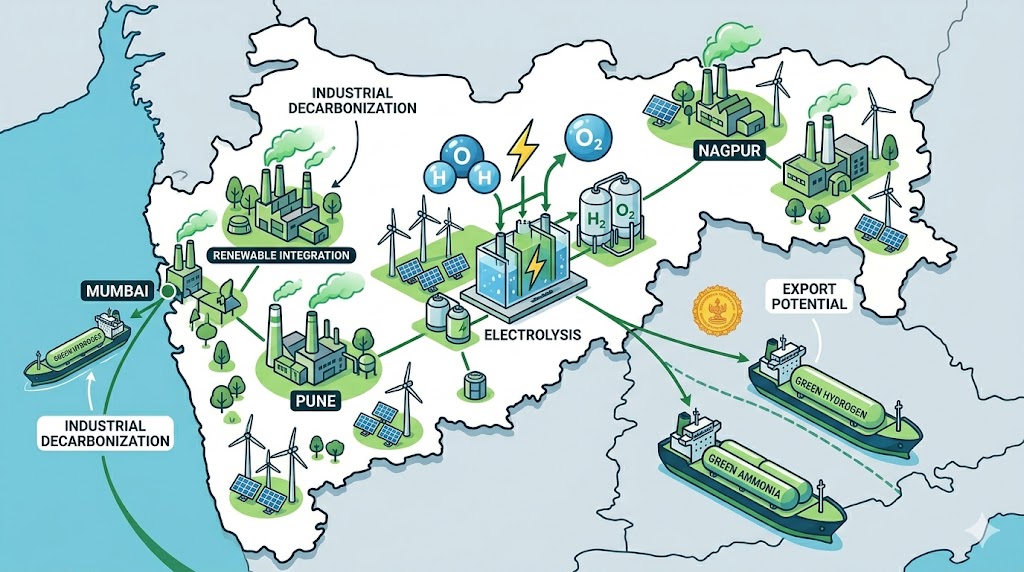
Maharashtra's Industrial Decarbonization
Gujarat Green Hydrogen Policy 2025: Ambitious Scale and Vision
Gujarat unveiled its comprehensive Green Hydrogen Policy 2025, which builds on the state’s renewable energy strengths and industrial ecosystem. The policy, effective until December 2035, targets an impressive 3 MMTPA of green hydrogen production capacity by 2035, supported by 30 GW of electrolyser capacity and 75 GW of dedicated renewable energy.
The policy aims to attract investments of around ₹5 lakh crore, generate approximately 600,000 direct and indirect green jobs, reduce natural gas consumption by 2 MMTPA, and cut CO₂ emissions by about 5 MMTPA. It covers both electrolysis and biomass-based routes for green hydrogen production.
Notable incentives include:
Capital expenditure subsidy of 20% for electrolysers (up to ₹1 crore per MW).
Support for renewable energy, storage, and infrastructure development.
Land allocation policies, including leasing of government waste land.
Incentives for green hydrogen derivatives such as green ammonia and green methanol.
Facilitation for export-oriented projects through the state’s extensive port network.
In 2026, Gujarat is actively developing green hydrogen hubs in regions like Kutch, Jamnagar, and Banaskantha, leveraging its port infrastructure for potential exports.
Comparative Analysis: Maharashtra vs Gujarat Approaches
While both states share common goals, their approaches reflect local strengths. Maharashtra emphasizes industrial decarbonization and early-mover incentives, capitalizing on its manufacturing base and proximity to demand centers. Gujarat adopts a larger-scale, export-oriented strategy supported by abundant renewable resources and port advantages.
Maharashtra’s shorter-term target (500 KTPA by 2030) focuses on rapid demonstration projects, whereas Gujarat’s longer horizon (3 MMTPA by 2035) allows for ecosystem-wide development including large electrolyser manufacturing and derivative production. Both policies offer capital subsidies, power concessions, and land support, but Gujarat’s framework includes more detailed provisions for job creation and emission reduction tracking.
Implementation Progress and Key Projects in 2026
As of mid-2026, implementation is gaining momentum in both states. Maharashtra has seen commissioning of pilot facilities and advancement of several MoU-linked projects. Gujarat is focusing on detailed project reports, land allocation, and partnerships for integrated renewable-hydrogen complexes.
Challenges during implementation include high initial costs of electrolysers, renewable energy intermittency, water availability for electrolysis, and development of hydrogen storage and transportation infrastructure. Both states are addressing these through public-private partnerships, technology collaborations, and alignment with national schemes.
Economic and Environmental Impacts
The Green Hydrogen Policy 2026 initiatives in Maharashtra and Gujarat promise substantial economic benefits. Combined, they are expected to attract hundreds of thousands of crores in investments, create high-skilled green jobs, and boost ancillary sectors such as renewable equipment manufacturing and logistics.
Environmentally, these policies support India’s decarbonization goals by replacing grey hydrogen in fertilizers and refining, enabling low-carbon steel production, and facilitating cleaner mobility solutions. Long-term, they contribute to improved air quality and energy independence by reducing reliance on imported fossil fuels.
Challenges and the Road Ahead
Despite strong policy frameworks, several hurdles remain. Green hydrogen production costs must decline further to achieve parity with grey hydrogen. Supply chain development for electrolysers, skilled workforce availability, and safety standards for hydrogen handling require focused attention.
Looking forward, both states are expected to refine their policies based on early learnings. Greater inter-state collaboration, technology transfer, and integration with national infrastructure projects like hydrogen corridors will be crucial for scaling up.
Role in National Green Hydrogen Ecosystem
Maharashtra and Gujarat together represent a significant portion of India’s green hydrogen potential. Their success will serve as a blueprint for other states while strengthening India’s position in the global clean energy transition. International partnerships, export opportunities, and participation in global value chains for green ammonia and derivatives will further enhance outcomes.
Future Outlook Beyond 2026
By the end of the decade, these policies could position western India as a global green hydrogen powerhouse. Continued policy stability, technological advancements, and declining renewable energy costs will be key enablers. As production scales, focus will shift toward demand creation, infrastructure build-out, and international trade.
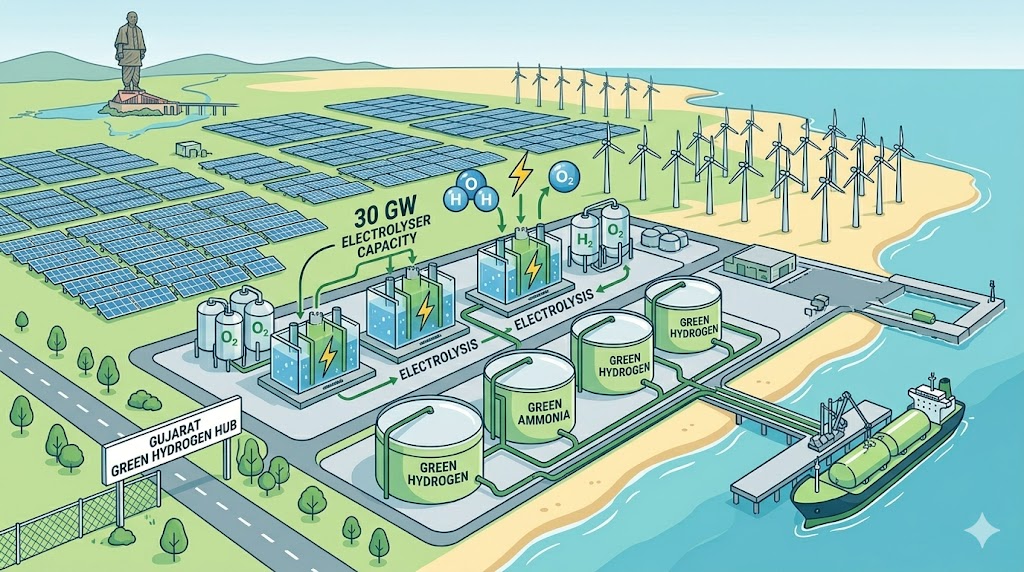
Gujarat's Massive-Scale Export Vision
Conclusion
The Green Hydrogen Policy 2026 frameworks in Maharashtra and Gujarat exemplify visionary state-level action in support of India’s energy transition. Through targeted incentives, ambitious production goals, and comprehensive ecosystem development, these policies are catalyzing investments, innovation, and sustainable growth.
As implementation progresses, the combined efforts of these two states will play a pivotal role in realizing India’s green hydrogen ambitions, driving industrial competitiveness, and contributing meaningfully to global climate goals. Stakeholders across industry, government, and academia must continue collaborating to overcome challenges and unlock the full potential of this transformative sector.