IMF Global Economic Outlook 2026: Growth and Risks
As 2026 unfolds, the global economy finds itself navigating uncharted waters shaped by geopolitical upheaval and lingering structural challenges. The International Monetary Fund’s latest World Economic Outlook, released in April 2026 under the theme “Global Economy in the Shadow of War,” paints a picture of resilient yet fragile growth. In its reference forecast, which assumes a relatively limited Middle East conflict, the IMF projects global growth at 3.1 percent for 2026, down from earlier expectations, with a modest rebound to 3.2 percent in 2027.
This outlook reflects the significant headwinds from ongoing tensions, particularly in the Middle East, which have disrupted energy markets and heightened inflationary pressures. At the same time, underlying strengths such as technological advancements and policy adaptability provide some counterbalance. This comprehensive article delves into the IMF’s key projections, regional variations, major risks, policy implications, and long-term prospects, offering insights for businesses, policymakers, and individuals seeking to understand the economic landscape ahead.
Overview of the IMF World Economic Outlook April 2026
The IMF’s April 2026 World Economic Outlook marks a notable shift from previous updates. Prior to recent escalations, analysts anticipated a slight upward revision to global growth figures. However, the intensification of conflict introduced substantial disruptions, prompting a downward adjustment. The reference scenario assumes the conflict remains contained in duration and scope, with energy price shocks moderating by mid-2026.
Under this baseline, global output growth stands at 3.1 percent in 2026, a 0.2 percentage point downgrade from January projections. Headline inflation is expected to rise to 4.4 percent before easing to 3.7 percent in 2027. These figures remain below pre-pandemic averages, highlighting a period of subdued expansion amid heightened uncertainty.
The report emphasizes significant cross-country differences. Advanced economies are projected to grow at 1.8 percent, while emerging market and developing economies (EMDEs) are anticipated to expand by 3.9 percent. The latter group faces sharper impacts from commodity price volatility and tighter financial conditions.
Global Growth Projections for 2026 and 2027
The IMF’s reference forecast anticipates a deceleration from the estimated 3.4 percent growth in 2025. This moderation stems largely from supply shocks and reduced confidence rather than a outright collapse in demand. In 2027, growth edges up slightly to 3.2 percent as disruptions fade under the baseline assumptions.
Several factors support this outlook. Continued investment in artificial intelligence and digital technologies provides a productivity tailwind in many economies. Accommodative financial conditions in select regions and fiscal support also contribute positively. However, these are partially offset by higher energy costs, supply chain frictions, and cautious consumer and business spending.
The report contrasts the reference scenario with more adverse ones. In an adverse case involving prolonged disruptions, global growth could fall to 2.5 percent in 2026 with inflation climbing to 5.4 percent. A severe scenario, featuring extended energy market dislocations, points to growth near 2 percent and inflation exceeding 6 percent, raising the specter of stagflationary pressures.
Regional and Country-Specific Forecasts
Growth trajectories vary markedly across regions:
Advanced Economies: Overall expansion of 1.8 percent in 2026 reflects resilience in the United States, where growth is projected at 2.3 percent, supported by strong domestic demand and technology investment. Euro area economies face slower paces, with Germany at 0.8 percent, France at 0.9 percent, Italy at 0.5 percent, and Spain performing relatively better at 2.1 percent. The United Kingdom stands at 0.8 percent, while Japan is expected at 0.7 percent.
Emerging Markets and Developing Economies: This diverse group is forecast at 3.9 percent growth. China is projected to expand by 4.4 percent, facing challenges from property sector adjustments and external demand shifts. India remains a bright spot with 6.5 percent growth, driven by domestic reforms and services expansion. Other notable figures include Brazil at 1.9 percent, Mexico at 1.6 percent, Saudi Arabia at 3.1 percent, and Nigeria at 4.1 percent.
Regions closer to conflict zones or heavily dependent on energy imports experience more pronounced slowdowns. Commodity exporters may see some offset from higher prices, but importers face rising costs and currency pressures.
Inflation Dynamics and Monetary Policy Challenges
Global headline inflation is set to tick upward to 4.4 percent in 2026 due to energy and food price increases linked to Middle East developments. Core inflation may also face mild upward pressure as second-round effects emerge through wages and expectations.
Central banks face delicate trade-offs. In advanced economies with more anchored expectations, policymakers can afford measured responses. In many EMDEs, however, currency depreciation and imported inflation complicate the picture, potentially requiring tighter policy stances even as growth slows. The IMF stresses the importance of preserving credibility to avoid de-anchoring of expectations, which could exacerbate the outlook in adverse scenarios.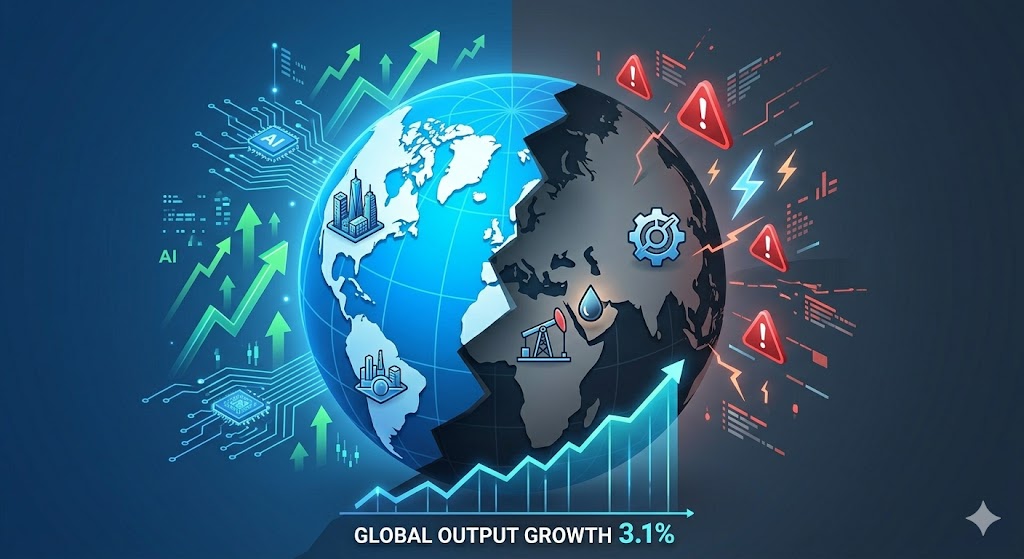
The 2026 economic landscape is defined by a sharp contrast: the 'Shadow of War' cast by Middle East conflicts and rising inflation is partially offset by the bright potential of AI-driven productivity and digital transformation. This visual represents the IMF's core theme of 'Global Economy in the Shadow of War,' where resilience meets significant fragility
Impact of Geopolitical Tensions and the Middle East Conflict
The April 2026 outlook is dominated by the ongoing conflict’s shadow. Disruptions to energy flows, including risks around critical chokepoints, have already influenced commodity markets. Even in the limited-conflict assumption, energy prices are expected to rise moderately, transmitting inflation and reducing real incomes globally.
Beyond direct energy effects, the report highlights broader channels: heightened uncertainty dampening investment, potential financial market volatility, and shifts in defense spending. Increased military outlays can provide short-term demand stimulus but risk crowding out productive investments and adding to fiscal pressures.
Trade fragmentation and renewed tensions add another layer of complexity, potentially slowing the flow of goods, capital, and technology across borders.
Role of Technology, AI, and Productivity Trends
One bright element in the IMF Global Economic Outlook 2026 is the potential from artificial intelligence and related technologies. Investment in these areas has provided resilience, and faster-than-expected productivity gains could offer upside surprises. However, the report cautions that realization of these benefits may take time and could be unevenly distributed, potentially exacerbating inequality if not accompanied by appropriate policies.
Disappointment in AI-driven productivity could trigger market corrections, representing a notable downside risk.
Fiscal Policy, Debt Sustainability, and Global Imbalances
Public debt levels remain elevated in many countries, with policy buffers eroded after successive shocks. The IMF urges rebuilding fiscal space where possible while protecting vulnerable populations. Scaling up defense expenditures requires careful management to avoid unsustainable trajectories or inflationary spillovers.
Global imbalances, including divergent growth paths and capital flows, could lead to exchange rate volatility and financial strains, particularly for economies with weaker fundamentals.
Risks and Uncertainties Surrounding the Outlook
Downside risks clearly predominate according to the IMF. These include:
Prolongation or expansion of conflict leading to major energy crises.
Deeper geopolitical fragmentation and trade barriers.
Financial market repricing amid tighter conditions.
Erosion of policy credibility and institutional trust.
Slower structural reforms hindering long-term potential.
Upside possibilities exist, such as quicker resolution of tensions, stronger AI productivity effects, or successful multilateral cooperation. However, the balance tilts toward caution.
Policy Recommendations from the IMF
The report emphasizes agile, credible, and cooperative policymaking. Central banks should remain data-dependent and communicate clearly. Fiscal authorities need to prioritize sustainable spending and revenue measures. Structural reforms in labor markets, education, and green transitions are vital for raising potential growth.
International cooperation remains essential for managing shared challenges like energy security, trade rules, and debt relief for vulnerable nations. The IMF itself stands ready to support members through its lending facilities and technical assistance.
Sectoral and Industry Implications
Different sectors will experience the 2026 environment unevenly. Energy and defense-related industries may see gains, while import-dependent manufacturing and consumer discretionary sectors could face cost pressures. Technology and services, particularly digital and AI-driven, hold promise for resilience. Agriculture and food systems remain sensitive to commodity volatility and climate factors.
Businesses are advised to enhance supply chain diversification, manage inventory prudently, and invest in productivity-enhancing technologies.
Long-Term Outlook Beyond 2026
Looking further ahead, the IMF anticipates global growth stabilizing around 3.2-3.3 percent in the medium term—below historical averages. Achieving stronger, more inclusive, and sustainable expansion will require addressing longstanding issues such as climate change, demographic shifts, and inequality. Successful navigation of current challenges could lay foundations for a more robust recovery in the latter part of the decade.
Conclusion
The IMF Global Economic Outlook 2026 presents a sobering yet manageable assessment of the world economy operating under significant strain. With projected growth of 3.1 percent amid geopolitical shadows, rising but contained inflation, and divergent regional performances, the year ahead demands vigilance, adaptability, and cooperation.
While risks loom large, particularly from energy market disruptions and uncertainty, underlying strengths in technology, policy frameworks, and human ingenuity provide grounds for cautious optimism. Policymakers, businesses, and citizens alike must prioritize resilience and forward-looking strategies to not only weather the current challenges but emerge stronger.
As the situation evolves, regular monitoring of developments and flexibility in response will be crucial. The coming months will test the global community’s ability to balance immediate pressures with long-term goals, shaping the economic landscape for years to come.