Indian Renaissance: History, Cultural and Social Awakening
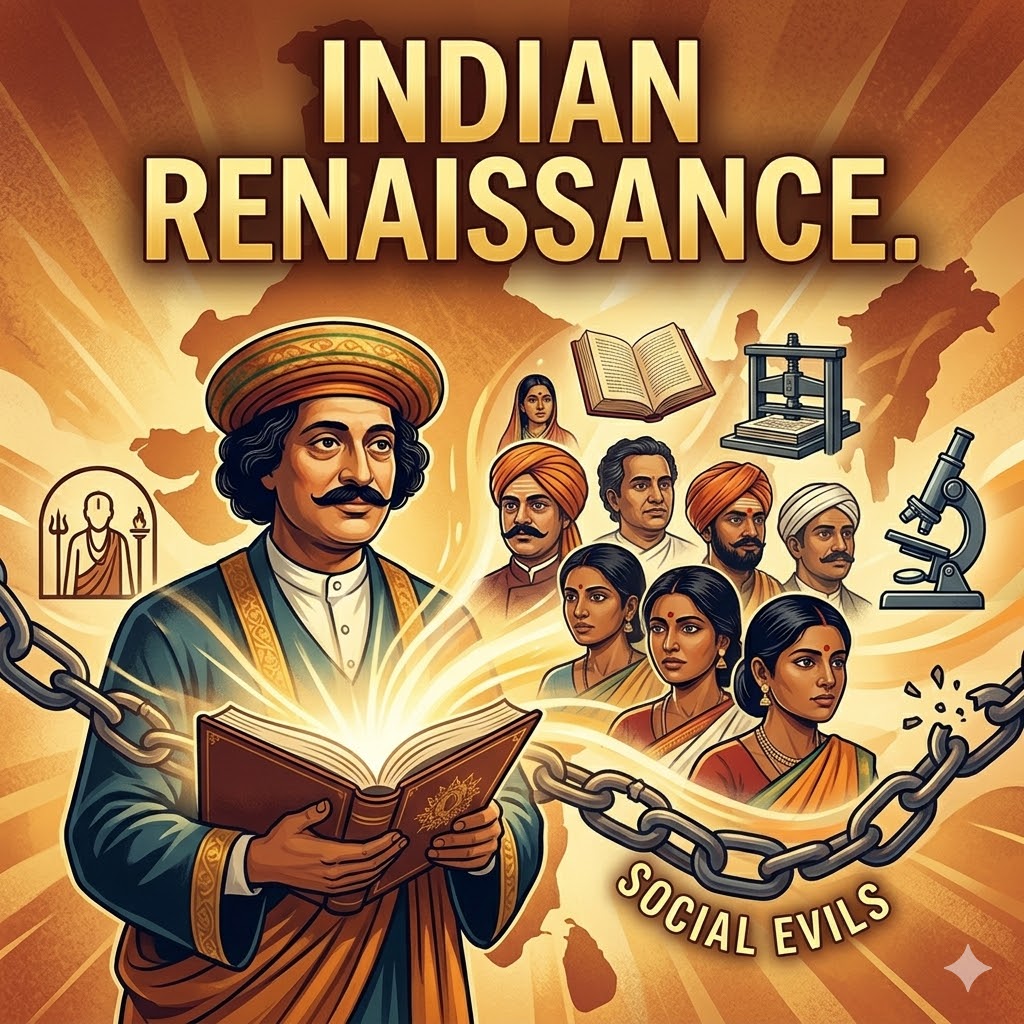
The Indian Renaissance represents one of the most transformative periods in modern Indian history. Emerging primarily in the 19th century, this cultural, intellectual, and social awakening breathed new life into Indian society after centuries of stagnation under colonial rule. Often compared to the European Renaissance for its emphasis on reason, reform, and cultural revival, the Indian Renaissance was uniquely rooted in India’s own spiritual and philosophical traditions while embracing select aspects of Western thought.
Centered initially in Bengal but spreading across the subcontinent, this movement laid the intellectual foundations for India’s freedom struggle and modern identity. It addressed pressing issues such as social evils, women’s rights, education, and religious orthodoxy, fostering a spirit of inquiry and reform. This article explores the origins, key figures, major achievements, and enduring legacy of the Indian Renaissance, offering a comprehensive understanding of its role in shaping contemporary India.
The roots of the Indian Renaissance can be traced to the early decades of British colonial consolidation in India. By the late 18th and early 19th centuries, the East India Company’s administrative control had brought exposure to Western education, science, and liberal ideas. This encounter created a new class of Indians educated in English who began critically examining their own society.
The Bengal region, particularly Calcutta (now Kolkata), became the epicenter due to its status as the capital of British India until 1911. Factors such as the spread of printing presses, growth of vernacular literature, and establishment of institutions like Hindu College in 1817 accelerated intellectual ferment. The Indian Renaissance was not a sudden eruption but a gradual response to colonial modernity, internal social decay, and a rediscovery of India’s glorious past.
Unlike the European Renaissance, which drew heavily from classical Greco-Roman sources, the Indian Renaissance sought inspiration from ancient Indian texts like the Vedas and Upanishads while selectively adopting rationalist and humanitarian principles from the West. This synthesis created a unique reformist ethos that balanced tradition with progress.
Key Figures of the Indian Renaissance
No discussion of the Indian Renaissance is complete without highlighting its towering personalities. Raja Ram Mohan Roy (1772–1833) is widely regarded as the “Father of the Indian Renaissance.” A brilliant scholar proficient in multiple languages, he founded the Brahmo Samaj in 1828, advocating monotheism and opposing idol worship, sati, and child marriage. His efforts led to the banning of sati in 1829 through Regulation XVII.
Ishwar Chandra Vidyasagar (1820–1891) emerged as a champion of women’s education and widow remarriage. His tireless campaigns resulted in the Hindu Widows’ Remarriage Act of 1856. Vidyasagar’s contributions to Bengali prose and education reform were equally significant.
Other luminaries included Debendranath Tagore, who strengthened the Brahmo movement, and Keshab Chandra Sen, who further popularized social reforms. In western India, figures like Jyotirao Phule and Gopal Krishna Gokhale carried forward similar ideals, addressing caste oppression and political awakening. Swami Vivekananda and Sri Ramakrishna Paramahamsa added a powerful spiritual dimension, presenting Indian philosophy on the global stage at the Parliament of the World’s Religions in 1893.
These leaders shared a common vision: reforming society from within while engaging constructively with colonial modernity.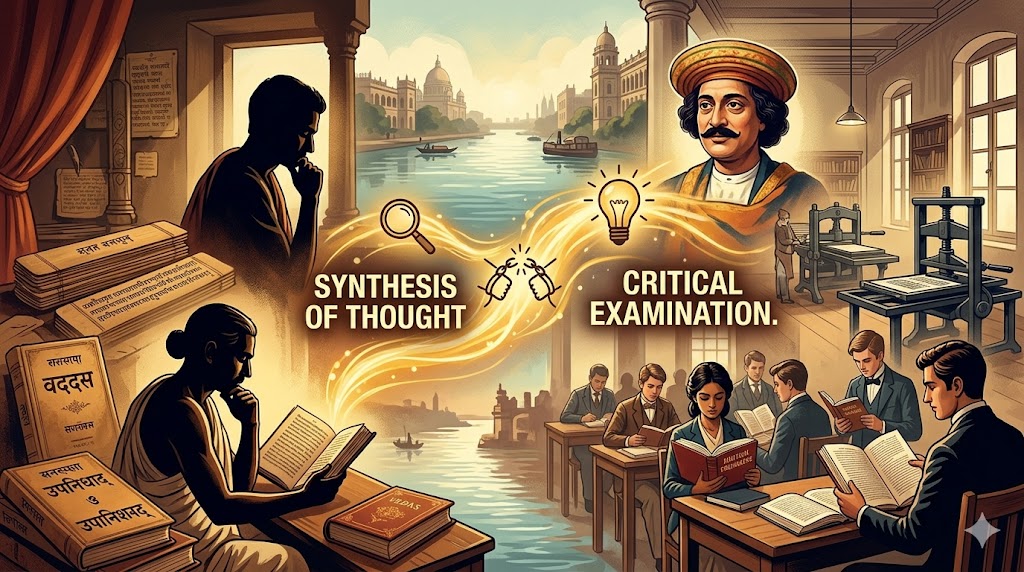
Intellectual Synthesis of East and West
Social and Religious Reforms
The Indian Renaissance was fundamentally a reform movement aimed at eradicating deep-rooted social evils. Practices such as sati, child marriage, polygamy, and untouchability came under sharp scrutiny. Reformers used both traditional scriptures and rational arguments to advocate change, demonstrating that many regressive customs lacked authentic scriptural sanction.
The Brahmo Samaj and Arya Samaj played pivotal roles in promoting monotheism and Vedic purity while rejecting superstition. Efforts toward women’s emancipation were particularly noteworthy. The establishment of girls’ schools and advocacy for property rights and education challenged patriarchal norms.
Caste reform gained momentum through the works of Phule and later Dr. B.R. Ambedkar, who built upon Renaissance ideals. Religious reform emphasized ethical spirituality over ritualism, fostering interfaith dialogue and tolerance. These changes gradually transformed Indian society, creating space for greater individual freedom and social mobility.
Literary and Cultural Awakening
One of the most vibrant aspects of the Indian Renaissance was its literary explosion. In Bengal, a modern Bengali prose emerged, replacing ornate classical styles with accessible, reform-oriented writing. Bankim Chandra Chatterjee’s novels, including Anandamath, inspired nationalist sentiments with the immortal song Vande Mataram.
Michael Madhusudan Dutt pioneered modern Bengali drama, while Rabindranath Tagore later elevated Bengali literature to global recognition, winning the Nobel Prize in 1913. The period also witnessed a resurgence of interest in classical Indian art, music, and theatre.
Printing technology played a transformative role by democratizing knowledge. Newspapers and journals in English and vernacular languages became platforms for debate, criticism, and mobilization. This cultural flowering helped restore pride in Indian heritage while encouraging critical engagement with contemporary issues.
Education and Scientific Temper
The Indian Renaissance placed immense importance on modern education. Institutions like Hindu College, Calcutta Medical College, and later universities in Bombay, Madras, and Calcutta became nurseries of new ideas. Reformers advocated English education not as cultural subjugation but as a tool for empowerment and access to global knowledge.
Simultaneously, there was a conscious effort to promote scientific temper and rational thinking. Leaders encouraged the study of science alongside traditional learning, believing that India’s progress depended on blending the best of East and West. This period laid the groundwork for India’s later achievements in science and technology, with figures like Jagadish Chandra Bose and P.C. Ray emerging as pioneers.
Political Awakening and Nationalism
While primarily cultural and social in its early phase, the Indian Renaissance gradually fed into political consciousness. The rediscovery of India’s past glory fostered a sense of national identity. Organizations like the Indian National Congress, founded in 1885, drew intellectual sustenance from Renaissance ideals.
Moderate leaders such as Dadabhai Naoroji, Surendranath Banerjee, and Gopal Krishna Gokhale embodied the spirit of constitutional agitation and reform. The Renaissance thus served as a bridge between social awakening and the more assertive phase of the freedom movement under Mahatma Gandhi.
Challenges and Criticisms
Despite its achievements, the Indian Renaissance faced limitations. It was largely confined to urban, educated elites, particularly in Bengal, with slower penetration into rural and other regional areas. Critics argued that excessive Western influence sometimes led to cultural alienation among some sections. There were also tensions between reformist and orthodox groups, occasionally resulting in social friction.
Nevertheless, these challenges did not diminish the movement’s overall positive impact. Its gradual, evolutionary approach helped minimize violent upheaval while achieving substantive change.
Legacy and Relevance in Modern India
The legacy of the Indian Renaissance continues to shape contemporary India. Constitutional values of equality, secularism, and social justice trace their intellectual roots to this period. Educational institutions, literary traditions, and reformist organizations established during the Renaissance remain active today.
In an era of rapid globalization, the movement offers valuable lessons on balancing tradition with modernity. Its emphasis on rational inquiry, social justice, and cultural pride remains relevant as India navigates 21st-century challenges. The spirit of questioning orthodoxy and striving for self-improvement continues to inspire new generations of thinkers, activists, and leaders.
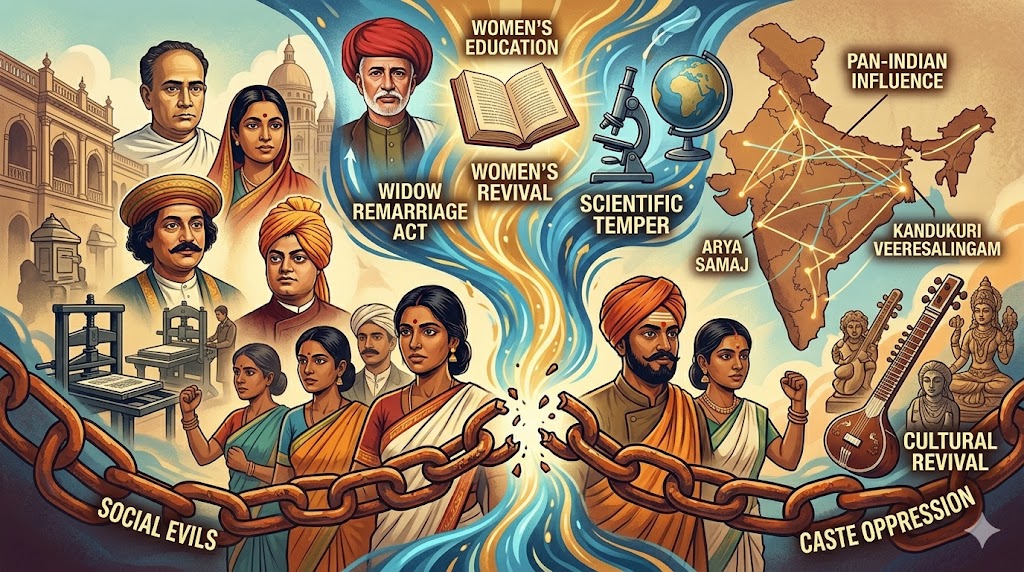
Social and Cultural Transformation across India
Regional Variations and Pan-Indian Influence
While Bengal led the way, parallel movements emerged elsewhere. In Maharashtra, the Prarthana Samaj echoed Brahmo ideals. In South India, reformers like Kandukuri Veeresalingam worked toward similar goals. These regional expressions enriched the national character of the Indian Renaissance, creating a diverse yet unified awakening.
Conclusion
The Indian Renaissance was a remarkable chapter in India’s history that combined intellectual revival, social reform, and cultural regeneration. Through the visionary efforts of leaders like Raja Ram Mohan Roy, Ishwar Chandra Vidyasagar, and countless others, Indian society underwent profound transformation. It challenged centuries-old customs, ignited a love for learning, and sowed the seeds of national consciousness that would eventually bloom into independence.
Today, as India asserts itself on the global stage, the ideals of the Indian Renaissance remind us of the power of enlightened thought and courageous reform. Its message of harmony between tradition and progress, reason and faith, and individual dignity and social responsibility continues to guide the nation’s journey toward a more equitable and enlightened future. The Renaissance was not merely a historical period but a living legacy that still illuminates India’s path forward.