Escalation of US-Iran Conflict: Regional Alliances & Impacts
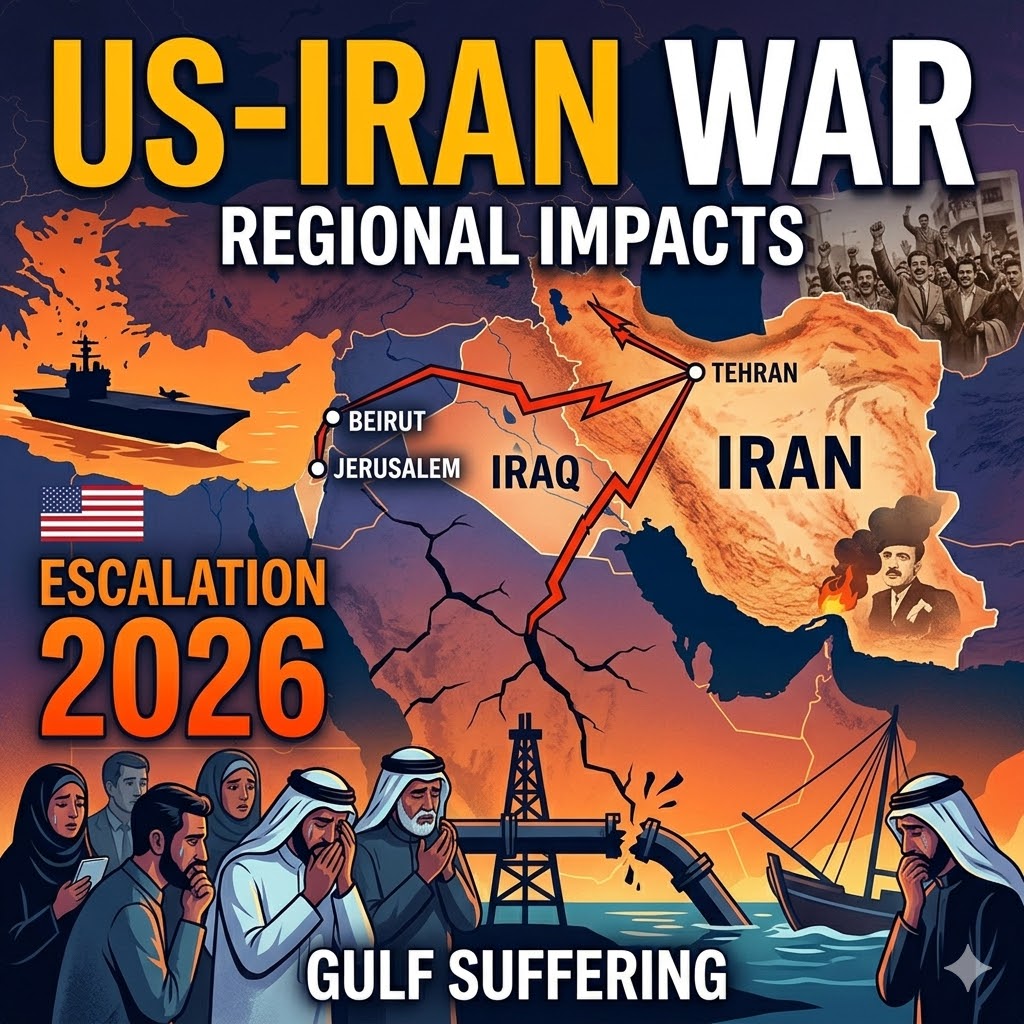
The Middle East stands at a precarious crossroads in 2026 as the US-Iran conflict intensifies through direct strikes, proxy engagements, and maritime disruptions. What began as targeted US and Israeli operations against Iranian leadership and infrastructure has rippled across borders, drawing in Hezbollah in Lebanon and straining relations with Gulf neighbors. This escalation is not isolated but rooted in decades of intertwined histories: longstanding US-Iran animosity, the bloody Iran-Iraq War, territorial disputes with the UAE, and Israel's security concerns over Iranian-backed militias.
Gulf countries, despite efforts to remain on the sidelines, find themselves suffering disproportionately through economic shocks, disrupted energy exports, and humanitarian pressures. This article examines the historical threads and current dynamics fueling the crisis, offering a structured analysis of its regional consequences.
Historical Background: US-Iran Relations – From Allies to Adversaries
US-Iran relations trace back to the mid-20th century with initial cooperation. In 1953, the US and Britain supported a coup against Prime Minister Mohammad Mossadegh after he nationalized Iran's oil industry, reinstalling Shah Mohammad Reza Pahlavi. This event sowed deep resentment, viewed by many Iranians as foreign interference in their sovereignty.
Under the Shah, ties flourished with US military and economic support. Iran served as a bulwark against Soviet influence. However, the Shah's authoritarian rule, backed by the US, fueled domestic opposition. The 1979 Islamic Revolution overthrew the monarchy, establishing the Islamic Republic under Ayatollah Ruhollah Khomeini. Anti-American sentiment peaked with the Iran Hostage Crisis, where students seized the US embassy in Tehran, holding 52 Americans for 444 days. Diplomatic ties severed, and sanctions began.
Subsequent decades saw cycles of tension. The US designated Iran a state sponsor of terrorism in 1984. During the Iran-Iraq War, the US tilted toward Iraq while engaging in the Iran-Contra affair. Iran's nuclear program became a flashpoint, leading to the 2015 JCPOA under Obama, which Trump withdrew from in 2018. By early 2026, longstanding disputes over nuclear ambitions, regional proxies, and sanctions set the stage for direct confrontation.
These historical grievances shape Iran's worldview of encirclement by hostile powers, influencing its support for proxies like Hezbollah and its responses to perceived threats.
Iran-Iraq History: A Legacy of Devastation Shaping Modern Rivalries
The 1980-1988 Iran-Iraq War remains one of the bloodiest conflicts of the modern era, claiming hundreds of thousands to over a million lives. Iraq, under Saddam Hussein, invaded Iran shortly after the revolution, seeking to exploit perceived Iranian weakness and control the Shatt al-Arab waterway and oil-rich Khuzestan province.
Iran's revolutionary fervor led to human-wave tactics and prolonged stalemate. Iraq used chemical weapons, drawing international condemnation but limited intervention. The war devastated both economies, with combined losses exceeding $1 trillion. It entrenched hardline elements in Iran, strengthening the Islamic Revolutionary Guard Corps (IRGC), and left a legacy of chemical weapon fears and mutual distrust.
This history influences current dynamics. Iraq, with its Shia majority, maintains complex ties with Iran, including militia links, while Gulf states recall Iran's wartime threats. The war's unresolved traumas contribute to today's proxy battles, as Iran projects power to prevent similar isolation.
Israel, Lebanon, and Hezbollah: The Proxy Front Driving Escalation
Israel's security concerns the center of Iran's "Axis of Resistance," particularly Hezbollah in Lebanon. Hezbollah, formed in the 1980s with Iranian support during Israel's occupation of southern Lebanon, has evolved into a powerful political and military force.
Tensions escalated after October 7, 2023, events, leading to 2024 clashes and a fragile ceasefire. In 2026, following US-Israeli strikes on Iran on February 28 that killed Supreme Leader Ali Khamenei, Hezbollah fired rockets into Israel in solidarity. Israel responded with intense airstrikes and ground operations in southern Lebanon, displacing over a million people.
This Lebanon front has complicated US-Iran ceasefire efforts. Iran conditions talks on ending Lebanese hostilities, while Israel demands Hezbollah's disarmament. Direct Israel-Lebanon talks in Washington highlight diplomatic pushes amid ongoing violations. The involvement of Hezbollah transforms a bilateral US-Iran clash into a broader regional war, with Iranian proxies providing plausible deniability and escalation ladders.
Iran-UAE Relations: Territorial Disputes Amid Economic Interdependence
Iran and the UAE share a complex history marked by the 1971 seizure of the islands of Abu Musa, Greater Tunb, and Lesser Tunb as British forces withdrew. Iran maintains control, viewing them as integral territory, while the UAE claims sovereignty and seeks resolution, sometimes internationalizing the dispute.
Despite tensions, economic ties persisted through Dubai's role as a trade hub for Iranian businesses, especially under sanctions. However, Iran's nuclear ambitions, proxy activities, and the islands issue strain relations. UAE normalization with Israel via Abraham Accords further irritated Tehran.
In the current war, UAE territory has faced risks from Iranian retaliation, including reported missile interceptions. Gulf states like the UAE balance security alliances with the US against economic exposure to Iranian disruption of the Strait of Hormuz.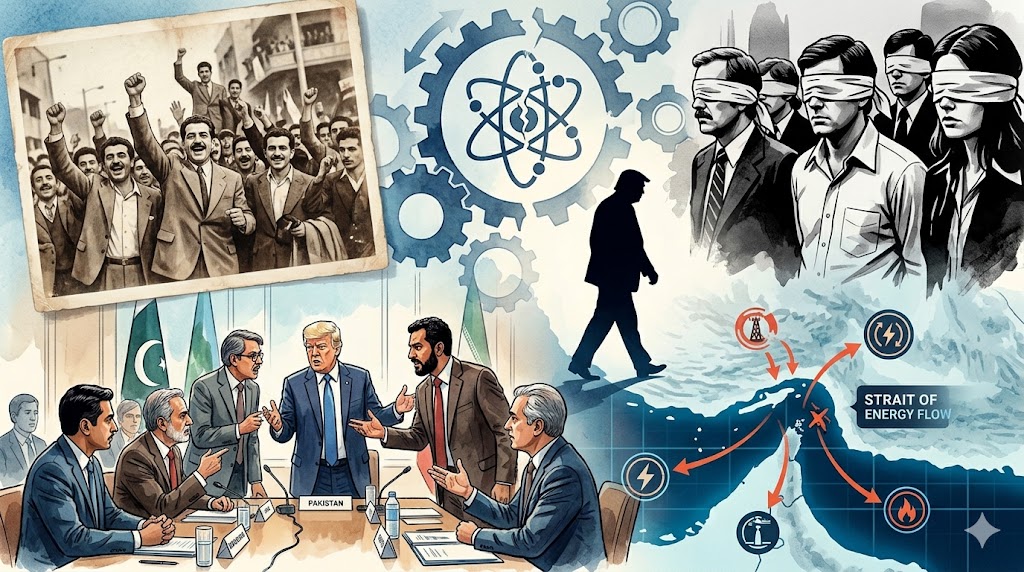
Historical Roots of Tension
Current Escalation: How Israel-Lebanon Dynamics Fuel the US-Iran War
The 2026 conflict ignited with Operation Epic Fury – US and Israeli strikes on February 28 targeting Iranian military sites, nuclear facilities, and leadership. The death of Khamenei triggered Iranian missile and drone barrages, alongside proxy activations.
Hezbollah's entry on March 2 amplified the crisis, prompting Israeli operations deep into Lebanon. This linkage forces the US to manage multiple fronts: direct pressure on Iran, support for Israel, and containment of spillover. Maritime tensions, including US blockades and Iranian threats to the Strait of Hormuz, add economic warfare dimensions. Ceasefire attempts, mediated partly through Pakistan, remain fragile amid violations.
The Suffering of Gulf Countries – Focus on Strait of Hormuz Impacts
.At the heart of the Gulf's economic vulnerability lies the Strait of Hormuz, a narrow waterway separating Iran from Oman. This strategic passage serves as the primary exit route for much of the Persian Gulf's vast energy resources. In normal times, approximately 20 million barrels per day of crude oil and petroleum products flowed through the strait in 2024-2025, accounting for roughly 20% of global petroleum liquids consumption and over a quarter of global seaborne oil trade. Additionally, nearly 20% of the world's liquefied natural gas (LNG) trade, predominantly from Qatar, transited these waters en route to Asian markets.
The geography of the strait—barely 21 miles wide at its narrowest point with shipping lanes just two miles across in each direction—makes it exceptionally vulnerable to disruption. Large tankers have limited maneuverability, and alternative routes remain severely constrained. While Saudi Arabia and the UAE have developed bypass pipelines (such as Saudi Arabia’s East-West pipeline to the Red Sea and the UAE’s Abu Dhabi pipeline to Fujairah on the Gulf of Oman), these can only reroute a fraction of total volumes, estimated at around 2.6 million barrels per day combined. Most refined products, LNG, and petrochemicals lack viable land alternatives.
Immediate Disruptions in the 2026 Conflict
Following the escalation of the US-Iran conflict in late February 2026, Iranian responses—including missile threats, naval harassment, mining risks, and reported attacks on vessels—effectively brought commercial traffic through the strait to a near standstill. Vessel transits dropped dramatically, from an average of over 100 per day to just a handful in some periods. Insurance premiums for shipping in the region skyrocketed, prompting many operators to avoid the area entirely or demand exorbitant fees. Some reports even mentioned Iran imposing informal transit charges on remaining vessels.
This disruption triggered immediate supply shocks. Oil prices surged, with Brent crude rising sharply and briefly threatening to approach or exceed $100-$115 per barrel in the initial phases. Qatar, heavily reliant on the strait for its LNG exports, declared force majeure on contracts, halting significant portions of production and affecting Asian buyers who depend on Qatari gas for power generation and industry. Damage to facilities like Qatar’s Ras Laffan terminal further compounded losses, with some estimates suggesting long-term repair timelines of several years for affected infrastructure.
Economic Toll on Gulf Countries
Gulf Cooperation Council (GCC) states have borne the brunt despite varying levels of exposure. Countries like Qatar, Bahrain, and Kuwait, with fewer bypass options, faced the most acute pain. Qatar’s economy, built on LNG leadership, saw export revenues plummet, forcing production cuts and declarations of force majeure that rippled through global energy contracts. The UAE, a major trade and logistics hub, experienced congestion at ports like Jebel Ali as transshipment activities slowed. Dubai’s role as a re-export center for Iranian and regional goods added another layer of strain under heightened risk.
Saudi Arabia leveraged its East-West pipeline more aggressively but still reduced overall output in response to market conditions and infrastructure risks. Broader effects included:
Stock market volatility and currency pressures — Regional bourses dipped as investor confidence wavered.
Higher domestic costs — Governments increased fuel and food subsidies to shield citizens from global price spikes, straining public finances already focused on diversification programs like Saudi Vision 2030.
Non-energy sectors — Disruptions extended to petrochemicals, aluminum, fertilizers, and even helium, affecting industries far beyond oil. Global fertilizer prices rose due to reduced Gulf exports, threatening food security in import-dependent nations while raising costs locally.
Daily economic losses for Gulf states were estimated in the billions, with combined regional impacts from reduced exports, higher insurance, rerouting, and damaged infrastructure running into tens of billions within the first months. Tourism, aviation, and financial services also suffered as risk perceptions rose and air corridors faced intermittent disruptions.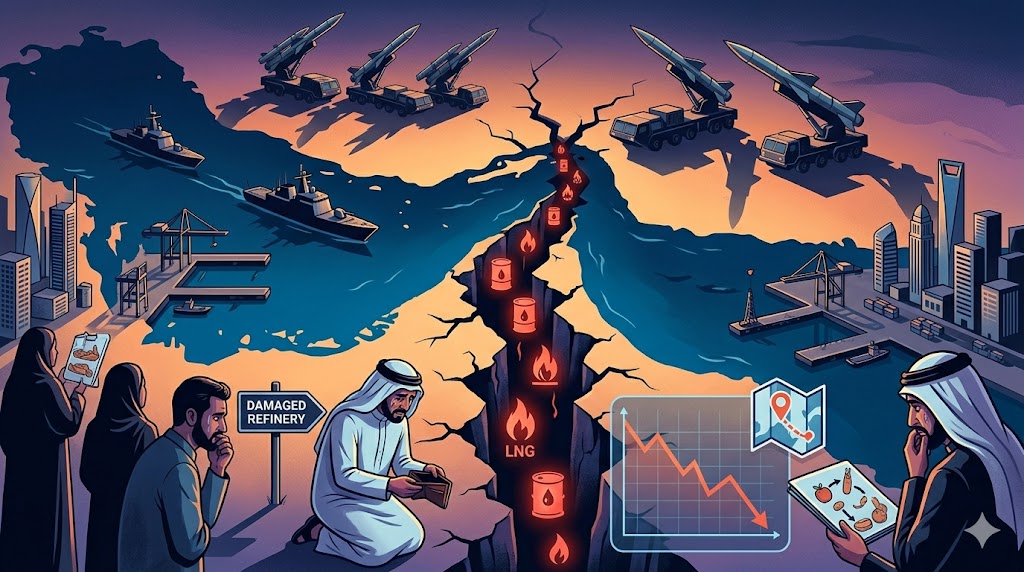
The Strait of Hormuz Chokepoint
Humanitarian and Long-Term Consequences
Beyond economics, the strait’s closure carried human costs. Food imports, heavily dependent on secure maritime routes, saw price increases and occasional shortages, pressuring lower-income households. Potential refugee movements or internal displacements from affected coastal areas added social strain. Desalination plants, critical for freshwater in the arid Gulf, faced indirect risks from heightened maritime insecurity.
Longer-term, the crisis has accelerated debates about infrastructure resilience. GCC countries are reportedly exploring enhanced pipeline networks, new maritime alternatives, and greater storage capacity. However, full diversification away from the strait remains a multi-year, enormously expensive challenge. The events have also prompted diplomatic pushes, with Gulf states urging international action through the UN to restore freedom of navigation and de-escalate threats to the waterway.
In essence, the Strait of Hormuz has transformed from a routine artery of global commerce into a focal point of vulnerability. For Gulf nations pursuing ambitious economic visions, the 2026 disruptions serve as a stark reminder of geographic realities and the intertwined nature of energy security, regional stability, and global markets. As efforts continue toward de-escalation and ceasefire enforcement, reopening and securing this critical chokepoint remains essential not only for Gulf prosperity but for broader international economic stability.
Broader Geopolitical Implications and Future Outlook
This escalation underscores the interconnectedness of Middle Eastern conflicts. US policy balances the deterrence of Iran with avoiding wider war. Israel's actions prioritize neutralizing threats from Hezbollah and Iranian entrenchment. Iran leverages asymmetric capabilities and proxies to impose costs.
For Gulf states, the crisis accelerates hedging strategies: diversifying alliances, investing in defense, and securing alternative trade routes. Diplomatic initiatives, including Israel-Lebanon talks, offer glimmers of de-escalation but require addressing root issues like proxy disarmament and nuclear concerns.
Conclusion
The US-Iran war's escalation in 2026 stems from a potent mix of historical animosities, proxy warfare through Lebanon and Hezbollah, territorial legacies with the UAE, and the enduring scars of the Iran-Iraq conflict. While strategic calculations drive major powers, Gulf countries endure the heaviest collateral damage – economic disruption, security threats, and human costs that could reshape the region for years. Sustainable peace demands multilateral dialogue addressing legitimate security concerns while fostering economic interdependence and sovereignty respect. As fragile ceasefires hold tenuously, the path forward requires wisdom to prevent further catastrophe in an already volatile region.