"Varaha Purana: Lord Vishnu's Boar Avatar Triumphs"
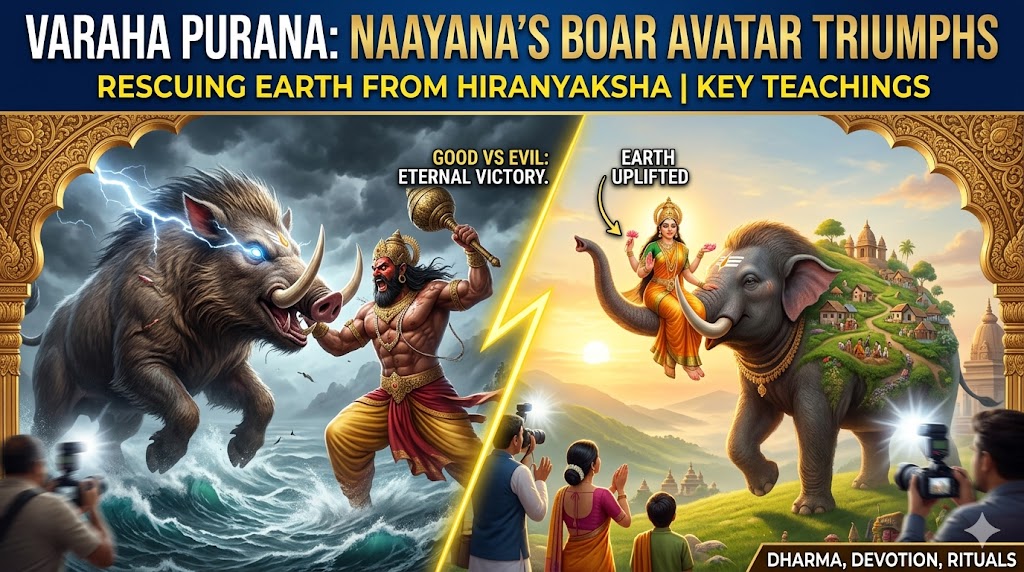
Among the revered 18 Mahapuranas of Sanatan Dharma, the Varaha Purana occupies a unique and exalted position. As a predominantly Sattvic scripture dedicated to Lord Vishnu, it vividly narrates the divine exploits of the Varaha Avatar — Lord Narayana’s incarnation as a cosmic boar. This Purana not only recounts the dramatic rescue of Mother Earth (Bhudevi) from the demon Hiranyaksha but also serves as a comprehensive guide to dharma, cosmology, devotion, and righteous living.
Structured as a profound dialogue between Varaha and Prithvi, the text emphasizes the eternal victory of good over evil and the protective grace of the Supreme Lord. With approximately 218 chapters and more than 10,000 verses, the Varaha Purana blends engaging mythology with practical spiritual instructions. It stands as both a devotional treasure and a philosophical masterpiece, offering timeless wisdom for devotees seeking to understand the cosmic order and their place within it.
This extended article delves deeply into the origins, narratives, teachings, rituals, cultural impact, and contemporary relevance of the Varaha Purana, providing readers with a thorough educational resource on this sacred text and the glorious Varaha Avatar of Lord Narayana.
The Varaha Purana is traditionally dated between the 10th and 14th centuries in its compiled form, though its oral traditions and core stories are far older, rooted in Vedic and early Puranic literature. It belongs to the Vaishnava category of Puranas, which primarily glorifies Lord Vishnu and his various manifestations.
Like other Mahapuranas, it was composed to make complex Vedic knowledge accessible to all sections of society. The text is presented in a conversational style, making it engaging and relatable. Lord Narayana, in his Varaha form, answers the earnest questions posed by the rescued Earth goddess, covering topics from the creation of the universe to the duties of individuals in different life stages.
The Purana references and harmonizes with other major scriptures, including the Vishnu Purana, Bhagavata Purana, and even elements from Shaiva and Shakta traditions. This inclusive approach reflects the underlying unity of Sanatan Dharma, where different paths ultimately lead to the same divine reality.
The Varaha Avatar: Divine Purpose and Manifestation
The Varaha Avatar represents the third incarnation in the Dashavatara sequence. It appeared at a critical juncture in the Satya Yuga when demonic forces threatened to engulf the world in chaos. The powerful demon Hiranyaksha, empowered by a boon from Brahma that made him nearly invincible against most beings, had grown arrogant and tyrannical.
After defeating the gods and disrupting cosmic harmony, Hiranyaksha abducted Bhudevi and plunged her into the primordial cosmic ocean. This act caused widespread imbalance — mountains sank, rivers changed course, and the very stability of the earth was compromised. The devas, led by Brahma, turned to the Supreme Lord for intervention.
Lord Narayana responded by manifesting as Varaha. Emerging first as a tiny boar from Brahma’s nostril, the form grew to gigantic proportions, with eyes shining like lightning and tusks gleaming like mountains. This incarnation was not random but perfectly suited to the crisis: the boar’s natural ability to dive deep and its strength made it the ideal form to confront the demon and retrieve the submerged earth. The manifestation itself symbolizes the Lord’s readiness to descend into the depths of darkness to restore light and order.
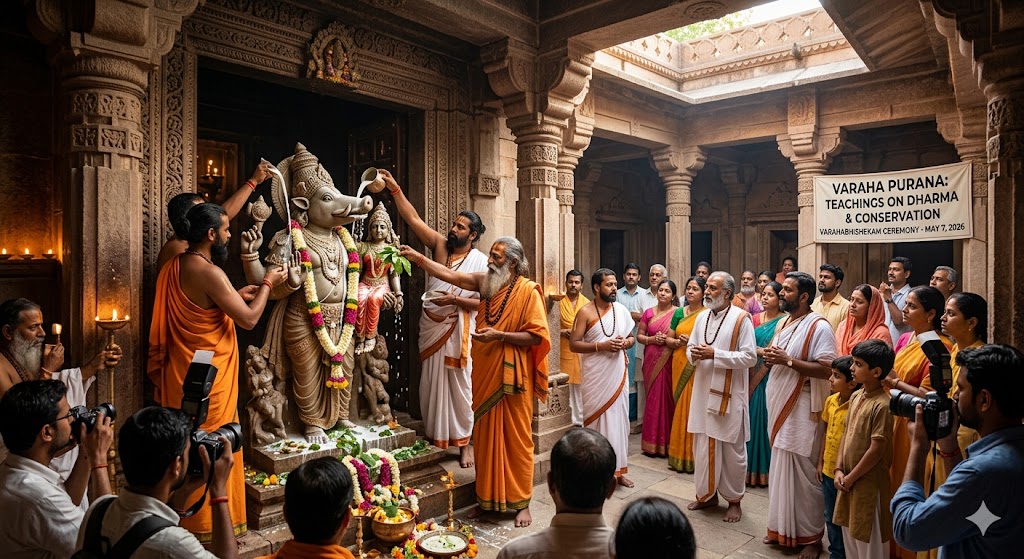
Worshipping the lord vishnu as Varaha Avtar
Detailed Account of the Epic Battle Against Evil
The battle between Varaha and Hiranyaksha is described with remarkable vividness in the Varaha Purana. Upon encountering the divine boar, Hiranyaksha initially underestimated his opponent, mocking the animal form. However, as the combat unfolded over a thousand celestial years, the demon witnessed the Lord’s unparalleled prowess.
Hiranyaksha employed every weapon in his arsenal — massive maces, illusory powers, serpentine nooses, and brute strength. The ocean waters churned violently, and the three worlds trembled with the force of their clashes. Yet, Lord Varaha remained composed, countering each attack with divine precision. The Purana highlights several key moments where Varaha demonstrated supreme strategy and compassion, even offering the demon a chance to reform before the final blow.
In the climactic phase, Varaha lifted the Earth goddess gently onto his mighty tusks, carrying her safely upward while simultaneously engaging the demon. With a decisive strike, he slayed Hiranyaksha, piercing through his formidable defenses. Blood flowed into the ocean, but the act brought purification and renewal. This victory was not merely physical destruction but the annihilation of ego, adharma, and chaos. It reaffirmed that no matter how powerful evil becomes, it cannot withstand the force of divine dharma when Lord Narayana intervenes.
The narrative serves as a powerful allegory: just as Varaha rescued the Earth, the Lord continues to uplift sincere souls from the ocean of material existence and ignorance.
Symbolism and Deeper Philosophical Teachings
The Varaha Avatar is rich in layered symbolism. The boar represents determination, resilience, and the capacity to thrive in challenging environments. His tusks, upon which the Earth rests, symbolize the supportive pillars of dharma that sustain creation. The rescue of Bhudevi underscores the Lord’s role as preserver and protector of all life forms.
Throughout the Varaha Purana, Lord Narayana elaborates on fundamental principles:
The cycles of creation, sustenance, and dissolution (Srishti, Sthiti, and Pralaya).
The importance of the three gunas and how to transcend them through devotion.
The value of ethical conduct, charity, and service to humanity.
The merits of visiting holy tirthas and performing prescribed rituals.
The path of bhakti as the most accessible means to liberation in the current age.
These teachings emphasize that good prevails not through random chance but through the eternal cosmic law upheld by the Supreme Lord. The Purana repeatedly assures that whenever dharma declines, Vishnu incarnates to restore balance, offering hope and moral guidance to humanity across ages.
Additional Narratives and Comprehensive Content
Beyond the central story, the Varaha Purana contains numerous subsidiary tales that enrich its spiritual landscape. It discusses the lives of great sages, the importance of environmental stewardship (such as planting trees and digging wells), and detailed instructions for performing shraddha ceremonies for ancestors.
Significant portions are devoted to the glory of Mathura and other sacred sites, including descriptions of festivals, vratas, and temple worship. The text also explores cosmology in detail, describing the structure of the universe, planetary systems, and the journey of the soul after death. These elements make the Varaha Purana a complete manual for both spiritual aspirants and householders.
Rituals, Worship, and Temple Traditions
Worship of Varaha is considered highly auspicious. Devotees perform abhishekam with milk, water, and sacred herbs, offer tulsi leaves, and recite Varaha mantras for protection and prosperity. Many temples across India, notably the Sri Varaha Lakshmi Narasimha Swamy Temple in Simhachalam and the Varaha Temple in Pushkar, attract thousands of pilgrims.
Observing Varaha Jayanti, which falls during the Varaha month, involves special prayers and charity. The Purana outlines specific benefits of such worship, including removal of obstacles, fulfillment of desires aligned with dharma, and ultimate spiritual progress.
Cultural Impact and Modern Relevance
The Varaha story has profoundly influenced Indian art, sculpture, and literature. Ancient temple carvings often depict the majestic boar lifting the Earth, serving as visual reminders of divine protection. In literature and performing arts, the narrative continues to inspire plays, dances, and devotional songs.
In contemporary times, the Varaha Purana offers valuable insights into environmental conservation — viewing Earth as a living goddess worthy of reverence. Its emphasis on ethical governance and moral leadership resonates strongly in today’s world. Scholars and spiritual leaders frequently reference its teachings when discussing the triumph of good over evil in personal and societal contexts.
Comparison with Other Puranas
While the Shiva Purana and Linga Purana focus on Lord Shiva, and the Bhagavata Purana elaborates on Krishna, the Varaha Purana uniquely centers on this particular avatar while maintaining respect for the broader pantheon. Its practical orientation distinguishes it, providing actionable guidance alongside mythology.
Conclusion
The Varaha Purana stands as a magnificent testament to the power, compassion, and wisdom of Lord Narayana in his Varaha Avatar. Through the dramatic rescue of Bhudevi and the decisive victory over Hiranyaksha, it eternally proclaims the triumph of good over evil and the unwavering commitment of the divine to uphold dharma.
As a sacred dialogue between the Lord and Mother Earth, this Purana continues to enlighten generations, guiding devotees toward righteous living, deeper devotion, and ultimate liberation. Its teachings remind us that in every age, whenever darkness threatens, the Supreme Lord manifests in the most appropriate form to restore light, balance, and harmony.
May the blessings of Varaha Narayana inspire strength, devotion, and unwavering faith in dharma among all who study, recite, and reflect upon this holy scripture. The Varaha Purana is not merely an ancient text but a living source of spiritual nourishment for humanity’s eternal journey toward truth and righteousness.