Operation Sindoor: India's Bold Strike Against Terrorism
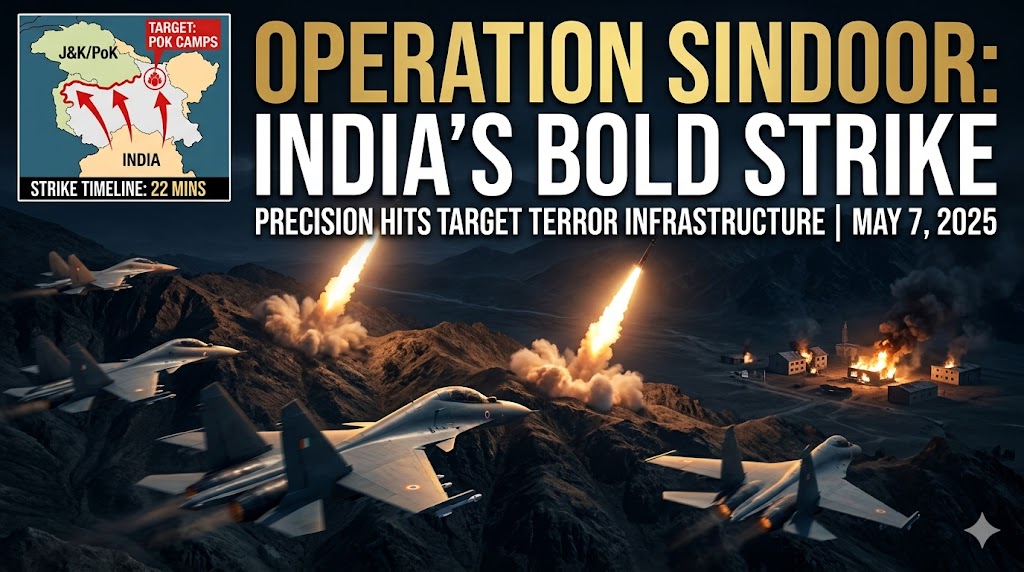
Operation Sindoor stands as a defining chapter in India's contemporary military history, representing a firm assertion of its zero-tolerance policy towards cross-border terrorism. Launched on May 7, 2025, this meticulously planned operation involved precision missile and airstrikes targeting terrorist infrastructure in Pakistan and Pakistan-occupied Kashmir (PoK). It came as a direct response to the brutal Pahalgam terror attack that claimed the lives of 26 innocent tourists.
This educational article examines the background, execution, strategic importance, and lasting impact of Operation Sindoor. Written for informative and academic purposes, it provides a confined, factual overview of the events, the rationale behind the decision, and how the first anniversary was observed in 2026. Understanding such operations offers valuable insights into modern counter-terrorism strategies, national security doctrines, and the complexities of regional geopolitics.
Background: The Triggering Pahalgam Terror Attack
The seeds of Operation Sindoor were sown on April 22, 2025, in the scenic tourist destination of Pahalgam in Jammu and Kashmir. Terrorists, identified as Pakistan-backed elements linked to groups like Lashkar-e-Taiba (LeT) and Jaish-e-Mohammed (JeM), carried out a targeted attack. They reportedly separated victims based on religion and killed 26 civilians in cold blood.
This horrific incident, widely condemned internationally, was seen as a direct provocation, especially following inflammatory statements from Pakistani officials. India, under the leadership of Prime Minister Narendra Modi, viewed the attack not merely as an isolated event but as part of a sustained pattern of cross-border terrorism supported by elements in Pakistan. Intelligence reports traced communication links and planning nodes back to Pakistani soil, leaving the Indian government with little choice but to respond decisively.
The name "Sindoor" — symbolizing the sacred vermilion powder worn by married Indian women as a mark of their marital vows and strength — was chosen to reflect the nation's resolve to protect its citizens and honor the dignity of those affected.
Why Operation Sindoor Was Launched: Strategic Rationale
Operation Sindoor was elected and authorized at the highest levels after thorough intelligence assessment and deliberations within the Cabinet Committee on Security. Several key factors drove this decision:
Zero Tolerance Policy: Successive Indian governments have increasingly adopted a proactive stance against terrorism. The operation embodied the doctrine that terror and talks cannot coexist.
Deterrence: Previous surgical strikes and airstrikes had set precedents; Sindoor escalated this by striking deeper into Pakistani territory, targeting not only PoK camps but also headquarters in mainland Pakistan such as Muridke (LeT) and Bahawalpur (JeM).
Precision and Proportionality: The operation was designed to minimize civilian casualties, focusing exclusively on terrorist infrastructure. Advanced intelligence, satellite imagery, and indigenous weaponry enabled high-accuracy strikes.
Technological Demonstration: It showcased India's growing self-reliance in defense (Atmanirbhar Bharat), utilizing a combination of missiles, drones, and air assets in what has been described as the subcontinent's first major non-contact war.
The operation was not about territorial gains or escalation into full-scale war but a calibrated response to neutralize immediate threats and send a strong message of deterrence.
Execution of Operation Sindoor: Precision in Action
On the intervening night of May 6-7, 2025, Indian forces executed the operation with remarkable coordination across the Army, Air Force, and other agencies. In a span of approximately 22-25 minutes, nine major terror camps and related infrastructure were destroyed.
Key targets included:
Terror launch pads in PoK areas like Muzaffarabad, Kotli, and Bhimber.
High-value sites in Pakistan's Punjab province, including LeT and JeM headquarters.
The strikes involved advanced missile systems and fighter jets operating at standoff ranges. Reports highlight exceptional tri-service synergy, real-time intelligence sharing, and the effective use of indigenous platforms. Pakistan attempted retaliation through its own operation (Bunyan-um-Marsoos), leading to aerial engagements, but India maintained dominance in the initial phase.
A U.S.-mediated ceasefire was eventually reached around May 10, 2025, after limited exchanges. Independent assessments, including later satellite imagery released by India, confirmed significant damage to terrorist facilities with minimal collateral impact on civilian areas.
Execution of Operation Sindoor
Immediate Outcomes and Casualties
Indian official statements emphasized that the strikes successfully eliminated 100 terrorists and destroyed critical infrastructure. While Pakistan reported civilian casualties and claimed defensive successes, international observers and subsequent evidence largely validated the precision of the Indian operation. The brief conflict resulted in losses on both sides, but it underscored India's air superiority and technological edge in a high-stakes environment.
The First Anniversary Celebration: Honoring Resolve and Sacrifice
On May 6-7, 2026, India marked the first anniversary of Operation Sindoor with dignity, patriotism, and educational focus. The Indian Air Force released a powerful commemorative video at 1:05 AM, featuring night-vision footage of strikes, maps of targeted locations, and messages of national resolve, including the phrase "India forgives nothing."
Key commemorative events included:
A special Joint Commanders' Conference in Jaipur hosted by the South Western Army Command, attended by Defence Minister Rajnath Singh, Chief of Defence Staff General Anil Chauhan, and senior military leaders. Discussions focused on future readiness in cyber, space, and integrated operations.
Release of satellite images and a documentary-style film highlighting tri-service coordination.
Tributes to the armed forces across media and public platforms, emphasizing self-reliance and the sacrifices of personnel.
Statements from leaders reinforcing the six pillars of the operation: clarity, precision, unity, innovation, professionalism, and purpose.
These observances served an educational purpose, reminding citizens — especially the youth — of the importance of national security, the valor of the armed forces, and the evolution of India's defense posture.
Strategic Significance and Long-Term Impact
Operation Sindoor established a new response doctrine for India. It demonstrated that the country possesses the capability and political will to strike at the heart of terrorist networks beyond immediate borders while exercising restraint to avoid broader humanitarian crises.
Key lessons include:
Enhanced integration of intelligence and military operations.
Importance of technological superiority and indigenous capabilities.
The value of international diplomacy in de-escalating conflicts.
Reinforcement of deterrence against state-sponsored terrorism.
The operation has been studied in military academies as an example of calibrated force application in a nuclear-shadowed environment. It also boosted domestic morale and international perception of India as a responsible yet firm power.
Broader Educational Insights
For students and researchers, Operation Sindoor illustrates several principles:
Just War Theory in Practice: Proportional response, discrimination between combatants and civilians.
Modern Warfare: Shift towards precision, standoff weapons, and multi-domain operations (air, cyber, intelligence).
Geopolitical Realities: The interplay between domestic politics, regional rivalries, and global powers like the United States in crisis management.
National Resilience: How a democratic nation unites in the face of tragedy to uphold sovereignty.
It also highlights the human cost of terrorism and the necessity of sustained diplomatic efforts alongside military preparedness.
Conclusion
Operation Sindoor remains a powerful testament to India's commitment to safeguarding its citizens and combating terrorism at its source. Born out of the tragedy in Pahalgam, it was executed with precision, celebrated on its first anniversary with honor and reflection, and continues to shape India's security outlook.
As the nation remembers the bravery of its armed forces, the operation serves as an enduring educational reminder: peace is best preserved through strength, vigilance, and strategic clarity. Future generations will study this chapter not just as military history but as a defining moment in India's journey as a secure and self-reliant global power.