Civil Wars Explained: History, Causes & Global Impact
Civil wars represent some of the most devastating and complex forms of human conflict. Unlike interstate wars, these internal struggles pit citizens, communities, and factions against one another within the same sovereign territory, often resulting in profound societal fragmentation that can last for generations. Characterized by intense violence, blurred lines between combatants and civilians, and deep ideological, ethnic, or resource-driven divisions, civil wars challenge traditional notions of warfare and peacebuilding.
Since the end of World War II, the global landscape has been shaped by numerous major civil wars, many of which have claimed millions of lives and reshaped entire regions. From the protracted Syrian civil war to the ethnic conflict in Sri Lanka and the Maoist insurgency in Nepal, these episodes reveal patterns of grievance, power struggles, and external interference that continue to plague fragile states. This article offers a comprehensive and in-depth analysis of civil wars — their definition, underlying causes, historical examples, statistical trends since 1945, multifaceted impacts, and pathways toward prevention and resolution.
What Is a Civil War? Precise Definition and Key Characteristics
Scholars generally define a civil war as a sustained armed conflict within a single country between organized groups, where at least one party is the recognized government. According to the Uppsala Conflict Data Program (UCDP), a conflict qualifies as a civil war when it results in at least 1,000 battle-related deaths in a year and involves a clear incompatibility over government or territory.
Key distinguishing characteristics include high levels of organization among rebel groups, significant territorial control or sustained challenges to state authority, and political objectives ranging from regime change to secession or autonomy. Unlike riots or communal violence, civil wars feature structured military strategies and command hierarchies.
The internal nature of these conflicts often leads to unique horrors: families divided, communities destroyed, and widespread atrocities such as ethnic cleansing, sexual violence, and the use of child soldiers. External actors frequently internationalize these wars through arms supplies, funding, or direct intervention, complicating resolution efforts and prolonging suffering.
Root Causes: Deeper Theoretical Analysis
Civil wars rarely stem from isolated triggers. Two major theoretical frameworks help explain their onset: the “greed versus grievance” debate and the “resource curse” thesis.
The grievance model emphasizes legitimate political, economic, and social injustices — horizontal inequalities between ethnic or religious groups, political exclusion, and state repression. When populations perceive systemic discrimination, the likelihood of rebellion increases significantly.
Conversely, the greed theory, popularized by Paul Collier and Anke Hoeffler, highlights economic incentives. Rebel leaders may exploit valuable resources (diamonds, oil, timber) to finance war, turning conflict into a profitable enterprise rather than purely ideological struggle. Many civil wars combine both elements: initial grievances provide mobilization, while resource control sustains fighting.
Additional structural factors include weak state institutions, demographic youth bulges, rapid urbanization, and the availability of small arms. Climate change is emerging as a threat multiplier, exacerbating resource scarcity and migration that can ignite or prolong conflicts. In post-colonial states, arbitrary borders that lumped diverse ethnic groups together have created long-term instability.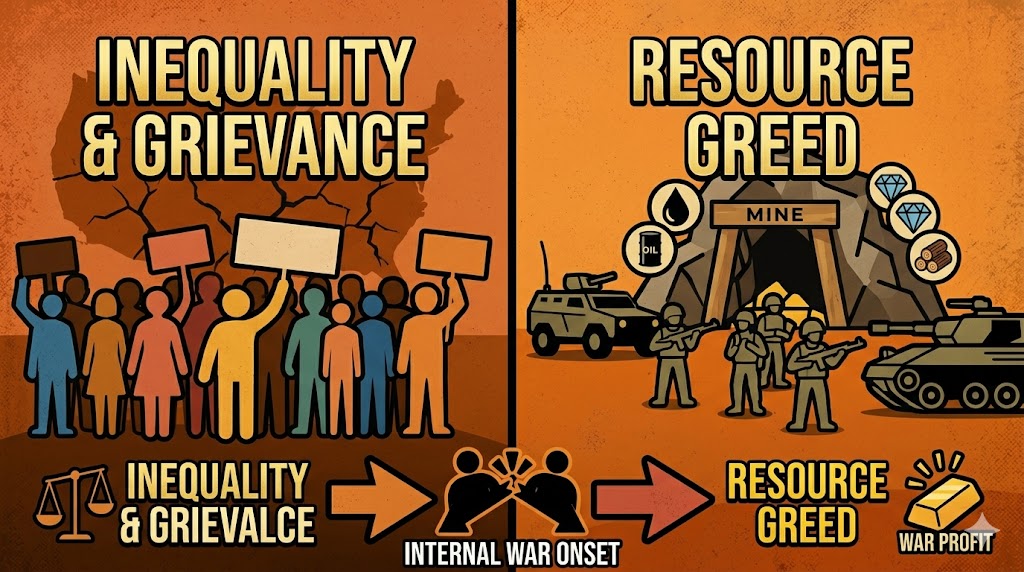
Root Causes: Grievance and Greed
Major Civil Wars: In-Depth Case Studies
Major Civil Wars: In-Depth Case Studies
Syrian Civil War (2011–Present): A Proxy Battlefield
The Syrian civil war erupted in 2011 as part of the Arab Spring, with peaceful protests against Bashar al-Assad’s authoritarian regime met with brutal crackdowns. It rapidly transformed into a multifaceted conflict involving secular opposition, Islamist factions including ISIS, Kurdish forces, and heavy foreign involvement.
By 2026, the war had caused over 500,000 deaths and displaced more than 13 million people. Russia’s military intervention in 2015 shifted the balance toward Assad, while Turkey focused on containing Kurdish groups. The conflict demonstrates how regional power rivalries (Iran-Saudi Arabia, US-Russia) can internationalize and prolong civil wars. Long-term consequences include destroyed infrastructure, a generation lost to trauma and exile, and the rise of global terrorism networks. Partial stabilization has occurred in government-held areas, but underlying political grievances remain unresolved.
Sri Lankan Civil War (1983–2009): Ethnic Separatism and Its Aftermath
Sri Lanka’s 26-year civil war between the Sinhalese-majority government and the Liberation Tigers of Tamil Eelam (LTTE) was rooted in post-independence ethnic marginalization. Discriminatory policies favoring Sinhalese language and religion alienated the Tamil minority, leading to demands for an independent Tamil state in the north and east.
The LTTE pioneered suicide bombings and used child soldiers, while government forces were later accused of war crimes during the final offensive in 2009. The conflict claimed between 80,000 and 100,000 lives. Although the military victory ended large-scale fighting, the lack of meaningful reconciliation, continued militarization of the north, and suppression of Tamil political voices have prevented genuine healing. Sri Lanka’s experience highlights the difficulty of transitioning from military victory to sustainable peace in ethnic civil wars.
Nepalese Civil War (1996–2006): Ideology Meets Reform
Nepal’s Maoist insurgency began in rural areas as a response to extreme poverty, caste discrimination, and monarchical authoritarianism. Led by the Communist Party of Nepal (Maoist), the conflict resulted in approximately 17,000 deaths over a decade.
Unlike many civil wars ending in decisive victory, Nepal’s conflict concluded with a comprehensive peace agreement in 2006. The monarchy was abolished, and the country adopted a federal democratic republic. This case offers valuable lessons in successful power-sharing and constitutional reform. However, persistent challenges such as corruption, slow implementation of federalism, and occasional political instability show that even negotiated settlements require continuous effort to prevent relapse.
Additional Notable Cases
The Chinese Civil War (1945–1949) fundamentally reshaped Asia by establishing Communist rule on the mainland. The Spanish Civil War (1936–1939) served as a testing ground for ideologies that fueled World War II. In Latin America, Colombia’s decades-long conflict involving FARC, paramilitaries, and drug cartels illustrates the dangerous nexus between insurgency and organized crime.
Post-WWII Trends: Scale, Statistics, and Patterns
The period since 1945 has been dominated by intrastate conflicts rather than traditional interstate wars. Data from the Correlates of War Project and UCDP indicate over 250 major armed conflicts, with the majority qualifying as civil wars. Peaks occurred during decolonization (1950s–1970s) and the immediate post-Cold War era (1990s), when the collapse of authoritarian regimes unleashed suppressed ethnic and nationalist tensions.
In recent years, the number of active conflicts has reached post-WWII highs, with over 50–60 concurrent state-based conflicts reported in some analyses. Africa and the Middle East have been particularly affected, though Asia has also seen significant episodes. A worrying trend is the increasing internationalization of civil wars, with external powers involved in nearly 40% of cases today compared to lower figures in earlier decades. This internationalization often prolongs conflicts and raises the human cost.
Multifaceted Consequences and Long-Term Impacts
The effects of civil wars extend far beyond battlefield casualties. Economically, they destroy infrastructure, deter investment, and create “lost decades” of development. Socially, they erode trust, disrupt education and healthcare, and produce intergenerational trauma. Psychologically, survivors often face elevated rates of PTSD, depression, and substance abuse.
Women and children suffer disproportionately through displacement, gender-based violence, and lost opportunities. Environmentally, civil wars lead to deforestation, wildlife decline, and pollution from unexploded ordnance. On the global stage, they generate refugee flows that strain neighboring countries and sometimes fuel radicalization and transnational terrorism.
Recovery is slow and expensive. Successful cases like post-war Rwanda and Liberia demonstrate the importance of justice mechanisms (such as truth and reconciliation commissions), inclusive governance, and sustained international support. Yet many nations struggle with cyclical violence, where unresolved grievances spark renewed fighting.
Prevention, Resolution, and Future Outlook
Effective prevention requires addressing root causes through inclusive institutions, equitable resource distribution, and early warning systems. International actors can play constructive roles via diplomacy, targeted sanctions, peacekeeping missions, and development assistance. The Responsibility to Protect (R2P) doctrine, though controversial, represents an evolving norm for international intervention in extreme cases.
Looking ahead, climate change, youth unemployment, and the proliferation of small arms may increase civil war risks in vulnerable regions. Conversely, advancements in mediation technology, women’s participation in peace processes, and regional organizations offer new tools for conflict prevention.
Conclusion
Civil wars remain among humanity’s most tragic failures of governance and social cohesion. From the definition and complex causes to detailed case studies of Syria, Sri Lanka, Nepal, and beyond, these conflicts reveal recurring patterns of grievance, opportunity, and external meddling. Since World War II, their sheer number and persistence underscore the urgent need for stronger preventive frameworks and more effective peacebuilding strategies.
As the international community confronts new challenges in an increasingly multipolar world, the lessons from past civil wars must inform future responses. Sustainable peace requires not only ending violence but addressing underlying inequalities, building inclusive institutions, and fostering genuine reconciliation. By investing in prevention and learning from both successes and failures, nations can reduce the frequency and severity of these devastating internal conflicts, paving the way for more stable and prosperous societies. The study of civil wars ultimately serves as a sobering reminder of our shared responsibility to resolve differences peacefully and uphold human dignity even in times of deep division.