French Revolution: Causes, Start, and Historic Ending
The French Revolution remains one of the most transformative and dramatic events in modern history. Spanning from 1789 to 1799, it dismantled the ancien régime, challenged monarchy, and laid the foundations for contemporary concepts of liberty, equality, and nationalism. Understanding how the French Revolution started, its underlying causes, and its eventual ending reveals profound lessons about society, power, and human aspiration.
What began as a demand for fiscal and political reform rapidly evolved into a radical upheaval that reshaped France and influenced revolutions worldwide. This article provides a detailed, chronological, and analytical examination of the revolution’s origins, progression, and conclusion, drawing on its complex social, economic, and intellectual dimensions.
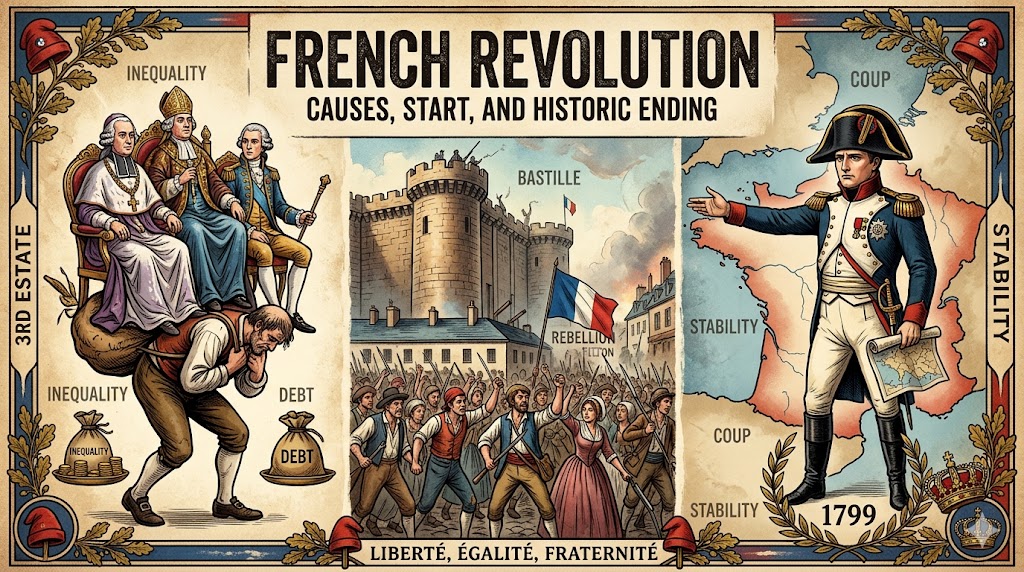
The causes of the French Revolution were multifaceted, combining long-term structural weaknesses with short-term triggers. At its core lay a rigid social structure divided into three Estates. The First Estate (clergy) and Second Estate (nobility) enjoyed privileges, including tax exemptions, while the Third Estate — comprising 98% of the population — bore the financial burden.
Economic distress played a pivotal role. France faced a severe debt crisis exacerbated by costly involvement in the American War of Independence and extravagant court spending at Versailles. Poor harvests in the 1780s led to skyrocketing bread prices, causing widespread hunger and unrest among the urban poor and peasants.
Enlightenment ideas further fueled discontent. Philosophers like Voltaire, Rousseau, and Montesquieu criticized absolute monarchy, advocated social contract theory, and promoted reason, liberty, and equality. These intellectual currents spread through salons, pamphlets, and educated middle classes, creating a climate receptive to change.
Political factors included the weakening authority of King Louis XVI, who lacked decisive leadership. Attempts at reform by ministers like Turgot and Necker faced resistance from privileged classes. The parliaments, judicial bodies dominated by nobles, blocked necessary tax reforms, deepening the fiscal impasse.
Social inequalities, resentment toward feudal privileges, and rising bourgeois aspirations for political power converged to create explosive conditions. These causes of the French Revolution were not isolated but interconnected, setting the stage for radical transformation.
How the French Revolution Started: The Crisis of 1788-1789
The immediate spark that ignited the French Revolution came in 1789. Facing bankruptcy, Louis XVI convened the Estates-General in May 1789 for the first time since 1614. This assembly was intended to address the financial crisis, but deep divisions emerged over voting procedures. The Third Estate demanded voting by head rather than by Estate, seeking fair representation.
On June 17, 1789, the Third Estate declared itself the National Assembly, signaling a revolutionary shift in sovereignty from the king to the people. When locked out of their meeting hall, members gathered at a tennis court and swore the famous Tennis Court Oath, vowing not to disband until a constitution was established. 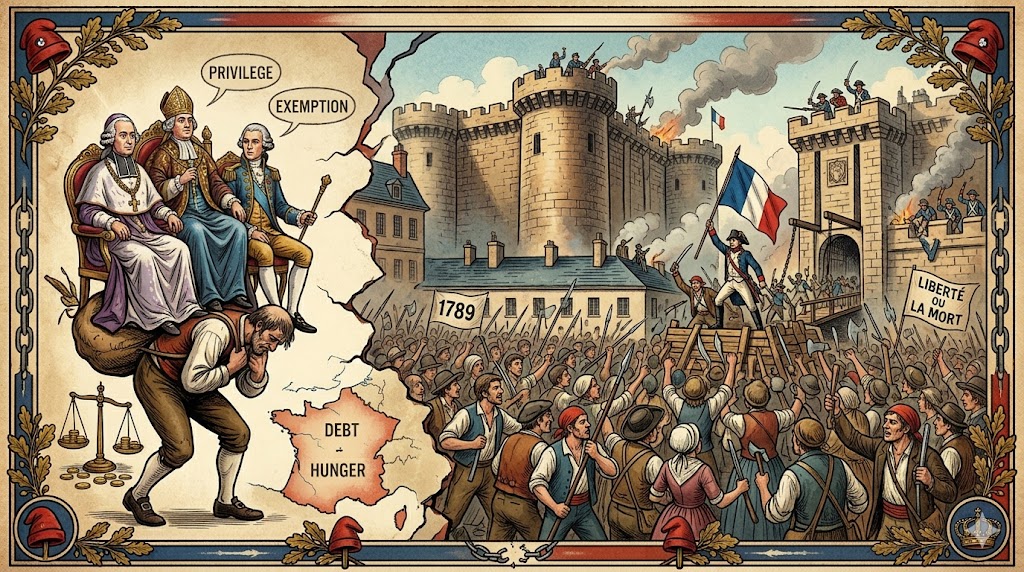
The Outbreak (1789)
Tensions escalated on July 14, 1789, when Parisians stormed the Bastille prison in search of arms. This iconic event, now celebrated as Bastille Day, symbolized popular resistance against royal tyranny and marked the practical beginning of the revolution. News spread rapidly, inspiring peasant revolts across the countryside known as the Great Fear.
In August 1789, the National Assembly abolished feudal privileges and adopted the Declaration of the Rights of Man and of the Citizen, a foundational document proclaiming liberty, property, security, and resistance to oppression. These early months established the revolutionary momentum that defined how the French Revolution started.
Major Phases of the Revolution: From Moderation to Radicalism
The French Revolution unfolded in distinct phases characterized by shifting leadership and intensifying radicalism.
The National Constituent Assembly (1789–1791) focused on constitutional monarchy. It reorganized administration into departments, reformed the Church through the Civil Constitution of the Clergy, and produced the Constitution of 1791. However, Louis XVI’s failed Flight to Varennes in June 1791 eroded trust in the monarchy.
The Legislative Assembly (1791–1792) faced war with Austria and Prussia, economic difficulties, and growing factionalism between Girondins and Jacobins. The storming of the Tuileries Palace in August 1792 led to the suspension of the king and the rise of the Paris Commune.
The National Convention (1792–1795) proclaimed the First French Republic in September 1792. Louis XVI was tried and executed by guillotine in January 1793, an event that shocked Europe. The Committee of Public Safety, led by Maximilien Robespierre, instituted the Reign of Terror (1793–1794) to defend the revolution against internal and external enemies. Thousands faced execution amid economic controls and de-Christianization campaigns.
The Thermidorian Reaction in July 1794 ended Robespierre’s dominance, ushering in a more moderate phase. The Directory (1795–1799) governed through a five-member executive but suffered from corruption, inflation, and military dependence. These phases illustrate the revolution’s turbulent evolution from reformist ideals to authoritarian measures and eventual stabilization attempts.
Key Figures and Their Roles
Several personalities shaped the course of the French Revolution. Louis XVI and Marie Antoinette symbolized the old order’s detachment. Honoré Mirabeau and the Abbé Sieyès influenced early moderate stages. Georges Danton, Jean-Paul Marat, and Maximilien Robespierre drove radical republicanism. Napoleon Bonaparte rose through military successes, eventually playing a decisive role in the revolution’s conclusion.
Women such as Olympe de Gouges advocated for gender rights through works like the Declaration of the Rights of Woman, though their influence faced significant backlash. These individuals embodied the competing visions that propelled events forward.
International Impact and Wars
The French Revolution quickly acquired an international dimension. Revolutionary France declared war on Austria in 1792, leading to the Revolutionary Wars. The levée en masse mobilized mass armies, spreading republican ideals across Europe while defending against coalitions. These conflicts both exported revolution and sowed seeds for future imperialism under Napoleon.
The Ending of the French Revolution: Rise of Napoleon and 1799 Coup
The French Revolution is generally considered to have ended in 1799 with Napoleon Bonaparte’s coup d’état on 18 Brumaire. By then, the Directory had lost legitimacy due to economic woes, corruption, and military setbacks. Napoleon, returning from the Egyptian campaign as a celebrated general, allied with Emmanuel Sieyès and others to overthrow the government.
This bloodless coup established the Consulate, with Napoleon as First Consul. The 1799 Constitution centralized power, effectively ending the revolutionary experiment in popular sovereignty while preserving many of its legal and administrative reforms. The Napoleonic era that followed consolidated revolutionary gains such as the Civil Code, metric system, and equality before the law, but replaced republican fervor with authoritarian efficiency.
Some historians extend the revolutionary period to 1815 with Napoleon’s final defeat at Waterloo and the Bourbon Restoration. However, the 1799 coup marks the conventional endpoint, transitioning from revolutionary chaos to structured empire-building.
Legacy and Historical Significance
The ending of the French Revolution did not erase its profound legacy. It inspired subsequent movements for independence and democracy across Latin America, Europe, and beyond. Concepts of citizenship, secular governance, and human rights gained global traction. Yet the revolution also demonstrated the dangers of radicalism, mob violence, and dictatorship emerging from idealistic beginnings.
In France, it created a centralized state, destroyed feudalism, and promoted meritocracy. Its contradictions — between liberty and terror, equality and authoritarianism — continue to fascinate historians and political thinkers.

The Historic Ending (1799)
Conclusion
The French Revolution began amid deep-seated economic distress, social inequality, and Enlightenment-inspired demands for reform. From the convening of the Estates-General and the storming of the Bastille in 1789, it unleashed forces that transformed France and the world. Its phases of hope, terror, and moderation ultimately concluded in 1799 with Napoleon’s coup, which stabilized the nation while curtailing pure republican ideals.
Understanding the causes of the French Revolution, how it started, and its historic ending reveals the complex interplay of ideas, economics, and power. More than two centuries later, its echoes persist in modern struggles for democracy, justice, and national identity. The revolution stands as a powerful testament to humanity’s capacity for both extraordinary change and profound upheaval.