Silk Road Legacy: Ancient Trade and Cultural Exchange
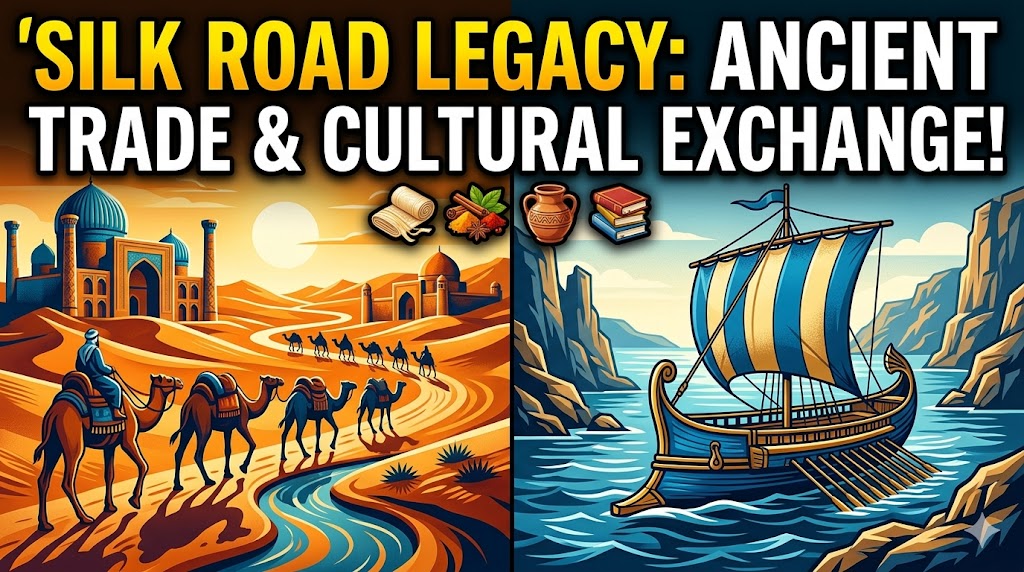
The Silk Road represents one of history's most transformative networks of human connection. Far more than a single path for transporting luxurious Chinese silk, it was a vast web of land and sea routes linking East Asia with the Mediterranean world. Alongside the ancient Mediterranean trade routes dominated by Phoenicians, Greeks, and Romans, these pathways facilitated not only commerce but also the profound exchange of ideas, technologies, religions, and cultures that shaped civilizations.
This article examines the origins and operations of these historic trade systems, their role in cultural exchange, and how echoes of this ancient connectivity persist in modern global trade initiatives. By fostering mutual influence across diverse societies, these routes demonstrated trade's power to bridge worlds and drive progress.
The Origins and Development of the Silk Road
The Silk Road emerged during China's Han Dynasty around 130 BCE when Emperor Wu sent envoy Zhang Qian westward to seek allies against nomadic threats. His journeys revealed fertile trading opportunities, opening formal routes that would endure for over 1,500 years until the mid-15th century.
The network comprised multiple land and maritime paths. Overland routes crossed Central Asia's deserts and mountains through cities like Samarkand, Bukhara, and Kashgar. Maritime extensions linked Chinese ports through Southeast Asia and the Indian Ocean to the Red Sea and Mediterranean.
Key traders included Chinese merchants, Central Asian nomads, Persian intermediaries, and Mediterranean buyers. Goods flowed eastward and westward: silk, tea, porcelain, and spices from the East; gold, silver, glassware, horses, and wool from the West. Trade was rarely direct; it operated through a relay system where merchants exchanged goods at oasis towns and ports.
The routes thrived under stable empires—the Han, Kushan, Parthian, and later Mongol—providing security against bandits. The Pax Mongolica in the 13th-14th centuries marked a golden age of safe passage.
Ancient Mediterranean Trade Routes: Complementary Networks
While the Silk Road connected East and West overland, the Mediterranean Sea served as a bustling maritime highway for the ancient world. Phoenician seafarers from the Levant pioneered extensive networks from around 1200 BCE, establishing colonies like Carthage and trading purple dyes, glass, timber, and metals across the Mediterranean, reaching as far as Britain and West Africa.
Greek city-states expanded these networks during the Classical and Hellenistic periods, founding colonies and trading olive oil, wine, pottery, and ideas. The Roman Empire unified the Mediterranean ("Mare Nostrum"), enabling massive grain shipments from Egypt and North Africa to feed Rome, alongside luxury goods from farther afield.
These Mediterranean routes intersected with Silk Road extensions via ports like Alexandria and Antioch, creating a truly interconnected Afro-Eurasian economy. Goods like Indian spices and Chinese silk reached Roman markets, while Roman coins and technologies traveled east.
Cultural Exchange: Ideas, Religions, and Innovations Along the Routes
The true significance of these trade networks lies in cultural diffusion. Merchants, pilgrims, and travelers carried more than commodities; they exchanged knowledge that transformed societies.
Religion and Philosophy: Buddhism spread from India to China and Central Asia via Silk Road monks and traders, influencing art and thought. Christianity, Zoroastrianism, Manichaeism, and later Islam followed similar paths. Nestorian Christians and Jewish communities established diaspora presence along the routes.
Art, Technology, and Science: Artistic styles blended—Greco-Buddhist sculpture in Gandhara exemplified fusion. Technologies like papermaking, gunpowder, and the compass moved westward from China, while viticulture, mathematics, and astronomy traveled east. Medical knowledge, crops (such as citrus and grapes), and musical instruments crossed borders.
Languages and Literature: The routes promote lingua francas like Sogdian and Aramaic. Stories, fables, and literary motifs spread, enriching global heritage.
Cities along the routes became cosmopolitan hubs. Samarkand and Palmyra thrived as melting pots where diverse languages, cuisines, and customs coexisted.
Mediterranean exchanges were equally rich: Phoenician alphabet influenced Greek and Latin scripts; Greek philosophy and Roman law shaped later European thought; Egyptian, Greek, and Near Eastern religious ideas intermingled.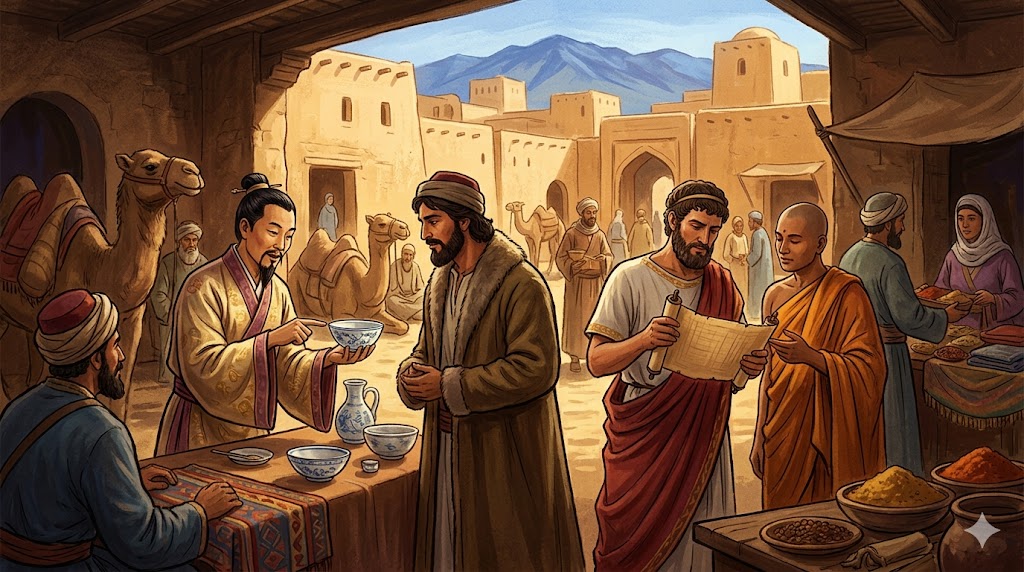
The Caravan Serai Exchange
Key Impacts on Civilizations
The Silk Road and Mediterranean routes accelerated development. They stimulated economic growth, urbanisation, and specialization. Empires gained wealth and power through control of trade nodes. Cultural openness fostered innovation and resilience.
However, challenges existed: disease transmission (including possibly the Plague of Justinian), conflict over routes, and cultural tensions. Overall, the benefits of connectivity outweighed risks, laying foundations for the modern world.
Ongoing Trade: From Ancient Routes to Modern Initiatives
Trade along these historic corridors never fully ceased, though it diminished with the rise of sea routes after 1492. Today, the spirit of the Silk Road lives on through China's Belt and Road Initiative (BRI), often called the New Silk Road, launched in 2013.
The BRI encompasses land (Belt) and maritime (Road) components, investing in infrastructure—railways, ports, highways, and pipelines—across Asia, Europe, and Africa. It aims to enhance connectivity, trade, and economic cooperation, echoing ancient networks while addressing contemporary needs like energy and digital links.
Modern trade continues via rail freight from China to Europe (China-Europe Railway Express), maritime shipping through upgraded ports like Piraeus in Greece, and energy pipelines. Goods include electronics, machinery, consumer products, and resources. Cultural exchange persists through tourism, educational programs, and people-to-people ties.
While the BRI faces debates over debt, environmental impact, and geopolitics, it underscores the enduring relevance of connectivity for mutual prosperity.
Lessons for Today: Globalization's Ancient Roots
The ancient Silk Road and Mediterranean networks remind us that globalization is not new. They fostered a more interconnected world, proving that trade can be a force for understanding and innovation. In an era of supply chain challenges and geopolitical tensions, their legacy advocates for resilient, cooperative networks that prioritize shared benefits.
Preserving heritage sites along these routes and promoting sustainable modern equivalents can help future generations appreciate this shared human story.
Conclusion
The Silk Road and ancient Mediterranean trade routes were arteries of civilization, pulsing with goods, people, and ideas. They enabled unprecedented cultural exchange that enriched art, religion, science, and daily life across continents. From Han China's silk to Roman glassware, Phoenician voyages to Central Asian caravans, these pathways wove a tapestry of human achievement.
As modern initiatives revive these connections, we see continuity in humanity's drive to connect, trade, and learn from one another. Understanding this history illuminates the foundations of our globalized world and the potential for future collaboration. The routes may have changed, but the enduring impacts of exchange continue to shape our collective destiny.