Ramakrishna Paramahansa: Mystic Sage of Spiritual Unity
Ramakrishna Paramahansa stands as one of the most remarkable spiritual figures in modern Indian history. Born in a small village in Bengal in 1836, he rose to become a beacon of devotional mysticism whose life and teachings continue to inspire millions across the world. Far from being a traditional scholar or reformer in the conventional sense, Ramakrishna embodied the living spirit of spirituality through direct, ecstatic experiences of the divine. His message was simple yet profound: God can be realized through any sincere path, and all religions ultimately lead to the same ultimate reality.
In an age marked by colonial rule and growing social divisions, Ramakrishna Paramahansa offered a refreshing vision of unity that transcended dogma and ritual. His influence extended far beyond his lifetime, primarily through his chief disciple, Swami Vivekananda, who carried his guru’s message to the West and laid the foundation for the Ramakrishna Mission. This article explores the life, spiritual practices, core teachings, and enduring legacy of Ramakrishna Paramahansa, offering readers a comprehensive understanding of this extraordinary mystic whose wisdom remains remarkably relevant today.
Early Life and Formative Years
Ramakrishna was born Gadadhar Chattopadhyay on February 18, 1836, in the village of Kamarpukur in West Bengal. Coming from a modest Brahmin family, he displayed unusual spiritual inclinations from a very young age. As a child, he would often lose himself in thoughts of God, experiencing spontaneous trances while listening to devotional stories or witnessing religious processions.
His formal education was limited, as he showed little interest in conventional schooling. Instead, Gadadhar found joy in nature, folk theater, and the company of wandering monks. The death of his father when he was just seven years old deepened his introspective nature. At the age of sixteen, he moved to Calcutta (now Kolkata) to assist his elder brother at the Dakshineswar Kali Temple, a pivotal turning point that shaped his spiritual destiny.
It was at Dakshineswar that Ramakrishna began his intense spiritual practices under the guidance of various gurus. His sincere yearning for God-realization set him apart from ordinary temple priests. He approached each form of worship with childlike innocence and total absorption, qualities that would define his entire life.
The Spiritual Journey: Sadhana and Divine Realizations
Ramakrishna Paramahansa’s spiritual journey was characterized by intense sadhana (spiritual discipline) across multiple traditions. He spent years in single-minded pursuit of the divine, often in states of ecstatic absorption known as samadhi.
His first major realization came through devotion to Goddess Kali. For months, he cried out to the Divine Mother with such intensity that he later described feeling as if a sword was piercing his heart. One day, in 1856, he experienced a vision of Kali that transformed him completely. This marked the beginning of his tantric practices under the guidance of Bhairavi Brahmani, who helped him navigate the complex path of divine ecstasy.
Ramakrishna did not stop with Hinduism. Driven by an insatiable thirst for truth, he explored other paths with equal sincerity. He practiced Vaishnavism, experiencing the love of Krishna and Radha. He delved into Advaita Vedanta under the monk Totapuri, achieving nirvikalpa samadhi — the highest state of non-dual consciousness — within a short period. Remarkably, he also practiced Christianity and Islam, realizing Christ and Allah through their respective traditions.
These diverse experiences led him to one of his most famous conclusions: “As many faiths, so many paths.” Ramakrishna Paramahansa demonstrated through personal example that different religions are like various roads leading to the same mountain peak. His teachings of religious harmony emerged not from intellectual study but from lived spiritual realization.
Throughout his practices, Ramakrishna maintained the attitude of a child before the Divine Mother. This “childlike” bhava allowed him to remain humble, joyful, and free from ego even as he attained the highest states of consciousness.
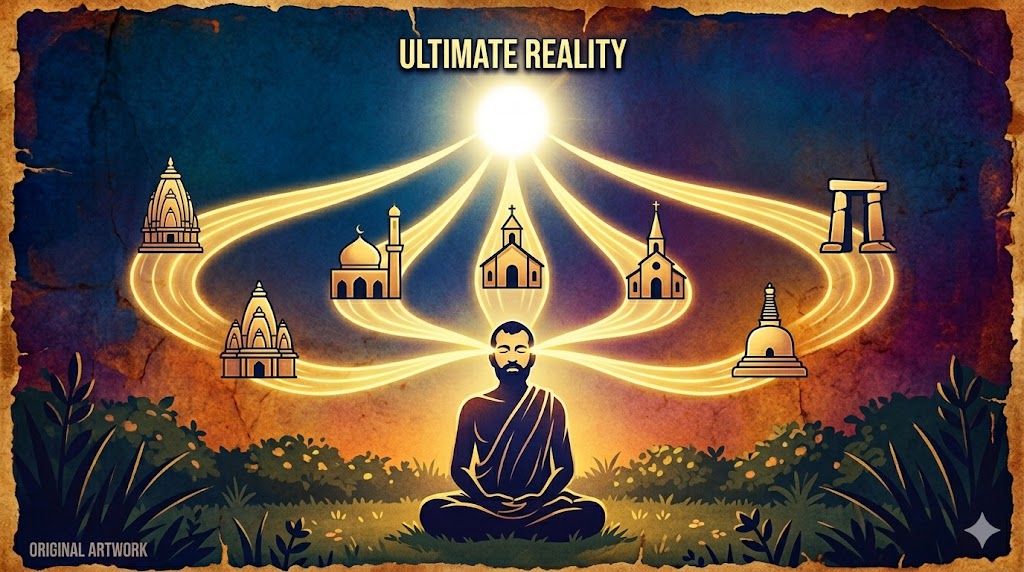
The Vision of Divine Unity (Religious Harmony)
Core Teachings of Ramakrishna Paramahansa
The teachings of Ramakrishna are practical, direct, and deeply rooted in personal experience rather than abstract philosophy. Several key themes emerge consistently from his conversations, later compiled inThe Gospel of Sri Ramakrishna.
Unity of Religions: This forms the cornerstone of his message. Ramakrishna taught that God is one, but appears in different forms according to the devotee’s culture and temperament. He often used the analogy of water being called by different names in various languages yet remaining the same substance.
Direct Experience of God: Mere intellectual knowledge or ritualistic worship was insufficient for him. He emphasized that true spirituality lies in realizing God directly. “God can be seen and talked to,” he would say, encouraging devotees to cultivate intense longing and purity of heart.
Renunciation and Detachment: While he did not advocate complete withdrawal from the world for everyone, Ramakrishna stressed mental renunciation. He taught that one should perform duties without attachment, like a maidservant who works in a wealthy household but keeps her mind on her own village home.
Devotion and Love (Bhakti): Ramakrishna placed great importance on pure love for God. He considered bhakti as the easiest path in the Kali Yuga. His own life was a testament to this, filled with songs, dances, and tears of divine love.
Purity of Mind: He repeatedly warned against lust and greed, calling them the greatest obstacles on the spiritual path. For householders, he advised moderation and channeling energies toward God.
Service to Humanity as Worship: Though this aspect was later expanded by Vivekananda, Ramakrishna laid the foundation by seeing God in every being. He taught that serving others with the right attitude is a form of worship.
His teachings were conveyed through parables, humorous stories, and simple examples drawn from everyday life, making profound truths accessible to ordinary people.
aThe Guru-Disciple Relationship with Swami Vivekanand
One of the most significant aspects of Ramakrishna Paramahansa’s life was his meeting with Narendranath Dutta, later known as Swami Vivekananda. Their relationship was transformative for both and for the future of Indian spirituality.
Initially skeptical and intellectually oriented, young Narendra tested Ramakrishna repeatedly. Yet, the guru recognized the disciple’s potential immediately. Through patient guidance and powerful spiritual transmission, Ramakrishna helped Narendra move from doubt to firm realization.
Before his passing in 1886, Ramakrishna entrusted Narendra with the care of his other disciples and the mission of spreading the universal message. This relationship ensured that the teachings of Ramakrishna Paramahansa reached a global audience through Vivekananda’s dynamic interpretation and organizational efforts.
Later Years, Illness, and Mahasamadhi
In his final years, Ramakrishna continued guiding devotees while battling throat cancer. Even in pain, his spiritual presence remained undiminished. He viewed his illness with detachment, seeing it as the Divine Mother’s will.
Ramakrishna Paramahansa entered mahasamadhi on August 16, 1886, at the age of fifty. His passing marked the end of an extraordinary chapter but ignited a movement that would carry his light worldwide.
Establishment of the Ramakrishna Mission and Order
Following Ramakrishna’s passing, Swami Vivekananda and other direct disciples formally established the Ramakrishna Math and Mission in 1897. The organization combined spiritual practices with selfless service to humanity — “Shiva Jnane Jiva Seva” (serving man as God). Today, it runs numerous educational institutions, hospitals, rural development projects, and disaster relief operations across India and abroad, faithfully carrying forward the guru’s vision.
Relevance of Ramakrishna’s Teachings in the Modern World
In today’s polarized world, the message of Ramakrishna Paramahansa offers profound hope. His emphasis on religious harmony provides a model for interfaith dialogue and mutual respect. His insistence on direct spiritual experience encourages individuals to move beyond superficial religiosity toward authentic transformation.
Young seekers particularly appreciate his practical approach that accommodates both householders and renunciates. In an age of materialism, his teachings on renunciation and inner joy serve as a necessary counterbalance. Mental health professionals and spiritual seekers also find value in his insights on controlling desires and cultivating purity.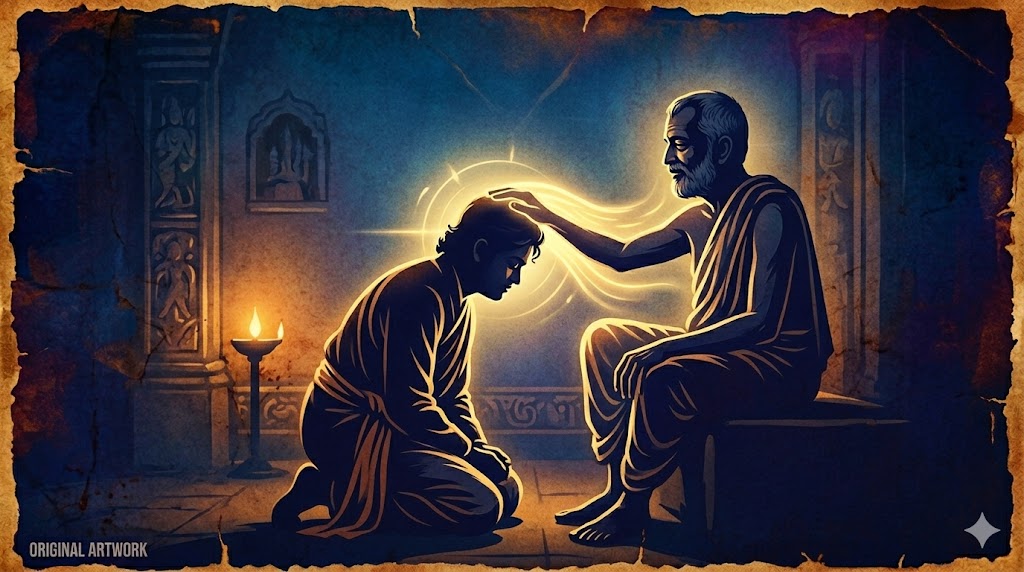
Transmission of Spiritual Light (Guru and Disciple)
Conclusion
Ramakrishna Paramahansa remains a towering figure whose life exemplified the highest possibilities of human consciousness. Through his intense sadhana, childlike devotion, and universal outlook, he demonstrated that spirituality transcends boundaries of creed, caste, and culture. His teachings continue to guide those who seek direct experience of the divine while living meaningfully in the world.
The legacy of Ramakrishna Paramahansa lives on not only in temples and ashrams but in the hearts of countless individuals who draw inspiration from his simple yet profound wisdom. As Swami Vivekananda famously declared, his master was an incarnation of divine love and wisdom for the modern age.
By studying the life and teachings of Ramakrishna, we reconnect with the eternal spiritual heritage of humanity and find practical tools for navigating contemporary challenges with inner strength and compassion. His message remains as fresh and relevant today as it was in 19th-century Bengal — an invitation to realize God in whatever form appeals to our heart and to see the divine presence shining through all of creation.