"Iran War 2026: Global Risks & IMF 2027 Warning"
The ongoing conflict involving the United States, Israel, and Iran that began in late February 2026 continues to send shockwaves across the global economy. What started as targeted military actions has developed into a tense standoff centered on the Strait of Hormuz, with profound consequences for energy markets, international trade, and economic stability. Despite intermittent ceasefire efforts, repeated violations and persistent tensions raise serious concerns about prolongation.
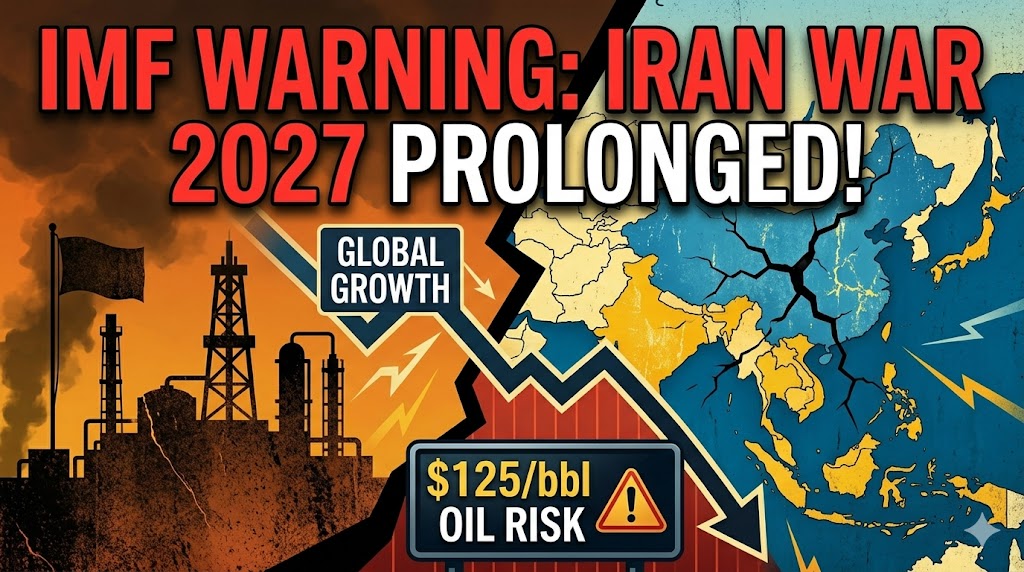
The International Monetary Fund (IMF) has issued stark warnings, cautioning that if the war extends into 2027 with oil prices climbing toward $125 per barrel, the world could face a significantly worse economic outcome, including slower growth, higher inflation, and increased hardship for vulnerable nations. Iran bears the heaviest direct burden, but Asian economies — heavily dependent on Middle Eastern energy — face substantial risks that demand urgent attention and strategic preparedness.
This article examines the current state of the conflict, its economic repercussions on Iran and Asia, the pivotal role of oil, ceasefire challenges, IMF projections, and what the future may hold as the world grapples with these uncertainties.
As of early May 2026, the conflict remains in a fragile phase. A ceasefire announced in early April has been repeatedly tested by incidents in the Strait of Hormuz, including attacks on commercial vessels, naval confrontations, and accusations of violations from both sides. The United States has pursued initiatives like "Project Freedom" to escort ships and reopen shipping lanes, while Iran has accused Washington of undermining the truce.
Negotiations continue through intermediaries, with new proposals exchanged, yet President Trump has expressed dissatisfaction with Iranian offers, emphasizing that Tehran must pay a sufficient price for long-term stability. Sporadic strikes and blockades persist, preventing full normalization of energy flows and keeping markets on edge. This volatility underscores the difficulty of achieving a lasting resolution amid deep-seated mistrust.
Direct Impact on Iran: Economic Devastation and Resilience Challenges
Iran has suffered the most immediate and severe consequences. Sanctions, military strikes on infrastructure, and disruptions to oil exports have crippled government revenues. The Iranian economy, already strained before the conflict, now faces hyperinflation risks, currency devaluation, and shortages of essential goods. Oil production and export capabilities have been significantly curtailed due to damage and export route blockades.
Ordinary Iranians endure rising food and fuel prices, reduced employment opportunities, and uncertainty about basic services. The regime's ability to maintain domestic stability is being tested, with reports of internal pressure mounting. While Iran demonstrates resilience through alternative trade routes and alliances, particularly with China and Russia, the prolonged conflict threatens deeper isolation and long-term developmental setbacks. Future awareness for Iran involves diversifying its economy beyond oil and strengthening regional diplomacy to mitigate isolation risks.
Ripple Effects on Asian Economies: Heightened Vulnerability
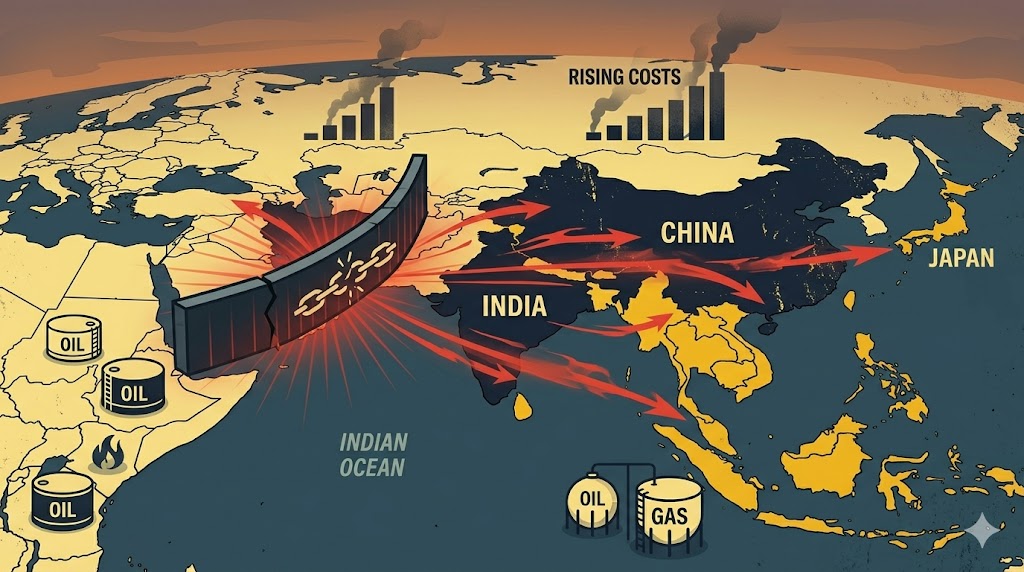
Asian countries, major importers of Middle Eastern energy, are particularly exposed. Around 80% of Asia’s oil imports historically pass through the Strait of Hormuz, making the region highly sensitive to disruptions. Nations like India, China, Japan, South Korea, and Southeast Asian economies face rising energy costs that feed into transportation, manufacturing, and electricity prices.
The United Nations Development Programme estimates potential output losses in the Asia-Pacific ranging from $97 billion to nearly $300 billion depending on conflict duration. Countries with limited strategic reserves, such as Vietnam, Pakistan, and the Philippines, are most at risk, implementing conservation measures like reduced industrial operations and fuel rationing. India and China, while better positioned, still contend with inflationary pressures and supply chain adjustments.
Asian policymakers should prepare for future contingencies by accelerating energy diversification, investing in renewables, building larger strategic petroleum reserves, and fostering regional cooperation on energy security. Over-reliance on a single chokepoint has proven costly, highlighting the need for alternative routes and supplier diversification.
The Central Role of Oil in Prolonging Tensions
Oil remains the conflict's economic heartbeat. Disruptions in the Strait of Hormuz have caused significant price volatility, with Brent crude often trading well above pre-war levels. Threats to close or restrict the strait — through which roughly one-fifth of global oil passes — create constant uncertainty that keeps risk premiums elevated.
Every attempt at a ceasefire or agreement is complicated by oil dynamics. When negotiations appear promising, incidents in the waterway often undermine progress, as seen in recent US escort operations met with Iranian responses. Higher prices benefit some producers but punish importers, creating uneven global pressures that influence diplomatic calculations. Sustained high oil prices also risk embedding inflation, complicating monetary policies worldwide.
The IMF notes that oil averaging around or above $100 per barrel in 2026, potentially reaching $125 in 2027 under adverse scenarios, would amplify these effects dramatically. Gas prices, particularly for Asia and Europe, could surge even more sharply, compounding energy security challenges.
The 2027 Energy Price Pivot
IMF Predictions: Risks of Prolongation to 2027
The IMF has outlined multiple scenarios in its recent assessments. In a reference case assuming relatively short disruptions, global growth faces modest downgrades. However, Managing Director Kristalina Georgieva has warned that continuation into 2027 with oil at $125 per barrel would lead to a "much worse outcome." Global growth could drop toward 2% — territory associated with recession — while inflation climbs significantly higher.
These projections factor in supply shortfalls of millions of barrels per day, persistent uncertainty, and secondary effects on food and commodity prices. For developing economies in Asia and beyond, the combination of higher import bills, weaker currencies, and reduced export demand could push millions into poverty and strain fiscal balances. The adverse scenario is already partially materializing, according to IMF observations, underscoring the urgency of de-escalation.
Ceasefire Violations and Barriers to Resolution
Repeated incidents in the Strait of Hormuz illustrate the fragility of current arrangements. Both sides accuse the other of violations, with naval clashes, attacks on merchant vessels, and proxy actions keeping tensions alive. Efforts to escort ships or enforce blockades often provoke responses that derail diplomatic momentum.
These dynamics create a cycle where economic pain incentivizes talks, yet security incidents and mutual distrust hinder breakthroughs. Iran seeks sanctions relief and security guarantees, while the US and allies demand verifiable limits on nuclear activities and regional influence. Bridging these gaps remains challenging amid domestic political considerations on all sides.
Future Outlook: Lessons and Preparations for a Uncertain World
If the conflict extends, the cumulative costs could reshape global economic patterns for years. Iran may face deeper isolation unless it pivots toward economic reforms and broader engagement. Asian nations must treat this as a wake-up call to reduce energy vulnerabilities through policy innovation and infrastructure investment.
For the wider world, prolonged instability risks higher baseline commodity prices, slower trade growth, and fragmented supply chains. Positive developments, such as successful diplomacy leading to a durable agreement, could allow rapid recovery as shipping normalizes and prices moderate. However, the longer the uncertainty persists, the greater the scarring effects on investment, confidence, and development goals.
Countries worldwide should enhance strategic reserves, promote energy transition technologies, and strengthen multilateral frameworks for crisis response. Businesses need to build more resilient supply networks, while investors should account for geopolitical risk premiums in long-term planning.
Broader Geopolitical and Economic Implications
The conflict highlights the interconnectedness of security and economics in the modern world. Superpowers like the US cannot entirely shield themselves from global repercussions, while emerging economies in Asia bear disproportionate burdens relative to their influence over the conflict's origins. This asymmetry may accelerate calls for diversified energy sources and reformed international governance of critical maritime routes.
Environmental considerations also emerge, as higher fossil fuel reliance during crises delays climate objectives. Conversely, sustained high prices could incentivize faster adoption of alternatives in some regions.
Conclusion
The US-Iran-Israel war of 2026 serves as a stark reminder of how regional conflicts can generate global economic turbulence. Iran confronts existential economic pressures, while Asian countries and other importers navigate inflation, growth slowdowns, and energy insecurity. The IMF’s caution about prolongation into 2027 with oil prices at $125 per barrel paints a concerning picture that demands proactive responses from policymakers everywhere.
Oil’s central role continues to complicate ceasefire efforts and diplomatic progress amid recurring violations in the Strait of Hormuz. The world is losing valuable time and resources with each passing day of instability. A swift, negotiated resolution offers the best path to recovery, but preparation for extended challenges is essential.
As nations reflect on these events, the key lesson is the importance of energy resilience, diplomatic foresight, and international cooperation. By learning from the current crisis, countries can better safeguard their economies against future geopolitical shocks, ensuring greater stability and prosperity in an increasingly interconnected world. The coming months will prove critical in determining whether this conflict becomes a temporary disruption or a defining economic challenge of the decade.