5th India-Tanzania Joint Trade Committee Meeting Held

The 5th Session of the India–Tanzania Joint Trade Committee (JTC) Meeting was successfully held on April 29-30, 2026, in Dar es Salaam, Tanzania. This important bilateral engagement marked a significant step forward in strengthening economic ties between the two nations, with bilateral trade reaching a new milestone of $9.02 billion in 2025-26.
Co-chaired by Shri Rajesh Agrawal, Commerce Secretary of India, and Amb. Dr. Samwel William Shelukindo, Permanent Secretary in Tanzania’s Ministry of Foreign Affairs and East African Cooperation, the meeting provided a comprehensive platform to review progress, address trade barriers, and explore new avenues for collaboration. Discussions highlighted a shared commitment to enhancing trade, investment, and people-to-people ties across diverse sectors.
This article offers a detailed examination of the 5th India-Tanzania Joint Trade Committee Meeting, its outcomes, historical context, economic significance, and future implications for the growing partnership between India and Tanzania.
India and Tanzania share longstanding historical, cultural, and economic relations dating back centuries. In the modern era, these ties have evolved into a robust strategic partnership, particularly in trade and development cooperation. The Joint Trade Committee serves as a key institutional mechanism to facilitate regular dialogue on economic issues and promote mutually beneficial engagement.
The previous (4th) session of the JTC was held in 2017. The gap of several years reflected global disruptions, including the COVID-19 pandemic, but the resumption in 2026 underscores renewed momentum. The 5th meeting took place against a backdrop of steady growth in bilateral trade, which increased from $8.64 billion in 2024-25 to $9.02 billion in 2025-26.
India has emerged as one of Tanzania’s major trading partners, while Tanzania offers Indian businesses a gateway to the East African market. The meeting in Dar es Salaam provided an opportunity to build on this foundation through focused discussions and a parallel business networking event.
Key Highlights and Outcomes of the 5th JTC Meeting
The two-day deliberations covered a wide range of topics aimed at removing bottlenecks and expanding cooperation. Major focus areas included:
Promotion of trade settlement in local currencies to reduce dependence on third-party currencies and lower transaction costs.
Facilitation of long-term business visas for Indian entrepreneurs and professionals.
Strengthening regulatory collaboration in pharmaceuticals and healthcare.
Capacity building initiatives in health, AYUSH (Ayurveda, Yoga, Unani, Siddha, and Homeopathy), education, and shipbuilding.
Enhanced cooperation in agriculture, livestock, energy, skill development, MSMEs, railways, infrastructure, and digital public infrastructure.
Both sides reviewed progress since the last meeting and identified actionable steps to resolve trade barriers faced by the private sector. The discussions emphasized practical solutions, technology transfer, and market access improvements. A comprehensive review of bilateral merchandise trade reflected consistent growth and positive momentum.
The meeting concluded with the signing of minutes and a reaffirmation of commitment to deeper economic engagement. The next (6th) session of the JTC is scheduled to be held in New Delhi on mutually agreed dates.
Parallel Business Engagement and Networking
Complementing the official talks, the High Commission of India in Dar es Salaam organized a business networking event that brought together over 120 stakeholders, including more than 75 Indian and Tanzanian business leaders. This platform allowed direct interaction between government officials and the private sector, fostering potential partnerships and investment opportunities.
Commerce Secretary Rajesh Agrawal expressed appreciation for the accelerating trade partnership and encouraged businesses to explore new frontiers in collaboration.
Economic Significance and Trade Profile
Bilateral trade between India and Tanzania has shown resilience and growth despite global challenges. India exports pharmaceuticals, vehicles, machinery, electrical equipment, and textiles to Tanzania, while importing cashew nuts, minerals, spices, and other agricultural products.
The $9.02 billion trade figure in 2025-26 highlights the expanding economic footprint. Indian investments in Tanzania span sectors such as manufacturing, energy, mining, and infrastructure. Tanzanian businesses benefit from Indian expertise in technology, skill development, and affordable healthcare solutions.
This partnership aligns with India’s broader “Act East” and Africa-focused policies, as well as Tanzania’s development vision emphasizing industrialization, agriculture modernization, and regional integration within the East African Community (EAC) and African Continental Free Trade Area (AfCFTA).
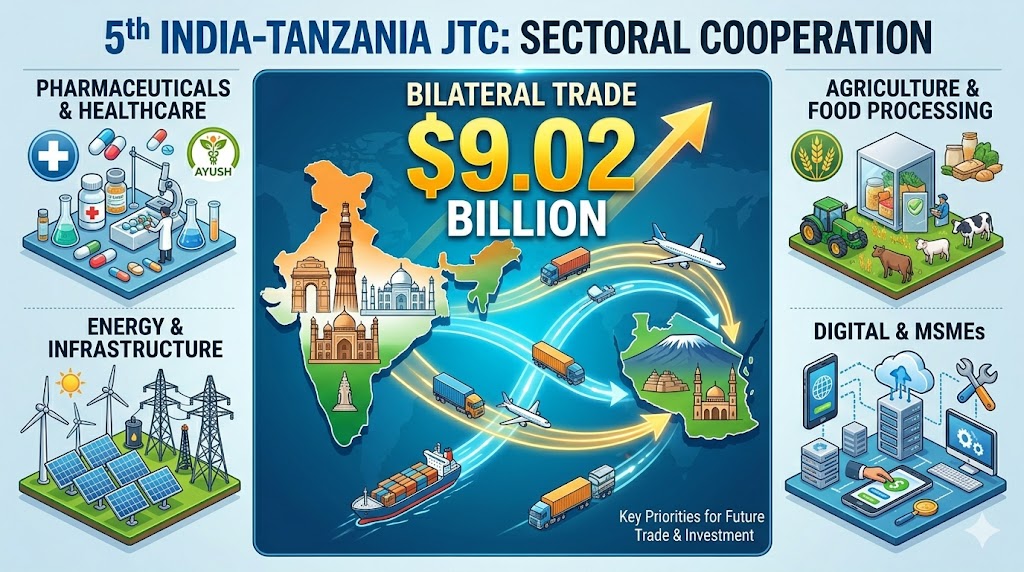
Economic Cooperation Visualization
Strategic Sectors for Future Collaboration
Several sectors emerged as priorities during the 5th JTC meeting:
Pharmaceuticals and Healthcare: Strengthening regulatory frameworks to facilitate greater access to quality medicines and explore joint manufacturing possibilities. AYUSH cooperation adds a traditional medicine dimension.
Energy and Infrastructure: Collaboration in renewable energy, oil and gas exploration, and large-scale infrastructure projects, including railways and ports.
Agriculture and Food Processing: Knowledge sharing in sustainable farming, livestock management, and value addition to agricultural produce.
Digital Economy and Fintech: Leveraging India’s digital public infrastructure expertise for financial inclusion and e-governance initiatives in Tanzania.
MSMEs and Skill Development: Promoting small and medium enterprises through technology transfer, training programs, and easier business visas.
Shipbuilding and Maritime Cooperation: Given Tanzania’s strategic coastal location, potential exists for joint ventures in maritime industries.
These areas reflect complementary strengths and offer substantial scope for win-win outcomes.
Challenges and Opportunities in Bilateral Trade
While progress has been encouraging, challenges remain. These include non-tariff barriers, logistical constraints, limited awareness among smaller businesses, and the need for better payment mechanisms. The JTC platform is designed precisely to address such issues through continuous dialogue and follow-up actions.
Opportunities abound in Tanzania’s growing economy, rich natural resources, and young population. For Indian companies, the country represents an attractive destination for investment with supportive government policies. Conversely, Tanzanian exporters can benefit from India’s vast consumer market and established distribution networks.
Promotion of local currency trade settlement stands out as a forward-looking step that could enhance resilience against global currency fluctuations.
Historical Evolution of India-Tanzania Relations
India and Tanzania have enjoyed warm relations since Tanzania’s independence. India supported Tanzania’s liberation struggle and has been a consistent development partner through lines of credit, capacity building, and technical assistance.
Institutional mechanisms like the Joint Commission on Economic, Technical and Scientific Cooperation and the Joint Defence Cooperation Committee complement the JTC in providing a multi-dimensional framework for engagement.
Over the years, people-to-people ties have strengthened through education, healthcare, and cultural exchanges. The Indian diaspora in Tanzania plays an important bridging role in economic and social spheres.
Broader Regional and Global Context
The 5th JTC meeting occurs within the larger context of India-Africa relations. India continues to expand its footprint across the continent through initiatives like the India-Africa Forum Summit and enhanced development cooperation. Tanzania, as a key East African nation, serves as an important anchor in these efforts.
Global shifts, including supply chain diversification and emphasis on South-South cooperation, further enhance the relevance of such bilateral platforms. Both countries also coordinate positions in multilateral forums such as the United Nations, WTO, and G77.
Expert Perspectives and Reactions
Officials from both sides have welcomed the outcomes. Dr. Shelukindo emphasized using the JTC to resolve practical issues facing businesses and unlock greater economic potential. Indian representatives highlighted the meeting’s role in translating high-level commitments into tangible results on the ground.
Analysts view the steady rise in trade volumes as evidence of a maturing partnership with potential to grow further in the coming years.
Looking Ahead: The Road to the 6th JTC Meeting
The decision to hold the next session in New Delhi signals continued high-level engagement. In the interim, both governments are expected to work on implementing the understandings reached in Dar es Salaam, including follow-up on specific proposals in priority sectors.
Business communities on both sides are encouraged to actively participate in this process, turning policy-level agreements into commercial successes. Monitoring mechanisms will likely be strengthened to track progress on agreed actions.
Conclusion
The successful conclusion of the 5th India-Tanzania Joint Trade Committee Meeting in Dar es Salaam represents a renewed commitment to deepening bilateral economic cooperation at a time of global economic transformation. With trade crossing the $9 billion mark and concrete steps identified across multiple sectors, the partnership is poised for accelerated growth.
As both nations work toward implementing the outcomes of this meeting, the focus remains on creating sustainable, inclusive, and mutually beneficial economic ties. The JTC mechanism continues to prove its value as a practical platform for dialogue, problem-solving, and opportunity creation.
The coming years will test the ability of both sides to translate intentions into impactful results. With strong political will, active private sector participation, and sustained institutional engagement, the India-Tanzania economic relationship is set to reach new heights, contributing to prosperity and development in both countries and the wider region.