Rohit Jain Appointed RBI Deputy Governor for 3 years
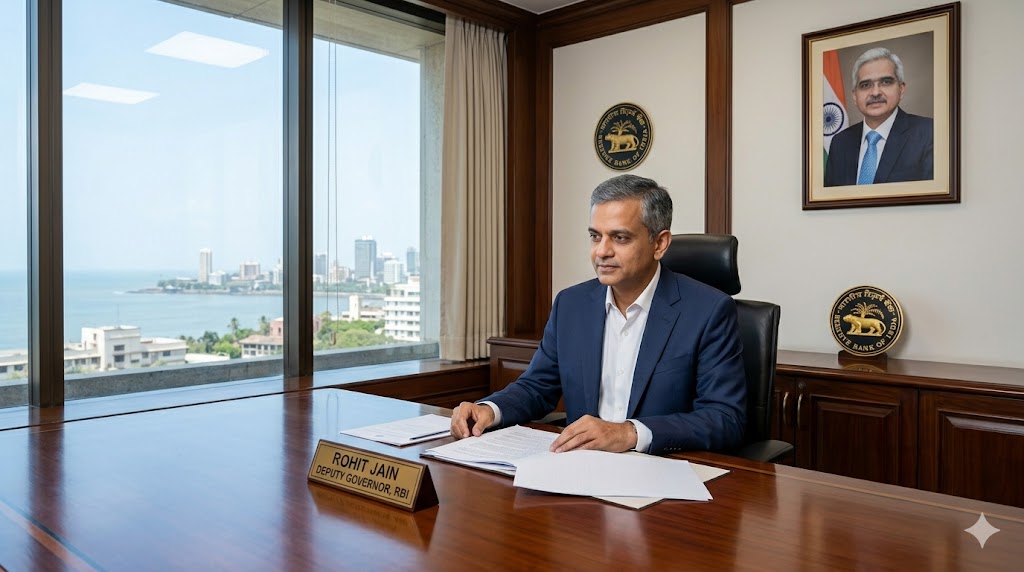
In a significant leadership transition at India’s apex financial institution, the government has appointed Rohit Jain as Deputy Governor of the Reserve Bank of India (RBI). The appointment, effective from May 3, 2026, for a period of three years, comes at a crucial time as the central bank navigates evolving challenges in financial stability, digital innovation, and regulatory oversight.
Rohit Jain, who brings nearly three decades of dedicated service within the RBI, steps into the role previously held by T Rabi Sankar. His elevation from Executive Director underscores the institution’s preference for internal expertise in key leadership positions. This development not only ensures continuity in policy implementation but also signals a focus on strengthening supervisory frameworks amid a rapidly transforming banking landscape.
This article provides a comprehensive overview of Rohit Jain’s appointment, his professional journey, the broader context of RBI leadership, potential responsibilities, and the implications for India’s financial sector.
The Appointments Committee of the Cabinet (ACC) formally approved Rohit Jain’s elevation, as notified by the Department of Personnel and Training. The decision fills the vacancy created by the conclusion of T Rabi Sankar’s extended tenure. Sankar, a seasoned central banker, had served as Deputy Governor since 2021 and received multiple extensions in 2024 and 2025.
Jain’s appointment took effect on or after May 3, 2026, aligning with the immediate need for seamless leadership transition. As one of the senior-most Executive Directors, he was among top contenders that included Vivek Deep, Radha Shyam Ratho, and Ajay Kumar. His selection reflects recognition of long-term institutional knowledge and proven contributions in critical areas.
This marks the second internal promotion to Deputy Governor in recent times, following SC Murmu’s elevation in October 2025. The RBI’s current Deputy Governors now include internal leaders like Jain and Murmu alongside external appointees such as economist Poonam Gupta and banker Swaminathan J.
Who is Rohit Jain? Professional Journey and Expertise
Rohit Jain has dedicated approximately 30 years to the Reserve Bank of India, rising through the ranks with diverse exposure across core functions. Prior to his appointment as Deputy Governor, he served as Executive Director since December 2020, where he oversaw crucial supervisory responsibilities, including assessment and monitoring of banks and financial institutions.
His career within the RBI spans banking supervision, human resource management, regulatory policy, and operational oversight. Jain has been instrumental in strengthening the supervisory framework, risk analytics, and compliance mechanisms that underpin the stability of India’s banking system. His hands-on experience in these domains positions him well to address contemporary challenges such as cybersecurity threats, fintech integration, and climate-related financial risks.
Academic credentials and professional acumen have defined Jain’s trajectory. Holding advanced qualifications in commerce and related fields, he exemplifies the RBI’s tradition of nurturing domain experts who combine technical proficiency with strategic vision. Colleagues and industry observers describe him as a meticulous and balanced leader focused on pragmatic regulation that supports growth while safeguarding stability.
Context Within RBI Leadership Structure
The RBI operates with a Governor and up to four Deputy Governors, each overseeing specific portfolios that collectively cover the central bank’s vast mandate. Deputy Governors play pivotal roles in shaping monetary policy, regulatory frameworks, payment systems, foreign exchange management, and financial inclusion initiatives.
T Rabi Sankar, whom Rohit Jain succeeds, managed an extensive portfolio that included financial markets regulation, foreign exchange, fintech, payment and settlement systems, risk monitoring, and more. With Jain’s arrival, a reshuffle of departmental responsibilities is expected in the coming days to optimize expertise alignment.
This internal promotion maintains institutional memory at the highest levels, which is particularly valuable during periods of economic uncertainty, technological disruption, and global financial volatility. It also reinforces the RBI’s commitment to merit-based advancement for career central bankers.
Key Responsibilities Likely for Rohit Jain
While official portfolio allocation is pending final distribution, analysts anticipate Jain will handle several critical departments based on his background. Potential areas include banking supervision, regulatory oversight, risk management, and aspects of fintech or payment systems.
In his new role, Jain will contribute to key decisions on interest rates, liquidity management, and macro-prudential policies. He will also play a vital part in ongoing efforts to enhance digital banking resilience, improve credit flow to underserved sectors, and strengthen mechanisms against money laundering and financial fraud.
His supervisory experience will prove invaluable in addressing non-performing assets, improving governance standards in banks, and ensuring robust stress-testing frameworks. As India’s economy continues its digital transformation, Jain’s leadership could influence policies promoting responsible innovation while mitigating associated risks.

Addressing Fintech and Modernization Challenges
Implications for Indian Banking and Economy
Rohit Jain’s appointment as RBI Deputy Governor arrives amid several ongoing priorities for the central bank. These include managing inflation expectations, supporting economic growth, deepening financial inclusion, and adapting regulations to emerging technologies like central bank digital currency (CBDC) and artificial intelligence applications in finance.
Industry experts view the move positively, noting that a seasoned insider brings continuity and deep understanding of ground-level operations. This is expected to facilitate smoother implementation of policies and quicker responses to sector-specific challenges.
For commercial banks and financial institutions, Jain’s elevation signals sustained emphasis on prudent supervision and compliance. It may encourage further focus on capital adequacy, risk diversification, and customer protection measures.
From a broader economic perspective, strong and experienced leadership at the RBI bolsters investor confidence and supports India’s ambition to become a global financial hub. Stable regulatory oversight helps maintain the country’s robust credentials even as global headwinds persist.
Reactions and Expert Commentary
The announcement has been received with widespread approval across financial circles. Industry leaders and former RBI officials have congratulated Jain, highlighting his integrity and expertise. Market analysts suggest the appointment will have a stabilizing influence, with minimal disruption expected in ongoing policy trajectories.
Social media and professional networks have seen positive sentiments, with many emphasizing the value of promoting internal talent who understand the nuances of India’s unique financial ecosystem.
Historical Perspective on RBI Deputy Governors
RBI Deputy Governors have historically played transformative roles in shaping India’s monetary and financial architecture. From pioneering reforms in the 1990s to navigating the 2008 global crisis and the more recent pandemic response, these leaders have provided institutional backbone during critical junctures.
Internal promotions like Rohit Jain’s are not uncommon and often bring valuable continuity. Past examples demonstrate how long-serving officials contribute unique insights that complement external expertise brought in for specialized domains such as economics or commercial banking.
Challenges Ahead for the New Deputy Governor
Rohit Jain assumes office at a time when the RBI faces multifaceted challenges. These range from balancing growth and inflation to managing the implications of geopolitical tensions on capital flows and currency stability. Cybersecurity in banking, climate risk integration into financial regulation, and ensuring equitable credit distribution remain high-priority areas.
Additionally, evolving global standards in banking supervision and coordination with international regulators will demand strategic engagement. Jain’s supervisory background equips him to tackle these issues with a practical, experience-driven approach.
Future Outlook and Expectations
As Rohit Jain settles into his role, expectations are high for contributions to forward-looking initiatives. These may include further digitization of financial services, strengthening of cooperative banking structures, and enhanced focus on financial literacy and consumer protection.
His three-year tenure, extending potentially until 2029, provides sufficient time to influence medium-term policy directions and institutional reforms. Observers anticipate a collaborative leadership style that fosters innovation within a framework of prudence and stability.
Conclusion
The appointment of Rohit Jain as Deputy Governor of the Reserve Bank of India represents a thoughtful and strategic leadership transition. With nearly three decades of rich experience, Jain brings institutional knowledge, supervisory acumen, and a commitment to financial stability that will serve the nation well in the coming years.
As the RBI continues to evolve in response to dynamic economic realities, leaders like Jain play a crucial role in upholding the central bank’s reputation for integrity, expertise, and effectiveness. His elevation not only fills an important vacancy but also reinforces confidence in India’s monetary and regulatory framework.
The coming months will reveal more about specific portfolios and policy priorities under Jain’s oversight. For now, the focus remains on smooth onboarding and continued delivery of the RBI’s mandate to foster a resilient and inclusive financial system for India’s growing economy.