"Vishnu Purana: Complete Guide, Summary & Stories".
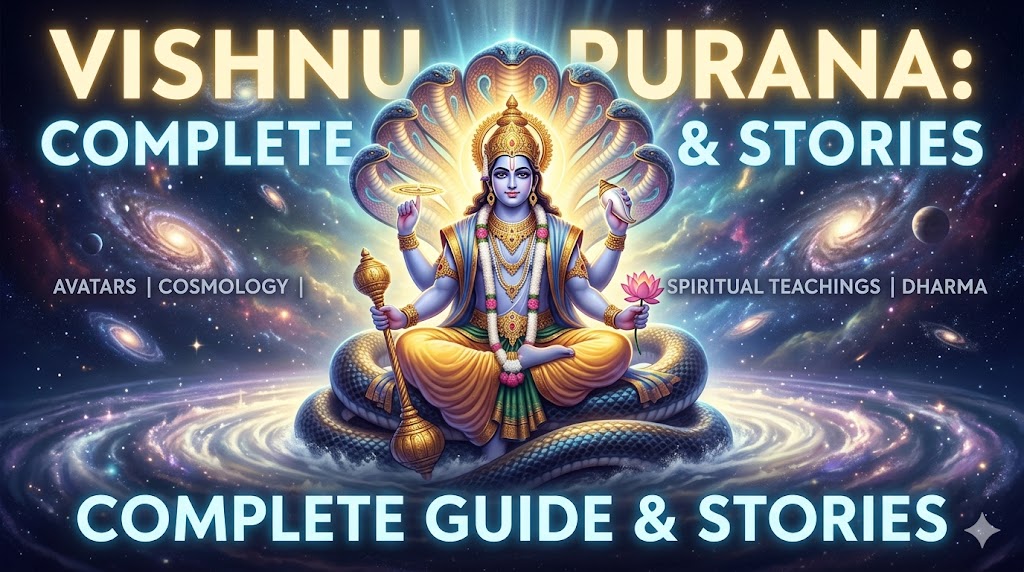
The Vishnu Purana stands as one of the most revered texts among the eighteen Mahapuranas in Hindu tradition. Often called the Puranaratna or "gem of the Puranas," it serves as a profound repository of cosmology, genealogy, philosophy, and devotion centered on Lord Vishnu, the preserver of the universe.
Composed in the form of a dialogue between the sage Parashara and his disciple Maitreya, the Vishnu Purana offers timeless insights into the nature of existence, the cycles of creation and destruction, and the path to liberation. Unlike some other Puranas that emphasize drama or sectarianism, this text maintains a balanced, encyclopedic approach while upholding Vaishnava principles. Scholars date its composition between the early centuries BCE and the first millennium CE, with layers added over time, yet its core message remains consistent across manuscripts.
For devotees and seekers alike, the Vishnu Purana is more than ancient scripture—it is a guide to understanding the divine play (lila) of Vishnu and how one can align with dharma in everyday life. In this article, we delve deeply into its structure, key stories, philosophical truths, and enduring relevance.
Historical and Literary Context of the Vishnu Purana
The Vishnu Purana is attributed traditionally to Sage Vyasa, the compiler of the Vedas, though it was narrated by Parashara. It belongs to the Sattvic category of Puranas, promoting purity, knowledge, and devotion to Vishnu. It follows the Pancalaksana framework more faithfully than most other Puranas: Sarga (creation), Pratisarga (re-creation or dissolution), Vamsa (genealogies), Manvantara (cosmic cycles or ages of Manu), and Vamsanucarita (legends of kings and sages).
This structure makes the Vishnu Purana particularly systematic. It contains approximately 23,000 verses in its traditional count, though surviving versions are shorter, divided into six Amshas (parts) and 126 chapters. Its language is classical Sanskrit, accessible yet profound, blending narrative with philosophical discourse.
In Hindu society, the Vishnu Purana has influenced temple traditions, festivals, and ethical teachings. It praises Vishnu as the ultimate reality while respectfully acknowledging Brahma and Shiva as aspects of the divine. This inclusive tone has contributed to its widespread acceptance across Vaishnava traditions.
Structure and Division of the Vishnu Purana
The text is organized into six main sections, each building upon the previous to create a comprehensive worldview:
First Amsha (Cosmology and Creation – 22 chapters): This part introduces the universe's origin, the nature of Vishnu, and primary creation stories.
Second Amsha (Geography and Astronomy – 16 chapters): Detailed descriptions of the Earth, continents (like Jambudvipa and Bharatavarsha), planetary systems, and the movement of celestial bodies.
Third Amsha (Time, Manus, and Duties – 18 chapters): Explores cosmic time cycles, the reigns of different Manus, and social and religious duties.
Fourth Amsha (Genealogies – 24 chapters): Royal lineages of solar and lunar dynasties, including stories of famous kings.
Fifth Amsha (Krishna Avatar – chapters focused on Vishnu's incarnations): A detailed account of Lord Krishna's life, considered one of the most vivid narrations in Puranic literature.
Sixth Amsha (Liberation and Conclusion): Discussions on yoga, dharma, and the path to moksha, ending with prophecies and the importance of devotion.
This logical progression—from macro-level creation to micro-level human conduct—sets the Vishnu Purana apart.
Chapter 1 and the Opening Dialogue
In the very first chapter of the Vishnu Purana, Maitreya approaches his guru Parashara with deep questions about the universe: its origin, sustenance, and end. Parashara, having gained divine knowledge after a personal tragedy involving rakshasas, begins by invoking Vishnu.
Parashara explains that Vishnu is the supreme cause— the universe arises from Him, exists in Him, and dissolves back into Him. The sage performs a ritual but is advised by Vashistha to focus on knowledge rather than vengeance. This sets a tone of wisdom over retribution. The chapter establishes the text's purpose: to impart comprehensive knowledge of the divine.
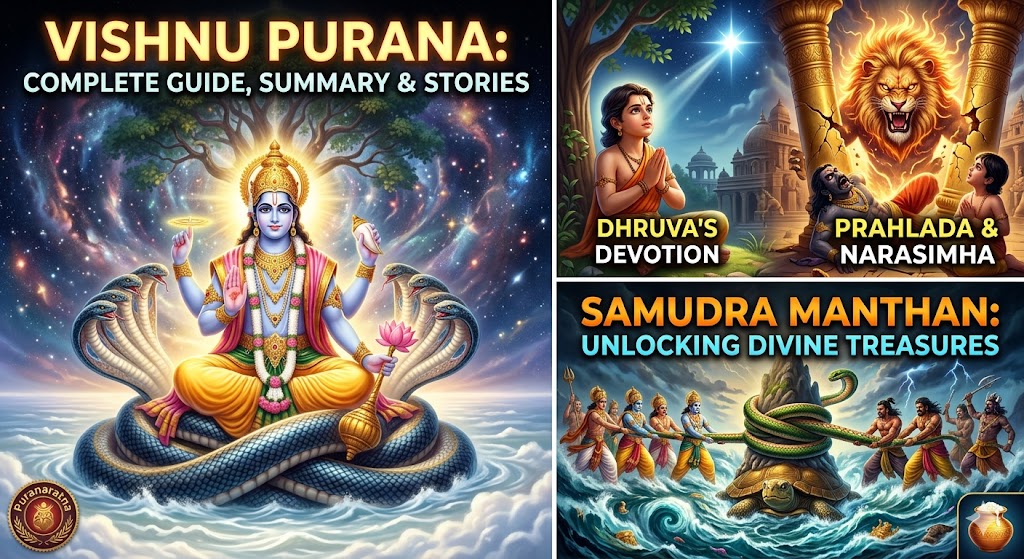
Samundra manthan
Key Stories and Narratives in the Vishnu Purana
The Vishnu Purana is rich with inspiring tales that illustrate dharma, bhakti, and cosmic order.
The Story of Dhruva: A young prince's unwavering devotion leads him to attain the pole star (Dhruva Nakshatra) as a boon from Vishnu. This narrative highlights the power of determination and pure devotion, especially relevant for those facing adversity.
Prahlada and Narasimha Avatar: The demon king Hiranyakashipu persecutes his Vishnu-devotee son Prahlada. Vishnu appears as Narasimha (man-lion) to slay the tyrant, protecting the devotee. This story underscores that true faith triumphs over seemingly invincible evil.
Churning of the Ocean (Samudra Manthan): Gods and demons churn the milky ocean using Mount Mandara and serpent Vasuki. Vishnu as Kurma (tortoise) supports the mountain, and later as Mohini, helps distribute the nectar. This episode yields treasures like Lakshmi, the moon, and amrita, symbolizing the quest for immortality and the balance of forces.
Varaha Avatar:Vishnu as a boar lifts the Earth from the cosmic waters where the demon Hiranyaksha had submerged it. This act restores order and is celebrated in many traditions.
Krishna's Life: The fifth section provides a full account of Krishna's birth, childhood exploits in Gokul, slaying of demons like Putana and Kamsa, and his role in the Mahabharata. It portrays Krishna as the complete avatar of Vishnu, blending playfulness with profound wisdom.
Sheshnag and Vishnu: Sheshnag (Ananta), the serpent with a thousand hoods, serves as Vishnu's eternal couch in the Kshira Sagara (ocean of milk). He symbolizes infinity and supports the universe. At the end of a kalpa, poison from his hoods contributes to dissolution. This relationship represents the intimate bond between the divine and its supportive cosmic forces.
Other notable accounts include the legends of King Bharata, the solar and lunar dynasties, and various Manvantaras.
Cosmology and Philosophy in the Vishnu Purana
The text presents a sophisticated view of creation. Vishnu, as the ultimate reality (often called Vasudeva or Narayana), exists beyond time and space. Through His will, Prakriti (matter) and Purusha (spirit) interact, leading to the cosmic egg (Brahmanda) from which Brahma emerges to shape the worlds.
Time is divided into vast cycles: yugas, manvantaras, kalpas, and beyond. A kalpa equals one day of Brahma. The universe undergoes periodic creation and dissolution, yet Vishnu remains eternal.
Philosophically, the Vishnu Purana aligns with Vedantic ideas. The world is real yet illusory in its changing forms (maya). Devotion (bhakti), knowledge (jnana), and righteous action (karma) lead to liberation. It emphasizes that Vishnu pervades everything— "Out of Vishnu this universe has arisen, in Him it exists, He is the one who governs its existence and destruction."
It also details the varnashrama system, ethical duties, and the importance of pilgrimages and rituals, always with an eye toward inner transformation.
The Truth and Spiritual Significance of the Vishnu Purana
The Truth and Spiritual Significance of the Vishnu Purana
The "truth" of the Vishnu Purana lies not merely in historical facts but in its symbolic and spiritual depth. It teaches that behind the multiplicity of gods and forms is one supreme consciousness—Vishnu. Avatars descend whenever dharma declines, as stated in the Bhagavad Gita (which this Purana complements).
Reading or listening to the Vishnu Purana is said to purify the mind, grant prosperity, and lead toward moksha. It promotes values like compassion, truthfulness, and detachment. In modern times, its messages on environmental stewardship (Earth as divine), cosmic interconnectedness, and ethical leadership remain highly relevant.
While some view Puranas as mythological, for believers they encode profound truths accessible through faith and contemplation. The text's emphasis on Pancalaksana provides a holistic framework for understanding reality.
Vishnu Purana in Contemporary Context
Today, the Vishnu Purana inspires countless YouTube videos, Telugu narrations (Vishnu Puranam videos and kathalu), temple discourses, and books. Its stories are enacted in festivals like Janmashtami and Deepavali. Scholars study it for insights into ancient Indian geography, astronomy, and society.
Whether you seek Vishnu Purana summary, full story explanations, or specific chapters, the text rewards repeated engagement. Translations by H.H. Wilson and others make it accessible in English.
Conclusion: Embracing the Wisdom of Sri Vishnu Puranam
The Vishnu Purana invites us into a universe where the divine is both transcendent and immanent. Through its stories of creation, preservation, and devotion—especially those involving Sheshnag, avatars like Krishna and Narasimha, and sages like Dhruva—it offers practical and spiritual guidance for all.
In an age of rapid change, its teachings on dharma, bhakti, and the eternal nature of the soul provide stability and hope. By studying this sacred text, one not only learns about Lord Vishnu but also discovers the path to inner peace and ultimate liberation.
May the blessings of Sri Vishnu illuminate your journey as you explore the depths of the Vishnu Purana.