Democracy: Evolution from Roots to Modern Challenges
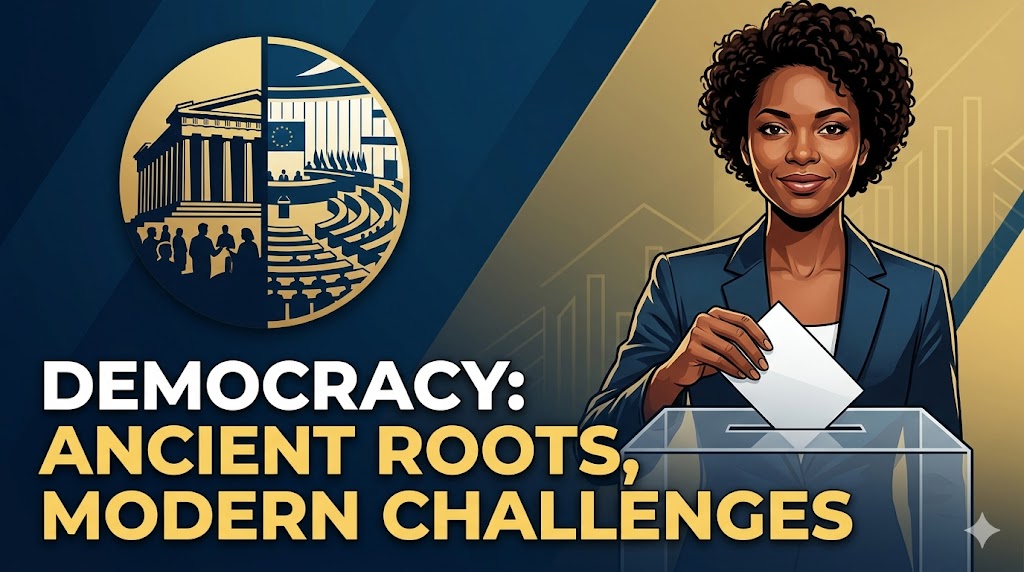
Democracy stands as one of humanity's most enduring and influential ideas. Derived from the Greek words demos (people) and kratos (rule), it translates to "rule by the people." At its core, democracy empowers citizens to participate in governance, holding leaders accountable while protecting individual rights and promoting collective welfare.
From its experimental beginnings in ancient Athens to the complex representative systems of the 21st century, democracy has evolved significantly. Yet its fundamental promise remains: the government should serve the people, not the other way around. This article examines the origins and development of democracy, contrasts ancient and modern forms, explores its various types, and assesses its effectiveness in delivering public welfare amid contemporary challenges.
While no system is perfect, democracy's emphasis on participation, accountability, and adaptability often positions it to prioritize citizens' needs over governmental self-interest.
The story of democracy begins in ancient Greece, particularly Athens, around the late 6th century BCE. It emerged not overnight but through gradual reforms amid social and political struggles.
Early Foundations: Before democracy, Athens was ruled by aristocrats and tyrants. In 594 BCE, Solon, an Athenian lawmaker, introduced significant reforms. He canceled debts, freed enslaved citizens, and restructured society into classes based on wealth rather than birth, broadening political participation. Solon laid groundwork by promoting the rule of law and reducing aristocratic dominance, though full democracy was yet to come.
Cleisthenes and the Birth of Demokratia:Often called the "father of Athenian democracy," Cleisthenes enacted sweeping reforms in 508-507 BCE. He reorganized citizens into demes (local units) based on geography rather than kinship, breaking old tribal loyalties and fostering broader unity. He established the Council of 500, selected by lot, and strengthened the Assembly (Ekklesia), where male citizens could debate and vote on laws.
Peak and Refinements: Under leaders like Ephialtes and Pericles in the mid-5th century BCE, power shifted further to ordinary citizens. The Assembly became central, meeting frequently to decide on war, peace, laws, and policies. Juries were large and chosen by lot to minimize corruption. Ostracism allowed citizens to exile potential threats to democracy.
Athenian democracy was direct: citizens (free adult males, excluding women, slaves, and foreigners—who formed the majority) participated personally. It emphasized equality among citizens (isonomia) and free speech (parrhesia). During the Golden Age under Pericles, it fueled cultural and military achievements.
However, it faced challenges. The Peloponnesian War exposed vulnerabilities, leading to brief oligarchic interruptions. Critics like Plato and Aristotle questioned its stability, fearing mob rule. Despite flaws, it demonstrated that ordinary people could govern effectively.
Democracy also appeared in other forms elsewhere, but Athens provided the most influential model, inspiring later thinkers.
Evolution Through History: From antiquity to the Modern Era
After Athens fell under Macedonian and later Roman influence, democratic practices waned for centuries. The Roman Republic offered a mixed system with elected officials and senatorial checks, influencing modern republicanism.
The Renaissance and Enlightenment revived democratic ideas. Thinkers like John Locke, Montesquieu, and Jean-Jacques Rousseau emphasized natural rights, separation of powers, and the social contract. The American Revolution (1776) and French Revolution (1789) put these into practice, establishing representative systems with constitutions and bills of rights.
The 19th and 20th centuries saw expansions: voting rights extended to women, minorities, and lower classes through struggles and reforms. Decolonization after World War II spread democracy globally. The fall of the Soviet Union in 1991 marked a peak for liberal democracy.
Today, democracy manifests in diverse forms, shaped by culture, history, and technology. It continues evolving with digital participation, while facing threats from populism, inequality, and authoritarianism.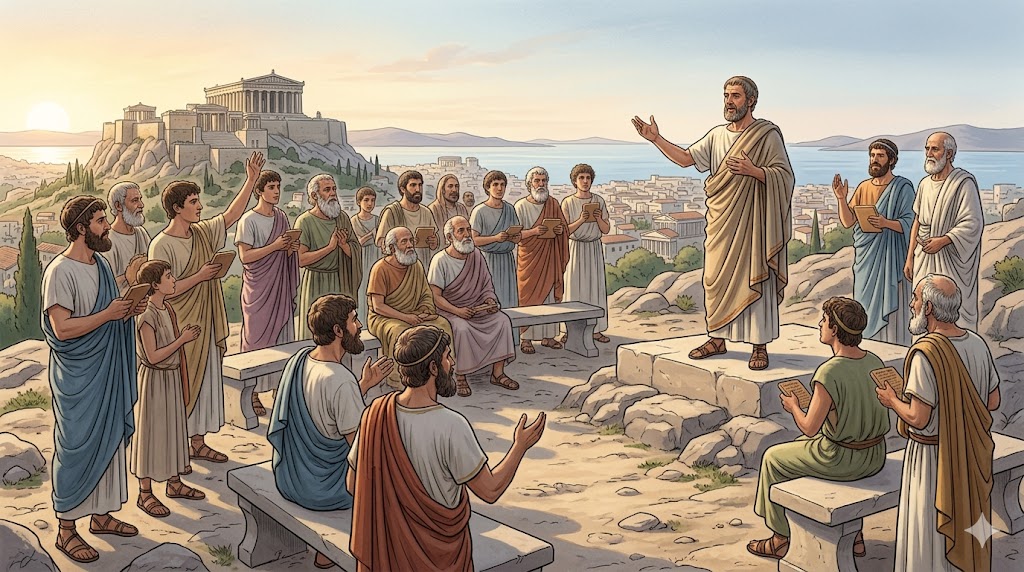
Athenian Sortition
What Is Democracy? Core Principles and Types
Democracy Explained: Democracy is a system where power derives from the people, exercised directly or through elected representatives. Key principles include popular sovereignty, rule of law, protection of minority rights, free and fair elections, freedom of expression, and accountability.
It is not a mere majority rule but a balance ensuring justice, deliberation, and respect for rights.
Types of Democracy:
1. Direct Democracy: Citizens vote directly on laws and policies, as in ancient Athens or modern referendums (e.g., Switzerland). Ideal for small groups but impractical for large nations.
2. Representative Democracy: Citizens elect officials to make decisions. Most common today, seen in parliamentary (e.g., UK) and presidential (e.g., US) systems. It balances efficiency with accountability.
3. Constitutional Democracy: Limited by a constitution protecting fundamental rights and dividing powers.
4. Parliamentary vs. Presidential: In parliamentary systems, the executive derives from the legislature. Presidential systems separate them for checks and balances.
5. Participatory/Participative Democracy: Emphasizes broader citizen involvement beyond voting, through consultations and civil society.
6. Deliberative Democracy: Focuses on reasoned discussion and consensus-building.
7. Liberal Democracy: Combines majority rule with strong protections for individual liberties and minority rights.
8. Other Variants: Include social democracy (emphasizing welfare and equality), radical democracy, and emerging digital or liquid democracy models.
These types adapt the ancient ideal to modern scales and complexities.
Ancient vs. Present-Day Democracy: Key Differences and Similarities
Scale and Participation: Ancient Athenian democracy was direct and limited to a small citizen body in a city-state. Modern democracy is mostly representative, encompassing millions across vast territories, with broader suffrage including women and all adults.
Institutions: Athens relied on assemblies and sortition (random selection). Today, we have parliaments, independent judiciaries, constitutions, political parties, and media.
Challenges: Ancient democracy contended with tyranny and external wars. Modern faces polarization, misinformation, economic inequality, and declining trust.
Similarities: Both value citizen input, debate, and accountability. The core idea—that the government exists for the people—persists.
In ancient times, democracy fostered innovation and identity. Today, it correlates with better economic opportunities, health outcomes, and human rights when functioning well. Democracies generally outperform autocracies in delivering long-term welfare.
Democracy and the Welfare of the People
True democracy prioritizes citizens' well-being over governmental convenience or elite interests. By requiring leaders to seek re-election, it incentivizes policies addressing public needs like education, healthcare, infrastructure, and economic security.
Mechanisms include:
Accountability: Elections, transparency, and free press expose corruption.
Participation: Engaged citizens shape policies reflecting diverse needs.
Welfare Focus: Many democracies develop robust social safety nets, progressive taxation, and public services.
Evidence shows democracies often achieve higher GDP growth over time, better health, and lower extreme poverty compared to autocracies. They provide safety nets and respond to public demands.
However, when captured by special interests or plagued by gridlock, democracy can falter. The ideal is the government of the people, by the people, for the people.
The Present Situation of Democracy: Strengths, Flaws, and Outlook (2025 Perspective)
In 2025, democracy faces a mixed global picture. Many nations maintain strong institutions, but reports indicate declines in quality, with rising "flawed democracies" and authoritarian tendencies.
Challenges:
Polarization and Trust Erosion: Deep divisions hinder compromise.
Inequality and Populism: Economic gaps fuel discontent.
Disinformation and Technology: Social media amplifies extremes.
Global Metrics: Indices like the Economist Intelligence Unit note historic lows, with the US and others classified as flawed democracies due to political culture and institutional strains.
Strengths and Resilience: Democracies demonstrate adaptability. Peaceful power transfers, civil society activism, and judicial independence remain safeguards. Many countries continue delivering welfare improvements through democratic processes.
Does Democracy Work?Imperfectly, but better than alternatives for most. It allows correction through elections and reform. Strengthening civic education, reducing inequality, and combating misinformation are vital for its future.
Modern Political Tension
Conclusion
Democracy has journeyed from a radical experiment in ancient Athens to a global norm with deep imperfections. Its development reflects humanity's ongoing quest for fair governance. While ancient direct forms offered intense participation, modern representative systems scale to complex societies, ideally channeling power toward public welfare rather than governmental entrenchment.
As we navigate 21st-century challenges, the essence remains: democracy thrives when citizens engage actively and institutions uphold accountability. It is not self-sustaining but requires vigilance, education, and reform. By learning from its rich history and addressing current flaws, societies can ensure democracy continues serving people first—delivering freedom, prosperity, and dignity for generations to come.