RMS Titanic: Sinking Tragedy, Facts & Legacy in 2026
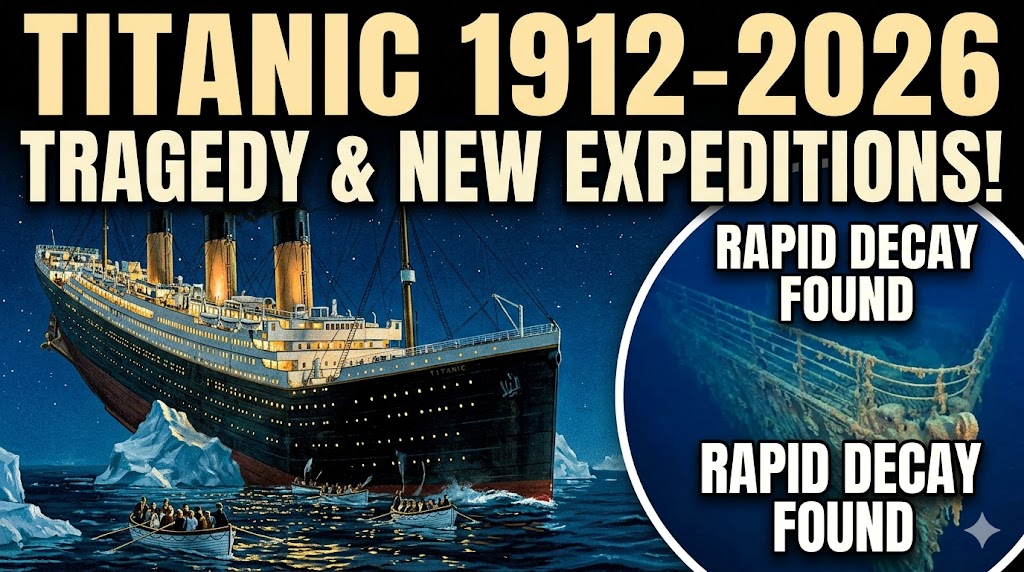
More than 114 years have passed since the RMS Titanic disappeared beneath the icy waters of the North Atlantic, yet its story continues to resonate deeply with people across generations. The Titanic was not merely a ship but a symbol of Edwardian ambition, technological confidence, and the stark realities of social class in the early 20th century. On its maiden voyage in April 1912, this floating palace of luxury struck an iceberg and sank, resulting in the loss of more than 1,500 lives and becoming one of the most studied maritime disasters in history.
In 2026, interest in the Titanic remains strong. Recent deep-sea expeditions using advanced 3D scanning and remotely operated vehicles have provided unprecedented views inside the wreck, revealing both its fragile state and surprising details about its final hours. These efforts remind us that while the ship rests silently on the seabed, the lessons it offers about human error, engineering limits, and societal values are as relevant today as ever.
This expanded article provides a thorough examination of the Titanic’s construction, fateful voyage, tragic sinking, scientific investigations, cultural impact through film and media, and the latest updates on the wreck’s condition as of 2026.
Construction and Design: Engineering Marvel of Its Time
The Titanic emerged from the Harland and Wolff shipyard in Belfast, Northern Ireland, as the second of three Olympic-class liners ordered by the White Star Line. Her sister ships, Olympic and Britannic, shared many design features, but the Titanic was intended to surpass them in luxury and scale.
Measuring 882 feet 9 inches in length with a beam of 92 feet and a gross register tonnage exceeding 46,000, she was the largest ship afloat when launched on May 31, 1911. The vessel featured a double-bottomed hull and 16 watertight compartments designed to keep her afloat even if several were flooded. Promotional materials of the era boldly called her “unsinkable,” though shipbuilders understood no vessel could be entirely immune to disaster.
Interior spaces reflected the class divisions of the period. First-class passengers enjoyed opulent surroundings, including a sweeping grand staircase with intricate oak carvings, a luxurious à la carte restaurant, a swimming pool, Turkish baths, and a gymnasium. Second-class accommodations offered comfort comparable to first-class on many other liners, while third-class passengers, many of whom were immigrants heading to America, traveled in simple but clean berths with access to shared dining areas.
One critical design choice later drew intense scrutiny: the ship carried only 20 lifeboats with a total capacity of about 1,178 people, far short of the more than 2,200 souls she could accommodate. This number met the legal requirements of the time, which were based on a ship’s tonnage rather than passenger capacity.
After fitting out and sea trials, the Titanic departed Southampton on April 10, 1912, under the command of Captain Edward Smith. She called at Cherbourg in France and Queenstown in Ireland before turning westward across the Atlantic Ocean toward New York City.
The Voyage and the Fateful Night
The crossing began smoothly, with passengers enjoying fine dining, music, and leisurely deck walks. Wireless operators received several ice warnings from other vessels, yet the ship maintained a high speed of around 22 knots, a common practice aimed at achieving a fast maiden voyage.
At 11:40 p.m. on April 14, lookout Frederick Fleet spotted an iceberg directly in the ship’s path. The bridge immediately ordered evasive action and engine reversal, but momentum carried the Titanic into a glancing collision along her starboard side. The impact lasted only seconds but proved catastrophic. The iceberg buckled hull plates and dislodged rivets, allowing water to flood five forward compartments.
Thomas Andrews, the ship’s chief designer who was aboard for the voyage, quickly assessed the damage. He informed Captain Smith that the Titanic could remain afloat for no more than two hours. Because the watertight bulkheads did not extend all the way to the upper decks, water soon spilled over from one compartment into the next, dooming the vessel.
Distress signals were transmitted via the Marconi wireless system. The RMS Carpathia, some 58 miles away, responded immediately and steamed at full speed toward the scene. However, the closer SS Californian failed to assist effectively due to communication breakdowns and possible misinterpretation of visual signals.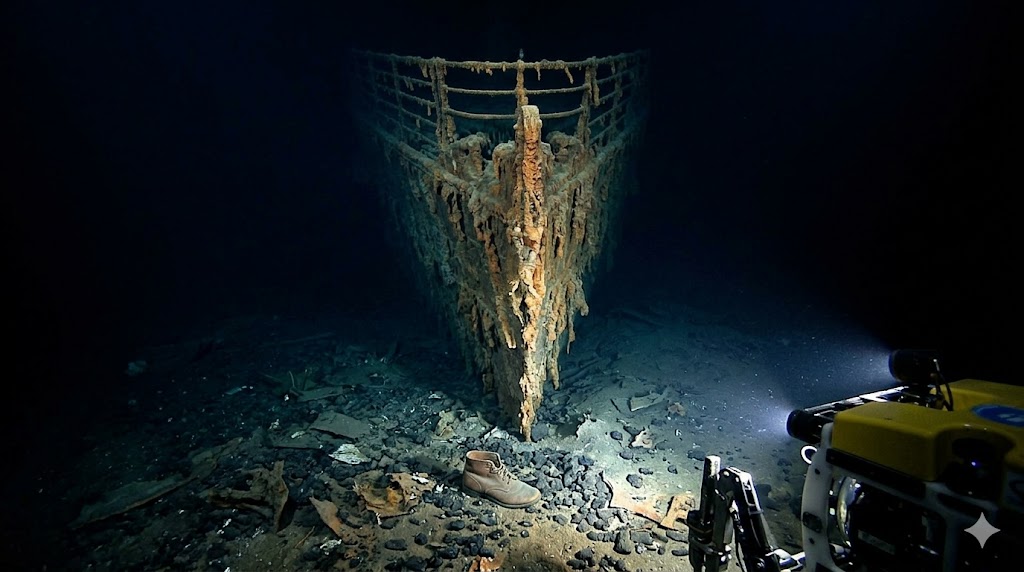
This deep-sea photograph focuses on the iconic, rusticle-covered bow of the RMS Titanic as it rests on the North Atlantic seabed. Illuminated by the lights of a Titanic wreck expedition vehicle (ROV) in the foreground, this view captures the scale of the ship.
The Sinking: Human Stories Amid Chaos
As water continued to pour in, the Titanic settled by the bow. Crew members roused passengers and guided them to the boat deck. The evacuation process exposed deep inequalities. First-class passengers had easier access to lifeboats, while many in third class faced barriers, confusion, and locked gates.
Officers generally followed the “women and children first” principle, though its application varied. Lifeboats were lowered partially filled in some cases, partly due to fears that fully loaded boats might buckle during descent. By 2:05 a.m., the last collapsible lifeboat had departed. Those remaining on board faced a grim choice between freezing water and the tilting decks.
Around 2:18 a.m., the ship’s lights flickered and went out. Moments later, the Titanic broke apart between the third and fourth funnels. The bow section plunged downward, while the stern rose almost vertically before slamming back and sinking. The entire process from collision to complete disappearance took roughly two hours and 40 minutes.
Hundreds of people entered the water, where the temperature was near freezing. Hypothermia set in rapidly, and most perished within minutes. Survivors in the lifeboats described haunting cries that gradually faded into silence. When the Carpathia arrived at dawn, only 710 people were rescued.
Key Titanic Facts and Enduring Statistics
The numbers associated with the Titanic disaster paint a sobering picture:
Total people aboard: Approximately 2,240 (passengers and crew).
Confirmed deaths: More than 1,500.
Survivors: About 710.
Lifeboat capacity: Sufficient for roughly half those aboard.
Age of the youngest victim: Just a few months old.
Wealthiest passenger lost: John Jacob Astor IV.
The tragedy prompted sweeping changes in maritime law. The International Convention for the Safety of Life at Sea (SOLAS) was established, requiring adequate lifeboats, continuous radio watches, and improved iceberg monitoring.
Scientific Insights: Physics, Iceberg, and Breakup
Modern analysis has clarified many aspects of the sinking. The collision created a series of small breaches rather than one large gash. A head-on impact might have allowed the ship to stay afloat longer. Additionally, unusual atmospheric conditions that night, including a temperature inversion, may have created a mirage that hid the iceberg until it was dangerously close.
The breakup sequence has been confirmed through wreck analysis. The bow and stern sections lie about 2,000 feet apart on the seabed, separated by a vast debris field containing thousands of personal items, coal, and ship fragments.
Discovery of the Wreck
For decades, the exact location of the Titanic remained unknown. On September 1, 1985, a Franco-American expedition led by Dr. Robert Ballard and Jean-Louis Michel located the wreck at a depth of approximately 12,500 feet using sonar and underwater cameras. The discovery of one of the ship’s distinctive boilers provided the first confirmation.
In 1986, Ballard returned with the submersible Alvin and the remotely operated vehicle Jason Jr., capturing the first interior images. Since then, numerous expeditions have visited the site, recovering over 5,500 artifacts now preserved in museums while emphasizing the wreck’s status as a gravesite.
The Titanic Wreck in 2026: Current Condition and New Expeditions
By 2026, the Titanic wreck shows clear signs of accelerated deterioration. Iron-eating bacteria, known as rusticles, continue to consume the metal structure at a rate of roughly 0.13 to 0.2 tonnes of iron per day. Recent surveys reveal collapsing sections, including the loss of a significant portion of the port-side bow railing that fell as a single piece to the seabed.
Advanced 3D scanning and high-resolution ROV footage from expeditions in recent years have provided detailed interior views of passenger cabins, the grand staircase area, and engineering spaces previously difficult to access. These scans have also confirmed damage consistent with eyewitness accounts, such as a smashed porthole likely caused by the iceberg impact.
Scientists estimate that iconic parts of the superstructure could largely disappear by around 2100, while complete dissolution of the hull might take several centuries. Ongoing expeditions focus on documenting the wreck before further decay occurs and studying the unique deep-sea ecosystem it supports.
Plans for additional dives in 2026, including potential visits by private explorers, continue to spark debate about preservation ethics versus scientific and historical documentation.
Cultural Legacy: The 1997 Film and Beyond
James Cameron’s 1997 film Titanic played a pivotal role in renewing global interest. Starring Leonardo DiCaprio as Jack and Kate Winslet as Rose, the movie combined a fictional love story with painstaking historical detail. Cameron personally made multiple dives to the wreck and built a near full-scale set for filming.
The film’s visual effects, particularly during the sinking sequences, set new industry standards. It became one of the highest-grossing movies ever and won 11 Academy Awards, including Best Picture. Celine Dion’s “My Heart Will Go On” remains one of the most recognizable songs associated with the tragedy.
While the film took some dramatic liberties, it introduced millions to the real events and encouraged further study of the disaster. Documentaries, books, podcasts, and museum exhibitions continue to explore different angles, from passenger stories to engineering analysis.
Lessons for the Modern World
The Titanic disaster offers enduring insights. It highlights the dangers of overconfidence in technology, the importance of adequate safety measures, and the human cost of prioritizing speed and profit. In today’s era of complex systems and rapid innovation, similar themes appear in discussions around artificial intelligence, climate resilience, and large-scale infrastructure projects.
The story also serves as a reminder of social responsibility. The unequal survival rates underscored class disparities that, while improved in many societies, still echo in contemporary debates about equity and access.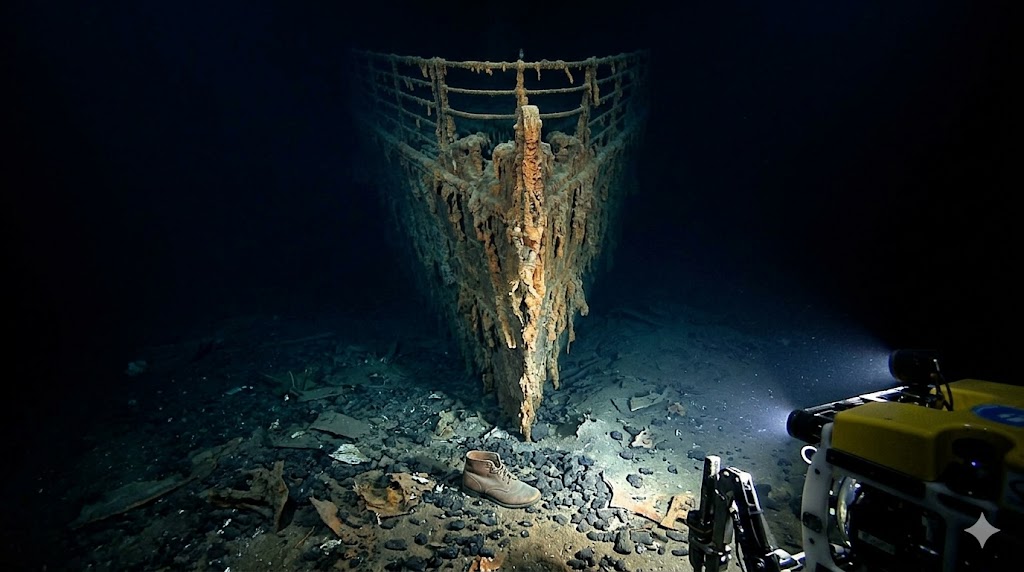
Documenting Rapid Deterioration in 2026
Conclusion: A Story That Endures
The Titanic continues to fascinate because it blends grand ambition with profound tragedy, individual heroism with collective failure, and romance with harsh reality. As new technologies allow us to peer deeper into the wreck and its surroundings in 2026, we gain not only technical knowledge but also a renewed appreciation for the lives lost and the survivors who carried the memory forward.
Whether through historical research, scientific expeditions, or cultural retellings, the Titanic reminds us of our shared vulnerability and capacity for resilience. The ship may one day dissolve into the Atlantic, but its legacy as a cautionary tale and a testament to human spirit will sail on for generations to come.