The Civil Rights Movement: History and Lasting Impact
The civil rights movements stands as one of the most transformative periods in American history. Spanning the mid-1950s to the late 1960s, it challenged systemic racial segregation and discrimination through nonviolent protests, legal battles, and moral courage. Led by extraordinary figures like Martin Luther King Jr., Rosa Parks, and John Lewis, the movement reshaped laws, institutions, and societal attitudes toward equality.
This comprehensive guide explores the civil rights history, pivotal events, influential leaders, and enduring legacy. Whether you seek an overview, key moments in the civil rights movement, or explanations suitable for younger audiences, this article provides clear, detailed insights. The struggle for civil rights continues to inspire global movements, including the gay rights movement, demonstrating the power of collective action for justice.
To understand the civil rights movement, one must examine its deep historical roots. Slavery defined early American life, with millions of African Americans enduring forced labor, family separations, and brutality. The Emancipation Proclamation of 1863 and the 13th Amendment ended legal slavery after the Civil War, yet freedom remained incomplete.
Reconstruction (1865–1877) brought hope through the 14th and 15th Amendments, granting citizenship and voting rights. However, the withdrawal of federal troops in 1877 enabled Southern states to enact Jim Crow laws. These mandated racial segregation in schools, transportation, public facilities, and housing. “Separate but equal” became the doctrine, upheld by the Supreme Court’s Plessy v. Ferguson decision in 1896.
Lynching, poll taxes, literacy tests, and grandfather clauses suppressed Black voting and economic progress. By the early 20th century, African Americans faced entrenched discrimination despite their contributions in World Wars I and II. This systemic oppression set the stage for organized resistance in the modern civil rights movement.
The Spark: Early Activism and the Montgomery Bus Boycott
The civil rights movement gained national momentum in the 1950s. On December 1, 1955, Rosa Parks refused to give up her seat to a white passenger on a Montgomery, Alabama bus. Her arrest ignited the Montgomery Bus Boycott, a 381-day protest that demonstrated the economic power of unified Black communities.
Martin Luther King Jr., then a young pastor, emerged as a central civil rights leader. Inspired by Gandhi’s nonviolence, King advocated peaceful resistance. The boycott ended with a Supreme Court ruling declaring segregated buses unconstitutional. This victory proved that ordinary citizens could challenge injustice effectively and propelled King into national prominence.
Other early efforts included the integration of public schools. The 1954 Brown v. Board of Education decision overturned Plessy v. Ferguson, declaring segregated education inherently unequal. However, implementation faced fierce resistance, as seen in the 1957 Little Rock Nine crisis, where federal troops escorted Black students into Central High School.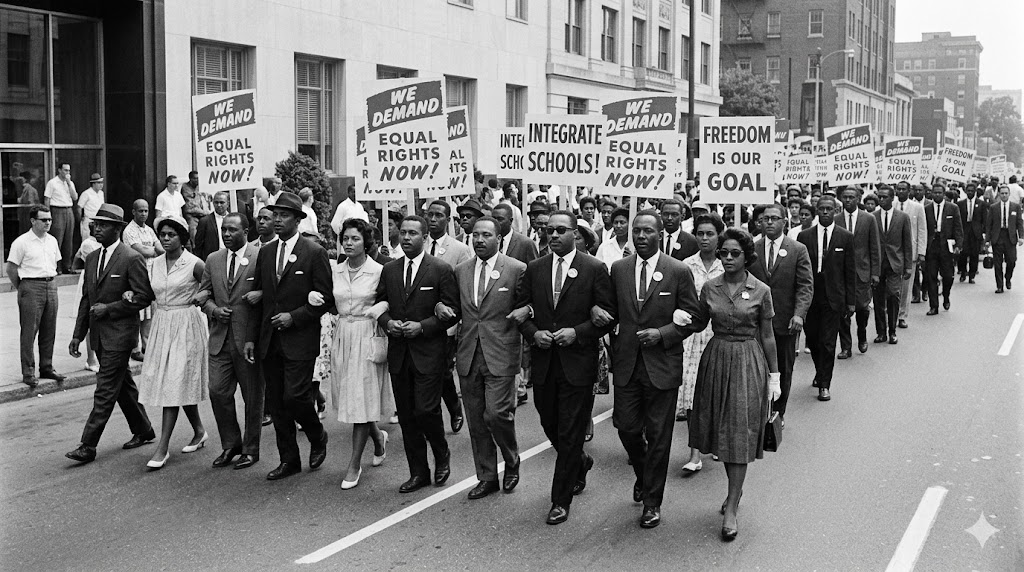
powerful monochrome historical photograph from the 1960s American South, visualizing a fundamental civil rights protest tactic.
Key Moments in the Civil Rights Movement
The civil rights movement featured several landmark events that captured worldwide attention:
Sit-ins and Freedom Rides (1960–1961):
In Greensboro, North Carolina, four Black college students sat at a whites-only Woolworth’s lunch counter, sparking similar nonviolent protests across the South. Freedom Riders tested Supreme Court rulings against interstate bus segregation, enduring brutal attacks yet persisting.
Birmingham Campaign (1963):
Under King’s leadership, activists in Birmingham, Alabama, organized marches, sit-ins, and boycotts against segregation. Police Commissioner Bull Connor’s use of fire hoses and attack dogs on peaceful demonstrators, including children, shocked the nation. These images galvanized public support for federal intervention.
March on Washington for Jobs and Freedom (August 28, 1963):
Over 250,000 people gathered at the Lincoln Memorial. Martin Luther King Jr. delivered his iconic “I Have a Dream” speech, calling for racial harmony and economic justice. This civil rights protest remains one of the largest and most influential in U.S. history.
Selma to Montgomery Marches (1965):
John Lewis and Hosea Williams led voting rights marches. “Bloody Sunday” saw state troopers attack marchers on the Edmund Pettus Bridge. National outrage prompted President Lyndon B. Johnson to push voting rights legislation.
Other notable actions: The Freedom Summer of 1964 registered Black voters in Mississippi, despite violence, and the 1968 Poor People’s Campaign addressed economic inequality.
Legendary Civil Rights Leaders
The civil rights movement succeeded through diverse leadership:
Martin Luther King Jr. (MLK): Advocate of nonviolence, masterful orator, and strategist. His moral vision unified supporters.
Rosa Parks: “Mother of the Freedom Movement,” whose quiet defiance inspired millions.
Malcolm X: Initially promoted Black nationalism and self-defense before evolving toward broader human rights.
John Lewis: “Conscience of Congress,” who faced beatings yet maintained commitment to nonviolence.
Thurgood Marshall: NAACP lawyer who argued Brown v. Board and later became the first Black Supreme Court Justice.
Women like Fannie Lou Hamer, Ella Baker, and Diane Nash played crucial behind-the-scenes and public roles.
These civil rights hero figures demonstrated courage, strategic thinking, and resilience.
Landmark Legislation: Civil Rights Act and Beyond
Pressure from the civil rights movement led to major laws:
Civil Rights Act of 1964: Banned discrimination based on race, color, religion, sex, or national origin in public accommodations, employment, and education. President Johnson signed it after Kennedy’s assassination.
Voting Rights Act of 1965: Eliminated discriminatory voting barriers and authorized federal oversight in discriminatory jurisdictions.
Fair Housing Act of 1968: Prohibited housing discrimination, passed after King’s assassination.
These measures dismantled legal segregation, though enforcement and cultural change required ongoing effort.
The Civil Rights Movement Explained for Kids
Explaining the civil rights movement for kids requires simplicity and honesty. Imagine a time when Black children could not drink from the same water fountains, ride the same buses, or attend the same schools as white children simply because of skin color. Brave people like Rosa Parks said “No, that’s not fair,” and walked or carpooled instead of riding segregated buses.
Martin Luther King Jr. taught that fighting with love and peace is stronger than fighting with fists. Children marched, sang freedom songs, and held hands across racial lines. Their efforts changed laws so everyone could have equal chances. Today, kids can learn that standing up for fairness, listening to others, and treating everyone with respect continues the dream of equality.
Classroom activities might include reading picture books about Ruby Bridges, discussing fairness, or creating posters with messages of kindness and justice.
Challenges, Internal Debates, and Opposition
The civil rights movement faced violent opposition: church bombings, assassinations (Medgar Evers, Malcolm X, Martin Luther King Jr.), and riots. The FBI surveilled leaders through COINTELPRO.
Debates existed within the movement between integrationists and Black Power advocates, nonviolence and self-defense strategies. These tensions enriched the movement’s strategies while highlighting its complexity.
Legacy and Connection to Other Movements
The civil rights movement’s impact extends far beyond the 1960s. It inspired the women’s rights movement, disability rights, and the gay rights movement. The Stonewall Riots of 1969 echoed tactics of sit-ins and visibility. Today, movements like Black Lives Matter draw on the same principles of protest, legal advocacy, and storytelling.
Achievements include increased Black political representation, a more diverse workforce, and cultural shifts toward inclusivity. Yet challenges persist: racial wealth gaps, disparities in education and criminal justice, and voting rights debates continue.
Key Moments Timeline
1954: Brown v. Board of Education
1955: Montgomery Bus Boycott begins
1957: Little Rock Nine
1960: Greensboro Sit-ins
1963: Birmingham Campaign and March on Washington
1964: Civil Rights Act
1965: Selma Marches and Voting Rights Act
1968: Fair Housing Act and King’s assassination
Continuing the Work: Modern Reflections
The civil rights history teaches that progress requires vigilance. Education, empathy, and civic engagement remain essential. Schools, museums like the National Civil Rights Museum in Memphis, and documentaries preserve these stories for new generations.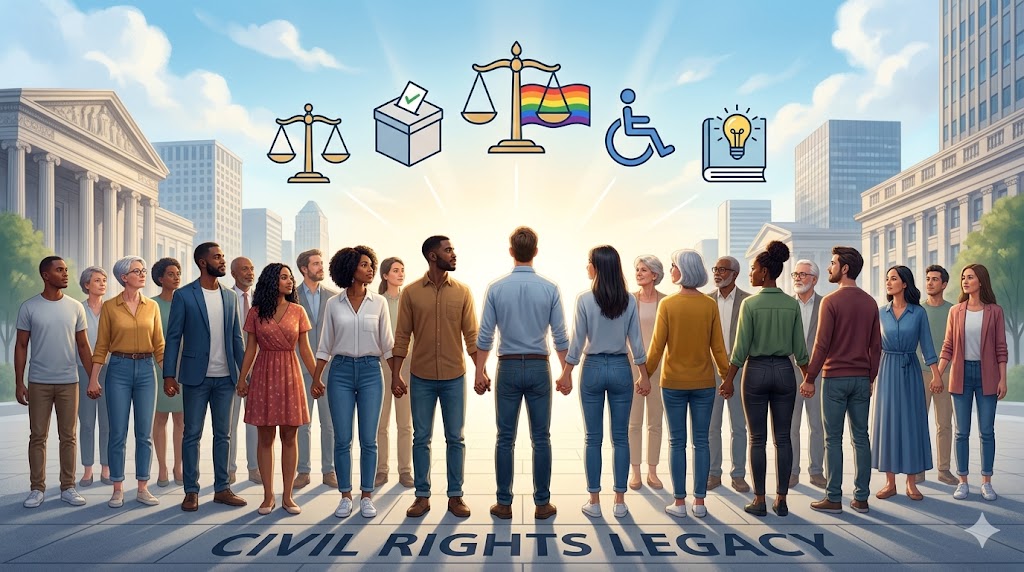
Conceptual Legacy and Inclusion
Conclusion
The civil rights movement transformed America from a nation divided by law to one striving toward equality under the law. Through peaceful protests, eloquent leadership, and unwavering determination, ordinary people achieved extraordinary change. Its lessons endure: courage, unity, and moral clarity can overcome injustice.
As we reflect on MLK’s dream and the sacrifices of countless civil rights leader figures, we recognize that the work continues. Every generation must renew the commitment to liberty and justice for all.