"The Brahma Purana: The Adi Purana of Hinduism"
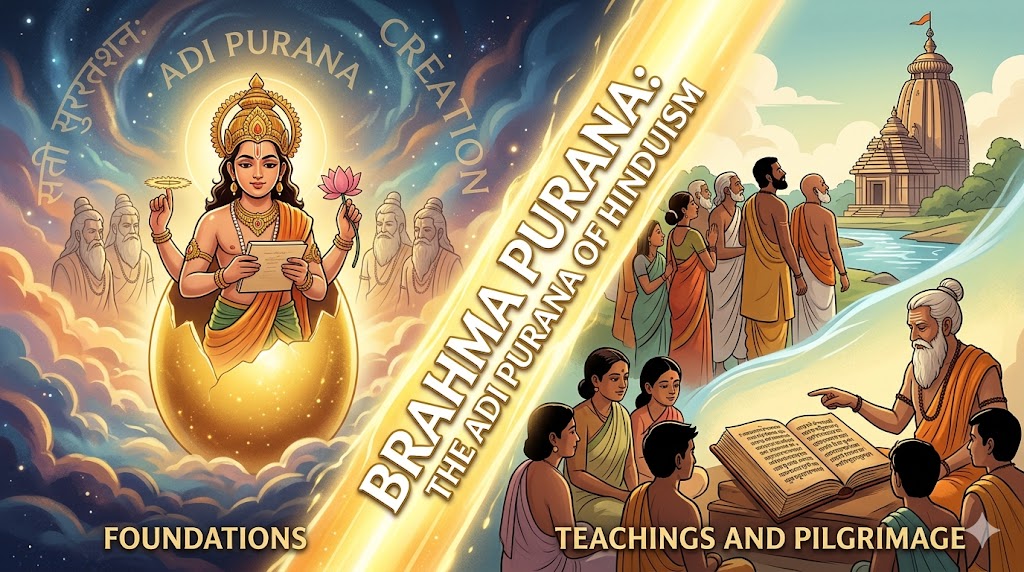
The Brahma Purana holds a distinguished position in Hindu scriptures as one of the eighteen major Mahapuranas. Often referred to as the Adi Purana, meaning the "first" or "primordial" Purana, it is traditionally placed at the beginning of the Puranic corpus. Attributed to the sage Vyasa, this ancient text serves as a comprehensive repository of cosmological knowledge, mythological narratives, geographical descriptions, and spiritual guidance.
Composed in Sanskrit, the Brahma Purana blends devotional elements with practical wisdom, making it a vital resource for understanding creation, dharma, and sacred geography. Its emphasis on Brahma, the creator deity, alongside significant sections on Vishnu, Shiva, and regional pilgrimage sites, underscores its eclectic nature within the broader Hindu tradition. This article delves deeply into every aspect of the Brahma Purana, exploring its origins, structure, contents, historical importance, and enduring relevance.
Origins and Historical Context
The Puranas emerged as a genre of Sanskrit literature designed to make Vedic knowledge accessible to a wider audience. They typically incorporate five key characteristics (Pancha Lakshana): creation (Sarga), dissolution and re-creation (Pratisarga), genealogy of gods and sages (Vamsha), cosmic time cycles (Manvantara), and accounts of royal lineages (Vamshanucharita).
The Brahma Purana is classified as a Rajasic Purana, associated with the mode of passion and activity linked to Lord Brahma. Traditional accounts credit Sage Vyasa with compiling it, though like other Puranas, it likely evolved through oral transmission and later redactions over centuries. Scholars date its core material to the early centuries of the Common Era, with additions continuing into the medieval period.
Its designation as Adi Purana stems from its placement as the first in most traditional lists of the eighteen Mahapuranas. This primacy reflects its foundational role in outlining cosmic origins and establishing the framework for subsequent texts.
Structure and Composition
The surviving manuscripts of the Brahma Purana consist of approximately 245 chapters and between 7,000 to 10,000 verses, though some traditions reference a larger original extent. It is divided into two main sections:
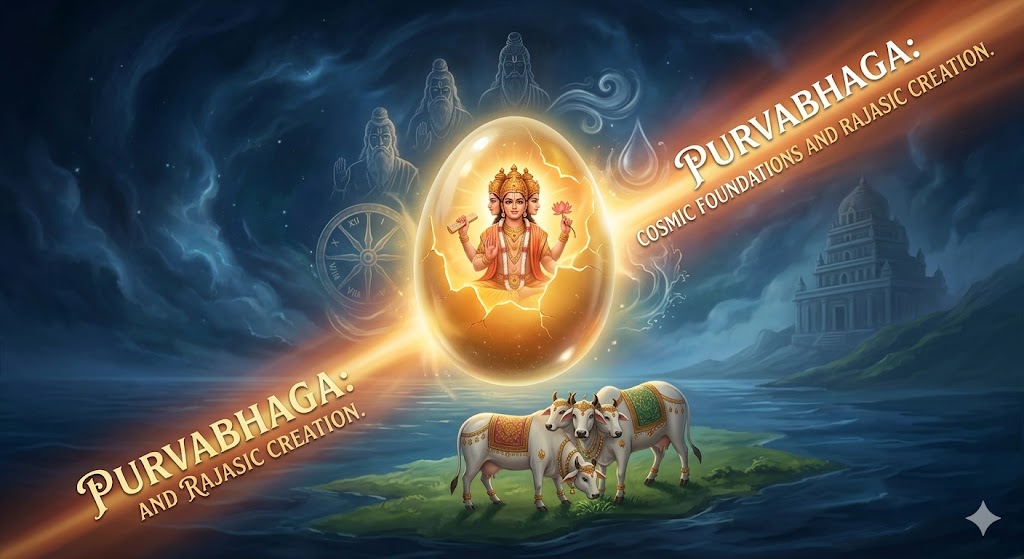
Purvabhaga (Former Part): This section focuses on foundational topics including cosmology, creation myths, genealogies, and general dharma. It lays the groundwork for understanding the universe's origins and the roles of various deities.
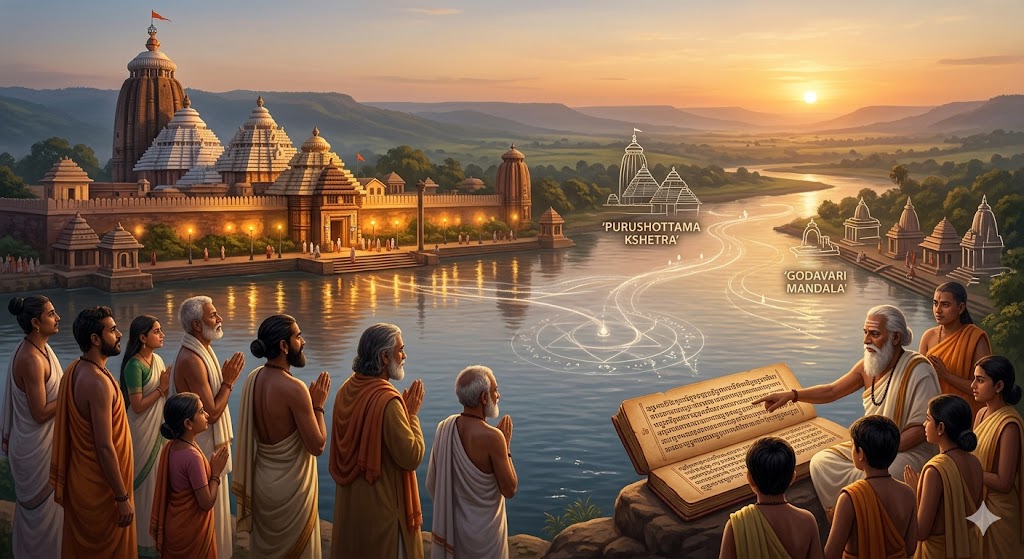
Uttarabhaga (Latter Part): This portion shifts toward mahatmyas (glorifications) of sacred places, particularly in Odisha and along the Godavari River region. It includes detailed descriptions of temples, pilgrimage circuits, and local legends.
The text's encyclopedic style interweaves narratives, hymns, rituals, and ethical teachings, characteristic of Puranic literature.
The Primordial Birth (The Purvabhaga)
Cosmology and Creation Myths
One of the Brahma Purana's core contributions is its detailed account of creation. It describes the primordial state where Vishnu (Narayana) rests on the cosmic waters. From this emerges a golden egg (Hiranyagarbha), within which Brahma is born as Svayambhu (self-born).
The text elaborates on the emergence of the universe through Brahma's creative powers. It details the manifestation of the elements, the seven great sages (Saptarishi), and the subsequent generations of beings. Cycles of time (Manvantaras), cosmic dissolutions (Pralaya), and re-creations are explained with philosophical depth, integrating concepts from Samkhya and Vedanta traditions.
These narratives emphasize the cyclical nature of existence, the interplay of the three gunas (qualities), and the supreme reality underlying all manifestation.
Deities and Mythological Narratives
While centered on Brahma, the Purana offers rich portrayals of the Hindu pantheon:
Brahma and Saraswati: Descriptions of their iconography and symbolic significance.
Vishnu and Avatars: Stories highlighting preservation and dharma.
Shiva and Shakti: Accounts of divine exploits and philosophical insights.
Other Deities: Legends involving Surya (Sun god), as it is sometimes called Saura Purana due to dedicated sections.
Mythological tales include battles between gods and demons, genealogies of royal lines, and moral stories illustrating karma and devotion. The text balances sectarian elements, promoting a harmonious view of the Trimurti.
Sacred Geography and Pilgrimage
A substantial portion of the Brahma Purana functions as a travel guide to holy sites (Tirthas). It provides vivid descriptions of sacred rivers, temples, and pilgrimage routes, with special emphasis on:
Regions in Odisha, including the famous Jagannath Temple area (Purushottama Kshetra).
Sites along the Godavari River.
Other pan-Indian tirthas.
These sections detail the spiritual merits (phala) of visiting specific locations, rituals to perform, and associated legends. Such mahatmyas encouraged pilgrimage and helped preserve cultural and architectural knowledge.
Temple Architecture and Cultural Insights
The Purana contains valuable information on temple construction, iconography, and worship practices. It discusses principles of Vastu, idol installation, and festivals. These passages offer historians and practitioners insights into ancient Indian art, architecture, and societal norms.
Topics extend to social duties, ethics, duties of different varnas and ashramas, and guidelines for righteous living.
Philosophical and Spiritual Teachings
Beyond stories, the Brahma Purana imparts profound philosophical wisdom. It explores:
The nature of Brahman (ultimate reality).
Paths of devotion (Bhakti), knowledge (Jnana), and action (Karma).
Concepts of liberation (Moksha).
Ethical frameworks for harmonious living.
Its inclusive approach appeals to various traditions within Hinduism, making it a unifying scripture.
Significance Among the 18 Mahapuranas
As the Adi Purana, it sets the tone for the entire genre. Its comprehensive coverage of creation, genealogy, and sacred sites makes it foundational. Traditional lists consistently place it first, underscoring its perceived antiquity and authority.
In the broader context of Smriti literature, it complements the Vedas, Upanishads, and epics like the Mahabharata and Ramayana by providing accessible narratives and practical guidance.
Manuscripts, Translations, and Scholarship
Surviving manuscripts vary slightly in content, reflecting the dynamic nature of Puranic transmission. Critical editions and translations have made the text accessible to modern audiences. Scholars value it for studies in comparative mythology, ancient geography, and religious evolution.
Relevance in Contemporary Hinduism
In modern times, the Brahma Purana continues to inspire devotees, scholars, and cultural enthusiasts. Its pilgrimage descriptions guide contemporary tirtha yatras, while cosmological insights resonate with those exploring spirituality and science intersections. Temples and traditions referenced in the text remain active centers of worship.
The Path of Pilgrimage (The Uttarabhaga)
Comparative Perspectives
When compared to other Mahapuranas like Vishnu Purana or Shiva Purana, the Brahma Purana stands out for its balanced treatment and strong regional focus on eastern India. Its Rajasic classification highlights themes of creation and activity, contrasting with Sattvic or Tamasic emphases in other texts.
Conclusion
The Brahma Purana, revered as the Adi Purana, remains a cornerstone of Hindu scriptural tradition. Its rich tapestry of cosmology, mythology, sacred geography, and ethical teachings offers timeless wisdom for spiritual seekers and cultural historians alike. By preserving ancient knowledge in an engaging narrative form, it continues to illuminate the path of dharma and devotion in the vast landscape of Sanatana Dharma.
As the first major Purana, it invites readers to explore the depths of creation and the sanctity of divine presence in the world. Its study not only enriches understanding of Hinduism but also fosters appreciation for the profound philosophical heritage of ancient India.