Puranic and Vedic Cosmology: Ancient Hindu Visions
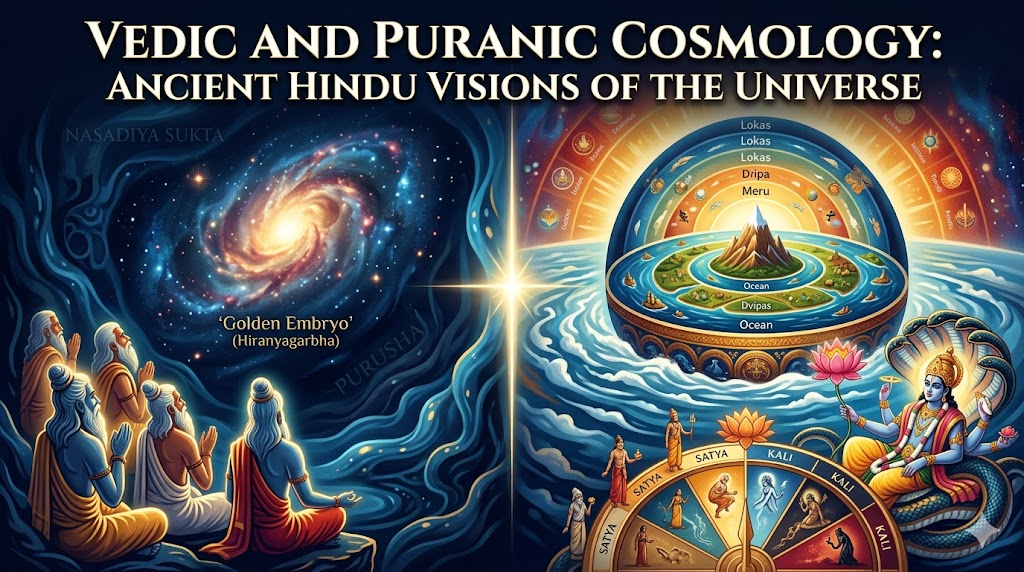
The exploration of the cosmos has fascinated humanity since time immemorial. In the rich tapestry of Hindu tradition, Vedic and Puranic cosmology stand out as sophisticated, holistic frameworks that integrate science, philosophy, mythology, and spirituality. These ancient systems describe the universe not as a random occurrence but as a purposeful, cyclical manifestation of divine consciousness.
Vedic cosmology, rooted in the oldest sacred texts of Hinduism (circa 1500–500 BCE), lays the foundational hymns and philosophical inquiries. The Puranas, composed later by drawing from Vedic seeds, expand these ideas into elaborate narratives, vast time scales, and detailed cosmic geography. Together, they form a comprehensive worldview that continues to inspire scholars, devotees, and thinkers worldwide.
This article delves deeply into both traditions, their interconnections, key concepts, philosophical implications, and relevance today. By examining Vedic and Puranic cosmology, we uncover timeless insights into creation, existence, and the human place within the grand design.
Foundations of Vedic Cosmology
The Vedas—Rigveda, Yajurveda, Samaveda, and Atharvaveda—contain the earliest recorded cosmological ideas in Hinduism. Unlike systematic treatises, Vedic cosmology emerges through poetic hymns (suktas) that blend observation, speculation, and reverence.
Nasadiya Sukta (Rigveda 10.129): Often called the Hymn of Creation, this profound text contemplates the origins before existence. It describes a state neither existence nor non-existence, where the One breathed by its own power. “Who really knows? Who can declare it?”—highlighting the limits of human knowledge and the mystery of the Absolute. This reflects an agnostic yet deeply spiritual approach.
Hiranyagarbha and Purusha Sukta: The Rigveda speaks of the Golden Embryo (Hiranyagarbha) as the source from which the universe emerges. The Purusha Sukta envisions the cosmic being (Purusha) whose sacrifice creates the world, social order (varnas), and celestial bodies. This yajna (sacrifice) motif underscores interconnectedness—everything arises from and returns to the divine.
Vedic texts describe a tripartite universe: heaven (dyauh), atmosphere (antariksha), and earth (prithvi). Deities like Indra, Varuna, Agni, and Surya personify natural forces and cosmic order (Rta). Time is cyclical yet tied to ritual calendars, with concepts of yugas emerging in later Vedic literature like the Brahmanas.
Astronomical references in the Vedas demonstrate advanced knowledge—tracking planets, eclipses, and constellations. The universe is seen as sustained by Rta, the cosmic moral order, which gods uphold and humans support through rituals.
Vedic cosmology is more intuitive and ritualistic, focusing on harmony between microcosm (human) and macrocosm (universe). It emphasizes inquiry (“Who created this?”) while affirming a singular underlying reality (often Brahman in Upanishadic extensions).
Evolution into Puranic Cosmology
As Vedic traditions evolved, the Puranas (circa 300–1500 CE) systematized and popularized these ideas. Attributed traditionally to Vyasa, the 18 Mahapuranas transforms abstract concepts into vivid stories accessible to all. They retain Vedic essence while adding layers of bhakti (devotion), detailed geography, and expansive timelines.
The transition reflects societal changes: Puranas addressed a broader audience, incorporating regional lore and responding to Buddhist and Jain influences. Where Vedas focus on hymns and rituals, Puranas narrate myths of creation, preservation, and dissolution through deities like Vishnu, Shiva, and Brahma.
Key Puranas for cosmology include the Vishnu Purana, Bhagavata Purana, Brahmanda Purana, Matsya Purana, and Shiva Purana. They elaborate Vedic seeds into comprehensive systems.
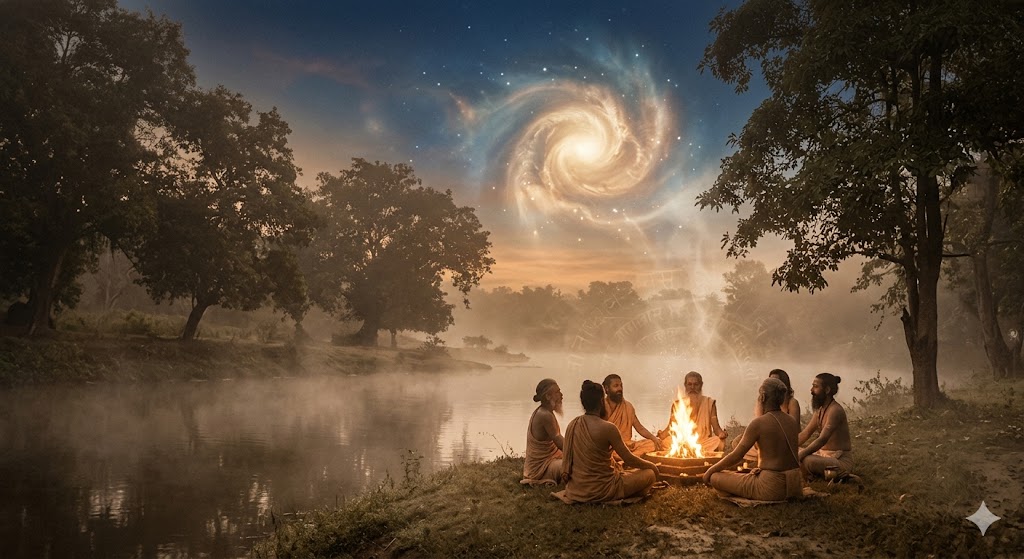
Vedic Dawn Contemplation: A group of ancient seers (rishis) conduct a yajna (sacrifice) on a misty riverbank at dawn. Their focus is on the primordial 'seed' of creation—the luminous 'Golden Embryo' (Hiranyagarbha) emerging in the deep, swirling sky, capturing the mystical inquiry of the Nasadiya Sukta (Hymn of Creation).
Creation (Sarga and Pratisarga): Puranas describe creation arising from Brahman or a personal God. In Vaishnava accounts, Vishnu floats on the cosmic ocean (Ksheera Sagara); a lotus emerges from his navel, bearing Brahma, who creates the world. Shaivite versions emphasize Shiva’s role in both creation and dissolution.
The process involves gunas (qualities of nature), mahat (cosmic intellect), and the evolution of elements. The Brahmanda (cosmic egg) encloses multiple universes, each undergoing cycles.
Cosmic Structure and Lokas: Puranic texts detail 14 lokas. Upper realms (Bhu to Satya) represent ascending planes of existence, while lower ones (Atala to Patala) house diverse beings. Mount Meru stands as the cosmic axis, surrounded by seven dvipas (continents) and oceans. This model is symbolic—levels of consciousness—and geographical within the ancient Indian worldview.
The Brahmanda Purana provides one of the most detailed accounts, describing layers, dimensions, and inhabitants.
Vast Time Scales: Puranic time is majestic. A Chaturyuga spans over 4 million years. Fourteen Manvantaras made a Kalpa (one day of Brahma, ~4.32 billion years). Brahma’s lifespan totals 311 trillion years, followed by great dissolution (Maha Pralaya). These cycles echo modern ideas of Big Bang/Big Crunch or oscillating universes.
Yugas illustrate moral decline: Satya (perfect dharma) to Kali (strife). Yet each cycle ends in renewal, offering hope.
Dissolution and Renewal: Pralaya occurs at various scales. At Kalpa’s end, fire, flood, and wind dissolve the world. Souls rest in a subtle state until the next creation. This underscores impermanence (maya) and the eternal nature of the soul (atman).
Multiverse and Diversity: Many Puranas mention countless Brahmandas, each with its Brahma and cycles—anticipating multiverse theories. Diversity of life across realms reflects karma and divine play (lila).
Comparative Analysis: Vedic vs. Puranic Cosmology
Vedic cosmology is poetic, concise, and ritual-centered. It asks profound questions and affirms Rta and divine powers. Puranic cosmology is narrative-driven, expansive, and devotional. It systematizes Vedic ideas, adds bhakti elements, and incorporates astronomy, geography, and ethics.
Similarities: Both affirm cyclical time, divine origin, interconnectedness, and moral order. Vedic Rta evolves into Puranic dharma upheld by avatars.
Differences: Vedas are speculative and hymn-based; Puranas are encyclopedic with stories. Vedic focus is on this-worldly rituals; Puranas emphasize bhakti, afterlife, and liberation across lifetimes.
Together, they complement each other: Vedas as roots, Puranas as branches and fruits.
Philosophical and Spiritual Dimensions
Puranic and Vedic cosmology transcend physical description. They teach:
Unity in Diversity: Brahman manifests as many yet remains one (advaita insights).
Karma and Rebirth: Actions determine lokas and future births.
Purpose of Existence: The universe facilitates soul evolution toward moksha.
Ecological Harmony: Earth as Bhudevi demands respect.
Devotion as Path: Stories of deities make cosmology relatable and transformative.
Texts like the Bhagavata Purana blend cosmology with Krishna’s pastimes, showing the personal and impersonal aspects of the Divine.
Science and Puranic-Vedic Cosmology
Ancient seers encoded observations in myth. Puranic time scales align roughly with geological eras. Descriptions of planetary motions, comets, and geography show empirical knowledge. Concepts of subtle matter and energy parallel quantum ideas. While not modern science, these frameworks demonstrate sophisticated reasoning and holistic thinking.
Contemporary physicists and Indologists note resonances with relativity, quantum mechanics, and cosmology. The cyclic model offers alternatives to linear Big Bang theories.
Cultural Impact and Modern Relevance
Vedic-Puranic cosmology shapes Hindu festivals, art, temple architecture (e.g., Meru-inspired designs), and literature. It influences yoga, meditation, and environmental ethics. In the diaspora and global spirituality, these ideas foster wonder and unity consciousness.
In education and research, they provide perspectives on the history of science and philosophy. For individuals, they offer comfort—life’s challenges are transient within vast cycles—and motivation for ethical living.
Challenges include literal vs. symbolic interpretations. Scholars advocate metaphorical understanding alongside historical context, preserving wisdom while embracing modernity.
Practical Engagement with These Traditions
Study begins with accessible translations: Vishnu Purana, selections from Rigveda, and Bhagavata Purana. Recitation, kathas, and temple visits enrich experience. Reflecting on concepts like yugas encourages self-assessment and dharma in daily life.
Digital resources, books, and discourses make this heritage accessible globally.
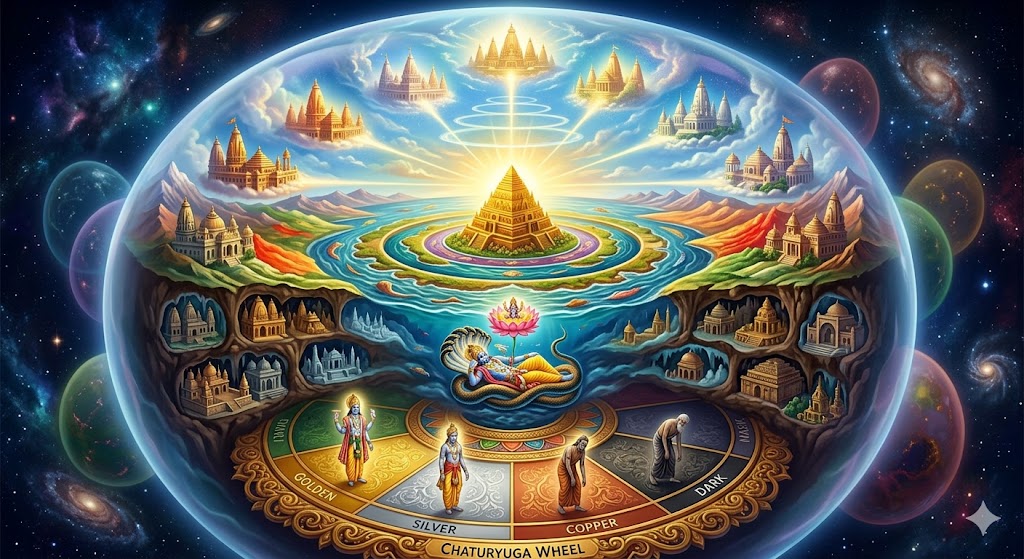
The Puranic Structured Cosmos: A visualization of the vast 'Brahmanda' (Cosmic Egg). Centered on Mount Meru, it details the 14 lokas (ascending and descending realms of consciousness), concentric continents, and the cyclical Chaturyuga (Time Wheel), illustrating the Puranic emphasis on order, scale, and multi-layered existence within countless multiverses.
Conclusion: Eternal Wisdom for a Changing World
Vedic and Puranic cosmology represent humanity’s enduring quest to understand our place in the cosmos. From Vedic hymns pondering origins to Puranic visions of infinite cycles and realms, these traditions paint a universe alive with consciousness, purpose, and divine play.
They teach humility before the infinite, responsibility toward creation, and hope through renewal. In an age of scientific advancement and existential questions, Vedic-Puranic cosmology offers complementary insights—bridging material discovery with spiritual depth.
By exploring these ancient systems, we honor the rishis’ legacy and gain tools for meaningful living. The cosmos, as described, is not distant but intimately connected to our inner journey. May this wisdom illuminate paths toward harmony, understanding, and ultimate liberation.