"Mahabharata Karma Lessons: Dharma Beyond Power"
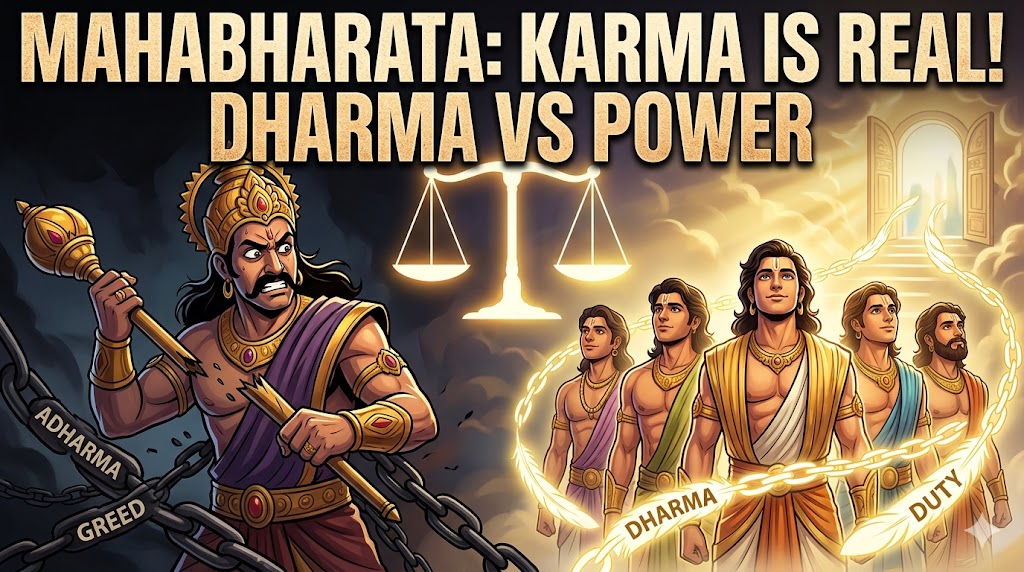
The Mahabharata stands as one of humanity’s greatest literary and philosophical treasures. While often remembered for its grand war, complex characters, and dramatic conflicts, the epic offers far more than tales of warriors, jealousy, or the thirst for power. At its heart, the Mahabharata delivers a profound exploration of karma — the law of cause and effect — and the enduring importance of good deeds.
This perspective moves beyond surface-level narratives of rivalry between the Pandavas and Kauravas. Instead, it focuses on how every individual, irrespective of their social position, wealth, knowledge, or role, ultimately reaps the consequences of their actions. Whether a mighty king, a revered guru like Dronacharya, a devoted wife like Draupadi, or a loyal son like Bhishma, no one escapes the impartial judgment of karma.
In this article, we examine the Mahabharata as a universal guide to righteous living. It illustrates that good deeds and adherence to dharma form the only reliable foundation for a meaningful life. The epic beautifully demonstrates that Sanatan Dharma — the eternal way of righteous conduct — transcends personal or organized religion. Its principles of performing one’s duty with integrity, avoiding injustice, and aligning with natural cosmic laws apply equally to people of any background, including Muslims, Christians, or those of any faith. The Mahabharata invites every reader to reflect on their role — as a leader, protector, parent, or citizen — and act accordingly.
Understanding Karma and Dharma in the Mahabharata
The Mahabharata repeatedly emphasizes that actions (karma) shape destiny more powerfully than birth, status, or circumstances. Dharma, often translated as righteous duty, is not rigid dogma but a subtle, context-aware principle that demands wisdom, compassion, and discernment.
Good deeds — truthfulness, generosity, self-control, and justice — accumulate positive karma, leading to harmony and eventual liberation. Conversely, acts driven by greed, partiality, or adharma (unrighteousness) bring suffering, even to the most powerful. The epic shows this law operating universally across all characters, proving that no position grants immunity from karmic consequences.
This teaching aligns with the broader Sanatan ethos, which views life as part of an eternal cosmic order. Sanatan Dharma is not confined to any single community; it represents timeless values such as honesty, compassion, duty without attachment, and respect for all beings. It teaches that every person must fulfill their svadharma — the duty appropriate to their role and stage of life — while upholding universal ethics.
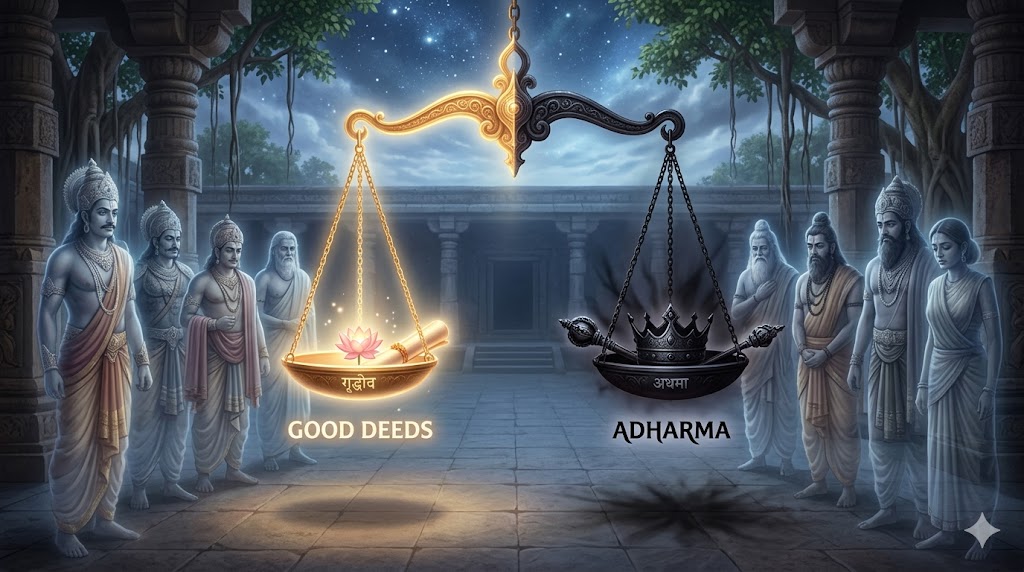
The Universal Law: The impartial balance scale of karma weighs the consequences of deeds. The radiant pan of 'Good Deeds' aligns with Dharma, while the dark pan of 'Adharma' brings suffering, demonstrating that actions, not status, determine destiny for all.
Karma at Work: Lessons from Key Characters
The Mahabharata masterfully portrays how individuals from vastly different backgrounds face the fruits of their deeds, reinforcing that karma levels everyone.
Bhishma, the grandsire and embodiment of duty, took a vow of lifelong celibacy and unwavering loyalty to the throne of Hastinapura. His commitment to his word was extraordinary, yet his silence during Draupadi’s humiliation in the assembly hall stemmed from a narrow interpretation of dharma. Bound by his oath to protect the king, he failed to prioritize universal justice. In the end, he lay on a bed of arrows, imparting profound wisdom in the Shanti and Anushasana Parvas, but he too had to endure the consequences of his choices. His life teaches that even the most knowledgeable and powerful must align personal duty with broader righteousness.
Dronacharya, the revered guru of both Pandavas and Kauravas, was a master of warfare and ethics. However, his attachment to his son Ashwatthama and his dependence on the Kaurava court led him to compromise on several occasions. He demanded Ekalavya’s thumb as guru dakshina out of partiality and fought against his own disciples during the war. Despite his immense knowledge and contributions to society, Dronacharya met a tragic end. The epic illustrates that even great teachers must answer for actions influenced by personal bias or material needs. Loyalty to one’s profession is noble, but it must never justify injustice.
Yudhishthira, known as Dharmaraja, consistently strove to uphold truth and righteousness, yet even he faltered with the half-lie to Drona about Ashwatthama’s death. This small deviation caused him immense guilt and required purification through later trials, including his journey to heaven. His character shows that good deeds build a strong foundation, but constant vigilance is necessary.
Draupadi, the daughter of King Drupada and wife to the five Pandavas, endured profound suffering — from her public humiliation to the loss of her sons. Yet her resilience, devotion, and sense of justice earned her eventual restoration and celestial glory. Her story highlights that enduring trials with dignity while refusing to abandon dharma generates positive karma.
Even Duryodhana, driven by jealousy and greed, received respect as a Kshatriya warrior who fought valiantly. However, his unrighteous means led to the destruction of his entire clan. The Mahabharata does not celebrate vengeance but demonstrates that actions rooted in adharma inevitably bear bitter fruit.
Lord Krishna, as the divine guide, repeatedly advised performing one’s duty (karma yoga) without attachment to results. In the Bhagavad Gita, he tells Arjuna that one must act according to their role — as a warrior in his case — while maintaining inner equanimity. This message resonates universally: a king must govern justly, a warrior must protect without unnecessary cruelty, a wife and mother must nurture wisdom, and a son must honor parents without blind obedience when it conflicts with higher dharma.
The Beauty of Sanatan Dharma in the Mahabharata
Sanatan Dharma, as presented in the Mahabharata, shines as a philosophical framework rather than a sectarian creed. It emphasizes eternal truths: the soul’s immortality, the law of karma, the importance of righteous action (dharma), and the pursuit of moksha (liberation) through selfless deeds.
The epic shows that these principles are not limited to any particular religion. A Muslim, Christian, or follower of any faith can draw inspiration from the Mahabharata’s call to perform one’s duty honestly, avoid harming others, and contribute positively to society. When a king rules with justice, a protector safeguards the weak, a parent raises children with values, or a professional conducts work ethically, they embody the spirit of Sanatan Dharma.
The Mahabharata celebrates “Vasudhaiva Kutumbakam” — the world is one family — encouraging harmony and mutual respect. It teaches that good karma arises not from ritual alone but from daily actions performed with sincerity and without causing injustice. Natural laws of cause and effect operate impartially, guiding individuals toward happiness when they align with truth and compassion.
In today’s world, these teachings remain remarkably relevant. Amid political ambition, corporate greed, and social conflicts, the Mahabharata reminds us that shortcuts driven by jealousy or power ultimately fail. Sustainable success and inner peace come only through consistent good deeds and fulfillment of responsibilities in their highest sense.
Universal Application: Duty According to One’s Role
The beauty of the Mahabharata lies in its nuanced portrayal of svadharma. Every character has a specific role — king, warrior, teacher, wife, friend — yet the epic insists that these roles must be performed ethically.
A ruler must prioritize the welfare of subjects over personal gain.
A warrior must fight for justice, not personal glory.
A teacher must impart knowledge without discrimination.
A spouse and parent must balance love with moral guidance.
When individuals act with integrity within their roles while respecting universal dharma, society flourishes. The Mahabharata warns against blind adherence to duty when it conflicts with higher righteousness, as seen in several characters’ dilemmas.
This framework transcends religious boundaries. It speaks to fundamental human questions: How should I act in my position? What responsibilities come with my relationships? How can I contribute positively without causing harm? Answers lie in cultivating good karma through conscious, compassionate choices.
Enduring Relevance and Happiness Through Righteous Living
The Mahabharata ultimately conveys that lasting happiness arises not from material conquest or fleeting victories but from a life rooted in good deeds. Characters who consistently chose the path of dharma, even amidst suffering, attained peace and higher realms. Those swayed by greed or partiality faced turmoil.
In the current age, often called Kali Yuga, the epic’s message serves as a beacon. It encourages individuals to examine their actions daily: Am I fulfilling my duties honestly? Am I avoiding injustice? Am I contributing to the welfare of others? By practicing these principles, one aligns with natural cosmic laws and experiences inner fulfillment that no external success can match.
Sanatan Dharma, as illuminated by the Mahabharata, promotes a harmonious existence where personal growth and societal well-being go hand in hand. It invites every person — irrespective of background — to walk the path of righteousness, perform their karma selflessly, and trust in the ultimate justice of the universe.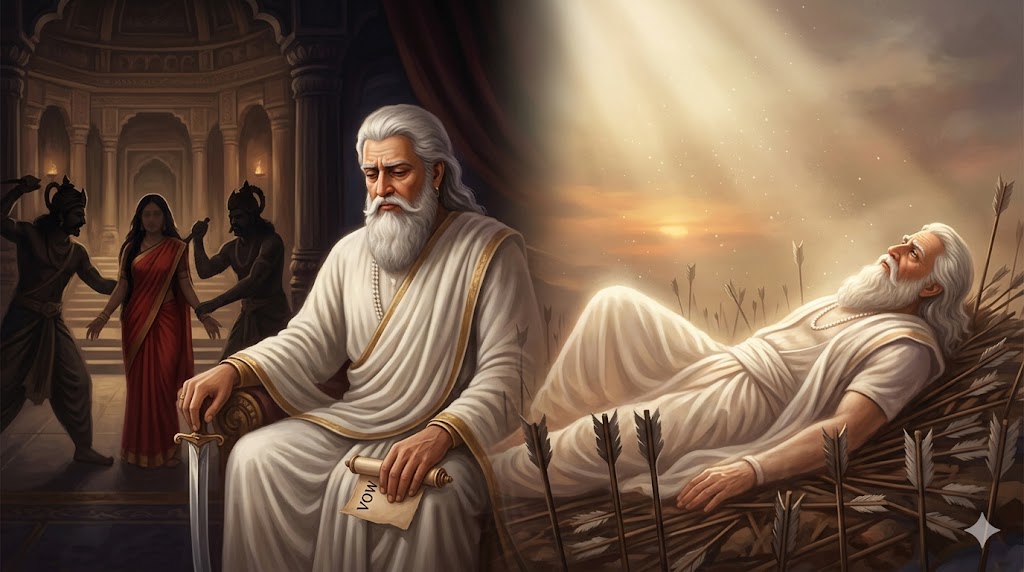
The Tragic Choice: A pained Bhishma Pitamah remains silent during Draupadi's distress in the assembly hall (left), bound by his oath to the king. Years later (right), he lies on a bed of arrows, enduring the consequences of prioritizing a narrow vow over universal justice, teaching that even the noble must face the fruits of their choices
Conclusion: The Eternal Call of Good Deeds
The Mahabharata, when viewed through the lens of karma and dharma, reveals itself as far more than an ancient war story. It is a comprehensive manual for ethical living that underscores one central truth: good deeds and righteous conduct are the only enduring essentials a human should pursue.
From the wise Bhishma to the accomplished Dronacharya, from the powerful Pandavas to the resilient Draupadi, every figure illustrates that position, knowledge, or relationships cannot shield one from the consequences of actions. The epic celebrates the beauty of Sanatan Dharma as a universal guide that transcends religious labels. It teaches Muslims, Christians, and people of all faiths the same timeless lesson — act according to your duty with integrity, avoid injustice, and contribute positively to the world around you.
In embracing these values, individuals discover true happiness and purpose. The Mahabharata thus remains a living source of wisdom, reminding humanity that while roles and circumstances differ, the path of good karma unites us all in the pursuit of a just and harmonious existence.