Svargarohana Parva: Final Ascent to Heaven in Mahabharata
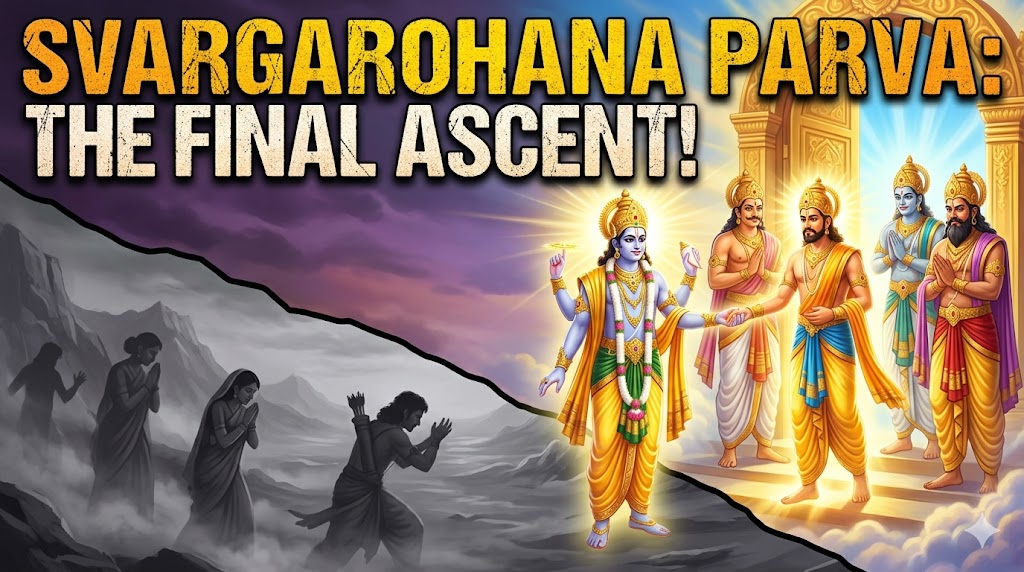
The Mahabharata, the timeless epic of dharma and human existence, reaches its majestic conclusion in the Svargarohana Parva (also spelled Swargarohan Parva or Svargarohana Parvam). As the 18th and final Parva, it is one of the shortest yet most philosophically profound sections, often called the “Book of the Ascent to Heaven.”
This Parva continues directly from Mahaprasthanika Parva, where the Pandavas and Draupadi undertook their great departure (Mahaprasthana). After their physical journey and the falls along the Himalayan path, Svargarohana Parva reveals what happens after death. It explores the Pandavas’ and Draupadi’s entry into the celestial realms, Yudhishthira’s ultimate tests of righteousness, and the resolution of all enmities from the Kurukshetra war.
More than a simple tale of reward and punishment, Svargarohana Parva reflects on the cycle of life, death, and salvation. It shows that even the greatest warriors — the mighty Bhima, the peerless Arjuna, the wise Yudhishthira, the beautiful Draupadi (daughter of Drupada and beloved friend of Lord Krishna) — must face the consequences of their actions. No one escapes the wheel of karma, yet through dharma and divine grace, all find their rightful place. The Parva underscores that earthly roles, however grand, are temporary; true liberation comes from completing one’s deeds with integrity.
This article provides a detailed examination of Svargarohana Parva, its position among the 18 Parvas, the complete narrative of the Pandavas’ heavenly journey, the tests faced by Yudhishthira, and selected Sanskrit shlokas that capture its wisdom.
The 18 Parvas of Mahabharata: Positioning the Final Chapter
Sage Vyasa structured the Mahabharata into 18 Parvas, tracing the Kuru dynasty from origins to transcendence:
1. Adi Parva – Beginnings and lineage.
2. Sabha Parva – Assembly hall and dice game.
3. Vana Parva – Forest exile.
4. Virata Parva – Year in disguise.
5. Udyoga Parva – War preparations.
6. Bhishma Parva – War begins with the Bhagavad Gita.
7. Drona Parva – Drona’s command.
8. Karna Parva – Karna’s valor.
9. Shalya Parva – End of the war.
10. Sauptika Parva – Night massacre.
11. Stri Parva – Women’s lament.
12. Shanti Parva – Peace and governance teachings.
13. Anushasana Parva – Final instructions.
14. Ashvamedhika Parva – Horse sacrifice.
15. Ashramavasika Parva – Elders’ forest retirement.
16. Mausala Parva – Destruction of the Yadavas and Krishna’s departure.
17. Mahaprasthanika Parva – The great physical journey of the Pandavas and Draupadi.
18. Svargarohana Parva – Ascent to heaven and ultimate resolution.
Svargarohana Parva brings closure to the epic, resolving the fates of all major characters after the Kurukshetra war and the subsequent events.
Context: From Mahaprasthanika Parva to Heavenly Ascent
In Mahaprasthanika Parva, the Pandavas renounced their kingdom, crowned Parikshit, and began their northward journey toward the Himalayas with Draupadi and a faithful black dog. One by one, Draupadi, Sahadeva, Nakula, Arjuna, and Bhima fell due to subtle human flaws — partiality, pride in wisdom, beauty, skill, and strength. Only Yudhishthira, accompanied by the dog (later revealed as Dharma), reached the threshold of heaven.
Svargarohana Parva picks up from this point. Yudhishthira, having passed the test of compassion by refusing to abandon the dog, ascends in Indra’s chariot with his mortal body — a rare privilege. The Parva then unfolds the final revelations about heaven (Swarga), hell (Naraka), and the nature of karma.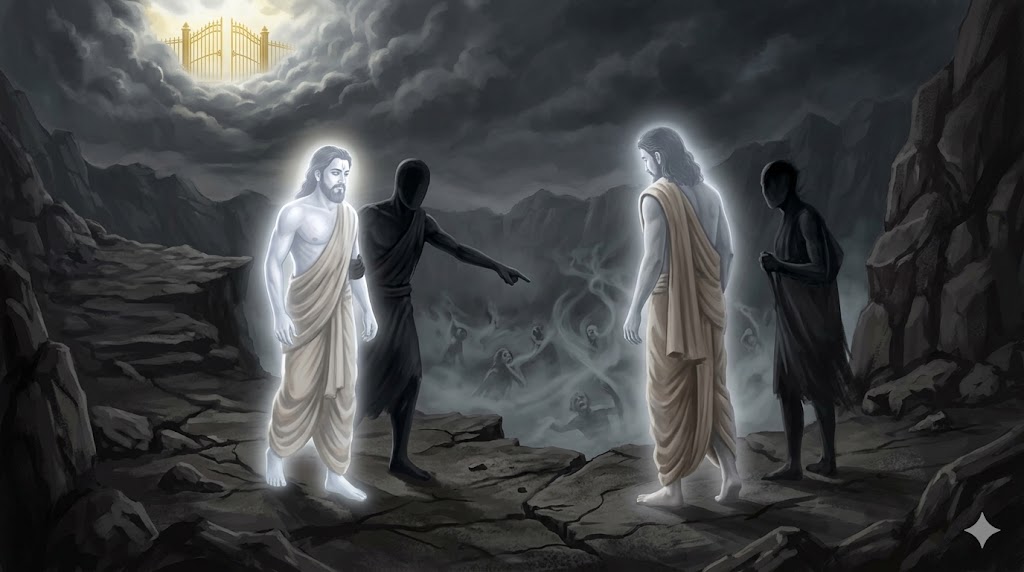
The Descending Test: Yudhishthira, still in his mortal form, is led by a divine messenger into a gloomy, misty chasm—the illusory hell—where he hears the cries of his loved ones, marking his final and most profound test of dharma.
Detailed Story of Svargarohana Parva
Upon entering heaven, Yudhishthira is welcomed but immediately faces disillusionment. He sees Duryodhana, his arch-rival, seated in glory, adorned with celestial ornaments and enjoying divine pleasures alongside other Kaurava warriors. Shocked and angered, remembering the injustices of the dice game, Draupadi’s humiliation, and the war’s devastation, Yudhishthira questions this apparent injustice. He demands to know the whereabouts of his brothers, Draupadi, Karna, and other righteous souls like Bhishma, Drona, and the sons of Draupadi.
A divine messenger leads Yudhishthira to a hellish realm filled with darkness, foul odors, and torment. There, he hears the agonizing cries of his loved ones — Bhima, Arjuna, Nakula, Sahadeva, Draupadi, and even Karna — begging him to stay and comfort them. Overwhelmed by compassion, Yudhishthira chooses to remain in hell rather than enjoy heaven without them. He declares that true dharma lies in standing by those who suffered with him.
This moment proves to be the ultimate test. The gods, including Indra and Yama, reveal that the vision of hell was an illusion created to examine Yudhishthira’s unwavering commitment to righteousness and loyalty. The brief suffering in the illusory hell cleansed the remaining karmic traces from the Pandavas’ and Draupadi’s earthly lives, particularly those incurred during the war (such as Yudhishthira’s half-truth to Drona).
The scene transforms. Yudhishthira is reunited with his brothers and Draupadi in their celestial forms. Enmities dissolve; Duryodhana and the Kauravas are honored as Kshatriya warriors who died valiantly on the battlefield. All souls — Pandavas, Kauravas, Karna, and others — find peace in Swarga, free from earthly grudges. Yudhishthira meets Lord Krishna in his divine Vishnu form, bringing full circle to the guidance that shaped the entire Mahabharata.
The Pandavas and Draupadi, having completed their earthly roles, attain their rightful places. Draupadi, who endured immense trials as the common wife of the Pandavas and friend of Krishna, achieves celestial glory. The epic concludes with Yudhishthira’s contentment, marking the end of the Dvapara Yuga’s heroic age.
Philosophical Significance: Karma, Salvation, and the Cycle of Existence
Svargarohana Parva beautifully illustrates that death is not the end but a transition. The Pandavas and Draupadi, despite their divine connections and heroic deeds, had to face the consequences of their actions. Even Arjuna, the greatest warrior blessed by Krishna, and Draupadi, the daughter of Drupada and embodiment of grace, fell during the physical journey and underwent karmic review.
This reflects the Hindu understanding of samsara — the cycle of birth, death, and rebirth. Even avatars like Krishna participate in this cycle when assuming human form to establish dharma. The Parva shows that heaven and hell are not permanent destinations but temporary states based on accumulated karma. True salvation (moksha) transcends both, though Swarga offers a period of reward before further evolution.
Yudhishthira’s tests — first with the dog in Mahaprasthanika Parva and then with the illusory hell — emphasize that dharma is tested until the very end. Compassion, truth, and loyalty matter more than past victories or power. The resolution, where all warriors reunite without enmity, teaches forgiveness and the impermanence of worldly conflicts.
The narrative also highlights that one’s fate is written according to deeds, yet divine grace and righteous living can elevate the soul. Draupadi’s presence in heaven alongside her husbands underscores the dignity restored after her earthly sufferings.
Selected Sanskrit Shlokas from Svargarohana Parva
Svargarohana Parva contains verses that capture its essence. Here are a few notable ones (with English translation for clarity):
1. On the futility of ignoring dharma:
“There are thousands of occasions for joy and hundreds of occasions for fear; These affect only him that is ignorant but never him that is wise.”
(A reflective verse on wisdom and equanimity in the face of heaven and hell.)
2. Yudhishthira’s declaration of dharma:
“With uplifted arms I am crying aloud but nobody hears me. From Righteousness comes Wealth, also Pleasure; Why should not Righteousness, therefore, be courted? For the sake neither of pleasure, nor of fear, nor of cupidity should any one cast off Righteousness.”
3. On the dissolution of enmity in heaven:
The gods explain through Narada that in Swarga, old hatreds cease, as all have fulfilled their Kshatriya dharma through battlefield death.
These shlokas reinforce the Parva’s message: righteousness (dharma) is the ultimate guide, transcending temporary joys or sorrows.
Lessons for Contemporary Readers
Svargarohana Parva offers enduring wisdom on leadership, justice, and the human condition. It reminds us that success and power are fleeting, while moral character endures. In a world of conflicts, the Parva’s vision of ultimate reconciliation in heaven inspires hope for harmony beyond divisions. It also addresses universal questions about death, afterlife, and salvation, encouraging righteous living regardless of one’s station.
Whether studied in traditional recitals, regional versions (including Odia or Telugu Mahabharata), or modern discussions, this final Parva provides closure to the epic’s vast narrative while opening doors to deeper spiritual reflection.
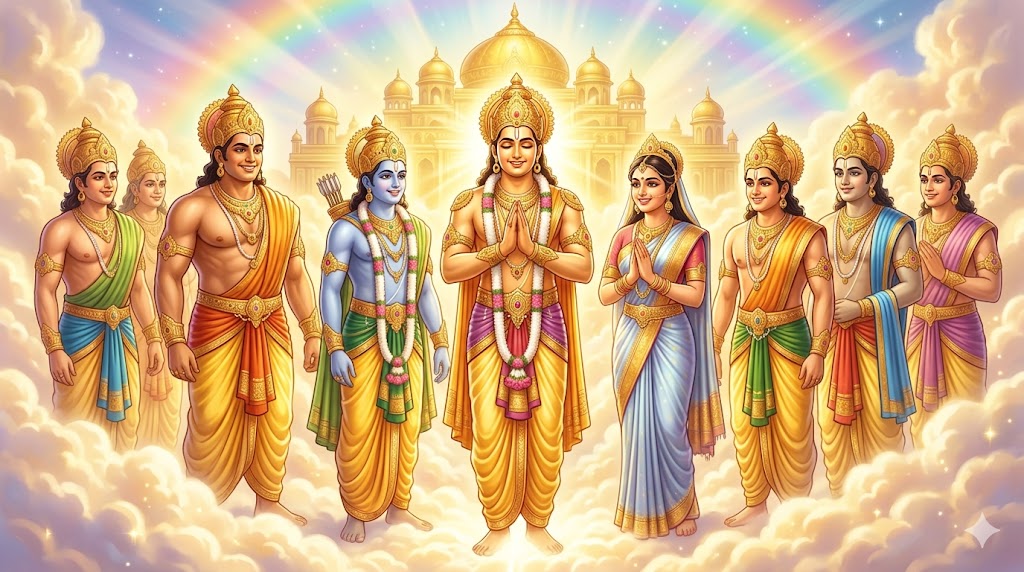
The Celestial Reunion: Having passed all tests, Yudhishthira is reunited in a glorious, golden Swarga Lok with his brothers, Draupadi, and all the warriors of the Kurukshetra war, who appear in their perfected, celestial forms, free from earthly enmities
Conclusion: The Eternal Close of the Mahabharata
Svargarohana Parva stands as a fitting culmination to the Mahabharata. After the physical journey in Mahaprasthanika Parva, it reveals the celestial fates of the Pandavas, Draupadi, and all warriors. Yudhishthira’s trials, the illusory hell, and the joyful reunion demonstrate that karma shapes destiny, yet compassion and dharma open the gates to higher realms.
Even the powerful Arjuna, wise Yudhishthira, strong Bhima, and resilient Draupadi — friend of Lord Krishna — had to navigate the cycle of action and consequence. Their story affirms that every soul completes its earthly role before ascending, and in the end, divine order prevails.
As the Mahabharata draws to a close, readers are left with a message of hope: through steadfast dharma, all paths lead toward light, forgiveness, and ultimate peace in the grand design of existence.