Mahaprasthanika Parva: Pandavas' Final Journey to Heaven
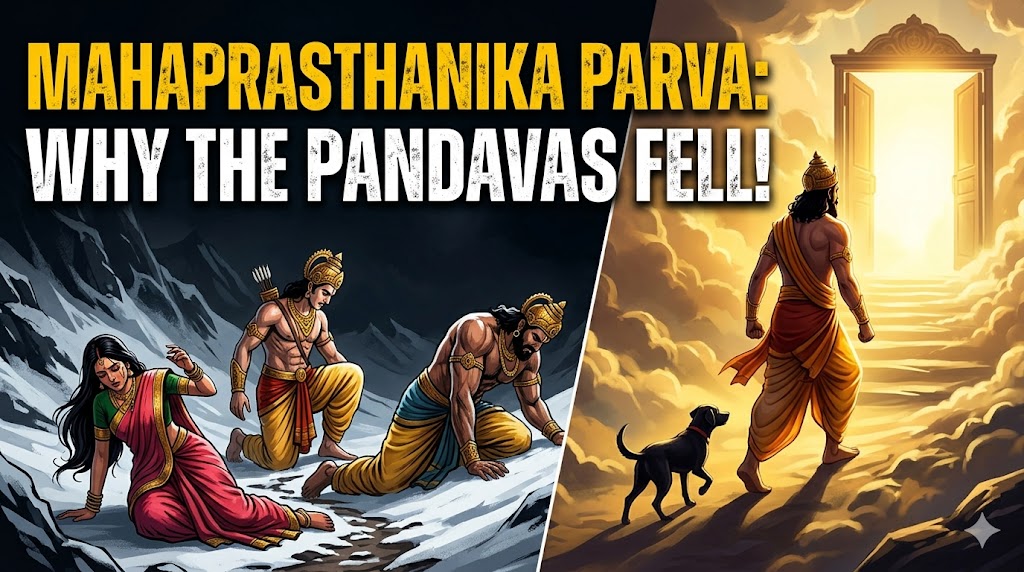
The Mahabharata, one of the most profound epics of ancient India, reaches its philosophical climax in its final Parvas. Among the 18 major sections, Mahaprasthanika Parva (also known as Mahaprasthanik Parva or Mahaprasthanika Parba) stands as the 17th book. Often translated as the “Book of the Great Departure” or “The Great Journey,” this Parva narrates the poignant final chapter in the lives of the Pandavas and Draupadi.
After witnessing the destruction of the Yadava clan in Mausala Parva and the passing of an entire heroic age, the Pandavas decide to renounce the world. Accompanied by Draupadi and a mysterious black dog, they embark on a sacred journey toward the Himalayas, aiming to attain Swarg Lok (heaven). This journey, known as Mahaprasthana, is not merely a physical trek but a profound spiritual test of dharma, karma, and detachment.
Mahaprasthanika Parva beautifully illustrates that even the greatest warriors and the divine Draupadi must complete their earthly roles before ascending. It answers a timeless question: why only Yudhishthira ultimately enters heaven while the others fall along the way. Through this narrative, the epic emphasizes that no one — not even those blessed by Lord Krishna — escapes the consequences of their actions, and entry into heaven depends on purity of conduct rather than past glory.
This article provides a detailed exploration of Mahaprasthanika Parva, its place among the 18 Parvas of the Mahabharata, the complete story of the Pandavas’ final journey, and the deeper philosophical lessons it offers.
The 18 Parvas of Mahabharata: A Quick Overview
Vyasa structured the Mahabharata into 18 Parvas, each marking a distinct phase of the epic:
1. Adi Parva – Origins of the Kuru dynasty and early lives of the heroes.
2. Sabha Parva – The dice game and Draupadi’s humiliation.
3. Vana Parva – The Pandavas’ forest exile.
4. Virata Parva – The year in disguise.
5. Udyoga Parv – Preparations for war.
6. Bhishma Parva – The war begins with the Bhagavad Gita.
7. Drona Parva – Drona’s command.
8. Karna Parva – Karna’s role and death.
9. Shalya Parva – Final days of the war.
10. Sauptika Parva – Night massacre.
11. Stri Parva – Lamentations of the women.
12. Shanti Parva – Teachings on governance.
13. Anushasana Parva – Bhishma’s final instructions.
14. Ashvamedhika Parva – The horse sacrifice.
15. Ashramavasika Parva – Elders retire to the forest.
16. Mausala Parva – Destruction of the Yadavas and Krishna’s departure.
17. Mahaprasthanika Parva – The Pandavas’ great departure.
18. Svargarohana Parva – The ascent to heaven and final revelations.
Mahaprasthanika Parva acts as a bridge between the destruction of the old order and the ultimate judgment of the heroes’ souls.
Context Leading to Mahaprasthanika Parva
After the Kurukshetra war, Yudhishthira ruled righteously for many years. In Ashramavasika Parva, the older generation left for the forest. In Mausala Parva, the Yadava clan perished, and Lord Krishna departed from the earth. These events deeply affected the Pandavas. The world they knew had changed irreversibly. The weapons lost their power, and a sense of detachment grew.
Realizing that their time on earth was over and their dharma on the mortal plane was complete, the five Pandava brothers— Yudhishthira, Bhima, Arjuna, Nakula, and Sahadeva — along with their wife Draupadi, decided to undertake the final journey. They handed over the kingdom to Parikshit, Arjuna’s grandson, and set forth northward toward the Himalayas, the abode of the gods.
A faithful black dog mysteriously joined them at the start of the journey, following the group silently.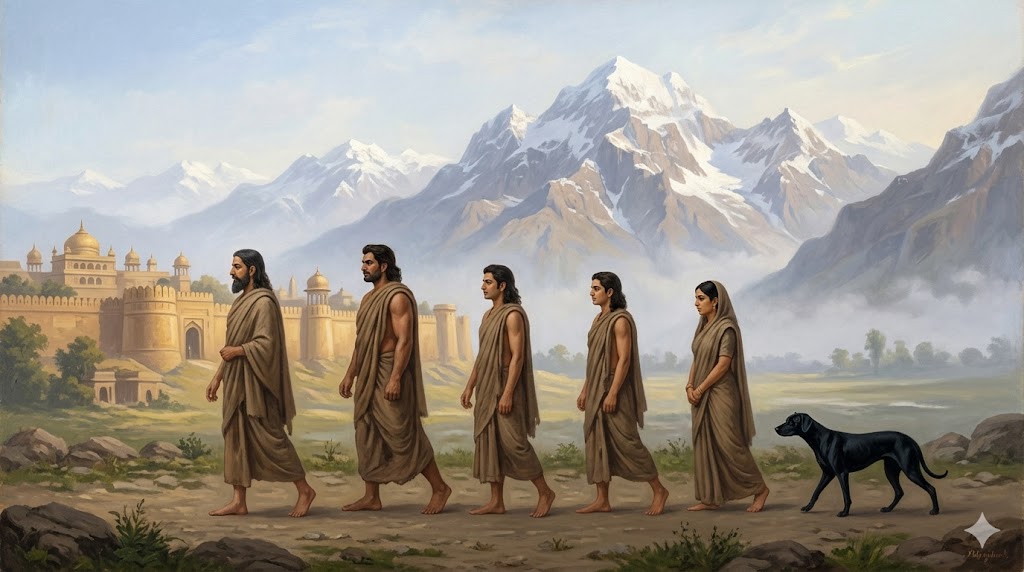
The Great Renunciation: Dressed in simple ascetic robes, the five Pandavas and Draupadi begin their final, arduous journey (Mahaprasthana) toward the Himalayas, accompanied from the start by a mysterious black dog, symbolizing the silent presence of Dharma.
Detailed Story of Mahaprasthanika Parva
The Parva opens with the Pandavas and Draupadi beginning their arduous trek. Clad in simple garments, they walk barefoot, renouncing all royal luxuries. The journey is long and increasingly difficult as they climb higher into the mountains.
One by one, the travelers begin to fall:
Draupadi falls first. When questioned by Yudhishthira, he explains that though she was devoted, she had a special fondness for Arjuna, showing a slight partiality. This subtle imbalance in her heart caused her to fall short of perfect detachment.
Sahadeva falls next. He was proud of his wisdom and knowledge, believing himself superior in intelligence.
Nakula follows. He was proud of his exceptional beauty and physical appearance.
Arjuna collapses later. His pride in his archery skills and the celestial weapons given by the gods proved to be his weakness. He had once boasted that he could destroy all enemies single-handedly.
Bhima falls toward the end. Though immensely strong and loyal, he was proud of his physical power and had occasionally shown arrogance and gluttony.
With each fall, Yudhishthira offers calm explanations rooted in dharma, without looking back, as per the rules of the sacred journey. Only the black dog continues to accompany him.
Finally, only Yudhishthira and the dog remain. As they reach the gates of heaven, Indra (the king of gods) arrives in his chariot to welcome Yudhishthira. However, Indra refuses to allow the dog to enter, stating that heaven is not meant for animals.
Yudhishthira, known for his unwavering commitment to dharma, refuses to abandon the loyal dog. He declares that he would rather stay behind than forsake a creature that has shown him devotion and companionship. This act of compassion proves decisive.
The dog then reveals its true form — it is none other than Dharma (Yudhishthira’s divine father in disguise). The test was to examine whether the eldest Pandava would uphold righteousness even at the threshold of heaven.
Yudhishthira is then taken to Swarg Lok. However, what he finds there shocks him — he sees Duryodhana and the Kauravas enjoying celestial pleasures, while many righteous souls appear to be missing. This sets the stage for the revelations in the final Parva, Svargarohana Parva.
Philosophical Lessons: Completion of Deeds and the Cycle of Karma
Mahaprasthanika Parva powerfully illustrates that even the greatest heroes, including those blessed and guided by Lord Krishna, must complete their earthly roles and face the consequences of their actions. Draupadi, despite being the divine incarnation of Shri (goddess of fortune) and having suffered immensely during her life, had to fall because of a minor human flaw — partiality toward Arjuna.
The falls of the Pandava brothers highlight the subtle imperfections that persist even in noble souls: pride in knowledge, beauty, skill, and strength. The epic teaches that true entry into heaven requires complete detachment and purity of heart, not merely past achievements or divine favor.
Lord Krishna himself, though an avatar of Vishnu, had to fulfill his role on earth and eventually leave his mortal body in Mausala Parva. This underscores a central message of the Mahabharata: when the divine descends as a human, it too must participate in the cycle of karma, action, and eventual departure to re-establish justice and dharma.
The presence of the black dog and Yudhishthira’s refusal to abandon it emphasizes that compassion and steadfast adherence to dharma are the ultimate qualifications for heaven, more important than martial glory or royal status.
Why Only Yudhishthira Entered Heaven Initially
The selective falls during the journey are not punishments but reflections of karmic balance. Each character had performed extraordinary deeds, yet residual human weaknesses remained. Yudhishthira’s unparalleled commitment to truth and righteousness — even when it cost him his kingdom and caused immense suffering — made him worthy. His final test with the dog confirmed his unshakeable moral character.
This narrative beautifully balances the concepts of divine grace and personal effort. While Krishna guided the Pandavas, their entry into heaven ultimately depended on how purely they lived their dharma.
In modern times, Mahaprasthanika Parva continues to inspire discussions on leadership, detachment, and the true meaning of success. It reminds readers that material achievements and even great victories on the battlefield are temporary. What endures is moral integrity and compassion.
Whether studied in traditional recitals, academic courses, or popular quizzes and MCQs on Mahaprasthanika Parva, this Parva offers timeless wisdom about the impermanence of life and the importance of living righteously until the very end.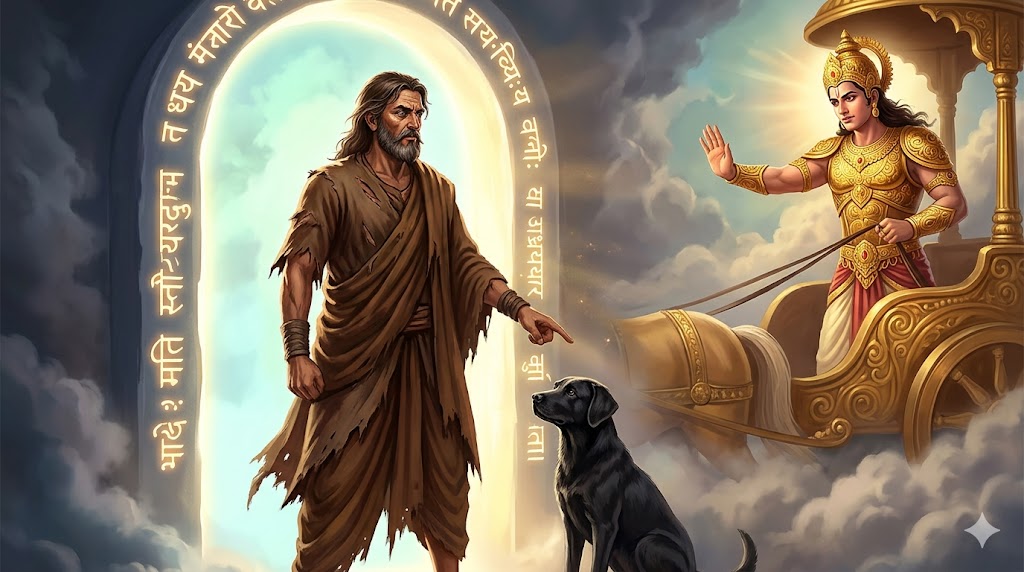
The Final Test of Dharma: At the gateway to Swarg Lok, King Indra refuses entry to the dog. Yudhishthira, defining true righteousness, declares he cannot abandon a faithful companion, proving his worthiness for heaven.
Conclusion: The Great Departure and Eternal Dharma
Mahaprasthanika Parva stands as one of the most moving and philosophical sections of the Mahabharata. The final journey of the Pandavas and Draupadi, accompanied by the faithful black dog, symbolizes the universal truth that every soul must eventually leave the earthly stage after completing its assigned role.
The falls along the path and Yudhishthira’s solitary entry into heaven teach that dharma is tested until the last moment. Even those who walked with Lord Krishna had to face the consequences of their actions, reinforcing that no one is exempt from the cycle of karma.
Through this great departure, the epic brings closure to the heroic age while preparing the ground for the ultimate revelations in Svargarohana Parva. Mahaprasthanika Parva remains a profound meditation on life, death, duty, and the eternal quest for righteousness.