Mausala Parva: End of Yadavas & Krishna in Mahabharata
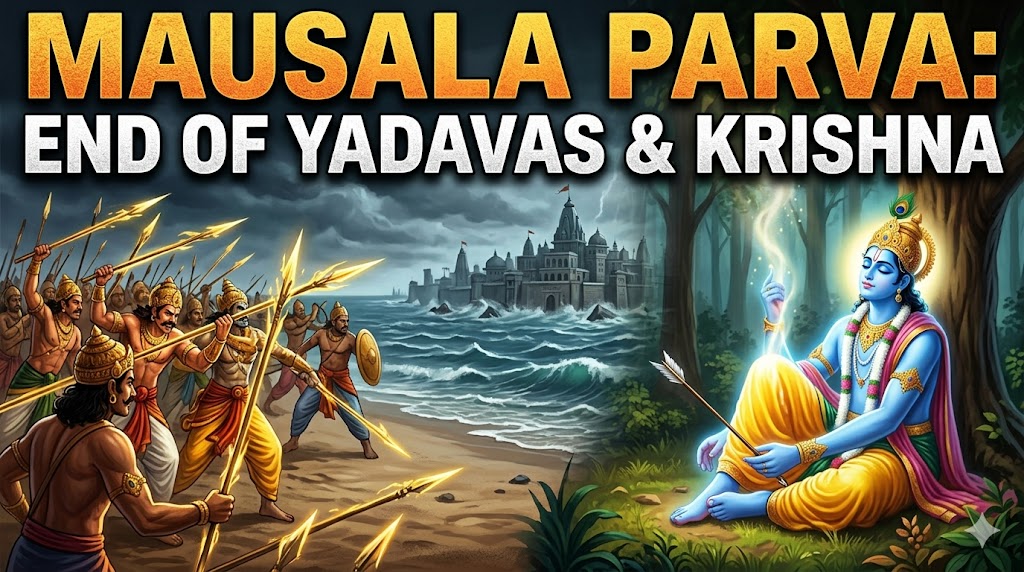
The Mahabharata, the grand Indian epic attributed to Sage Vyasa, unfolds across 18 major sections known as Parvas. While the earlier books focus on the origins of conflict, the devastating Kurukshetra war, and its immediate aftermath, the later Parvas shift toward reflection, renunciation, and the inevitable passage of time. Among these, Mausala Parva (also spelled Mausala Parwa or Mausala Prava) holds a unique and poignant position as the 16th Parva.
Often translated as the "Book of the Clubs" or "Book of Iron Clubs," Mausala Parva narrates the self-inflicted destruction of the mighty Yadava clan, the lineage of Lord Krishna, and the eventual departure of Krishna himself from the earthly realm. Set approximately 36 years after the great Kurukshetra war, this Parva serves as a sobering reminder that even the most powerful dynasties and divine incarnations are subject to the laws of karma, time, and cosmic cycles.
This detailed exploration covers the full context within the 18 Parvas of the Mahabharata, a comprehensive summary of Mausala Parva, the destruction of the Yaduvansh, the death of Lord Krishna, and the deeper philosophical message that even God, when born as a human, must navigate the cycle of life and death to establish dharma and justice on earth.
The 18 Parvas of Mahabharata: Complete Overview
To appreciate Mausala Parva's significance, one must understand its place in the epic's structure. Vyasa organized the Mahabharata into 18 Parvas, each advancing the narrative from origins to conclusion:
1. Adi Parva – The Book of the Beginning: Introduces the Kuru lineage, births of Pandavas and Kauravas.
2. Sabha Parva– The Book of the Assembly Hall: The dice game and Draupadi's humiliation.
3. Vana Parva (Aranya Parva) – The Book of the Forest: Pandavas' 12-year exile.
4. Virata Parva – The Book of Virata: The 13th year in disguise.
5. Udyoga Parva – The Book of Effort: War preparations.
6. Bhishma Parva – Bhishma's command and the Bhagavad Gita.
7. Drona Parva – Drona's leadership and key deaths.
8. Karna Parva – Karna's role and fall.
9. Shalya Parva – Shalya's command and Duryodhana's end.
10. Sauptika Parva – The nocturnal massacre by Ashwatthama.
11. Stri Parva – Lamentations of the women.
12. Shanti Parva – Teachings on peace and governance.
13. Anushasana Parva – Further instructions from Bhishma.
14. Ashvamedhika Parva– Yudhishthira's horse sacrifice.
15. Ashramavasika Parva – Elders' retirement to the forest.
16. Mausala Parva – Destruction of the Yadavas and Krishna's departure.
17. Mahaprasthanika Parva – The Pandavas' final journey (Swarg Yatra).
18. Svargarohana Parva – Ascent to heaven and final revelations.
Mausala Parva follows the relatively peaceful years after the war and precedes the Pandavas' renunciation. It bridges the established order under Yudhishthira with the ultimate dissolution of the heroic age.
Context: Mahabharata After the War
The Kurukshetra war left both sides devastated. Yudhishthira, though victorious, ruled with a heavy heart, seeking guidance from the dying Bhishma in Shanti and Anushasana Parvas. The Pandavas performed the Ashvamedha sacrifice to consolidate power and atone. In Ashramavasika Parva, the older generation—Dhritarashtra, Gandhari, and Kunti—retired to the forest.
Meanwhile, the Yadavas, led by Krishna and Balarama, continued to flourish in their prosperous city of Dwarka. Krishna had played a pivotal role as Arjuna's charioteer and divine counselor, guiding the Pandavas toward victory and establishing dharma. However, the seeds of future tragedy were sown during the war itself. Gandhari, in her profound grief over her 100 sons' deaths, cursed Krishna and the Yadava clan, foretelling that they would perish in a similar fratricidal conflict 36 years later.
This curse, combined with the arrogance that crept into the Yadavas over time, set the stage for the events of Mausala Parva.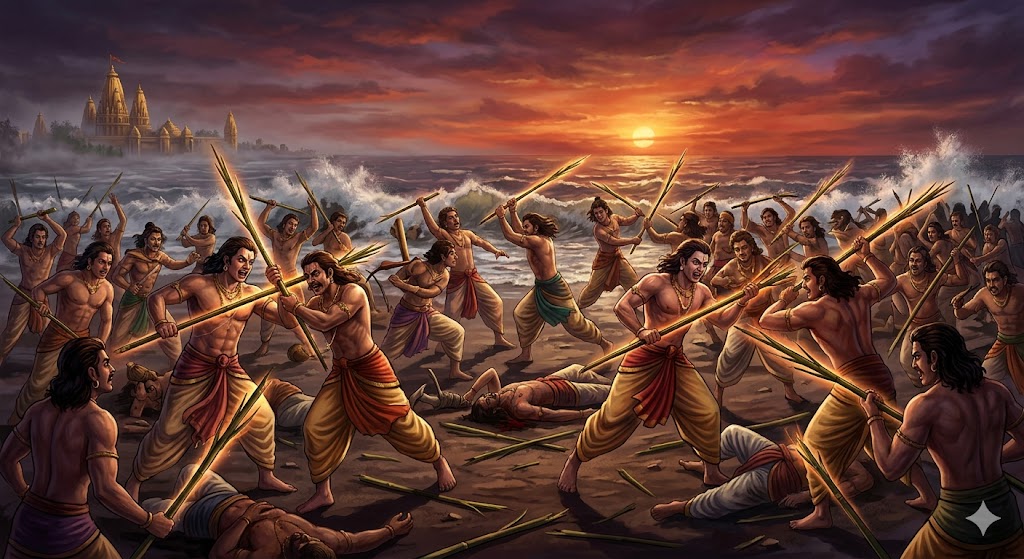
The Tragic Conflict: Yadava warriors, consumed by rage and madness born of a curse, destroy one another on the shores of Prabhasa using the fatal Eraka grass that turned into iron clubs, marking the self-destruction of the mighty clan
Detailed Story of Mausala Parva
Mausala Parva is relatively short, comprising about nine chapters in most editions. It begins with ominous signs in Dwarka: strange omens, immoral behavior among the Yadavas, and a general decline in dharma. The Yadavas, once disciplined warriors, had grown indulgent.
A pivotal incident occurs when some Yadava youths, including Samba (Krishna's son), mock the sages Vishvamitra, Narada, and Kanva. They dress Samba as a pregnant woman and ask the sages to predict the child's gender. Offended by the prank, the sages curse that Samba will give birth to an iron club (musala) that will destroy the entire Yadava race.
The Yadavas, alarmed, grind the iron pestle into powder and throw it into the sea, keeping only a small piece. Over time, this powder causes sharp grass (eraka) to grow, which later becomes deadly weapons. The small iron piece is swallowed by a fish, eventually fashioned into an arrowhead by a hunter named Jara.
As the 36th year arrives, the Yadavas gather at Prabhasa (near modern Somnath). Heavy drinking and revelry lead to heated arguments. Old grudges resurface. In the ensuing chaos, they pluck the eraka grass, which miraculously turns into iron clubs due to the sages' curse. A frenzied civil war erupts, with Yadavas killing one another indiscriminately.
Krishna and Balarama witness the slaughter helplessly at first. Balarama, saddened, retires to the forest and enters a meditative state, eventually leaving his mortal body as the divine serpent Shesha and merging with the ocean.
Krishna, seeing his own kin—including his son Pradyumna and friend Satyaki—fall, takes up the grass in anger, which turns into an iron bolt. He uses it to slay the remaining violent warriors. When the massacre ends, vast numbers of Yadavas lie dead. Only a few survivors, such as Babhru and Daruka, remain.
The Death of Lord Krishna and Submergence of Dwarka
After the destruction, Krishna retreats to a secluded forest. He sits in a yogic posture, aware that his earthly mission—to relieve the burden of adharma and establish justice—is complete. A hunter named Jara, searching for prey, mistakes Krishna's raised foot for a deer's ear and shoots an arrow tipped with the remaining iron piece from the curse.
The arrow strikes Krishna in the heel, his only vulnerable spot (echoing the legend of his earlier invulnerability except for the feet). Krishna consoles the remorseful hunter and ascends to his divine abode, Vaikuntha, as Vishnu.
Following Krishna's departure, the sea rises and submerges the once-glorious city of Dwarka, symbolizing the end of an era. Arjuna later arrives to escort the surviving Yadava women and children but faces challenges, highlighting the fading power of the Pandavas' celestial weapons in the changing times.
News of these events reaches the Pandavas, deepening their sense of detachment and prompting their own Mahaprasthana (great journey) toward the Himalayas in the subsequent Parva.
Philosophical Significance: Even the Divine Must Face the Cycle
One of the most profound aspects of Mausala Parva is its portrayal of Lord Krishna. As an incarnation of Vishnu, Krishna descended to earth to uphold dharma, guide the Pandavas, and remove the burden of evil kings. He orchestrated the Mahabharata war not out of personal desire but to re-establish righteousness.
Yet, even as God in human form, Krishna had to experience the full cycle of life and death. The epic illustrates that no one— not even the Supreme Being in avatar form—escapes the laws of karma and time (kala). The destruction of the Yaduvansh fulfills Gandhari's curse and the sages' pronouncement, underscoring that unchecked pride and moral decline lead to downfall, regardless of lineage or divine protection.
This narrative emphasizes impermanence (anitya). The mighty Yadavas, protected by Krishna himself, perished through internal conflict. Dwarka's submergence symbolizes how even grand civilizations fade. Krishna's calm acceptance of his end teaches detachment and the completion of one's dharma.
For devotees, it reinforces that avatars take birth to establish justice but must adhere to the rules of the mortal world they enter. Krishna's life and departure remind humanity that true victory lies in righteous action, not in clinging to power or glory.
Lessons from Mausala Parva for Modern Readers
Mausala Parva offers timeless wisdom. It warns against arrogance, internal divisions, and the neglect of dharma. The self-destruction of the Yadavas mirrors how societies can crumble from within due to moral decay. The story also highlights forgiveness and acceptance—Krishna bears no grudge against the hunter Jara, viewing the event as part of a larger cosmic design.
In popular retellings, whether in traditional recitals, television adaptations, or discussions on Mahabharata after war, Mausala Parva provides closure to the heroic age, paving the way for the Pandavas' final journey and ultimate revelations in Svargarohana Parva.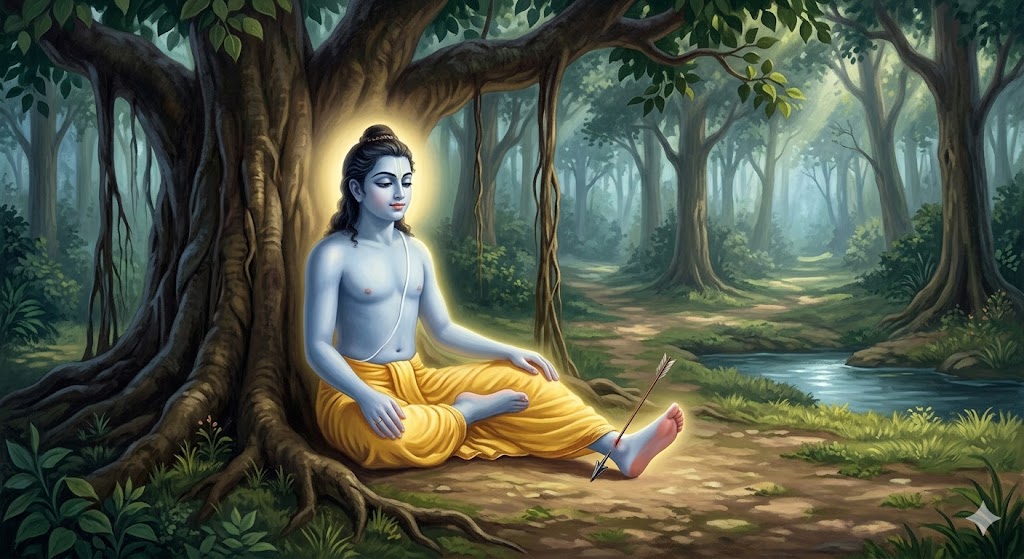
The Final Moments: A serene Lord Krishna rests in the forest, accepting his departure as the hunter's arrow strikes his heel—his only vulnerable spot—fulfilling the cosmic design and completing his earthly mission.
Conclusion: The Inevitable Close of an Era
Mausala Parva stands as a powerful, albeit tragic, chapter in the Mahabharata. It depicts the complete annihilation of the Yadava dynasty through fratricide, the serene departure of Balarama, and the poignant end of Lord Krishna on earth. Through these events, the epic conveys that time spares no one and that even divine incarnations participate in the cycle of birth and death to fulfill their sacred purpose of upholding justice.
By reading Mausala Parva in the context of the full 18 Parvas, one gains a holistic understanding of the Mahabharata—not merely as a tale of war, but as a profound philosophical treatise on duty, impermanence, and the eternal nature of dharma. The destruction of the Yaduvansh and Krishna's departure mark the twilight of the Dvapara Yuga, reminding every generation that glory is fleeting, but righteous living leaves an enduring legacy.