Reserve Bank of India History and role :India's Central Bank
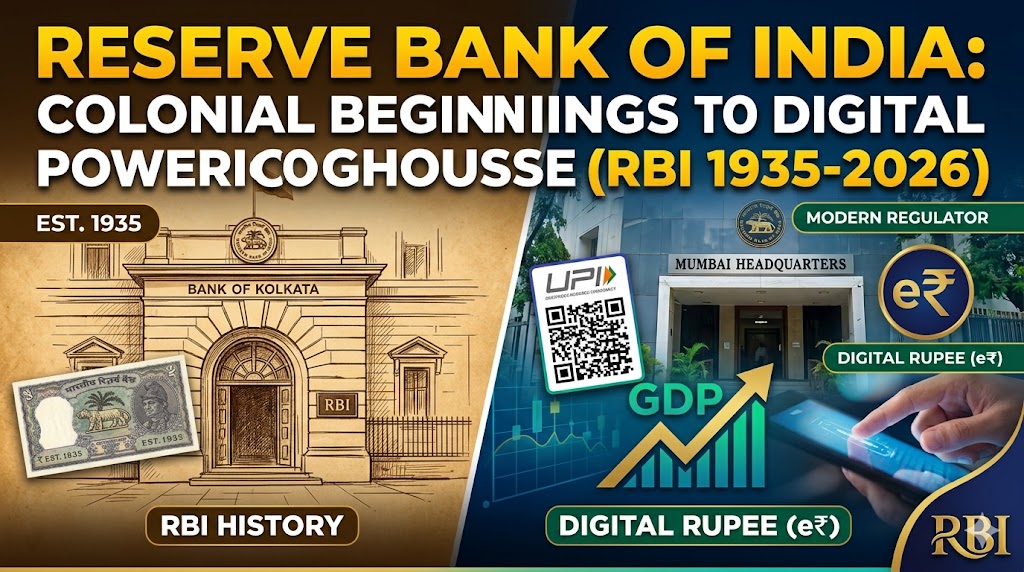
The Reserve Bank of India, widely known as the RBI, stands as the cornerstone of India's financial architecture. Established nearly a century ago, it has guided the nation through colonial times, post-independence economic reconstruction, liberalization, and the digital transformation of the 21st century. As the central bank, the RBI shoulders the dual responsibility of maintaining monetary stability while fostering sustainable economic growth.
In an era marked by global uncertainties—ranging from geopolitical tensions to rapid technological shifts—the RBI's decisions on interest rates, banking regulations, and digital innovations influence every Indian, from small savers to large corporations. This article explores the rich history of the Reserve Bank of India, its core functions and present-day structure, recent policy developments as of 2026, and the key controversies shaping public discourse.
The Origins and Early History of the RBI
The story of the Reserve Bank of India traces back to the economic challenges following the First World War. In 1926, the Royal Commission on Indian Currency and Finance, popularly called the Hilton Young Commission, recommended the creation of a dedicated central bank for India. The goal was to separate currency and credit control from direct government oversight and to strengthen banking facilities across the country.
The Reserve Bank of India Act was passed in 1934, providing the statutory foundation. The RBI officially commenced operations on April 1, 1935, initially as a privately owned shareholders' bank with an initial capital of ₹5 crore. Its headquarters began in Kolkata before shifting permanently to Mumbai in 1937, where it remains today.
The bank's early mandate, as outlined in the preamble of the RBI Act, focused on regulating the issue of banknotes, maintaining reserves to secure monetary stability, and operating the currency and credit system to India's advantage. Sir Osborne Smith served as the first Governor from 1935 to 1937. The first Indian Governor, C.D. Deshmukh, took office in 1943 and played a significant role in shaping the institution.
A pivotal moment came after India's independence. On January 1, 1949, the RBI was nationalized through the Reserve Bank (Transfer to Public Ownership) Act, 1948. All shares were transferred to the Central Government, transforming it into a fully state-owned entity. This nationalization aligned the central bank more closely with the nation's developmental priorities, including support for agriculture and planned economic growth.
Over the decades, the RBI evolved in response to India's changing economic landscape. It managed the currency system post-partition, navigated the 1960s bank nationalization wave, supported the Green Revolution, and later guided the 1991 economic liberalization under Governor C. Rangarajan and others. Each phase reinforced its role as guardian of financial stability.
Core Functions and Organizational Structure of the RBI
The Reserve Bank of India performs several critical functions that underpin the economy:
Monetary Authority: Formulates and implements monetary policy through tools like the repo rate to control inflation while supporting growth. The Monetary Policy Committee (MPC), established in 2016, decides on the policy repo rate with a mandate to target 4% CPI inflation (with a 2-6% band).
Regulator and Supervisor: Oversees commercial banks, non-banking financial companies (NBFCs), payment systems, and cooperative banks. It sets capital adequacy norms, licensing requirements, and prudential guidelines to ensure systemic stability.
Issuer of Currency: Sole authority for issuing banknotes and coins (except one-rupee notes and coins, managed by the Government). It ensures adequate currency supply while combating counterfeiting.
Banker to the Government: Manages government accounts, handles public debt, and advises on economic matters.
Banker to Banks: Provides liquidity through the Liquidity Adjustment Facility (LAF) and acts as the lender of last resort.
Manager of Foreign Exchange: Oversees the foreign exchange market under the Foreign Exchange Management Act (FEMA) and builds up foreign exchange reserves.
Developmental Role: Promotes financial inclusion through initiatives like priority sector lending, microfinance support, and digital payment infrastructure such as UPI.
The organizational structure is headed by the Governor, currently Sanjay Malhotra (as of 2026), supported by up to four Deputy Governors and a Central Board of Directors. The Board includes representatives from various regions and sectors, ensuring diverse perspectives. Regional offices across India help implement policies at the grassroots level.
The Present Role of the RBI in India's Economy
In the contemporary context, the RBI balances the objectives of price stability, growth, and financial inclusion amid complex global and domestic challenges. Under Governor Sanjay Malhotra, the central bank has navigated post-pandemic recovery, inflation pressures from global commodity shocks, and the rapid digitization of finance.
As of April 2026, the RBI has maintained a cautious monetary stance. In its recent MPC meetings, including the April 2026 review, the policy repo rate was kept unchanged at 5.25% with a neutral stance. This decision reflected concerns over potential inflationary spillovers from geopolitical developments, such as tensions in West Asia affecting oil prices, while projecting GDP growth around 6.9% for FY27. The central bank has emphasized resilience in domestic demand and strong external buffers.
The RBI has also accelerated regulatory modernization. In 2025-26, it introduced consumer protection measures targeting mis-selling of financial products, aggressive debt recovery practices, and digital payment frauds. New guidelines aim to strengthen customer safeguards without stifling innovation. Efforts to support MSMEs include doubling collateral-free loan limits and easing certain norms for digital lending platforms.
On the digital front, the RBI continues to expand the Digital Rupee (e-Rupee), its Central Bank Digital Currency (CBDC). Pilot projects for both wholesale and retail segments have progressed, with banks encouraged to prepare for potential shifts in deposit patterns. The central bank maintains a cautious approach toward private cryptocurrencies and stablecoins, prioritizing sovereign-backed digital money to preserve monetary sovereignty.
from 1935 to present role and regulations and digital payments
Recent Developments and Policy Initiatives
The years 2025 and 2026 have witnessed significant regulatory recalibration by the Reserve Bank of India. After a series of rate cuts in 2025 totaling 125 basis points, the focus shifted toward simplifying regulations and unlocking credit flow. Key moves include:
Easing Default Loss Guarantee (DLG) norms for NBFCs and fintech partnerships to revive digital lending.
Proposals for bank boards to focus more on strategic policy rather than day-to-day operations.
Deferrals and clarifications on capital market exposure limits and acquisition financing.
Push for stronger authentication in digital payments, including two-factor authentication mandates, while acknowledging emerging risks like quantum computing threats.
Reforms in trade finance under FEMA and measures to develop corporate bond and derivatives markets.
These initiatives reflect a broader transition from crisis-era tight regulation toward growth-oriented policies, while still prioritizing financial stability. The RBI has also addressed liquidity management effectively, injecting funds during temporary deficits and maintaining orderly market conditions.
Current Controversies Surrounding the
RBILike any powerful institution, the Reserve Bank of India occasionally finds itself at the center of debate. Several issues have sparked discussion in recent times:
First, the pace and sequencing of regulatory changes. While many welcome the easing of certain norms for NBFCs and digital lending, critics argue that rapid relaxations could reintroduce risks seen in earlier episodes of stress in the shadow banking sector. Questions have arisen about whether the balance between growth and prudence is being maintained adequately.
Second, monetary policy forecasting and communication. Some analysts have pointed to divergences between RBI projections and actual inflation outcomes in past periods, raising concerns about forecasting accuracy. However, the MPC's transparent deliberations and data-driven approach have generally earned respect.
Third, the Digital Rupee rollout and stance on cryptocurrencies. Banks have expressed concerns about potential deposit migration as CBDC adoption grows. Meanwhile, the RBI's cautious-to-restrictive position on private digital currencies has drawn both praise for risk aversion and criticism from innovation advocates who seek clearer regulatory pathways for crypto assets.
Fourth, consumer protection versus industry flexibility. New rules on mis-selling, recovery agents, and fraud prevention have been welcomed by the public but have led to operational adjustments for banks and NBFCs. Some stakeholders argue that overly prescriptive guidelines could raise compliance costs.
Fifth, external challenges such as rupee volatility and global spillovers. With the currency facing pressure at times due to foreign fund outflows and commodity price swings, the RBI's intervention strategies in the forex market occasionally invite scrutiny regarding the extent of managed float versus market determination.
Governor Malhotra and the central board have consistently emphasized that policies are guided by data and long-term stability rather than short-term pressures. The institution's independence, while collaborative with the government on broader economic goals, remains a key strength.
The Road Ahead for the Reserve Bank of India
Looking forward, the RBI faces the task of steering the economy through an uncertain global environment while harnessing technology for inclusive growth. Priorities likely include further deepening of digital payment systems, strengthening cyber resilience, enhancing climate-related financial risk management, and ensuring that credit reaches underserved segments without compromising asset quality.
The ongoing evolution of the regulatory framework—cleaning up outdated rules while introducing forward-looking ones—suggests a maturing approach. Success will depend on continued stakeholder consultation, robust supervision, and adaptability to emerging risks such as those posed by geopolitical developments or technological disruptions.
Conclusion: Enduring Guardian of India's Financial System
From its humble beginnings in 1935 as a shareholders' bank to its current stature as a modern, influential central bank, the Reserve Bank of India has demonstrated remarkable resilience and adaptability. Its history reflects India's own economic journey—from colonial constraints to a vibrant, aspiring economy.
Today, amid rapid digitization and complex global interlinkages, the RBI continues to balance stability with growth. While controversies and challenges are inevitable in such a critical role, the institution's commitment to transparency, prudence, and public interest remains its greatest asset.
As India aims for sustained high growth and greater financial deepening, the role of the Reserve Bank of India will only grow in importance. Understanding its history, functions, and current priorities equips citizens, businesses, and policymakers to navigate the financial landscape with greater confidence.