Ram Setu: Ancient Bridge Between India and Sri Lanka
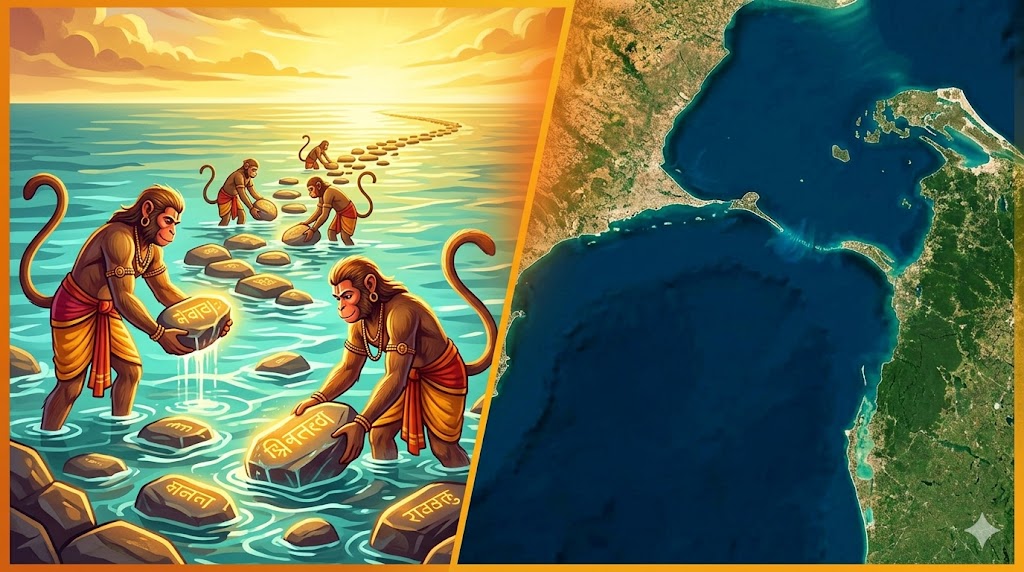
Ram Setu, also widely known as Adam's Bridge, stands as one of the most fascinating natural formations that bridges myth, history, and science. This 48-kilometer chain of limestone shoals stretches between Pamban Island (Rameswaram) off the southeastern coast of Tamil Nadu, India, and Mannar Island off the northwestern coast of Sri Lanka. For millions of Hindus, it represents the divine engineering feat described in the ancient epic Ramayana, built by Lord Rama's army of vanaras (monkey warriors) to rescue Sita from the demon king Ravana in Lanka.
Yet, beyond its spiritual resonance, Ram Setu raises profound questions about our past. Geologists view it as a product of natural processes shaped by changing sea levels and sedimentation. Some scientific observations, including age discrepancies between underlying sands and overlying stones, have fueled debates suggesting possible human intervention thousands of years ago. Its location in the shallow Palk Strait has also made it a focal point for economic, environmental, and political discussions, particularly around shipping routes.
This article delves into the rich tapestry of Ram Setu: its legendary origins, historical and cultural legacy, scientific findings that hint at something extraordinary, its critical geographical role, and the controversies that continue to stir passions. We approach the topic with respect for both faith and empirical inquiry, recognizing that truth often lies at the intersection of multiple perspectives.
The Legendary Origins: Ram Setu in the Ramayana
The story of Ram Setu is immortalized in Valmiki's Ramayana, composed roughly between 1000 and 500 BCE, though the events it describes are placed in the Treta Yuga, an ancient era in Hindu cosmology. According to the epic, Lord Rama, the seventh avatar of Vishnu, faced an insurmountable ocean barrier while marching to Lanka to confront Ravana, who had abducted Sita.
With the guidance of the vaanara sena led by figures like Hanuman, Nala, and Nila, Rama invoked the sea god and orchestrated the construction of a bridge. Stones were brought from distant mountains, and remarkably, they are said to have floated on water due to inscriptions of Rama's name. The bridge allowed the army to cross, leading to the epic battle and the triumph of dharma.
This narrative is not just a tale of heroism but a profound allegory of devotion, engineering ingenuity, and the power of collective effort. Temple records and local traditions in Rameswaram further claim that parts of the structure remained walkable until a cyclone in 1480 CE damaged it significantly. Islamic traditions also reference the formation, calling it Adam's Bridge, as the point where Adam crossed after his expulsion from Eden to reach Adam's Peak in Sri Lanka.
For believers, Ram Setu is living proof of the Ramayana's historicity. It embodies faith that ancient epics preserve kernels of real events, even if embellished through oral transmission over millennia.
Historical and Cultural Legacy
Ram Setu's cultural footprint extends far beyond the Ramayana. It has been a pilgrimage site for centuries, with devotees visiting Rameswaram to perform rituals at the sacred Rameshwaram Temple, one of the twelve Jyotirlingas dedicated to Shiva. The bridge itself is revered as a symbol of unity—connecting two lands and, metaphorically, diverse cultures.
Historically, the region around the Palk Strait served as a maritime crossroads. Ancient trade routes between the Indian subcontinent and Sri Lanka (known in various texts as Lanka, Tamraparni, or Serendib) likely utilized the shallow waters and shoals for safer passage. Fisherfolk communities on both sides have long navigated these waters, their lives intertwined with the bridge's shifting sands and currents.
In medieval times, European maps and accounts referred to it as Adam's Bridge, blending local lore with biblical interpretations brought by traders and colonizers. British colonial surveys documented the formation, noting its challenges to navigation. Post-independence, it became a symbol in India's cultural and religious discourse, especially as debates over heritage preservation intensified.
The legacy also includes ecological and social dimensions. The Gulf of Mannar and Palk Bay, flanking the bridge, form a rich marine biosphere reserve with coral reefs, seagrass beds, and endangered species like dugongs. Local Tamil fishing communities depend on these waters, viewing the area as part of their ancestral seascape—an "aquapelago" where land, sea, and human life merge fluidly.
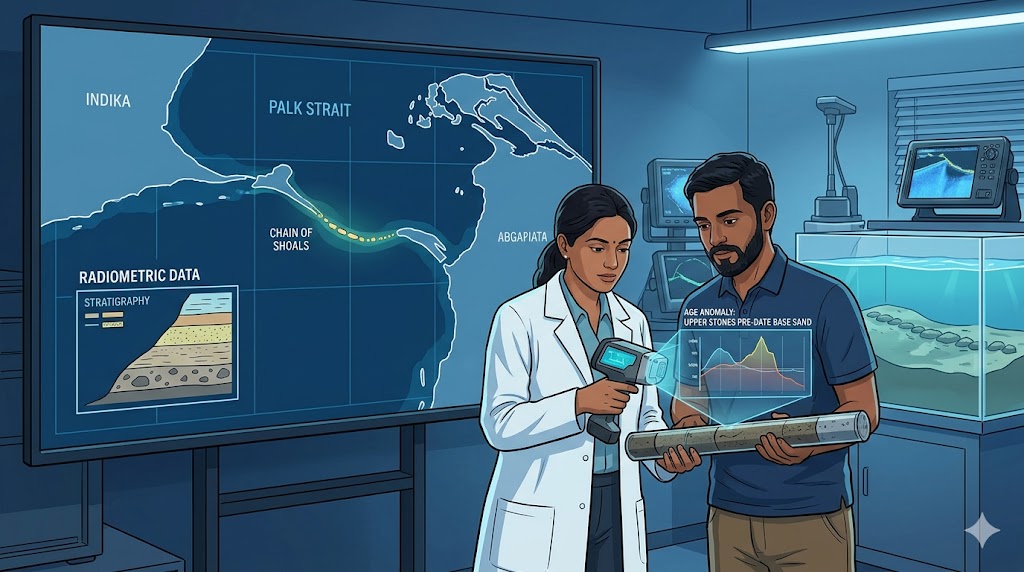
Scientists analyze a geological core sample from the underwater shoals. Digital graphical overlays visualize the 'age anomaly' highlighted by researchers, where the stones forming the upper layers appear to be older than the loose marine sand on which they rest.
Scientific Perspective: What Studies Reveal
Science offers a complementary, sometimes converging, lens on Ram Setu. Geologically, it is classified as a chain of natural limestone shoals, likely a tombolo or remnant of an ancient land connection. During the Last Glacial Period (approximately 115,000 to 11,700 years ago), global sea levels dropped by up to 120 meters, exposing much of the shallow Palk Strait (maximum depth around 35 meters) as dry land linking India and Sri Lanka. As seas rose in the Holocene epoch, around 7,000 years ago, the area submerged, leaving the current shoals.
However, several studies highlight anomalies that intrigue researchers and believers alike. Satellite imagery from NASA and ISRO clearly shows the linear chain of shoals, which some interpret as too structured to be purely random. A 2017 Science Channel program featured archaeologists from institutions like Southern Oregon University and the University of Colorado, noting that rocks atop the sandbar appear older than the underlying sand—suggesting the upper layer may have been placed deliberately. Historical archaeologist Chelsea Rose remarked that the rocks predating the sand "means there is more to this story."
Carbon dating and radiometric studies provide further layers. Oceanography and core sampling from the Gulf of Mannar indicate formations around 7,000–18,400 years old in different layers. One study by researchers from Anna University and Madras University on drilled cores found fossils dating back 18,400 years in deeper sediments, with younger overlays. Coral growth on the structure has been dated to roughly 3,500–7,000 years in some analyses, aligning intriguingly with certain timelines proposed for Ramayana events.
Geologist S. Badrinarayanan (former Director, Geological Survey of India) and others have pointed to evidence of loose marine sand beneath coral boulders, suggesting the upper stones were not formed in situ but possibly transported and arranged. While mainstream geology attributes this to natural tidal and current actions over millennia, the age mismatch between base and top has led some to propose early human modification—perhaps an ancient causeway enhanced by people during lower sea levels.
Importantly, no peer-reviewed consensus declares it "man-made" in the mythological sense, nor does science claim supernatural construction. Instead, findings underscore a complex history: a natural ridge possibly utilized or modified by ancient humans. NASA has clarified that its images show the feature but do not confirm origins or human involvement. Ongoing proposals for underwater studies by India's National Institute of Oceanography (using radiometric and thermoluminescence dating) aim to clarify the exact formation process and age, potentially shedding more light on links to ancient civilizations.
These scientific inquiries do not "prove" the Ramayana literally but demonstrate that the region holds evidence of significant geological and possibly anthropogenic activity thousands of years ago— a period when early human societies were navigating and shaping coastal environments. In that sense, science acknowledges something remarkable and powerful in Ram Setu's enduring structure, resilient against time, tides, and tempests.
From a geographical standpoint, Ram Setu is far more than a scenic curiosity; it defines the maritime boundary and ecology between two nations. The shoals separate the Gulf of Mannar (deeper, biodiverse waters to the southwest) from the Palk Strait (shallower, to the northeast). Depths over the bridge often range from just 1 to 3 meters, making it a natural barrier that has historically restricted large-ship navigation.
This positioning has profound implications. It creates a unique marine ecosystem, recognized as a UNESCO Biosphere Reserve, supporting thousands of species, including corals, fish, and marine mammals. For India and Sri Lanka, the bridge influences ocean currents, sediment flow, and even climate patterns in the region.
Economically, the shallow waters have long hindered efficient shipping between India's east and west coasts. Ships must detour around Sri Lanka, adding distance and costs. This reality underpins proposals like the Sethusamudram Shipping Canal Project, which envisions dredging a channel through or near the shoals to create a shorter, protected route. Geographically, such a canal could transform regional trade, boosting ports like Tuticorin and enhancing connectivity. Yet, it also risks altering tidal patterns, increasing erosion or sedimentation elsewhere, and impacting the fragile ecology.
For local communities, the bridge's geography sustains traditional fishing but also exposes them to cyclones and sea-level changes. Its liminal nature—neither fully land nor sea—embodies the dynamic interaction between continents and oceans, a reminder of how plate tectonics, glaciation, and human activity continue to reshape our world.
In essence, Ram Setu symbolizes connectivity: a geological suture between the Indian subcontinent and the island of Sri Lanka, fostering shared biodiversity, cultural exchanges, and economic interdependence.
Controversies Surrounding Ram Setu
No discussion of Ram Setu is complete without addressing its controversies, which blend faith, politics, development, and science. The most intense debates erupted in the mid-2000s over the Sethusamudram Shipping Canal Project. Proponents argued for economic benefits and strategic autonomy in shipping. Opponents, including Hindu organizations, viewed any damage to the formation as an assault on sacred heritage. In 2007, a government affidavit in the Supreme Court describing the Ramayana account as lacking "scientific and historical veracity" sparked nationwide outrage, protests, and political polarization. The affidavit was later withdrawn.
Environmental concerns added weight: dredging could harm marine life, disrupt fisheries, and exacerbate coastal vulnerabilities. Fisherfolk on both sides protested potential livelihood losses. In 2013, a Supreme Court-appointed committee deemed the project unviable on economic and ecological grounds, effectively halting it while preserving the status quo.
Political dimensions have kept the issue alive. Parties have leveraged Ram Setu for cultural mobilization, with calls to declare it a national monument or heritage site. Films, documentaries, and public discourse often frame the debate as "faith versus science," though many scholars advocate for epistemic pluralism—valuing mythological, geological, and historical narratives side by side without forcing binary outcomes.
Colonial legacies linger too; the name "Adam's Bridge" reflects external interpretations layered over indigenous ones. Modern controversies also touch on tourism, conservation, and Indo-Sri Lankan relations, as any major intervention requires bilateral coordination.
These debates highlight deeper questions: How do societies balance development with heritage? Can ancient faith coexist with modern infrastructure? Ram Setu's controversies endure precisely because they touch on identity, sovereignty, and the meaning of the past in the present.
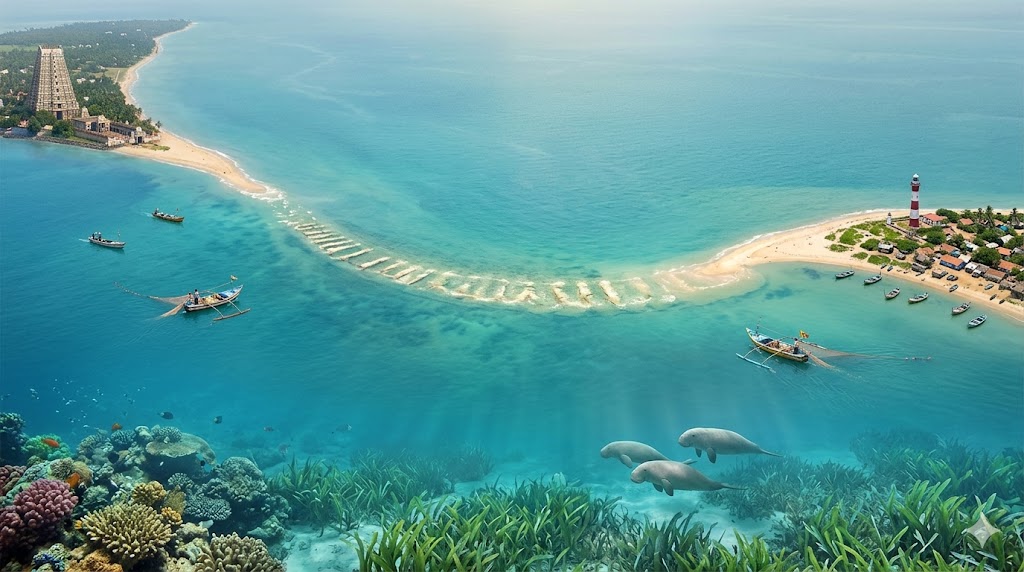
A geographical perspective: Ram Setu (the curve of light in the water) functions as a natural suture connecting Pamban Island (India, left) with Mannar Island (Sri Lanka, right). The image highlights the rich, shared marine ecosystem and fishing communities that thrive on this unique formation.
Conclusion: A Timeless Symbol of Connection and Mystery
Ram Setu endures as a powerful emblem—sacred to believers, intriguing to scientists, and vital to geographers. Its legacy in the Ramayana inspires values of duty, courage, and unity. Scientific studies reveal a formation with ancient roots, where natural forces and possible human touches create an anomaly worthy of continued respectful exploration. Geographically, it binds India and Sri Lanka in a shared seascape rich in life and potential.
Whether viewed through the lens of divinity, geology, or geopolitics, Ram Setu reminds us that some places transcend simple categorization. They invite wonder, dialogue, and humility before the forces—natural or otherwise—that shape our world. As research advances and conversations evolve, this ancient bridge continues to connect not just lands, but ideas, faiths, and futures.