Bengal EVM Controversy 2026: Mamata's Strong Room Visit

The West Bengal Assembly Elections 2026 have entered a tense post-poll phase marked by sharp political exchanges, allegations of irregularities, and heightened focus on the security of Electronic Voting Machines (EVMs). With counting scheduled for May 4, the spotlight has shifted from polling booths to the strong rooms where EVMs and related materials are stored under strict protocols.
Chief Minister Mamata Banerjee and her Trinamool Congress (TMC) have raised concerns over possible manipulation, leading to a dramatic late-night visit by the CM to a strong room in her Bhabanipur constituency. The Bharatiya Janata Party (BJP) has countered these claims, while the Election Commission of India (ECI) has stepped in with clarifications. This unfolding scenario underscores not only the high stakes of the election but also the pivotal importance of robust electoral infrastructure and institutional oversight in India's democracy.
As parties gear up for results, the events in Kolkata highlight how even minor procedural questions can ignite major debates about electoral trust. This article examines the current developments, the strong room controversy, the role of EVMs, and the Election Commission's responsibilities.
West Bengal's 2026 polls were conducted in two main phases, amid heavy security deployment by central forces. The Election Commission deployed record numbers of Central Armed Police Forces (CAPF) personnel—estimates reaching up to 2.4 lakh—to ensure smooth voting in a state known for its politically charged atmosphere.
Polling saw reports of isolated incidents, including EVM glitches in some booths and allegations of tampering, such as claims in Falta constituency where BJP symbols were reportedly taped over, prompting demands for repolling. The Chief Electoral Officer indicated that repolls would be ordered wherever verifiable evidence of tampering emerged, reflecting the Commission's zero-tolerance approach.
Exit polls released after the final phase have projected a competitive or potentially favorable outcome for the BJP, with some surveys suggesting the party could cross the majority mark, while TMC leaders have dismissed these as attempts to demoralize workers. Official results on May 4 will determine the next government, but the interim period has been dominated by post-poll maneuvering.
The Strong Room Controversy and Mamata Banerjee's Visit
The latest flashpoint erupted on April 30, 2026, when TMC leaders alleged suspicious activities at strong rooms housing EVMs and postal ballots in Kolkata. Videos circulated showing movement inside or near facilities like those near Netaji Indoor Stadium and Khudiram Anushilan Kendra, prompting claims of unauthorized access or ballot handling without proper party representation.
In a dramatic turn, Mamata Banerjee visited the EVM strong room at Sakhawat Memorial School in Bhabanipur late on April 30. She spent nearly four hours inside the premises, citing reports of manipulation across various locations and CCTV visuals that raised her concerns. Upon emerging around midnight, she issued a strong warning:
“If someone tries to steal the EVM machine or tamper with the counting, we will fight a life-and-death battle. I will fight all my life.”
Banerjee alleged that central forces initially obstructed her entry, though rules allow candidates and agents access up to the sealed area. She emphasized that her party would remain vigilant to prevent any foul play. TMC leaders, including senior figures, staged sit-in protests outside strong rooms, demanding transparency and greater access to CCTV footage.
The BJP responded sharply. Leaders like Suvendu Adhikari, who is contesting against Banerjee in Bhabanipur, questioned the prolonged presence of the CM inside the facility and suggested her party was preemptively creating a narrative of defeat. BJP spokespersons dismissed the allegations as baseless, attributing them to TMC's anxiety over anticipated results.
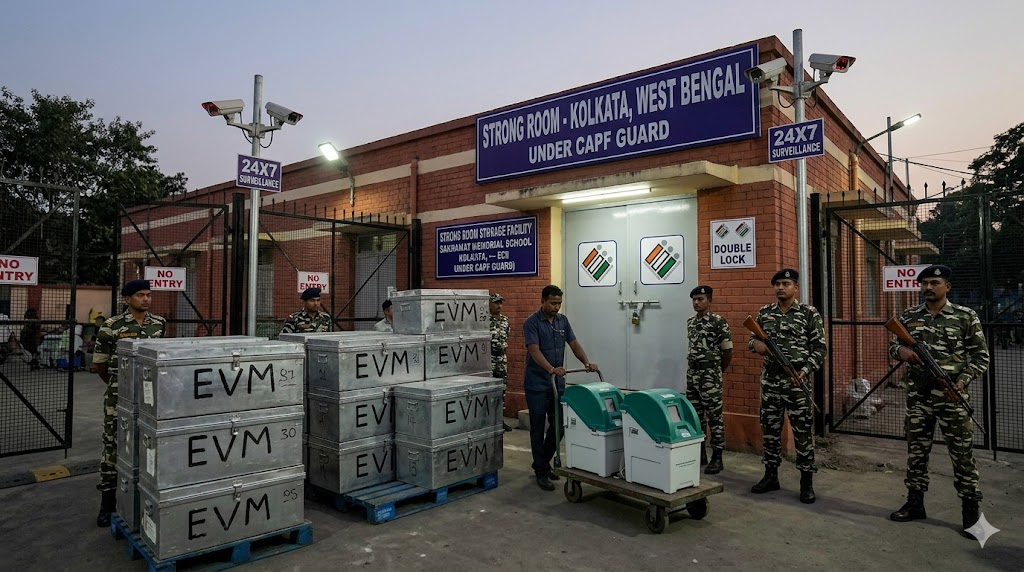
strong room : kolkata, west bengal
Election Commission’s Response and Clarifications
The Election Commission of India and the West Bengal Chief Electoral Officer promptly addressed the claims. Officials clarified that activities observed involved the standard segregation of sealed postal ballots in corridors or designated areas, conducted in the presence of authorized party representatives and under CCTV surveillance. Strong rooms themselves remained double-locked and securely guarded with two-tier security.
The ECI stressed that no unauthorized opening of polled EVMs had occurred and that all procedures followed established guidelines. It invited party agents to observe processes and reiterated that main strong rooms were safely secured. The Commission also noted ongoing reviews of pre-poll complaints, including the 77 reported EVM-related issues, with provisions for repolling where evidence warrants it.
This measured response highlights the ECI's mandate to maintain neutrality while addressing grievances transparently. By deploying extensive central forces, AI-assisted surveillance, body cameras, and strict perimeters around polling stations and strong rooms, the Commission aimed to minimize risks in a sensitive state.
Why EVMs Are Central to Electoral Integrity
Electronic Voting Machines have revolutionized Indian elections by reducing manual errors, minimizing invalid votes, and accelerating the counting process. Introduced widely in the early 2000s, EVMs paired with Voter Verifiable Paper Audit Trails (VVPAT) allow voters to confirm their choice, adding a crucial layer of verifiability.
In high-stakes contests like West Bengal 2026, EVM security becomes paramount. Strong rooms feature multiple locks, round-the-clock armed guards, regular inspections by returning officers and district election officers, and continuous CCTV monitoring. These measures are designed to prevent any post-poll interference.
The current controversy, even if resolved as procedural, illustrates public sensitivity around these machines. Allegations—whether of taping symbols during polling or post-poll handling—fuel debates on transparency. Yet, India's track record shows EVMs have withstood legal scrutiny in the Supreme Court and multiple elections, with safeguards continuously evolving.
The events also reveal how political narratives can amplify doubts. When one side alleges corruption of the system, it tests institutional credibility, making the Election Commission's role even more vital as an impartial arbiter.
The Election Commission’s Crucial Role in Conducting Fair Elections
The ECI is constitutionally tasked with superintendence, direction, and control of elections. In West Bengal 2026, this involved:
Security Management: Massive CAPF deployment for free and fearless voting.
Technology Integration: Use of AI surveillance, operational control of local CCTVs, and strict "Lakshman Rekha" no-entry zones around booths.
Grievance Redressal: Prompt review of complaints, including EVM issues, with options for repolling.
Post-Poll Protocols: Strict strong room security, randomized counting staff, and transparent processes for VVPAT verification if needed.
Mamata Banerjee's statements questioning whether EVMs have "properly justified" the mandate or implying systemic issues place the onus on the Commission to demonstrate procedural soundness. The ECI's duty includes not only conducting polls but also upholding public faith through timely clarifications and adherence to rules. Its interventions in this row—rejecting unsubstantiated tampering claims while keeping channels open for verified complaints—exemplify this balancing act.
Critics from various parties have at times accused the Commission of bias, yet its consistent framework across states reinforces its institutional strength. In Bengal's polarized context, the ECI's ability to navigate TMC-BJP tensions will be closely watched.
Current Scenario and Broader Implications
As of May 1, 2026, tensions remain elevated in Kolkata, with police imposing restrictions on gatherings near sensitive areas. Both TMC and BJP continue mobilizing supporters, with the former urging vigilance over EVMs and the latter framing the protests as signs of impending loss.
The strong room drama, while intense, appears to have ended without confirmed breaches, according to official accounts. It has, however, brought renewed attention to electoral reforms, including demands for greater VVPAT auditing or hybrid systems in future polls.
This episode reinforces a key truth: In a vibrant democracy like India, the integrity of the vote depends as much on technology and protocols as on political maturity and public trust. EVMs are not infallible in perception if procedures invite doubt, making constant vigilance by all stakeholders essential.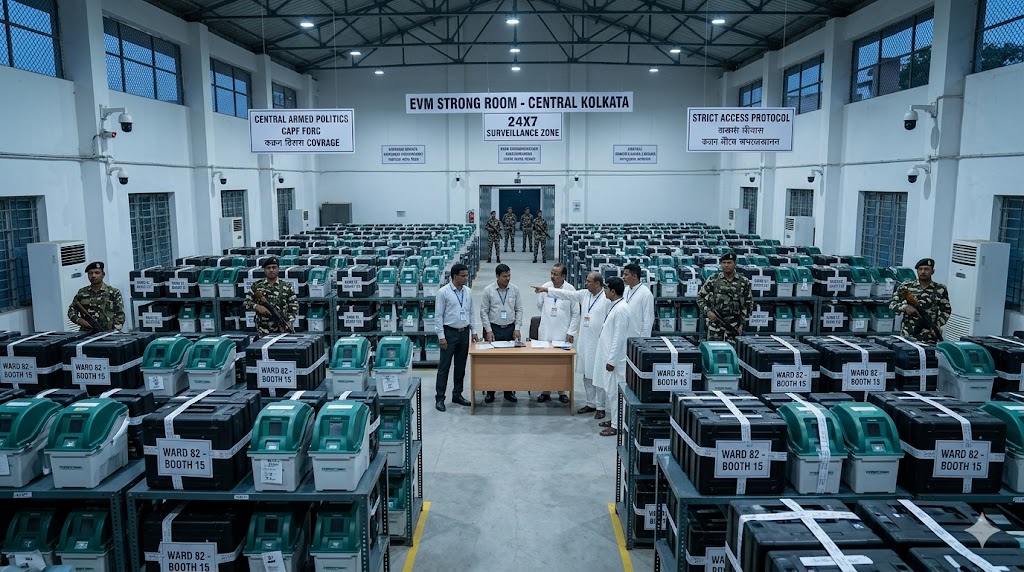
EVM Security under the Spotlight
Conclusion
The West Bengal Elections 2026 EVM controversy, centered on Mamata Banerjee's strong room visit and subsequent allegations, captures the passion and scrutiny inherent in Indian polls. While TMC voices fears of manipulation and the BJP sees it as preemptive deflection, the Election Commission continues to affirm the robustness of its arrangements.
Ultimately, the true test will come on counting day. Until then, the focus remains on safeguarding every vote. The Commission's proactive yet rule-bound approach serves as a reminder of its indispensable role in conducting credible elections. As results approach, all parties and citizens must prioritize democratic norms over narrative battles, ensuring that India's electoral process emerges stronger from such debates.