US-Israel-Iran War: Trump’s Ultimatum on Kharg Island
International Affairs• March 30, 2026• Global Edition
The Brink of Total War: Trump’s Ultimatum, the Kharg Island Siege, and the Global Energy Collapse
The geopolitical landscape of West Asia has reached a terrifying crescendo this Monday, March 30, 2026. As the US-Israel-Iran war enters its second month, the world stands on the precipice of a total energy collapse. What began as a targeted campaign on February 28 has evolved into a high-stakes siege involving the world's most vital maritime chokepoints and energy hubs. Today, the rhetoric from Washington has shifted from strategic degradation to a promise of total "obliteration," while global financial markets, including India’s Sensex, have reacted with historic volatility.
This US-Israel-Iran war is not just a localized conflict; it is a systemic shock to the international order, challenging the very foundations of global trade and security. As we analyze the Middle East conflict updates, it becomes clear that the window for diplomacy is closing rapidly, replaced by the thundering machinery of modern warfare. The US-Israel-Iran war has now forced every major global power to take a side, as the global oil crisis 2026 looms larger than any economic challenge since the 1970s. In this deep dive, we explore the tactical shifts on the ground, the psychological warfare being waged from the White House, and the catastrophic impact on the Sensex crash today.
I. The Escalation: From Precision Strikes to Total War
To understand the current state of the US-Israel-Iran war, one must look back at the rapid escalation that took place throughout February 2026. Following months of rising tensions over nuclear enrichment and regional proxy attacks, the first major blow was struck on February 28. A coordinated series of air strikes, attributed to a joint US-Israeli task force, targeted command-and-control centers across five Iranian provinces. Since then, the US-Israel-Iran war has spiraled into a multi-front conflict involving Lebanon, Syria, Yemen, and Iraq.
The intensity of the US-Israel-Iran war has surpassed all previous military simulations, with Iran deploying its extensive ballistic missile arsenal and "asymmetric" naval tactics. The Middle East conflict updates from earlier this month highlighted the destruction of key IRGC infrastructure, yet the regime's resilience remains a point of concern for Western military planners. Every day the US-Israel-Iran war continues, the risk of a "miscalculation" leading to a nuclear exchange grows. This is why the Donald Trump Iran threat issued today carries such weight; it represents a pivot from military containment to potential total destruction of the state's capacity to function. The US-Israel-Iran war is now at a point where the survival of the Iranian state is being openly debated in the halls of power in D.C. and Jerusalem.
tactical breakdown of the current US-Israel-Iran war. This map shows the blockade paralyzing the Strait of Hormuz and the destruction of the vital Kharg Island oil terminal. The conflict has triggered a historic Sensex crash today and is driving the global oil crisis 2026. President Trump has issued a final ultimatum: 'Open for business, or be wiped off the map.'
II. The Trump Doctrine: "Peace Through Absolute Power"
President Donald Trump has redefined the American approach to this conflict. His "America First" war strategy is characterized by a refusal to engage in long-term "nation-building" while simultaneously threatening the use of overwhelming, disproportionate force. Today, the Donald Trump Iran threat focused on the complete dismantling of Iran's civilian infrastructure. Trump warned that if the "bad actors" in Tehran do not capitulate, the U.S. will target electricity grids, water treatment plants, and the very oil wells that fund the regime.
This Donald Trump Iran threat is part of a broader strategy to force a popular uprising or a military coup within Iran. "We are not there to occupy," Trump stated from the Oval Office, "we are there to finish it." His ultimatum regarding the Strait of Hormuz is a central pillar of this doctrine. By framing the blockade as an act of economic piracy, Trump is positioning the U.S. as the defender of global commerce, even as his actions accelerate the global oil crisis 2026. The Donald Trump Iran threat also includes a personal warning to the remaining Iranian leadership: there will be no safe haven. As part of the US-Israel-Iran war narrative, Trump’s rhetoric serves to isolate Iran diplomatically, leaving them with few allies beyond those similarly sanctioned by the West.
III. The Strait of Hormuz: The World's Most Dangerous Choke Point
The Strait of Hormuz remains the most dangerous stretch of water on the planet. For the past 30 days, the IRGC (Islamic Revolutionary Guard Corps) has maintained a de facto blockade, utilizing a "mosquito fleet" of fast-attack craft, drone swarms, and sophisticated sea mines to paralyze shipping. In the context of the US-Israel-Iran war, the Strait of Hormuz is more than just a waterway; it is a weapon of mass economic destruction.
Iran knows that by closing the Strait of Hormuz, they can hold the global economy hostage. Currently, over 20% of the world's oil supply is unable to pass through the Strait of Hormuz, leading directly to the global oil crisis 2026. U.S. naval attempts to clear the Strait of Hormuz have been met with fierce resistance, including the use of "suicide drones" and coastal anti-ship missiles. The Middle East conflict updates indicate that several tankers have been damaged or seized within the Strait of Hormuz over the last week.
Opening the Strait of Hormuz is now the top priority for the U.S. Navy's Fifth Fleet, but the narrow geography of the strait makes it a tactical nightmare. If the Strait of Hormuz remains closed for another month, analysts predict oil could reach $150 per barrel, further exacerbating the Sensex crash today and global market instability. Every move made in the US-Israel-Iran war is calculated based on its effect on the Strait of Hormuz.
IV. Kharg Island: The Economic Jugular
President Trump issues a final warning to Iran over the Strait of Hormuz and Kharg Island as the Sensex crashes 1,635 points amid the escalating US-Israel-Iran war.
Kharg Island has emerged as the most likely flashpoint for a U.S. ground operation. Located in the Persian Gulf, this island is the terminal through which 94% of Iran's oil exports pass. In the strategy of the US-Israel-Iran war, Kharg Island is the ultimate prize and the ultimate target. Trump’s specific mention of Kharg Island today suggests that the U.S. is preparing to either seize the facilities or destroy them permanently to cut off the regime's oxygen—oil revenue.
Kharg Island is currently defended by some of Iran's most advanced remaining air defense systems, yet U.S. stealth bombers have already made several passes over the area. The Middle East conflict updates confirm that military infrastructure on Kharg Island was hit on March 13, but the oil loading docks remain largely intact—for now. Seizing Kharg Island would allow the U.S. to control the flow of Iranian oil, potentially using it as leverage in post-war negotiations. However, any battle for Kharg Island would be bloody and could result in environmental catastrophe if the terminals are set ablaze. For the Iranian leadership, losing Kharg Island would mean the end of their ability to sustain the US-Israel-Iran war economically. It is the "red line" for both sides.
V. Monday’s Battlefield: Fire Across the Desert
The reports coming out of the Middle East this Monday, March 30, paint a grim picture of a widening conflict. The US-Israel-Iran war is no longer confined to military bases; it has spilled into civilian and industrial sectors. Today’s Middle East conflict updates report a devastating strike on a major desalination plant in Kuwait, which Iran claims was a mistake but others see as a warning to Gulf states cooperating with the U.S.
The scenes of war on Monday included heavy exchanges of fire along the Israel-Lebanon border, where Hezbollah has launched its most significant rocket barrage since the US-Israel-Iran war began. In Tehran, residents report the sound of anti-aircraft fire throughout the night as Israeli drones target suspected missile storage sites. These "Monday scenes of war" illustrate the sheer scale of the US-Israel-Iran war, which now stretches from the Mediterranean to the Persian Gulf.
The humanitarian toll is rising, with thousands displaced in southern Lebanon and northern Israel. Each event reported in today's Middle East conflict updates further cements the reality that there is no "easy" exit from this war. The US-Israel-Iran war has become a grinding battle of attrition, where each side is waiting for the other's internal support to crumble.
VI. Financial Aftershocks: The Sensex Collapse
The economic fallout of the US-Israel-Iran war hit home for Indian investors with unprecedented force today. The Sensex crash today was a direct reflection of the heightened anxiety over oil supplies and foreign fund outflows. By the closing bell on March 30, 2026, the BSE Sensex plummeted 1,635.67 points, settling at 71,947.55. This Sensex crash today represents one of the largest single-day drops in the history of the Indian markets.
Investors are fleeing to safe-haven assets like gold as the global oil crisis 2026 threatens to push India's inflation into double digits. The Sensex crash today was exacerbated by a record exodus of Foreign Institutional Investors (FIIs), who have pulled out over ₹1.14 lakh crore this month. The Indian Rupee’s fall to 95 against the dollar is another symptom of the US-Israel-Iran war's impact on emerging markets. Traders are watching the Middle East conflict updates more closely than earnings reports, knowing that a single missile hit on an oil refinery could trigger another Sensex crash today. The interconnectedness of global finance means that the US-Israel-Iran war is being fought as much on trading screens in Mumbai as it is on the shores of Kharg Island.
VII. The Global Oil Crisis 2026: A Long Winter Ahead
The global oil crisis 2026 is the most significant threat to the modern industrial world. With the Strait of Hormuz blocked, the supply-demand balance has been shattered. The US-Israel-Iran war has removed millions of barrels of oil from the market daily. This global oil crisis 2026 is not just about the price at the pump; it’s about the cost of shipping, the price of plastics, and the stability of food supplies.
Countries like India, which import the vast majority of their energy needs, are particularly vulnerable. The Sensex crash today is just the beginning of what could be a multi-year economic downturn if the US-Israel-Iran war does not conclude quickly. The global oil crisis 2026 has also forced a rapid re-evaluation of energy security in Europe and Asia. However, green energy alternatives cannot be scaled fast enough to mitigate the immediate impact of the US-Israel-Iran war. Trump’s strategy of threatening Iranian energy sites could, paradoxically, make the global oil crisis 2026 even worse in the short term, as the destruction of infrastructure on Kharg Island would take years to repair.
VIII. Strategic Implications and The Path Forward
As the US-Israel-Iran war continues, the geopolitical map is being redrawn. China and Russia are carefully watching the U.S. military's commitment to the Middle East, potentially looking for opportunities in their own spheres of influence. For Israel, the US-Israel-Iran war is an existential battle to permanently remove the threat of the "Ring of Fire" encircling them. For the United States, it is a test of whether their military dominance can still dictate terms in the 21st century.
The Middle East conflict updates tonight suggest that both sides are preparing for a long fight. The Donald Trump Iran threat indicates that the U.S. is not looking for a "moderate" solution but a total capitulation. Meanwhile, the scenes from Kharg Island and the Strait of Hormuz suggest that Iran is willing to risk everything to survive.
The Sensex crash today has alerted world leaders that the economic cost of the US-Israel-Iran war is becoming unsustainable. However, the ideological and strategic stakes of the US-Israel-Iran war are so high that neither Washington nor Tehran seems willing to blink first. The fate of the Strait of Hormuz remains the key to global stability.
IX. Conclusion: The April 6 Deadline
As the sun sets on this chaotic Monday, the international community is looking toward April 6, the date President Trump set as the end of his current "pause" on hitting Iranian energy sites. The US-Israel-Iran war stands at a crossroads. Will there be a diplomatic "off-ramp" facilitated by backchannel talks involving Secretary of State Marco Rubio, or will we see a full-scale invasion of Kharg Island?
Until the Strait of Hormuz is reopened and the US-Israel-Iran war reaches a definitive conclusion, the world must brace for more volatility, more scenes of war, and a continued global oil crisis 2026. The next few days will likely be the most consequential in modern history. The Sensex crash today may just be a harbinger of a deeper shift in the global order.
Frequently Asked Questions
What is the primary significance of US-Israel-Iran War: Trump’s Ultimatum on Kharg Island?
The Brink of Total War: Trump’s Ultimatum, the Kharg Island Siege, and the Global Energy CollapseThe geopolitical landscape of West Asia has reached a terrifying crescendo this Monday, March 30, 2026. As the US-Israel-Iran war enters its second month, the world stands on the precipice of a total energy collapse.
How does this development impact International Affairs?
What began as a targeted campaign on February 28 has evolved into a high-stakes siege involving the world's most vital maritime chokepoints and energy hubs. Today, the rhetoric from Washington has shifted from strategic degradation to a promise of total "obliteration," while global financial markets, including India’s Sensex, have reacted with historic volatility.This US-Israel-Iran war is not just a localized conflict; it is a systemic shock to the international order, challenging the very foundations of global trade and security.
What are the key future projections to monitor?
As we analyze the Middle East conflict updates, it becomes clear that the window for diplomacy is closing rapidly, replaced by the thundering machinery of modern warfare.

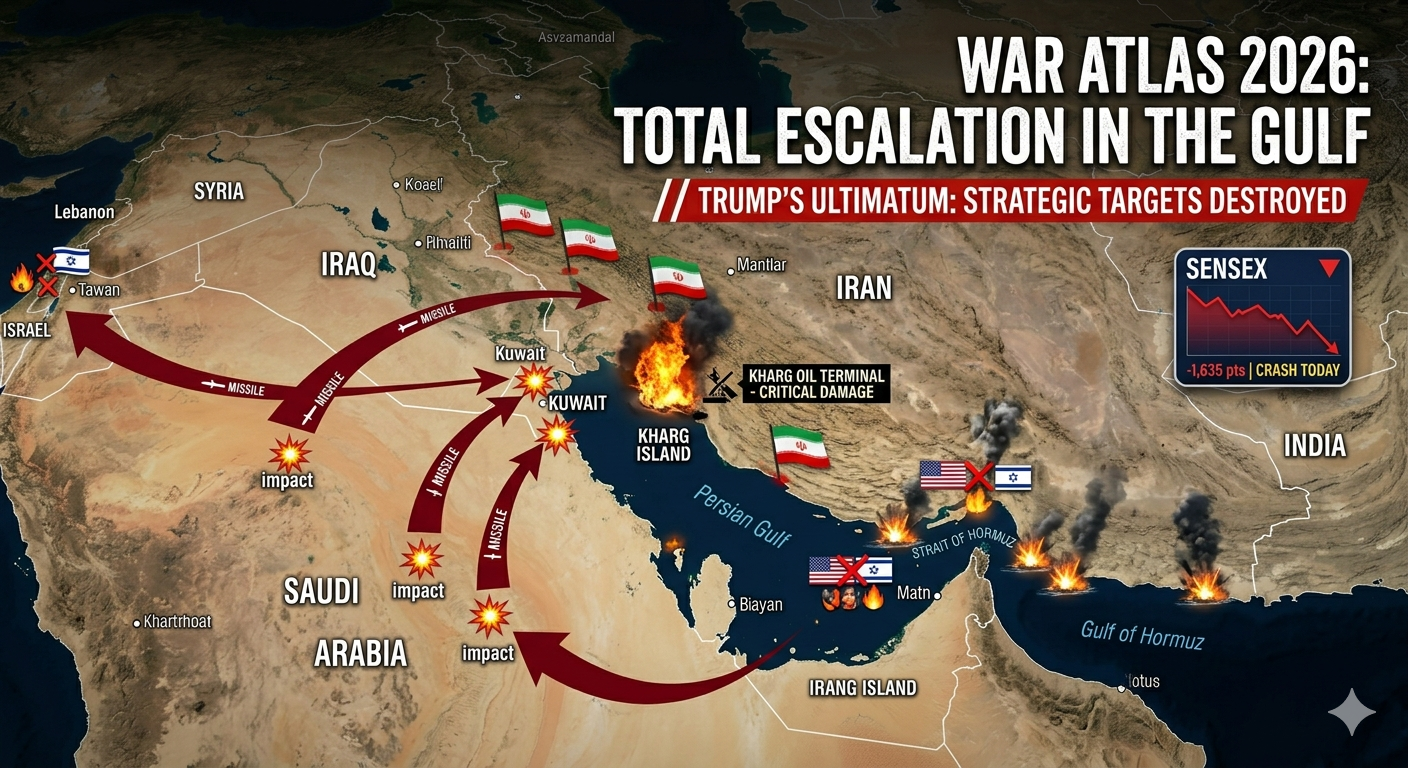 tactical breakdown of the current US-Israel-Iran war. This map shows the blockade paralyzing the Strait of Hormuz and the destruction of the vital Kharg Island oil terminal. The conflict has triggered a historic Sensex crash today and is driving the global oil crisis 2026. President Trump has issued a final ultimatum: 'Open for business, or be wiped off the map.'
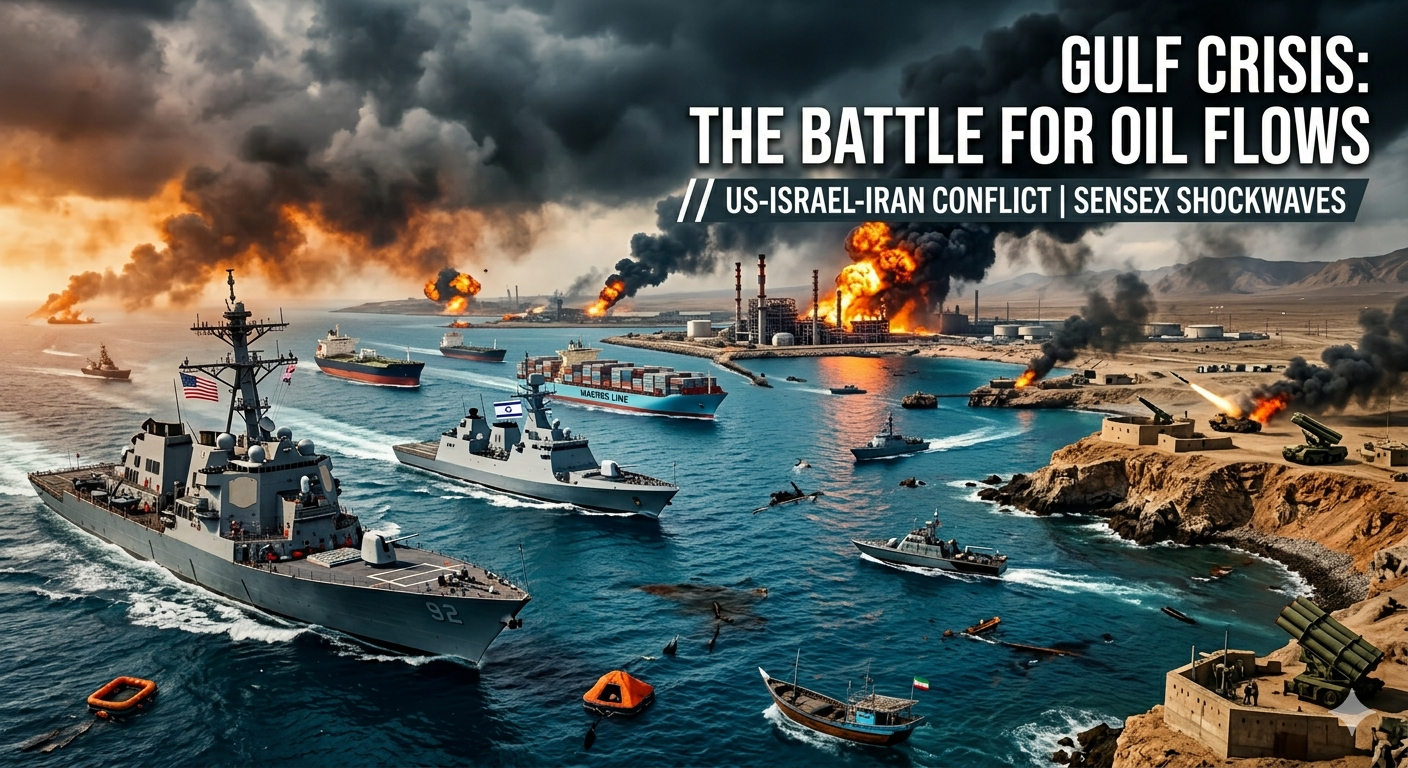 President Trump issues a final warning to Iran over the Strait of Hormuz and Kharg Island as the Sensex crashes 1,635 points amid the escalating US-Israel-Iran war.Kharg Island has emerged as the most likely flashpoint for a U.S. ground operation. Located in the Persian Gulf, this island is the terminal through which 94% of Iran's oil exports pass. In the strategy of the US-Israel-Iran war, Kharg Island is the ultimate prize and the ultimate target. Trump’s specific mention of Kharg Island today suggests that the U.S. is preparing to either seize the facilities or destroy them permanently to cut off the regime's oxygen—oil revenue.