Indira Gandhi: Iron Lady of India and Only Female PM
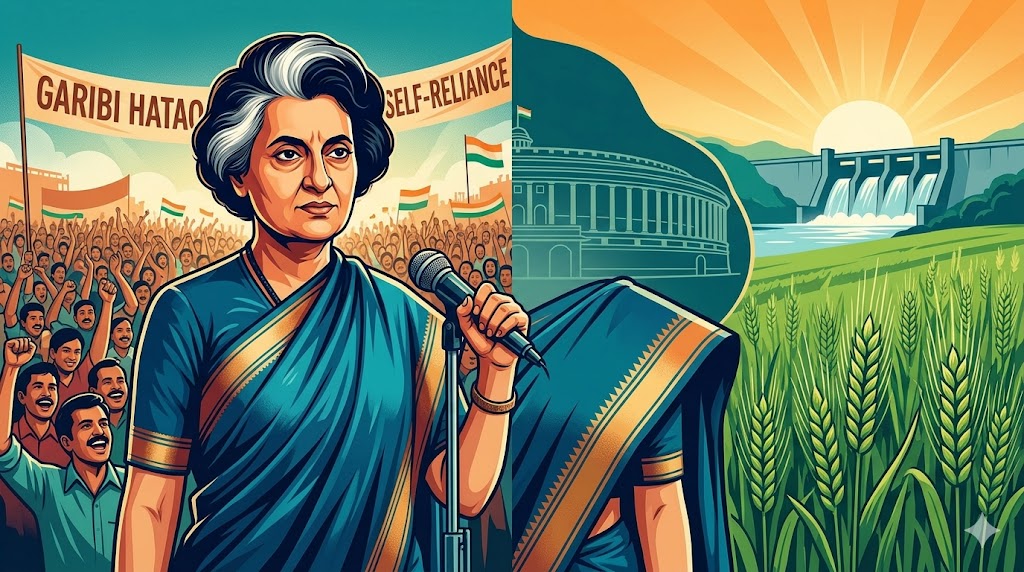
Indira Gandhi stands as one of the most commanding figures in modern Indian history. Often called the "Iron Lady of India," she served as the country's first and only female Prime Minister, holding office for nearly 16 years across two separate terms—from 1966 to 1977 and again from 1980 until her assassination in 1984. Her leadership style, marked by decisive action and unyielding resolve, earned her respect and criticism in equal measure.
Born into the Nehru family, Indira Priyadarshini Gandhi grew up amid India's freedom struggle. She rose through the ranks of the Indian National Congress, eventually steering the nation through economic challenges, wars, and social reforms. Supporters remember her as the architect of poverty alleviation programs and a champion of self-reliance, while critics point to periods of authoritarian rule and decisions that deeply polarized society.
This article delves into her early life, ascent to power, major achievements in development, bold foreign and domestic policies, and the controversies that continue to define her complex legacy. Decades after her passing, Indira Gandhi remains a subject of fascination, symbolizing both the strengths and vulnerabilities of Indian democracy.
Early Life and Political Awakening
Indira Gandhi was born on November 19, 1917, in Allahabad (now Prayagraj) to Jawaharlal Nehru, India's first Prime Minister, and Kamala Nehru. Her childhood was steeped in political activity. While her father led the independence movement from prison, young Indira organized children's groups like the Vanar Sena to support the freedom struggle.
She received education in India and abroad, studying at institutions in Switzerland, England, and India. Marriage to Feroze Gandhi in 1942 brought her the surname that would become synonymous with Indian politics, though the couple faced personal challenges. After independence in 1947, Indira acted as her father's unofficial hostess and advisor, gaining invaluable insight into governance.
Following Nehru's death in 1964, Lal Bahadur Shastri became Prime Minister, appointing Indira as Minister of Information and Broadcasting. When Shastri passed away suddenly in 1966, Congress leaders saw Indira as a compromise candidate—someone they believed could be influenced. Little did they know that the woman they underestimated would soon consolidate power and reshape India's trajectory.
Her early years in office tested her resilience. Facing internal party dissent and economic difficulties, Indira quickly demonstrated her political acumen by outmaneuvering rivals and building popular support through direct appeals to the masses.
Indira Gandhi assumed the office of Prime Minister on January 24, 1966. As the only woman to hold this position in India, she broke significant barriers in a predominantly male political landscape. Initially viewed as a transitional figure, she proved her mettle by splitting the Congress party in 1969 and forging the New Congress, which secured a landslide victory in the 1971 general elections under the slogan "Garibi Hatao" (Remove Poverty).
Her ability to connect with the rural and poorer sections of society earned her the affectionate title "Mother Indira." She centralized decision-making within the party and government, often relying on a close circle of advisors, including her younger son Sanjay Gandhi in later years.
By the early 1970s, Indira had established herself as a dominant force in Indian politics. Her tenure coincided with significant global shifts, including the Cold War dynamics, and she navigated them with a pragmatic non-aligned yet increasingly pro-Soviet tilt
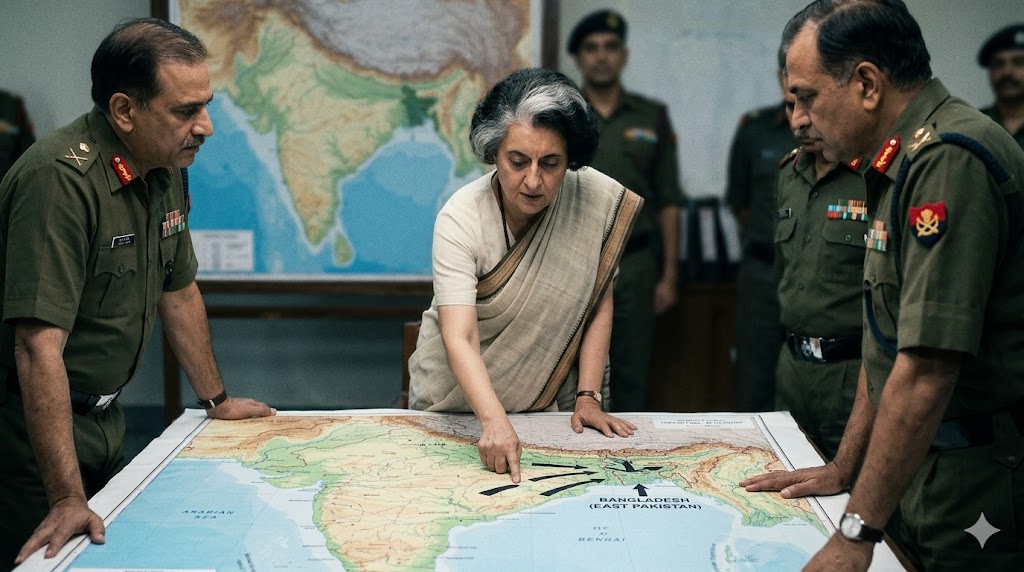
Indira Gandhi (center), exhibiting her trademark resolve, chairs a crucial war room meeting during the 1971 crisis. Her decisive leadership led to India’s swift military victory and the creation of Bangladesh, a pivotal moment that solidified her 'Iron Lady' reputation.
Bold Decisions and Key Development Initiatives
Indira Gandhi's leadership was defined by several transformative policies aimed at economic self-reliance and social equity.
One of her earliest and most impactful moves was the nationalization of 14 major commercial banks in July 1969. This step sought to channel credit toward agriculture, small industries, and rural development rather than large conglomerates. Bank branches expanded dramatically, particularly in underserved areas, supporting financial inclusion and the ongoing agricultural push.
Complementing this was her strong backing for the Green Revolution. Through the adoption of high-yielding variety seeds, improved irrigation, fertilizers, and modern farming techniques, India moved from chronic food shortages and dependence on imports to self-sufficiency in grain production. States like Punjab, Haryana, and Uttar Pradesh saw remarkable increases in wheat and rice output. While the revolution had regional limitations and environmental costs, it significantly reduced hunger and laid the foundation for India's food security.
In foreign policy, her most celebrated decision came during the 1971 crisis in East Pakistan. When millions of refugees fled to India amid widespread atrocities, Indira Gandhi supported the Bangladesh Liberation War. Despite international pressure, particularly from the United States and China, she orchestrated a swift military campaign that led to Pakistan's defeat and the creation of independent Bangladesh. The victory enhanced India's regional stature and was hailed as a diplomatic and military triumph.
Domestically, she abolished the privy purses of former princely rulers, promoted land reforms, and launched the Twenty Point Programme during the mid-1970s to address poverty through measures like bonded labor abolition, housing for the landless, and rural development. She also oversaw India's first nuclear test, Pokhran-I in 1974, signaling the country's entry into the nuclear club and asserting strategic autonomy.
These initiatives reflected Indira Gandhi's vision of a strong, self-reliant India capable of standing tall on the global stage.
The Emergency: A Dark Chapter in Indian Democracy
No account of Indira Gandhi's tenure is complete without addressing the 21-month Emergency declared on June 25, 1975. Facing political turmoil after the Allahabad High Court invalidated her 1971 election on technical grounds and amid widespread protests led by Jayaprakash Narayan, she advised President Fakhruddin Ali Ahmed to impose a state of internal emergency.
During this period, fundamental rights were suspended, press censorship was enforced, and thousands of opposition leaders, journalists, and activists were arrested under laws like the Maintenance of Internal Security Act (MISA). The government ruled by decree, implementing measures such as slum clearances in Delhi and aggressive family planning drives involving forced sterilizations, often associated with Sanjay Gandhi's influence.
Supporters argued that the Emergency brought discipline, curbed black marketing, and accelerated development projects. Critics, however, view it as a grave assault on democratic institutions, marking one of the darkest periods in independent India's history. When elections were finally held in 1977, Indira's Congress suffered a massive defeat, leading to the formation of the first non-Congress government at the center.
Her return to power in 1980 demonstrated remarkable political resilience, as voters once again turned to her for stability.
Operation Blue Star and the Tragic End
In her final term, Indira Gandhi confronted growing separatist challenges in Punjab. Sikh militants led by Jarnail Singh Bhindranwale fortified positions inside the Golden Temple complex in Amritsar. In June 1984, she authorized Operation Blue Star, a military operation to flush out the militants.
The assault resulted in significant damage to the sacred shrine and heavy casualties, including civilians. While the government maintained it was necessary to restore order, the operation deeply offended Sikh sentiments and fueled resentment. On October 31, 1984, Indira Gandhi was assassinated by two of her Sikh bodyguards in her New Delhi residence, in retaliation for the military action.
Her death triggered widespread anti-Sikh violence across the country, adding another tragic layer to her legacy. She was succeeded by her elder son, Rajiv Gandhi.
Controversies and Criticisms
Indira Gandhi's career was not without significant controversies. The imposition of the Emergency remains the most debated aspect, often cited as an example of power concentration that undermined democratic norms. Critics accuse her of fostering a personality cult, promoting dynastic politics, and using state machinery for political gains.
Economic policies, while transformative in some areas, faced criticism for excessive state control, leading to inefficiencies and the "license-permit raj." The Green Revolution, though successful in increasing production, exacerbated regional inequalities and environmental concerns over time.
Her handling of regional issues, including the Punjab crisis, highlighted the challenges of balancing national unity with diverse aspirations. Internationally, her tilt toward the Soviet Union drew mixed reactions during the Cold War era.
Despite these, many historians acknowledge that her decisions were often driven by a deep concern for India's sovereignty and the welfare of its marginalized sections.
Lasting Legacy: Why Indira Gandhi Remains Iconic
More than four decades after her assassination, Indira Gandhi continues to be remembered as a leader of extraordinary courage and vision. She is revered by many for elevating India's global standing, advancing social justice causes, and demonstrating that a woman could lead the world's largest democracy with firmness and foresight.
Her "Garibi Hatao" campaign and focus on the poor left a lasting imprint on Indian political discourse. The nationalization of banks and emphasis on rural credit influenced subsequent financial policies. The 1971 victory reshaped South Asian geopolitics.
At the same time, her legacy serves as a cautionary tale about the fragility of democratic institutions and the dangers of unchecked executive power. Political analysts often study her tenure to understand the interplay between populism, authoritarian tendencies, and development imperatives in a diverse nation like India.
Indira Gandhi's life illustrates the complexities of leadership—bold actions that deliver progress alongside decisions that invite lasting debate. She was, in many ways, a product of her times, navigating immense challenges with an iron will that earned her the moniker "Iron Lady."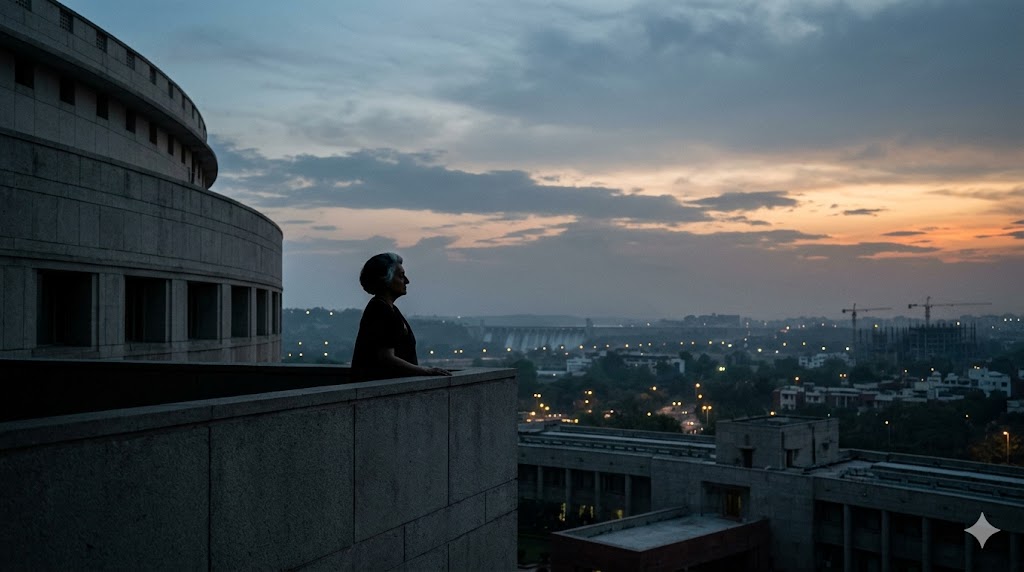
Standing silhouette against a dusky cityscape, this image visualizes the centralization of power during the Emergency era (1975–77). While development projects (visible on the horizon) continued, this period marked a severe contraction of democratic freedoms, a duality that remains the most controversial aspect of Indira Gandhi's 16-year tenure.
Conclusion
Indira Gandhi's journey from a young participant in the freedom struggle to India's only female Prime Minister encapsulates the triumphs and trials of a young nation finding its feet. Her bold decisions in economics, agriculture, and foreign policy contributed significantly to India's development, while her controversial choices, particularly during the Emergency and in Punjab, continue to provoke reflection on governance and democracy.
As India evolves in the 21st century, the lessons from her era—balancing strong leadership with institutional respect, pursuing self-reliance while embracing inclusivity—remain relevant. Whether celebrated as a transformative stateswoman or critiqued for her authoritarian streaks, Indira Gandhi undeniably left an indelible mark on the soul of modern India.
Her story reminds us that history rarely offers simple heroes or villains, but rather complex individuals whose actions shape the destiny of millions. The Iron Lady of India may have departed, but her influence on the nation's political and social fabric endures.