Green Data Centers: Nuclear SMRs Powering AI Energy
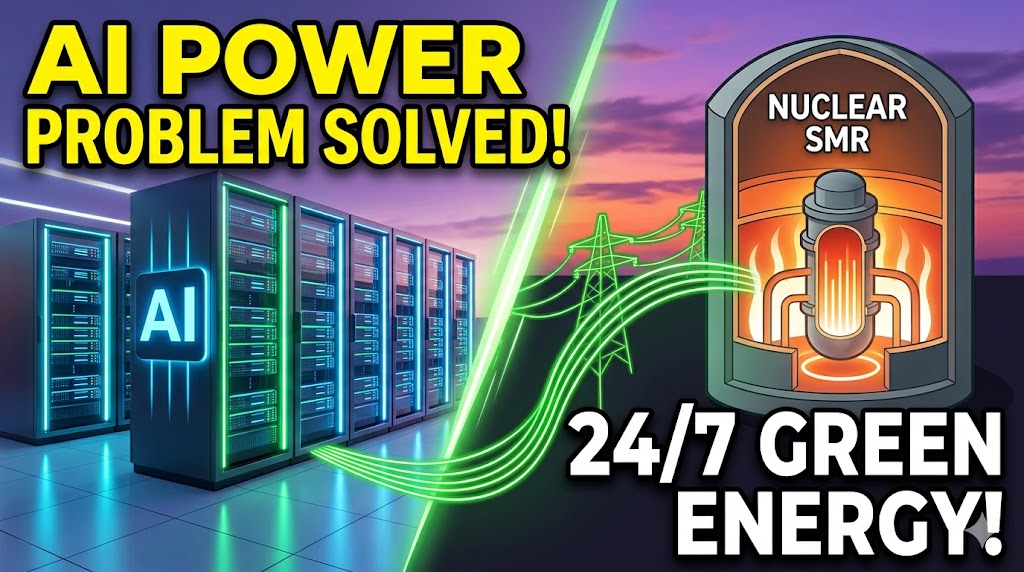
Green Data Centers and the AI Energy Challenge
In an era where artificial intelligence (AI) is transforming industries, the infrastructure supporting it faces unprecedented demands. Data centers, the backbone of cloud computing, machine learning, and generative AI, consume vast amounts of electricity. Projections indicate that global data center electricity use could double from around 415-448 TWh in recent years to nearly 945-980 TWh by 2030, driven largely by AI-optimized servers.
Traditional power sources struggle to meet this surge while aligning with sustainability goals. Renewables like solar and wind offer clean energy but are intermittent, requiring extensive storage or backup systems. This has led technology giants and energy innovators to revisit nuclear power—specifically through Small Modular Reactors (SMRs)—as a cornerstone for green data centers.
These next-generation facilities aim to deliver reliable, low-carbon, 24/7 power directly or near data centers, minimizing grid strain and environmental impact. By integrating SMRs, operators can achieve high energy density with a smaller footprint, supporting the explosive growth of AI without compromising on carbon reduction targets. This educational overview examines the technology behind SMR-powered green data centers, their advantages for AI infrastructure, real-world implementations, challenges, and future implications from a technical perspective.
AI workloads, particularly training large language models and running inference at scale, require dense clusters of specialized hardware like GPUs and TPUs. Unlike traditional servers, these accelerated systems draw significantly more power. Estimates suggest AI-optimized servers could account for 21% of data center electricity in 2025, rising to 44% by 2030, contributing to 64% of incremental demand.
Data centers already represent a growing share of national electricity consumption. In the United States, they accounted for about 4.4% in 2023, with forecasts reaching 6.7-12% by 2028 in some scenarios. Globally, the IEA and other project data centers could consume energy equivalent to that of major countries if unchecked.
Key technical challenges include:
Constant baseload needs: AI services demand uninterrupted power; downtime costs millions per hour.
High power density: Modern AI racks can exceed traditional cooling and electrical limits.
Grid constraints: Long interconnection queues and transmission limitations slow deployment in high-demand regions.
These factors push hyperscalers toward dedicated, dispatchable clean energy sources. Nuclear power, with its proven track record of high capacity factors (often above 90%), emerges as a compelling solution. SMRs take this further by offering modularity suited to data center scales.
Understanding Small Modular Reactors (SMRs)
Small Modular Reactors are advanced nuclear systems typically producing up to 300 MW per unit, far smaller than conventional gigawatt-scale plants. "Modular" refers to factory fabrication of components, enabling standardized production, easier transport, and faster assembly on-site.
Technologically, SMRs build on Generation III+ and Generation IV designs:
Light-water SMRs: Use ordinary water as coolant and moderator, similar to existing reactors but with enhanced passive safety features (e.g., natural circulation cooling that operates without external power).
Advanced variants: Include high-temperature gas-cooled reactors or molten salt designs, offering higher efficiency and inherent safety through TRISO (tri-structural isotropic) particle fuel—golf-ball-sized spheres that contain fission products even under extreme conditions.
Microreactors: Even smaller (1-20 MW) units for remote or dedicated applications.
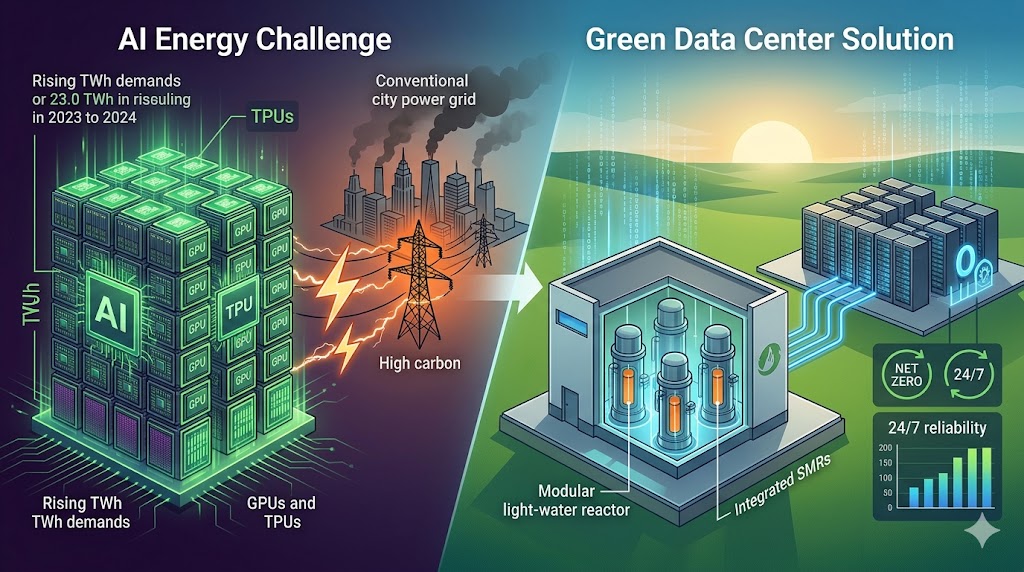
The AI Energy Paradox and the SMR Solution
Key technical advantages include:
Factory construction: Reduces on-site labor, cost overruns, and timelines compared to custom-built large reactors.
Scalability: Operators can deploy single modules initially and add more as demand grows, matching AI infrastructure expansion.
Enhanced safety: Many designs incorporate passive systems that shut down automatically without operator intervention or external power.
Fuel efficiency: Longer refueling cycles (some up to 10 years or more) minimize downtime.
Siting flexibility: Smaller footprints allow co-location with data centers, potentially using existing infrastructure from retired coal plants.
From an engineering standpoint, SMRs address data center needs by providing firm, carbon-free baseload power. They generate electricity through controlled nuclear fission, producing heat that drives steam turbines—much like conventional plants—but with greater adaptability.
How SMRs Enable Green Data Centers for AI
Integrating SMRs into data center operations creates truly sustainable facilities. Technical models include:
Co-location: Building data centers adjacent to nuclear sites for direct power delivery, bypassing grid congestion. This reduces transmission losses and enhances reliability.
Dedicated behind-the-meter supply: SMRs power the campus independently, with excess potentially fed to the grid.
Hybrid systems: Combining SMR baseload with renewables and battery storage for optimized performance.
Benefits for AI infrastructure are significant:
Reliability and uptime: Nuclear plants operate continuously, supporting always-on AI inference and training without the variability of solar or wind.
Carbon reduction: Near-zero operational emissions help hyperscalers meet net-zero commitments while powering compute-intensive workloads.
Energy density: A compact SMR module delivers substantial power, ideal for high-density AI racks requiring advanced cooling.
Cost predictability: Long-term power purchase agreements (PPAs) stabilize expenses amid volatile fossil fuel or renewable intermittency costs.
Cooling remains a critical aspect. Data centers generate immense heat from servers; nuclear co-location can leverage shared infrastructure or waste heat recovery for district heating or additional efficiency gains. Advanced liquid cooling systems paired with SMRs further optimize thermal management.
Industry Leaders and Real-World Deployments
Major technology companies are actively investing in SMRs and nuclear revival for their AI ambitions.
Microsoft has pursued restarting the Three Mile Island Unit 1 reactor in Pennsylvania through a partnership with Constellation Energy, targeting operations around 2028 to supply its data centers. This 835 MW project underscores commitment to reliable clean power.
Google signed agreements with Kairos Power for up to 500 MW of SMR capacity, with the first Hermes 2 units expected by 2030 and more by 2035. This includes collaboration with the Tennessee Valley Authority, focusing on advanced molten salt technology.
Amazon has multiple initiatives: a long-term PPA with Talen Energy for 1.92 GW from the Susquehanna plant (operational by spring 2026 in phases), investments in X-Energy for XE-100 SMRs (up to 80 MW per module), and explorations with Dominion Energy in Virginia and Energy Northwest in Washington. These support multi-billion-dollar data center campuses.
Other players like Meta and Equinix have also engaged with developers such as Oklo for Aurora Powerhouses. These deals, totaling over 10 GW in potential capacity, signal a shift toward vertically integrated energy strategies where tech firms treat power generation as core infrastructure.
Demonstration projects, such as those at Idaho National Laboratory, are testing integration pathways, from phased deployments starting with data centers followed by SMRs.
Technical Challenges and Considerations
While promising, SMR-powered green data centers face hurdles:
Deployment timelines: First commercial units are targeted for the late 2020s to 2030s; regulatory approvals and supply chain maturation take time.
Upfront costs: Although modular designs aim to lower per-unit expenses through standardization, initial projects remain capital-intensive.
Regulatory and licensing: Streamlining processes for advanced reactors is essential, balancing safety with innovation.
Waste and fuel management: Advanced fuels like TRISO improve containment, but long-term disposal strategies require attention.
Public acceptance and workforce: Building skilled nuclear talent and addressing community concerns are vital for scaling.
Engineers and policymakers are addressing these through international collaboration, simulation tools, and risk-informed regulations. Hybrid renewable-nuclear systems may mitigate some limitations in the interim.
The Broader Impact on Sustainable AI Infrastructure
From a technology perspective, SMRs represent a convergence of nuclear engineering, digital infrastructure, and sustainability science. They enable AI to scale responsibly by decoupling compute growth from fossil dependency and grid overload.
Future advancements may include microreactors for edge AI applications, improved fuel recycling, and AI-optimized reactor controls for dynamic load following. As data centers evolve toward liquid immersion cooling and higher-efficiency chips, integration with nuclear sources will become even more synergistic.
This approach not only supports technological progress but also contributes to energy security and climate goals. By providing dispatchable clean power, green data centers powered by SMRs help stabilize grids while accelerating AI-driven innovations in healthcare, climate modeling, and beyond.
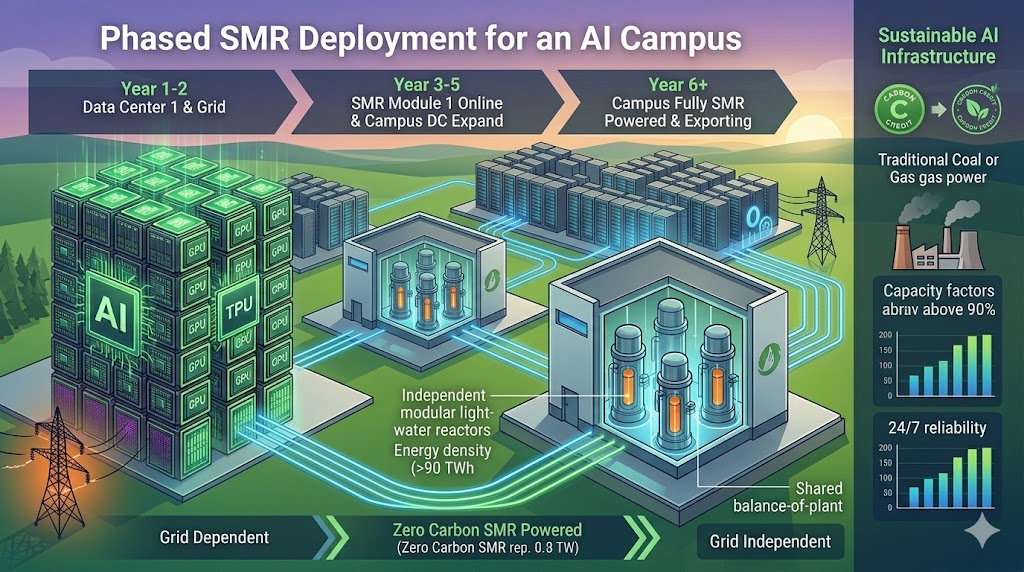
Phased Deployment of Sustainable AI Campus
Conclusion: A Technical Pathway to Sustainable AI Growth
Green data centers leveraging Small Modular Reactors offer a technically robust solution to the power challenges of AI infrastructure. With their modularity, safety features, and reliable output, SMRs address the need for constant, low-carbon energy at the scale required by modern hyperscale facilities.
Industry momentum—from Microsoft’s reactor restarts to Google and Amazon’s SMR investments—demonstrates practical feasibility. As deployment accelerates in the coming years, these technologies will likely play a pivotal role in shaping a sustainable digital future.
For students, engineers, and technology professionals, understanding SMRs highlights the interdisciplinary nature of modern innovation: combining nuclear physics, electrical engineering, thermal management, and AI systems design. Continued R&D and thoughtful policy will determine how effectively this pathway supports responsible AI advancement.
The integration of nuclear SMRs into data centers exemplifies how targeted technological solutions can resolve complex energy dilemmas, paving the way for AI to thrive without environmental trade-offs.