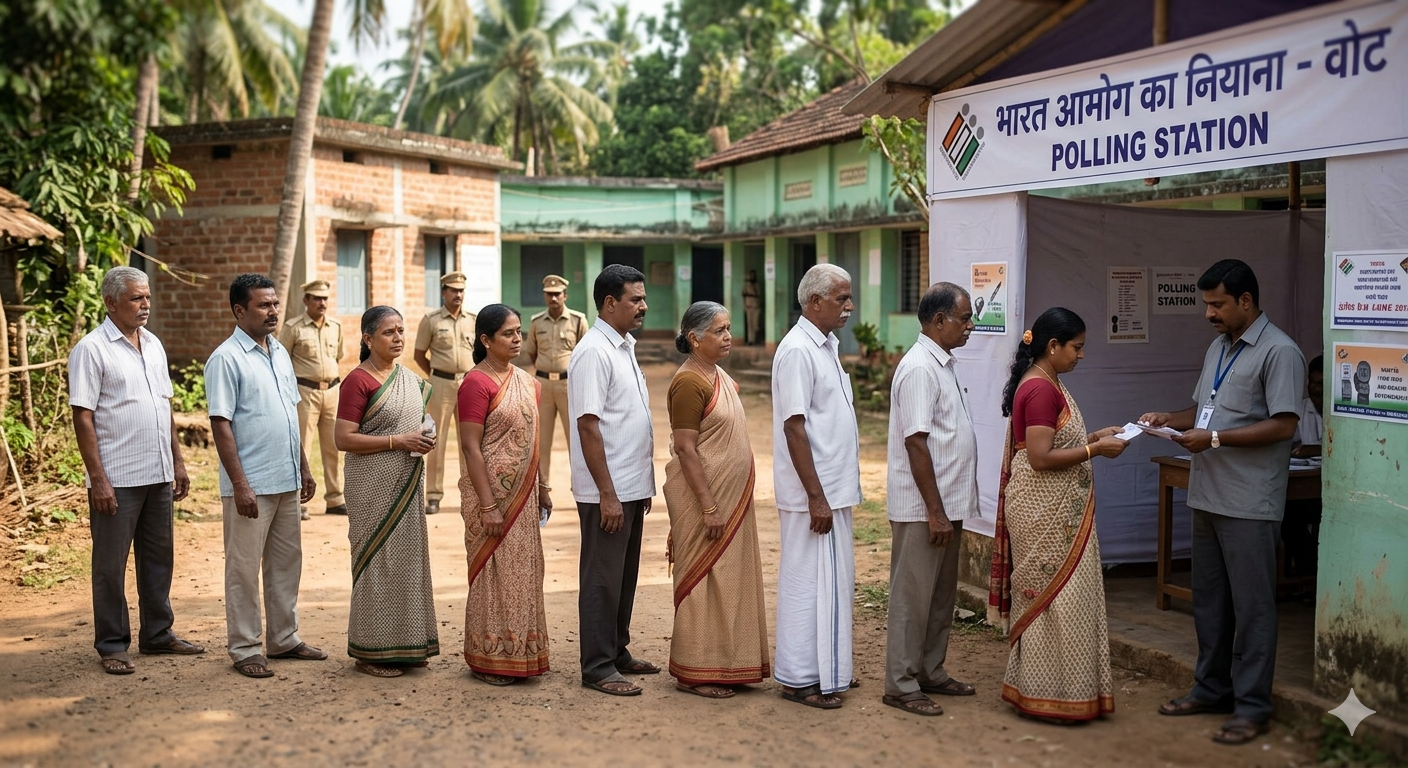
The Kerala election 2026 stands as one of the most anticipated political events in India’s southern state, with the Kerala assembly election 2026 scheduled for a single-phase poll on April 9, 2026, and results expected on May 4, 2026. As of late March 2026, the campaign trail is buzzing with intense activity across all 140 constituencies. The ruling Left Democratic Front (LDF), led by Chief Minister Pinarayi Vijayan and the Communist Party of India (Marxist) or CPI(M), is fighting for an unprecedented third consecutive term—a feat no front has achieved in Kerala’s electoral history. Meanwhile, the Congress-led United Democratic Front (UDF) senses a strong wave of anti-incumbency after a decade of LDF rule, and the Bharatiya Janata Party (BJP)-led National Democratic Alliance (NDA) is positioning itself as a credible third force in the 2026 Kerala assembly elections.
This article delves deep into the current situation of the Kerala election 2026, examining the performance and strategies of major parties, opinion polls, key issues, candidate selections, campaign highlights, and potential outcomes. With registered voters exceeding 26.9 million, the stakes are high not just for Kerala but for national politics, as the state remains a bastion of secular, welfare-oriented governance amid rising national polarization. The keywords “Kerala election 2026,” “Kerala elections 2026,” “Kerala assembly election 2026,” and related terms feature prominently in public discourse, reflecting widespread interest in the 2026 election and its implications for India’s political landscape.
Historical Context Leading to the Kerala Election 2026
Kerala’s political history has long been defined by alternating mandates between the LDF and UDF, with the state earning global acclaim for its high human development indices, robust public health system, and land reforms. In the 2016 Kerala assembly election, the LDF secured 91 seats, ending UDF rule and installing Pinarayi Vijayan as Chief Minister. The 2021 Kerala legislative assembly election delivered a historic verdict: the LDF won 99 seats (some reports cite 97 after minor adjustments), defying the anti-incumbency norm and granting Vijayan a second term. The UDF was reduced to around 41 seats, while the NDA drew a blank despite contesting aggressively.
This victory in the previous Kerala elections 2026 backdrop was attributed to the LDF’s effective COVID-19 management, welfare schemes like the “Kerala Model” of development, and strong grassroots mobilization. However, by 2026, the narrative has shifted. Ten years in power have bred fatigue, as evidenced by the UDF’s strong performance in the December 2025 local body elections, where it secured a higher vote share (38.8% vs. LDF’s 33.4%). The 2026 Kerala assembly elections thus represent a litmus test: Can the LDF overcome anti-incumbency in the Kerala election 2026, or will the UDF capitalize on voter discontent? The NDA, meanwhile, eyes its first major breakthrough in the state during the 2026 election.
Kerala Goes to the Polls. 140 seats, 2.7 crore voters, and one historic verdict. The road to the Kerala State Assembly officially enters the final stretch. Who will lead God’s Own Country.
Current Government Performance: LDF’s Strengths and Vulnerabilities in the Kerala Election 2026
The LDF, comprising CPI(M) (contesting 86 seats), CPI, Kerala Congress (M), and smaller allies, has governed with a focus on “Nava Keralam” (New Kerala) initiatives. Achievements highlighted in the Kerala election 2026 campaign include poverty alleviation programs, infrastructure development, and social welfare schemes such as enhanced pensions, free rations, and women’s empowerment drives. Pinarayi Vijayan, contesting again from his stronghold of Dharmadam in Kannur, remains a central figure, projecting continuity and experience. The front’s slogan, “Mattarundu LDF Allathe” (Who else but LDF?), underscores its claim of being the only reliable option for Kerala’s progress in the 2026 Kerala assembly elections.
Yet, anti-incumbency is palpable. Critics point to rising unemployment, particularly among youth, inflation in essential commodities, and allegations of corruption in projects like the Vizhinjam port and various infrastructure deals. Issues such as the Sabarimala gold smuggling case and perceived lapses in handling agrarian distress have fueled opposition attacks. Local body poll setbacks further signal voter disillusionment. In the Kerala election 2026 discourse, LDF leaders counter these by emphasizing constituency-level performance of sitting MLAs, many of whom have been renominated to project stability. CPI(M) state secretary M.V. Govindan and other leaders dismiss rebel threats, asserting that renegades joining the UDF will be rejected by voters.
As the Kerala elections 2026 heat up, the LDF has organized development marches and public meetings, focusing on achievements in health, education, and disaster resilience—hallmarks of Kerala’s model. However, with polls showing a narrow edge, the front must consolidate its core base while addressing minority concerns, as Muslims and Christians constitute nearly 47% of the electorate.
UDF’s Revival Strategy: Capitalizing on Anti-Incumbency in the 2026 Kerala Assembly Elections
The UDF, led by the Indian National Congress (INC, contesting 92 seats) and allies like the Indian Union Muslim League (IUML, 26 seats) and Kerala Congress factions, enters the Kerala assembly election 2026 with renewed vigor. Opposition Leader V.D. Satheesan, contesting from Paravur, leads the charge with the slogan “Keralam jayikkum, UDF nayikkum” (Kerala will win, UDF will lead). The front has launched the “Puthuyuga Yathra” (New Era March) and promises bold welfare measures: ₹1,000 monthly allowance for college-going girls, pensions hiked to ₹3,000, interest-free loans up to ₹5 lakh for youth, free KSRTC travel for women, and comprehensive health insurance.
UDF leaders like Ramesh Chennithala and Shashi Tharoor have aggressively highlighted governance failures in the Kerala election 2026 narrative, citing price rises, unemployment, and civic issues. The front has welcomed some CPI(M) rebels and fielded a mix of experienced and young candidates, including in key seats like Palakkad and Eravipuram. In the 2026 Kerala assembly elections, the UDF positions itself as the secular alternative to both LDF “misrule” and NDA’s communal politics. Congress MP Shashi Tharoor has endorsed young candidates in places like Chittoor, emphasizing a “wave in favour of the UDF.”
Challenges persist: internal rifts, such as hints of revolt from senior leader K. Sudhakaran over candidate selection, and the risk of vote-splitting with the NDA. Yet, buoyed by local body successes, the UDF believes the Kerala election 2026 will mark its return to power.
NDA’s Breakthrough Ambitions: The Third Front in the Kerala Election 2026
The NDA, spearheaded by the BJP and allies like Bharath Dharma Jana Sena and Twenty20, is contesting aggressively in the Kerala elections 2026, aiming for 10+ seats. BJP state president Rajeev Chandrasekhar and Union Minister Suresh Gopi (fresh from his Thrissur Lok Sabha win) are key faces. The alliance targets constituencies like Nemom (where BJP won in 2016), Thrissur, and central Kerala, leveraging recent local body gains in Thiruvananthapuram. PM Narendra Modi’s rallies have accused both LDF and UDF of “looting” the state, vowing change with the slogan “Marathathu Ini Marum.”
While polls project only 1-3 seats for the NDA in the 2026 Kerala assembly elections, its 12-15% vote share could prove decisive by splitting anti-incumbency votes. The NDA appeals to disenchanted voters, youth, and sections of minorities, particularly Christians in central Travancore. Critics, including Vijayan, dismiss it as reliant on “divisive rhetoric,” but its growing presence adds unpredictability to the Kerala election 2026.
Opinion Polls and Seat Projections for the Kerala Assembly Election 2026
Multiple pre-poll surveys paint a cliffhanger for the Kerala election 2026. The IANS-MatrizE poll (March 15, 2026) projects LDF at 61-71 seats, UDF 58-69, and NDA 2. VoteVibe/CNN-News18 (March 24) shows LDF at 71, UDF 67, NDA 2, with vote shares nearly tied (LDF 36.5%, UDF 36.6%, NDA 14.9%). Other surveys vary slightly but consistently indicate a neck-and-neck LDF-UDF race, with NDA as a potential kingmaker in hung scenarios. Pinarayi Vijayan leads as preferred CM choice, closely followed by Satheesan.
These projections underscore the competitiveness of the 2026 Kerala assembly elections. Factors like minority voting patterns, performance of sitting MLAs, and last-minute swings could tilt the balance. In the Kerala elections 2026, even a few seats in triangular contests (e.g., Nemom, Thrissur, Pala) may decide the majority.
Key Issues Shaping the 2026 Kerala Assembly Elections
Voters in the Kerala election 2026 prioritize unemployment, price inflation, healthcare access, and agrarian distress. The LDF highlights welfare continuity; the UDF promises targeted schemes for women and youth; the NDA focuses on development and anti-corruption. Minority votes—crucial at 47%—will be influenced by Sabarimala debates, land issues, and West Asia tensions affecting Non-Resident Keralites (NRKs). Environmental concerns, such as coastal erosion and waste management, also feature prominently in coastal and urban constituencies.
Campaigns are vibrant, with candidates in places like Kochi, Kollam, and Palakkad emphasizing local projects. Youth vs. experience battles, such as in Eravipuram, add dynamism to the Kerala election 2026.
Major Candidates and Battlegrounds in the Kerala Election 2026
Pinarayi Vijayan (Dharmadam), V.D. Satheesan (Paravur), K.K. Shailaja (Peravoor/Mattannur), and Shashi Tharoor’s endorsed youth leaders headline the lists. Triangular fights in nine seats, including Nemom and Thrissur, are critical. The LDF’s renomination of most sitting MLAs contrasts with UDF’s fresh faces, while NDA fields heavyweights like Chandrasekhar.
National and Regional Implications of the 2026 Election
A LDF win would bolster Left forces nationally; a UDF victory could signal Congress revival in southern India. NDA gains might encourage BJP expansion southward. The outcome will influence alliances ahead of future national polls and impact Kerala’s federal relations with the Centre.
As polling day on April 9 nears, the LDF fights for an unprecedented third term while the UDF and a rising NDA look to redraw the political map. With the counting set for May 4, will Kerala stick with continuity or embrace a change in guard.
Conclusion: What Lies Ahead in the Kerala Elections 2026
As polling day approaches in the Kerala election 2026, the state’s voters hold the power to script history—be it LDF’s third term, UDF’s comeback, or NDA’s emergence. With campaigns intensifying and issues resonating deeply, the 2026 Kerala assembly elections promise a transformative verdict. Whatever the result, Kerala’s commitment to inclusive, progressive politics remains its enduring strength. The coming weeks will test alliances, strategies, and the pulse of the people in this pivotal Kerala election 2026.
Frequently Asked Questions
What is the primary significance of Kerala Election 2026: Parties, Polls & Political Pulse?
The Tri-Cornered Tussle: Kerala’s High-Stakes Battle for the Assembly.The Kerala election 2026 stands as one of the most anticipated political events in India’s southern state, with the Kerala assembly election 2026 scheduled for a single-phase poll on April 9, 2026, and results expected on May 4, 2026. As of late March 2026, the campaign trail is buzzing with intense activity across all 140 constituencies.
How does this development impact Politics?
The ruling Left Democratic Front (LDF), led by Chief Minister Pinarayi Vijayan and the Communist Party of India (Marxist) or CPI(M), is fighting for an unprecedented third consecutive term—a feat no front has achieved in Kerala’s electoral history. Meanwhile, the Congress-led United Democratic Front (UDF) senses a strong wave of anti-incumbency after a decade of LDF rule, and the Bharatiya Janata Party (BJP)-led National Democratic Alliance (NDA) is positioning itself as a credible third force in the 2026 Kerala assembly elections.This article delves deep into the current situation of the Kerala election 2026, examining the performance and strategies of major parties, opinion polls, key issues, candidate selections, campaign highlights, and potential outcomes.
What are the key future projections to monitor?
With registered voters exceeding 26.9 million, the stakes are high not just for Kerala but for national politics, as the state remains a bastion of secular, welfare-oriented governance amid rising national polarization.

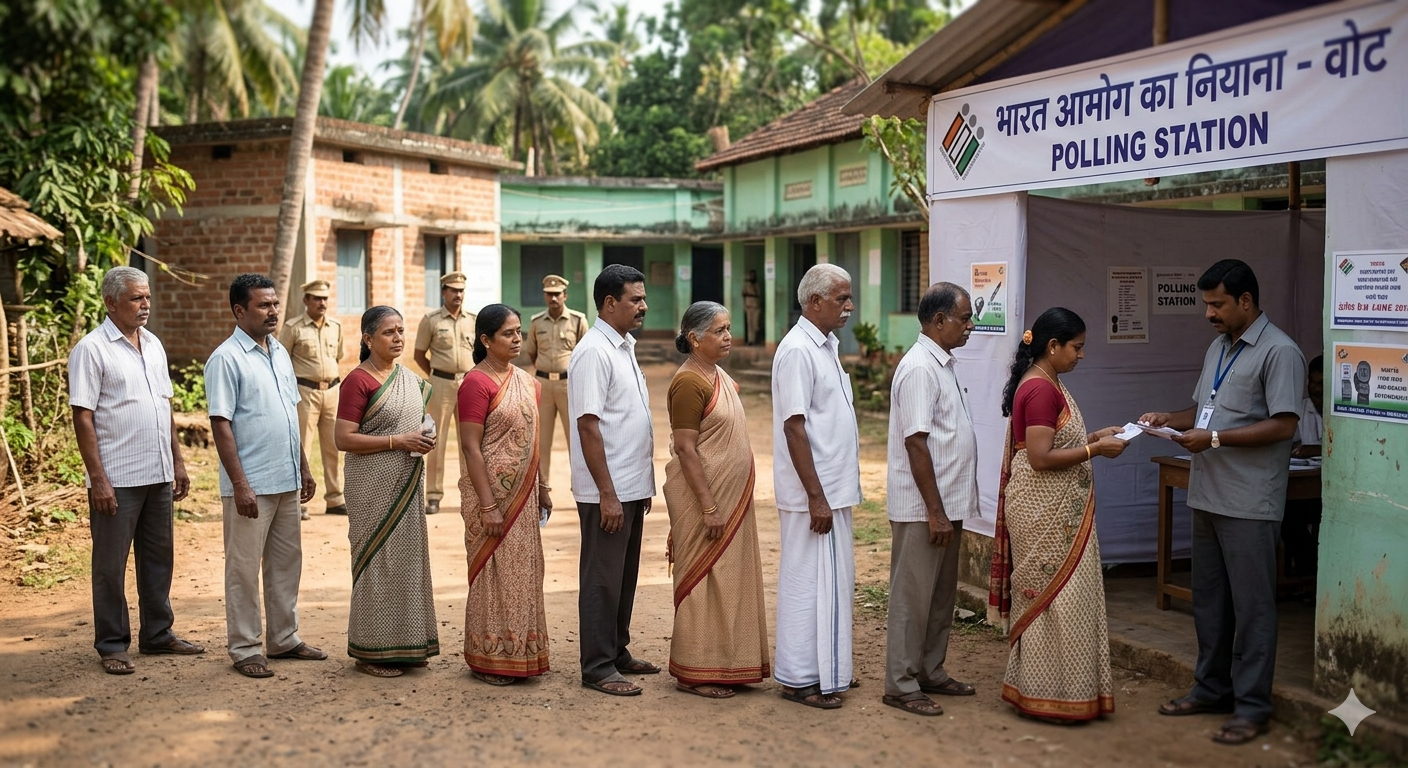 Kerala Goes to the Polls. 140 seats, 2.7 crore voters, and one historic verdict. The road to the Kerala State Assembly officially enters the final stretch. Who will lead God’s Own Country.