Anushasana Parva of Mahabharata: Bhishma's Final Teachings
Introduction to the Previous Parva: Shanti Parva
Before delving into Anushasana Parva, it is essential to understand its direct predecessor, Shanti Parva (the Book of Peace), the twelfth parva of the Mahabharata. Following the devastating Kurukshetra war, Yudhishthira, overwhelmed by grief over the loss of his kin, hesitates to assume the throne of Hastinapura. He questions the very purpose of victory when it comes at such a horrific cost in lives and moral compromise.
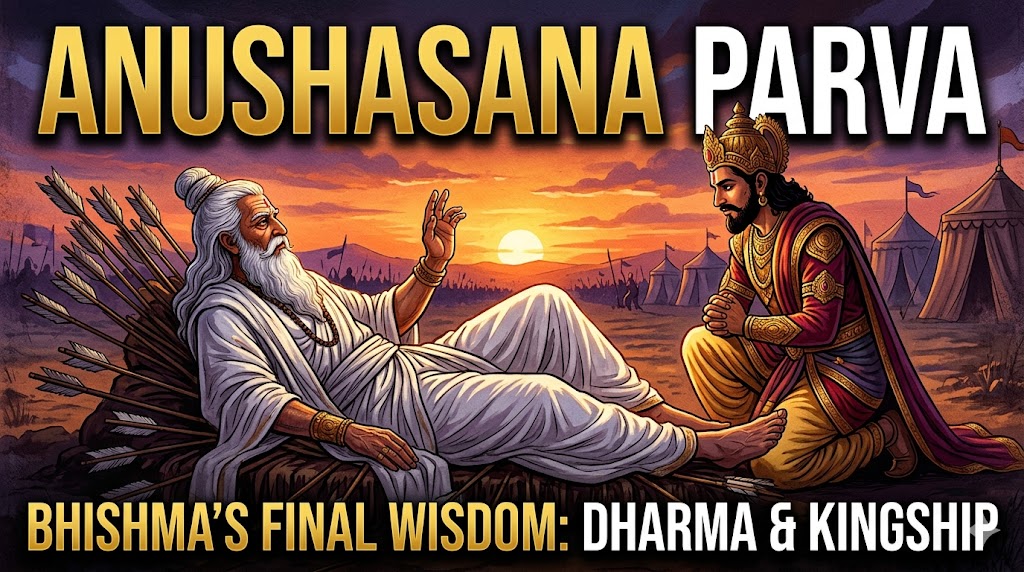
Krishna gently persuades him to seek guidance from Bhishma, the grandsire of the Kuru clan, who lies on a bed of arrows (sharashayya) on the battlefield, awaiting the auspicious arrival of Uttarayana to depart from his mortal body. Bhishma, granted the boon of ichha-mrityu (voluntary death), uses this period to impart extensive wisdom.
Shanti Parva is one of the longest sections in the epic, divided into three sub-parvas: Rajadharma (duties of a king), Apaddharma (conduct in times of adversity), and Mokshadharma (paths to liberation). It covers governance, justice, ethics in crisis, and philosophical inquiries into life, duty, and salvation. The dialogues between Yudhishthira and Bhishma, often witnessed by sages like Vyasa, Narada, and Krishna himself, lay the foundation for righteous rule and personal peace.
This parva sets a contemplative tone, shifting the narrative from the chaos of war to the restoration of dharma in society. Anushasana Parva seamlessly continues this conversation, deepening the exploration of practical and spiritual instructions as Bhishma's time on earth draws to a close.
Anushasana Parva, also spelled Anushasan Parva or Anusasana Parva, is the thirteenth of the eighteen major parvas (books) in the Mahabharata. Translated as the "Book of Instructions" or "Book of Precepts," it represents the final teachings delivered by Bhishma Pitamaha to King Yudhishthira and the assembled Pandavas.
Positioned right after the war's end and the initial restoration of peace in Shanti Parva, this parva focuses on anushasana—disciplined guidance on righteous living, charity (dana), social duties, and spiritual wisdom. In the traditional count, it comprises two upa-parvas (sub-sections) and around 168 chapters (the critical edition condenses it to 154 chapters with approximately 6,500 shlokas).
The setting remains poignant: Yudhishthira, now crowned king, visits Bhishma on the battlefield along with his brothers, Krishna, and revered sages including Vasishtha, Narada, Vyasa, and others. Bhishma, still enduring the pain of his arrow-bed yet serene in spirit, responds to Yudhishthira's queries with patience and depth. These teachings are not abstract philosophy alone but practical advice for rebuilding a war-torn kingdom and leading a dharmic life.
Structure of Anushasana Parva
Anushasana Parva is structured into two main sub-parvas, each serving a distinct yet interconnected purpose:
1. Dana Dharma Parva (Chapters 1–152 in traditional numbering): This is the bulk of the parva, spanning thousands of verses. It elaborates on the dharma of giving (dana), various forms of charity, and their spiritual fruits. Bhishma discusses duties of kings and common people, the varnashrama system (social orders and life stages), conduct for men and women, ahimsa (non-violence), and the merits of specific gifts like food, water, land, cows, and sesame seeds. Numerous illustrative stories and legends are woven in, such as the tale of Gautami and the snake (exploring karma, fate, and forgiveness) and discourses on free will versus destiny.
2. Bhishma Svargarohana Parva (Chapters 153–168): The concluding section is shorter, focusing on Bhishma's final moments. After completing his instructions, Bhishma praises Krishna, recites hymns, and peacefully ascends to heaven as the sun enters Uttarayana. The Pandavas perform his funeral rites, offering oblations in the Ganga. This marks the emotional closure of Bhishma's role in the epic.
The parva maintains a dialogic format, with Yudhishthira posing thoughtful questions on peace of mind, karma, righteous conduct, and the supremacy of devotion. Bhishma answers drawing from Vedic knowledge, ancient legends, and personal insight..jpeg)
The Discourse of the Bed of Arrows
Key Teachings and Stories in Anushasana Parva
Bhishma's discourses in this parva are rich with timeless wisdom, often presented through parables to make complex ideas accessible.
-Dharma and Righteous Conduct: Bhishma defines dharma through core virtues—truthfulness, non-violence, compassion, self-restraint, and forgiveness. He emphasizes that true righteousness lies in self-control and renunciation of ego. Duties are outlined for all four varnas (social classes) and ashramas (life stages), stressing that everyone shares certain universal obligations like supporting dependents and avoiding harm.
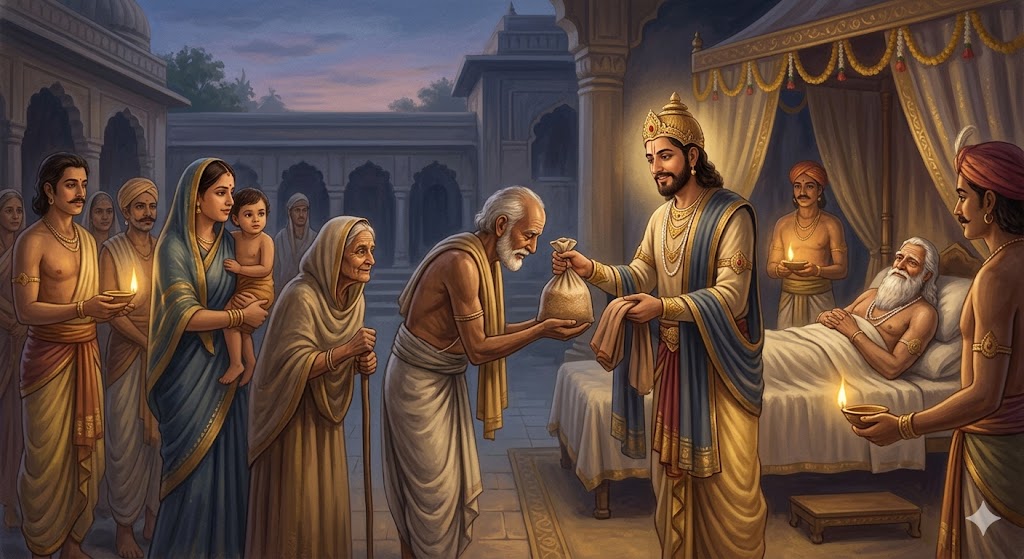
The Power of Dana (Charity): A central theme is the transformative power of giving. Bhishma explains the merits of annadana (giving food), jaladana (water), bhudana (land), godana (cows), and even planting trees. For instance, he highlights how providing water sustains life and brings immense punya (merit), equating it to supreme acts of hospitality. Stories illustrate how ethical gifts, offered without expectation, lead to prosperity in this life and higher realms afterward. He warns against donating to unworthy recipients or with impure motives.
Karma, Fate, and Free Will: Addressing Yudhishthira's guilt over the war, Bhishma narrates the story of Gautami, whose son is killed by a snake. The dialogue explores how time, fate, and past actions interplay, yet individuals retain responsibility for their responses. Bhishma consoles the king that the war was driven by larger cosmic forces, urging detachment from outcomes while performing one's duty.
Devotion and Glorification of the Divine: Notable sections include praises of Lord Shiva (Mahadeva) and Lord Vishnu/Krishna. In one chapter, Krishna himself recites 1,008 names of Shiva, underscoring his glory as the supreme deity. Another highlights the Vishnu Sahasranama (1,000 names of Vishnu), recited by Bhishma as the highest dharma—devotion to the divine, particularly to Krishna, who stands as the embodiment of dharma. These passages affirm the unity of divine manifestations and the path of bhakti (devotion) as supreme.
Social and Ethical Guidance: Discussions cover marriage types, duties of women and men, ahimsa (including teachings on vegetarianism in certain contexts), and the importance of good conduct for prosperity and longevity. Bhishma stresses ethical wealth acquisition and its use for righteous purposes.
These teachings extend beyond kingship to everyday life, offering guidance on overcoming grief, resolving moral dilemmas, and cultivating inner peace.
Significance of Anushasana Parva in the Mahabharata
Anushasana Parva holds profound importance as a bridge between the epic's martial narrative and its philosophical core. While the earlier parvas depict conflict and heroism, this section (along with Shanti Parva) provides the moral and ethical framework for societal reconstruction. It portrays dharma not as rigid rules but as a living, contextual wisdom adaptable to circumstances.
The parva underscores Bhishma's unparalleled knowledge and devotion. Despite fighting on the Kaurava side, his impartial teachings elevate him as a teacher of humanity. Krishna's presence and endorsement highlight the harmony between action (karma), knowledge (jnana), and devotion (bhakti).
In the broader Mahabharata, it reinforces central themes: the inevitability of karma, the supremacy of dharma over personal desires, and the redemptive power of sincere inquiry and guidance. Modern readers find relevance in its insights on leadership, charity, environmental care (e.g., tree planting), and ethical living amid uncertainty.
Scholars and devotees, including discourses by spiritual figures like Prashant Ji Maharaj on Mahabharata katha, often reference these teachings for their depth in exploring Hindu dharma, Lord Shiva's role, and Krishna's divine glory.
The Practical Application of Dharma (Charity
Conclusion: The Enduring Legacy of Bhishma's Instructions
As Bhishma concludes his discourse and ascends to heaven, the Pandavas, guided by his words and Krishna's grace, proceed to rule with wisdom and compassion. Anushasana Parva leaves readers with a message of hope: even after immense loss, dharma can restore order, and sincere seeking leads to enlightenment.
The parva reminds us that true victory lies not in conquest but in righteous governance and inner transformation. Bhishma's bed of arrows becomes a throne of knowledge, teaching that pain can be transcended through duty and devotion.
For those studying the Mahabharata story, Anushasana Parva offers shlokas and analyses that enrich understanding of Hindu philosophy. It stands as a testament to the epic's timeless relevance, encouraging us to seek our own "anushasana"—disciplined guidance—in the pursuit of a dharmic life.