Shanti Parva in Mahabharata: Timeless Lessons on Rajdharma
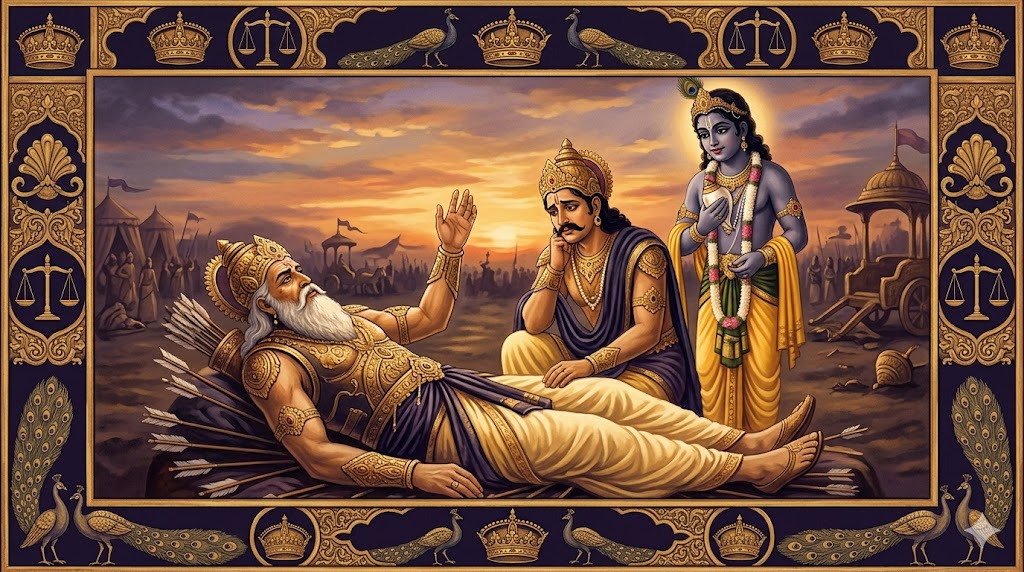
The Mahabharata, one of the greatest epics of ancient India, is not merely a tale of war and heroism but a vast repository of wisdom on life, duty, and society. Among its 18 parvas (books), the Shanti Parv stands out as the twelfth and the longest, often regarded as the philosophical heart of the epic. Also known as the Book of Peace, it marks a profound shift from the chaos of the Kurukshetra war to the restoration of order, justice, and inner tranquility.
After the devastating war that claimed countless lives, including many of his own kin, Yudhishthira—the eldest Pandava and rightful heir—finds himself overwhelmed by grief and guilt. Reluctant to assume the throne of Hastinapur, he questions the very purpose of kingship amid such immense loss. It is in this moment of despair that the dying Bhishma, lying on his bed of arrows, imparts extensive teachings on dharma, governance, ethics, and liberation. These discourses, delivered over many days, form the core of the Shanti Parva.
Comprising approximately 14,000 verses across 365–366 chapters (depending on the edition), the Shanti Parva is divided into three main sub-parvas: Rajadharmanushasana Parva (on the duties of kings), Apaddharmanushasana Parva (dharma in times of adversity), and Mokshadharma Parva (the path to liberation). This structure transforms the parva into an encyclopedic guide, blending statecraft with profound philosophical insights.
For readers seeking Shanti Parva summary, Shanti Parva Rajadharma, or explanations in various languages like Hindi and Kannada, this section serves as a foundational text in Hindu thought, influencing political philosophy, ethics, and leadership even today.
Historical and Narrative Context
The Shanti Parva unfolds in the aftermath of the great war. The Pandavas have triumphed, but victory tastes bitter. Yudhishthira, known for his unwavering commitment to truth and dharma, is consumed by remorse. Sages like Vyasa, Narada, and others approach him, urging him to fulfill his responsibilities as a ruler rather than renounce the world.
Krishna himself persuades Yudhishthira to seek counsel from Bhishma, the grand patriarch of the Kuru clan, who possesses unmatched knowledge of dharma. Bhishma, granted the boon to choose his time of death, waits on the battlefield for the auspicious moment when the sun turns northward.
The scene is poignant: Bhishma, pierced by arrows yet serene, addresses Yudhishthira and his brothers. His teachings are not dry lectures but rich dialogues, interspersed with stories, analogies, and fables that make complex ideas accessible. This narrative frame humanizes the wisdom, showing how even a warrior like Bhishma embodies selflessness and duty till his last breath.
The parva is methodically organized to cover different facets of dharma:
1. Rajadharmanushasana Parva (Chapters 1–130): This is the largest and most famous section, focusing on Rajadharma—the duties and responsibilities of a king. It discusses the origin of kingship, qualities of an ideal ruler, administration, justice, taxation, and the welfare of subjects.
2. Apaddharmanushasana Parva (Chapters 131–173): Here, Bhishma explains Apaddharma, or the code of conduct during emergencies and crises. It addresses how dharma can be adapted when normal rules cannot be followed, emphasizing flexibility without compromising core ethics.
3. Mokshadharma Parva (Chapters 174–365): The final and extensive section delves into Moksha Dharma—the pursuit of spiritual liberation. It explores philosophical systems like Samkhya, Yoga, and Vedanta, along with stories illustrating renunciation, the nature of the soul, and paths to freedom from worldly bonds.
This tripartite division ensures a holistic approach: from practical governance to crisis management and ultimate spiritual goals.
Key Teachings on Rajadharma in Shanti Parva
Rajadharma is the cornerstone of the Shanti Parva. Bhishma presents it not as a tool for personal power but as a sacred obligation to protect society and uphold cosmic order. The king is likened to a shepherd guarding his flock or a pregnant woman who sets aside personal comforts for the greater good.
Origin and Necessity of Kingship
Bhishma explains that in the absence of a ruler, society descends into matsya nyaya—the law of the fish, where the strong devour the weak, leading to anarchy. Kingship emerges to establish order through danda (the rod of justice). A strong, righteous king prevents chaos and enables people to pursue the four purusharthas: dharma, artha, kama, and moksha. Without protection, even virtue cannot flourish.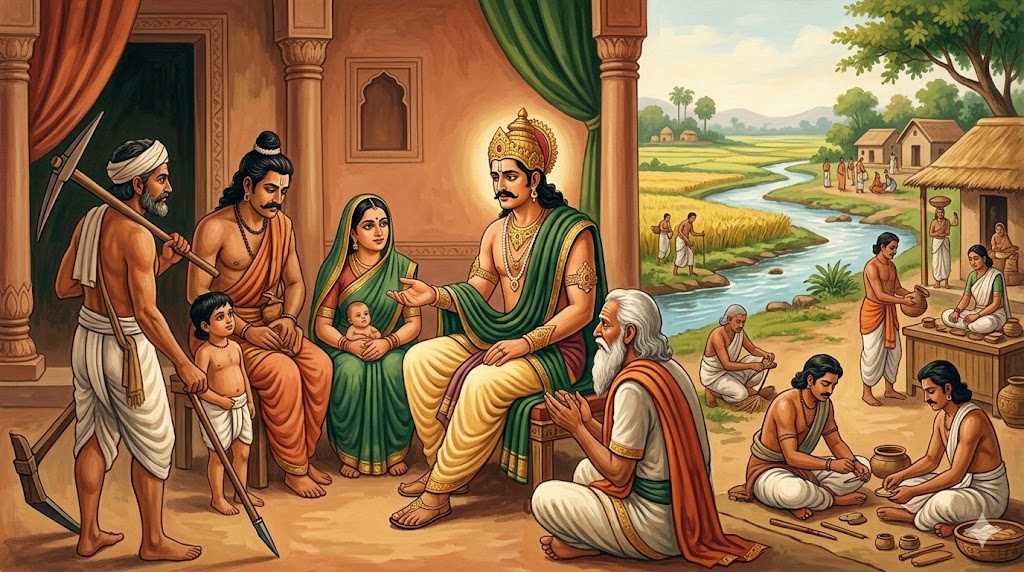
Rajadharma in action: the concepts of Rajadharma and governance discussed by Bhishma. It shows Yudhishthira, now crowned and following the dynamic nature of good rule.
Duties and Qualities of a King
The ideal king must prioritize the welfare of his subjects above all. Key duties include:
Protecting the righteous and punishing the wicked.
Ensuring impartial justice and equitable laws.
Collecting taxes wisely, like a bee gathering honey without harming the flower.
Appointing capable ministers, spies, and officials while remaining vigilant.
Promoting prosperity through agriculture, trade, and welfare measures.
Maintaining social harmony by upholding the varna system ethically, without rigid superiority claims (the parva asserts no inherent superior caste based on birth alone in certain contexts).
Bhishma lists numerous virtues a leader should cultivate, such as self-control, compassion, truthfulness, forgiveness, and fortitude. In one notable section, he outlines 36 qualities for a leader, including observing virtues without anger, never abandoning kindness, and acquiring wealth without cruelty.
A recurring theme is self-sacrifice: the king must renounce personal desires for the people's sake. Greed, fraud, or excessive violence disqualifies one from true rulership.
Governance and Administration
Rajadharma emphasizes good governance through dandaniti (science of punishment and policy). The king should consult wise advisors, inspect officials regularly, and balance firmness with mercy. Bhishma stresses that the king's character influences the entire kingdom—subjects often emulate their ruler.
Stories and analogies, such as fables of the fowler and pigeons, illustrate moral dilemmas and the importance of ethical decision-making.
Philosophical Insights Beyond Governance
While Rajadharma dominates the early part, the Shanti Parva extends into deeper philosophy. The Mokshadharma section discusses the impermanence of life, the role of time (kala), and various paths to moksha. It integrates ideas from Samkhya (enumeration of principles), Yoga (discipline), and Vedanta (ultimate reality).
Bhishma addresses topics like the nature of sin, greed as its root, and the superiority of truth over mere rituals. There is also a comparative discussion on different dharmas, highlighting that dharma itself sustains the world.
These teachings make the Shanti Parva relevant not just for kings but for anyone seeking ethical living and spiritual growth. Concepts like Shanti Parva explained often highlight its role as a bridge between worldly duties and renunciation.
Relevance of Shanti Parva in Modern Times
In an era of complex governance and leadership challenges, the Shanti Parva offers timeless principles. Its emphasis on ethical leadership, welfare-oriented policies, impartial justice, and balanced power resonates with modern ideas of good governance, rule of law, and sustainable administration.
Leaders today can draw from Bhishma's advice on self-restraint, consultation, and prioritizing public welfare. The parva's insights into crisis management (Apaddharma) are particularly valuable in times of uncertainty, while its philosophical depth encourages reflection on purpose beyond material success.
Scholars and students often explore Rajadharma in Shanti Parva for its contributions to ancient Indian political thought, comparing it with concepts from Aristotle or modern constitutionalism. Its focus on dharma as the root of prosperity remains a powerful reminder that true success lies in righteousness.
For those interested in regional interpretations, summaries and explanations of Shanti Parva in Hindi, Shanti Parva in Kannada, or other languages make these teachings accessible across India.
Conclusion
The Shanti Parva of the Mahabharata transcends its narrative setting to become a universal manual for peace, duty, and enlightened leadership. Through Bhishma's profound discourses on Rajadharma, it teaches that true governance is rooted in dharma—protecting the weak, upholding justice, and fostering prosperity while pursuing higher spiritual goals.
Whether you approach it for Shanti Parva summary , insights into kingly duties, or philosophical depth, this parva reminds us that peace is not merely the absence of war but the presence of righteous order. In our fast-paced world, revisiting these ancient teachings can guide individuals and societies toward harmony and ethical living.
For further reading, one can explore full translations or regional versions. The wisdom of Shanti Parva continues to inspire, proving that the lessons from the Mahabharata remain eternally relevant.