Stri Parva: The Heartbreaking Lament of Women in the war
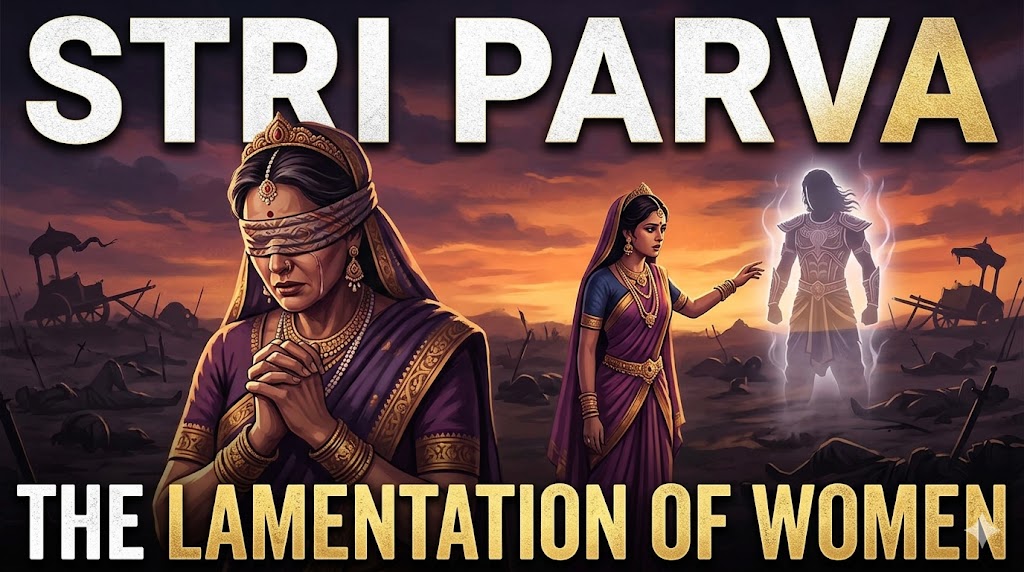
The Mahabharata, one of the greatest epics of ancient India, unfolds across 18 major parvas (books), each revealing layers of dharma, conflict, heroism, and profound human emotion. Among these, Stri Parva (also spelled Stree Parva), the eleventh book, stands apart as "The Book of the Women." It shifts the focus from the thunder of battle to the silent, shattering grief that follows victory and defeat alike.
This parva does not glorify warriors or celebrate conquest. Instead, it bears witness to the immense suffering of mothers, wives, sisters, and daughters on both sides of the Kurukshetra war. Through raw lamentations, it recognizes and establishes the central place of women in the epic narrative. Their voices highlight that war's true cost is borne not only by men on the battlefield but equally by the women who endure loss, perform rites, and carry forward the burden of memory.
In a world dominated by tales of male valor, Stri Parva humanizes the epic. It shows women as pillars of emotional strength, capable of fierce anger, deep compassion, and quiet acceptance. Their tears and curses remind readers that behind every fallen hero stands a woman whose life is forever altered.
The Parvas Leading to Stri Parva: Building Up to the Great War and Its Immediate Aftermath
To appreciate Stri Parva fully, one must understand the sequence of events in the preceding parvas. The Mahabharata begins with Adi Parva, which lays the foundation by narrating the origins of the Kuru dynasty, the birth of the Pandavas and Kauravas, and the early rivalries that sows seeds of discord.
This is followed by Sabha Parva (the game of dice and Draupadi's humiliation), Vana Parva (the 12 years of exile in the forest), and Virata Parva (the year spent in disguise). Udyoga Parva depicts the frantic efforts for peace, which ultimately fail due to Duryodhana's intransigence.
The war itself spans several intense books:
Bhishma Parva: The war begins on the first day. Bhishma serves as commander of the Kaurava forces until he falls on the tenth day. This parva famously includes the Bhagavad Gita, where Krishna imparts timeless wisdom to Arjuna.
Drona Parva: Drona takes command. It features dramatic episodes like the death of Abhimanyu (Arjuna's son) and the slaying of Drona through strategy and deception.
Karna Parva: Karna leads the Kauravas, showcasing his prowess and tragic loyalty until his death at Arjuna's hands.
Shalya Parva: Shalya becomes the final commander. The war reaches its climax with the mace duel between Bhima and Duryodhana.
Sauptika Parva: In a night raid after the war's 18th day, Ashwatthama, Kripacharya, and Kritavarma massacre the sleeping Pandava camp, killing Draupadi's five sons and the remaining Panchala warriors. This act of vengeance marks the brutal end of large-scale fighting.
Stri Parva opens immediately after this massacre. The battlefield lies strewn with corpses. Dhritarashtra, the blind king of the Kauravas, is overwhelmed by grief over his hundred sons. The narrative now turns inward, focusing on mourning, consolation, and the performance of last rites.
This progression—from origins and exile to fierce warfare and nocturnal slaughter—sets the stage for Stri Parva's emotional core. The epic, having shown the glory and horror of combat, now examines its lingering pain through the eyes of those left behind.
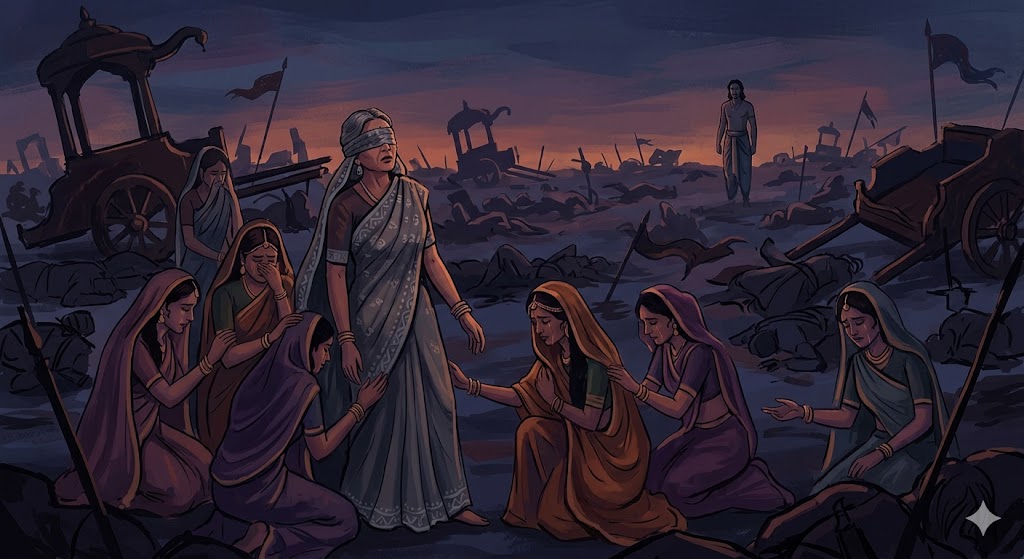
Gandhari’s Sorrow and the Cost of War
Brief Overview of the Mahabharata Family Tree
At the heart of the conflict lies the Kuru family tree. King Shantanu's lineage branches into two main lines:
Through his wife Satyavati and son Vichitravirya (with Vyasa's intervention), come Dhritarashtra (blind, married to Gandhari) and Pandu (married to Kunti and Madri).
Dhritarashtra and Gandhari have 100 sons, the Kauravas, led by the ambitious Duryodhana.
Pandu and his wives have the five Pandavas: Yudhishthira, Bhima, Arjuna, Nakula, and Sahadeva. Kunti also secretly bears Karna before her marriage.
The cousins' rivalry escalates over the throne of Hastinapura, culminating in the Kurukshetra war. Women like Gandhari (mother of the Kauravas), Kunti (mother of the Pandavas and Karna), and Draupadi (wife of the Pandavas) play pivotal roles, their lives intertwined with the fate of the dynasty.
Key Events in Stri Parva: Grief, Lamentation, and Recognition of Women's Strength
Stri Parva is divided into sub-sections, primarily Jalapradanika Parva (offerings of water to the departed) and Stri-vilapa Parva (the lamentations of the women). It begins with Dhritarashtra's profound sorrow. Sanjaya and Vidura console him, reminding him of fate and the inevitability of death. Vyasa appears to offer philosophical counsel on accepting loss.
Dhritarashtra, accompanied by Gandhari and other royal women, proceeds to the battlefield. There, the scene is devastating: vultures and dogs roam among the unclaimed bodies. Widows from both Kaurava and Pandava sides stream onto the field, clad in single white garments, their hair disheveled, searching frantically for their loved ones. They match limbs to torsos, often in vain, and break into heart-wrenching cries.
Gandhari's Lament and Vision: Gandhari, who had blindfolded herself in solidarity with her husband, receives divine vision through her austerities. She beholds her hundred sons and grandsons lying slain. Her grief turns to rage as she confronts Krishna, blaming him for not preventing the war despite his power. In her anguish, she curses Krishna that his own Yadava clan will perish in mutual slaughter, mirroring the Kuru women's plight. Krishna accepts the curse calmly, acknowledging the workings of destiny.
The women of both sides—Kaurava and Pandava—lament together. They cry over slain sons, husbands, brothers, and fathers. Gandhari specifically mourns Duryodhana, describing his once-mighty form now reduced to a pitiful state. Other queens, such as the wives of Bhurishrava and Somadatta, voice similar sorrows, falling to the ground in despair.
Kunti's Revelation: As the Pandavas perform water oblations (jalanjali) for the dead on the banks of the Ganges, Kunti suddenly reveals a long-hidden truth: Karna, the great warrior slain by Arjuna, was her eldest son, born to her before marriage through the sun god Surya. She had abandoned him in a basket on the river. The Pandavas, stunned, grieve deeply for their unknown brother. Yudhishthira, already burdened by the war's toll, feels this loss most acutely. This moment underscores Kunti's quiet strength and the secret burdens women often carry.
The parva also shows Dhritarashtra's momentary flash of anger toward Bhima. Krishna intervenes cleverly to prevent harm. Eventually, grief gives way to a shared performance of funeral rites for all fallen warriors, regardless of side. The women participate actively, their presence transforming the ritual into a collective act of remembrance.
How Stri Parva Recognizes and Establishes the Soul of Women in the Mahabharata
Stri Parva is remarkable for its empathetic portrayal of women. It does not reduce them to passive victims. Instead, it establishes their soul—their inner resilience, moral voice, and emotional depth—as integral to the epic.
The women of both Kaurava and Pandava sides lament with equal intensity. They do not celebrate victory or defeat; they mourn the shared human tragedy. Their cries fill the air like the screams of ospreys or cranes over a desolate sea. They search the battlefield under the scorching sun, their beauty faded, bodies exhausted, yet driven by love and duty.
This parva shows that warriors are not only the men who wield weapons. The women demonstrate profound courage in facing the death of their sons and husbands. They accept the harsh reality of war without denial, yet they grieve openly and fiercely. Their ability to endure loss while performing sacred rites reveals a different kind of heroism—one rooted in acceptance, compassion, and continuity of life.
Gandhari's curse and Kunti's revelation highlight women's agency. Gandhari channels her pain into a prophetic warning about the consequences of inaction and adharma. Kunti, who had borne the secret of Karna for decades, chooses the moment of collective mourning to unburden herself, forcing her sons to confront the full cost of their actions.
In doing so, Stri Parva elevates women from the margins of the war narrative to its emotional and moral center. It reminds us that true dharma includes acknowledging suffering and honoring the bonds that war destroys.
The Warriors' Wives: Strength in Acceptance and Mourning
The wives and mothers on both sides exemplify that resilience is not the absence of tears but the courage to face reality. They lament loudly, yet many rise to support one another. Gandhari comforts Draupadi, who has lost her five sons in the night raid. Kunti consoles the grieving widows.
Their mourning is not weakness. It is a powerful acknowledgment of love and loss. By performing the water rites alongside the men, these women ensure the departed receive proper spiritual transition. Their presence on the battlefield—once a male domain—asserts their right to witness and participate in the aftermath.
This portrayal challenges the notion that only armed combatants are warriors. The women "fight" by enduring, remembering, and rebuilding. Their acceptance of death, even as they cry over their sons and husbands, shows immense inner fortitude. They carry forward the lineage and the memory, ensuring the story of the Kurukshetra war lives on through generations.
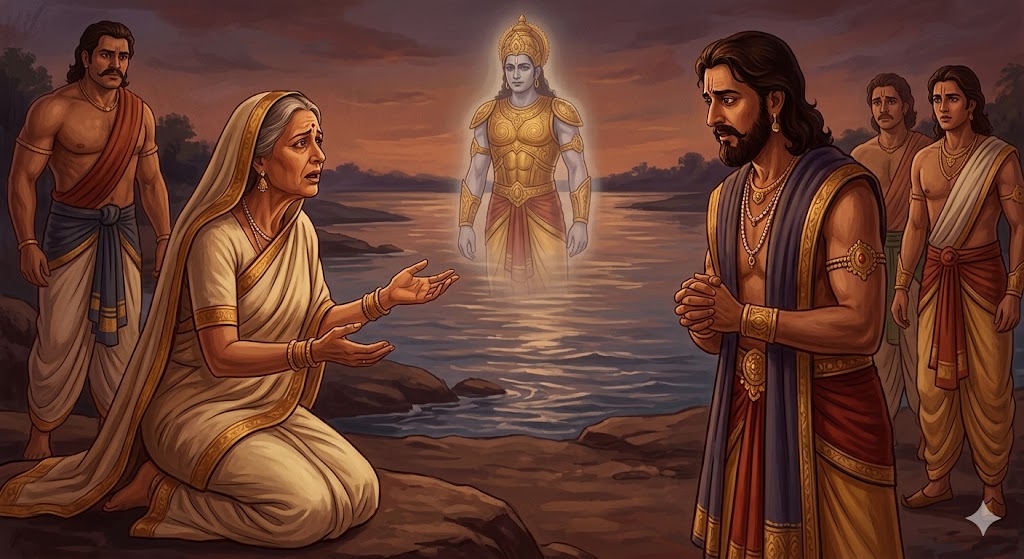
Kunti’s Confession and Yudhishthira’s Shock
Conclusion: The Enduring Legacy of Stri Parva
Stri Parva serves as a poignant reminder that every war has two sides—and countless innocent sufferers. It does not end the Mahabharata; subsequent parvas like Shanti and Anushasana focus on peace, governance, and dharma under Yudhishthira's rule. Yet its emotional honesty sets the tone for the epic's later philosophical reflections.
In recognizing women's grief, strength, and moral insight, Stri Parva enriches the Mahabharata. It teaches that victory without compassion is hollow, and that the soul of any civilization lies in how it honors its women and the fallen.
For readers today, this parva offers timeless lessons on empathy, the futility of unchecked ambition, and the healing power of shared mourning. It invites us to look beyond glory to the human faces behind historical or mythical conflicts.
Whether exploring the full Mahabharata story, its family tree, or specific episodes, Stri Parva remains one of its most moving and humanistic sections—a testament to Vyasa's genius in weaving profound emotion into an epic of cosmic scale.