Chaitanya Mahaprabhu: Golden Saint of Krishna Bhakti
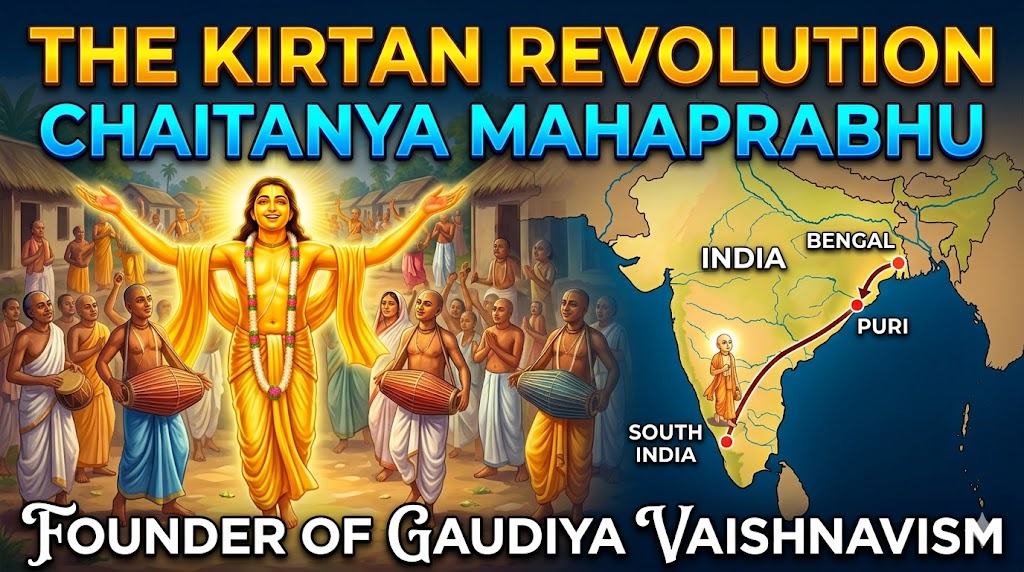
Chaitanya Mahaprabhu stands as a luminous figure in the spiritual history of India. Born in the late 15th century in Bengal, he appeared at a time when ritualistic practices had overshadowed the simple, heartfelt devotion central to Sanatan Dharma. Through his extraordinary life, Chaitanya Mahaprabhu revived the essence of Vaishnav Dharma, emphasizing pure love for Lord Krishna. His teachings, centered on congregational chanting and ecstatic devotion, continue to inspire millions worldwide.
Often revered as the combined incarnation of Radha and Krishna, Chaitanya Mahaprabhu embodied the highest form of divine love. He wandered from place to place, preaching the glories of Lord Krishna and establishing Gaudiya Vaishnavism as a distinct path of bhakti. Whether through his captivating kirtan, profound philosophy, or personal example of humility, Chaitanya Mahaprabhu transformed lives and revived the true spirit of Sanatan Dharma. This article explores his remarkable story, his role as a divine teacher, and his enduring legacy as one of India’s greatest saints.
Chaitanya Mahaprabhu was born as Vishvambhara Mishra on February 18, 1486, in the sacred town of Navadvipa (present-day Mayapur) in West Bengal. His parents, Jagannath Mishra and Sachi Devi, were devout Brahmins who had already lost several children. The birth occurred during a lunar eclipse, an auspicious moment that filled the household with joy and divine signs. Locals affectionately called him Nimai because he was born under a neem tree.
As a child, Nimai displayed exceptional intelligence and a playful yet mischievous nature. He excelled in studies, earning the title Nimai Pandit for his scholarly prowess. By his teenage years, he had mastered grammar, logic, and various scriptures, becoming a respected teacher in Navadvipa. He married Lakshmipriya at a young age, but after her untimely passing, he entered a second marriage with Vishnupriya Devi.
In these early years, Chaitanya Mahaprabhu appeared as an ordinary scholar, engaging in debates and teaching. Yet subtle signs of his divine nature emerged—moments of spontaneous devotion and an inner pull toward Krishna bhakti. His transformation began after a pilgrimage to Gaya, where he met his guru, Ishvara Puri, and received initiation into Vaishnava practices. This encounter awakened the deep love for Krishna that would define his mission.
Divine Incarnation: Chaitanya Mahaprabhu as Radha-Krishna Combined
In Vaishnava tradition, Chaitanya Mahaprabhu is not merely a saint but the Supreme Lord Krishna Himself appearing in a unique form. Scriptures describe him as the combined incarnation of Radha and Krishna. He possessed Krishna’s bodily features and transcendental qualities while embodying Radharani’s golden complexion and mood of intense, selfless love. This rare manifestation allowed the Lord to experience the ecstasy of devotion that Radha feels for Krishna.
Devotees see this as Krishna’s compassionate response to the needs of Kali Yuga. By appearing as His own devotee, Chaitanya Mahaprabhu demonstrated how ordinary souls could attain the highest spiritual perfection through humility and chanting. He never openly declared his divinity during his lifetime, instead living as the ideal bhakta to set an example. This self-effacing approach deepened the impact of his teachings, making the path accessible to all, regardless of caste or background.
His incarnation fulfilled ancient prophecies and revived the yuga-dharma of this age—sankirtana, or congregational chanting of the holy names. Through this, Chaitanya Mahaprabhu made the profound love of Radha and Krishna available to every sincere seeker.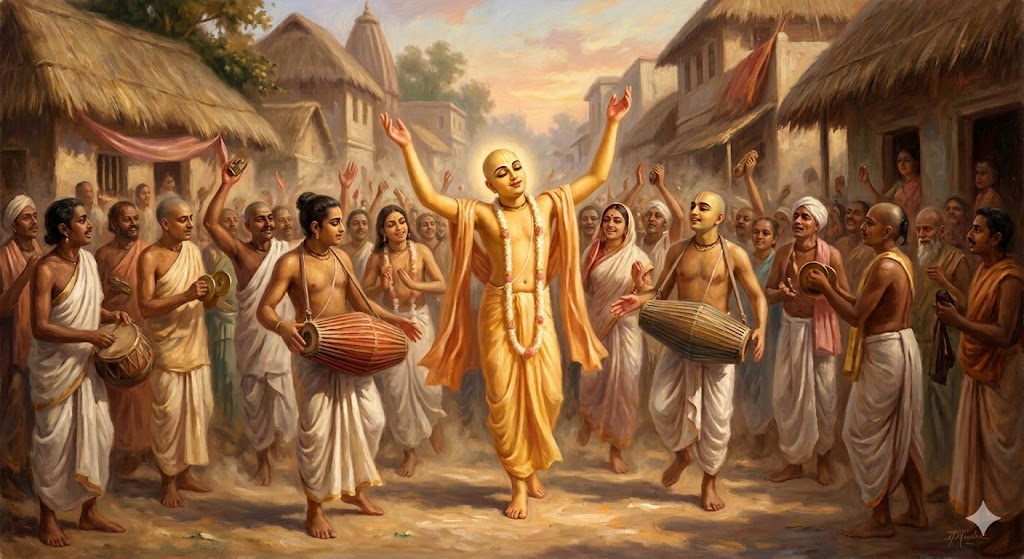
The Ecstatic Kirtan in Navadvipa
Taking Sannyas and the Birth of His Preaching Mission
At the age of twenty-four, in 1510, Chaitanya Mahaprabhu took sannyas (renunciation) from Kesava Bharati in Katwa. He received the name Sri Krishna Chaitanya, marking a complete shift from his scholarly life to one of full dedication to Krishna. This decision was driven by an overwhelming desire to spread Krishna consciousness without the distractions of family and social obligations.
Immediately after sannyas, he traveled to Jagannath Puri, the abode of Lord Jagannath, whom he regarded as non-different from Krishna. There, he immersed himself in ecstatic worship and kirtan. His emotional displays—dancing, chanting, and sometimes fainting in divine love—captivated onlookers and drew many to the path of bhakti.
Chaitanya Mahaprabhu’s sannyas marked the beginning of his active preaching. He emphasized that true religion lies not in external rituals but in developing pure love for Krishna. His message resonated deeply because it was simple, joyful, and universal, aligning perfectly with the eternal principles of Sanatan Dharma.
Wandering Across India: Preaching and Worshipping Lord Krishna
One of the most inspiring aspects of Chaitanya Mahaprabhu’s life was his extensive travels. He journeyed tirelessly across India, from Bengal and Odisha to the southern regions and the holy land of Vrindavan, spreading the glories of Lord Krishna.
After settling in Puri, he undertook a major tour of South India. Accompanied by a few close associates, he visited sacred temples and holy sites, engaging scholars and saints in spiritual discussions. Many learned pandits, initially skeptical of his devotional approach, were won over by his profound knowledge and ecstatic love. He converted numerous people to Vaishnav Dharma, establishing kirtan groups that continued long after his departure.
His visit to Vrindavan was particularly significant. There, he relived the pastimes of Radha and Krishna, identifying sacred places connected to their divine love. Overwhelmed with emotion, he danced and chanted in the forests and along the Yamuna River, inspiring devotees to this day.
Throughout his wanderings, Chaitanya Mahaprabhu practiced and preached the chanting of the Hare Krishna mahamantra: Hare Krishna, Hare Krishna, Krishna Krishna, Hare Hare / Hare Rama, Hare Rama, Rama Rama, Hare Hare. He taught that this sankirtan cleanses the heart and awakens dormant love for God. His personal example—worshipping Krishna through constant remembrance, humility, and service—became the model for his followers.
These travels were not mere pilgrimages; they were a dynamic mission to revive Sanatan Dharma among the common people, breaking barriers of social division and ritualism.
Founding Gaudiya Vaishnavism: The Path of Pure Love for Radha and Krishna
Chaitanya Mahaprabhu is revered as the founder of Gaudiya Vaishnavism, a vibrant branch of Vaishnav Dharma that flourished in Bengal and beyond. He did not create a new religion but restored and systematized the eternal teachings of bhakti found in the Bhagavata Purana and other scriptures.
The core of Gaudiya Vaishnavism is prema bhakti—the cultivation of spontaneous, selfless love for Radha and Krishna. Chaitanya Mahaprabhu taught that the highest goal of life is to serve the Divine Couple in the mood of Radharani, experiencing the sweetest form of devotion. He composed the Siksastakam, eight verses that encapsulate the essence of this path, stressing humility, tolerance, and constant chanting.
Unlike other traditions that emphasized knowledge or austerity alone, Gaudiya Vaishnavism places chanting and kirtan at the center. Chaitanya Mahaprabhu demonstrated how these practices could elevate even the most ordinary person to spiritual heights. His close associates, known as the Six Goswamis of Vrindavan, later formalized the philosophy, theology, and practices, building directly on his instructions.
Through this tradition, Chaitanya Mahaprabhu made the profound, intimate love of Radha and Krishna accessible, transforming abstract philosophy into a living, joyful relationship with the Divine.
Preaching Vaishnav Dharma and Sanatan Dharma to the People
Chaitanya Mahaprabhu’s preaching focused on restoring the pure essence of Vaishnav Dharma within the broader framework of Sanatan Dharma. He taught that devotion to Krishna is the universal religion, free from the divisions of caste, creed, or social status. In an era marked by ritual rigidity and social hierarchies, he welcomed everyone—Brahmins, lower castes, and even those outside traditional folds—into the fold of bhakti.
His method was revolutionary yet simple: through ecstatic kirtan, he created an inclusive spiritual experience. People from all walks of life joined in chanting, dancing, and tasting the bliss of Krishna’s holy names. This sankirtan movement broke down barriers and awakened genuine faith.
He also engaged with scholars and rulers, convincing them through scriptural evidence and personal example. His emphasis on compassion, humility, and service reinforced the timeless principles of Sanatan Dharma—dharma, artha, kama, and moksha culminating in pure love of God.
Chaitanya Mahaprabhu’s message was clear: in Kali Yuga, the easiest and most effective way to realize God is through the chanting of His names, a practice open to all and aligned with the eternal truths of Vaishnav Dharma.
Chaitanya Mahaprabhu: One of India’s Greatest Saints
Chaitanya Mahaprabhu is widely regarded as one of the greatest saints in Indian history for his unparalleled contribution to spiritual awakening. His life exemplified the highest ideals of devotion, humility, and selfless service. Unlike many spiritual leaders who remained in seclusion, he actively reached out to society, making bhakti a practical reality for millions.
His influence extended beyond religion into culture, literature, and social harmony. The Gaudiya tradition he inspired produced rich devotional literature, music, and art that continue to enrich Indian heritage. Leaders across generations, from medieval times to modern spiritual movements, have drawn inspiration from his example.
What sets Chaitanya Mahaprabhu apart is his embodiment of both divinity and humanity. He lived as the perfect devotee while revealing the path to the highest love. His kindness toward all beings, his tolerance in the face of opposition, and his unwavering focus on Krishna bhakti make him an eternal beacon of light in India’s spiritual landscape.
Later Years, Disappearance, and Timeless Legacy
Chaitanya Mahaprabhu spent his final eighteen years in Jagannath Puri, living in deep absorption in Krishna consciousness. Surrounded by intimate devotees, he continued to teach through his daily life and ecstatic kirtans. His final pastimes were marked by intense separation from Krishna, reflecting the pinnacle of devotional love.
He disappeared on June 14, 1534, at the age of forty-eight, merging into the divine in the presence of Lord Jagannath. Though his physical presence ended, his spirit and teachings live on through the Gaudiya Vaishnava tradition and the global Hare Krishna movement.
Today, Chaitanya Mahaprabhu’s legacy thrives in temples, festivals, and the hearts of devotees worldwide. His emphasis on chanting, kirtan, and love for Radha and Krishna offers a timeless solution to the spiritual needs of humanity. He remains a guiding light, reminding us that true greatness lies in humble, loving service to the Divine.
.jpeg)
The Sannyasi’s Journey South
Conclusion
The story of Chaitanya Mahaprabhu is one of divine compassion and transformative love. From his birth in Navadvipa to his wanderings across India, from founding Gaudiya Vaishnavism to preaching the pure bhakti of Radha and Krishna, he revitalized Vaishnav Dharma and Sanatan Dharma for the modern age. As one of India’s greatest saints, he showed that the path to God is open to all through sincere chanting and devotion.
In every kirtan, every heartfelt prayer, and every act of service inspired by his example, Chaitanya Mahaprabhu continues to guide souls toward the eternal truth. His life teaches that the greatest achievement is not worldly success but developing pure love for Lord Krishna. May his blessings awaken that love in every heart, spreading the joy of bhakti far and wide.