Kakbhushundi: The Eternal Crow Sage's timeless birth
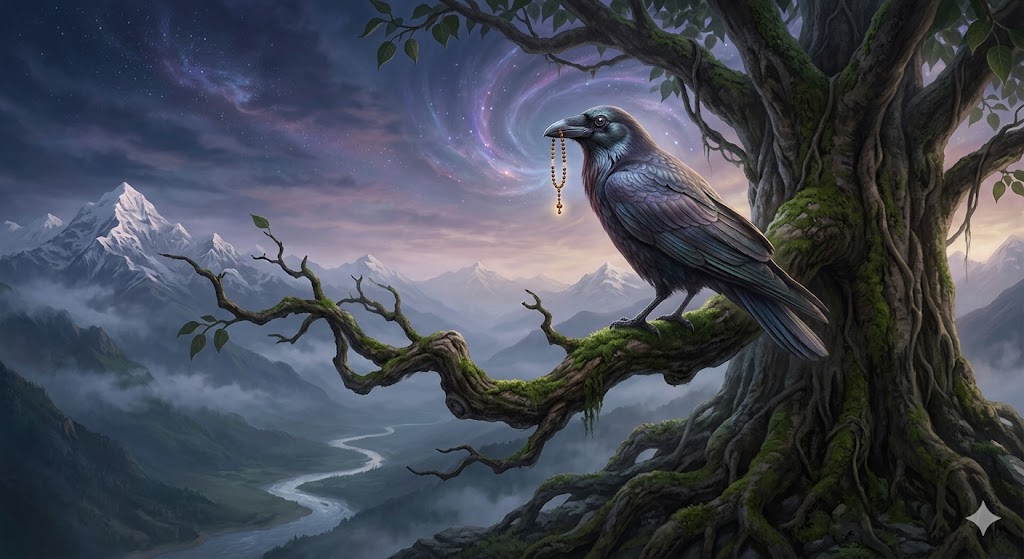
In the vast tapestry of Hindu scriptures, few figures capture the imagination quite like Kakbhushundi, also known as Kagbhusandi or Kak Bhushundi. This enigmatic sage, appearing in the form of a crow, stands as a symbol of unwavering devotion, cosmic memory, and the profound mysteries of time and existence.
Mentioned prominently in Tulsidas's Ramcharitmanas (Uttarkand) and referenced in texts like the Yoga Vasistha, Kakbhushundi is not merely a character but a living bridge between mortal understanding and divine eternity. He is said to have witnessed the Ramayana unfold 11 times and the Mahabharata 16 times, each iteration featuring the same core characters yet unfolding with different sequences of events or "moves," much like variations in an eternal cosmic play.
His story invites us to ponder deeper questions: Is time linear, or does it loop in endless cycles? What lies beyond a single universe? Kakbhushundi's narrative offers ancient wisdom that resonates with modern concepts of multiverses and time travel, all rooted in bhakti (devotion) and spiritual insight.
The Origin and Transformation of Kakbhushundi
Kakbhushundi was not always a crow. Legends trace his journey through multiple births, marked by intense devotion mixed with human flaws like arrogance.
In one account from the Ramcharitmanas, he began as a fervent devotee of Lord Shiva. Born in a scholarly family, he showed early promise but developed strong partiality toward Shiva, sometimes disrespecting other deities or even his guru. This rigidity led to curses that shaped his destiny.
One notable curse came from Sage Lomasha (or Lomas), transforming him into a crow due to a moment of pride or disrespect. Another version involves Lord Shiva himself moderating a harsher punishment after intercession. Through these trials—spanning thousands of lifetimes as various creatures—he gradually purified his ego.
Eventually, his steadfast chanting of Rama's name and sincere devotion pleased Lord Rama (an incarnation of Vishnu). Rama granted him immortality, divine vision, and the boon to remain in crow form if he wished, as it allowed him to move freely and witness divine leelas (plays) without hindrance. Kakbhushundi chose this form, embracing humility. He now resides on a sacred tree near Mount Meru or in Himalayan regions, observing the universe with equanimity.
His crow appearance symbolizes transcendence: external form matters little when the heart is filled with devotion. Birds flock to him to hear Ramakatha, underscoring his role as a guru even in this humble guise.
Kakbhushundi's Encounter with Garuda: The Divine Dialogue
One of the most celebrated episodes occurs in the Uttarkand of Ramcharitmanas. Garuda, the mighty eagle and vehicle of Lord Vishnu, once felt doubt or pride regarding Rama's divinity. Lord Vishnu directed him to seek wisdom from Kakbhushundi.
Garuda flew to the sage's abode, where the crow-sage welcomed him warmly. Their conversation forms a profound exchange of life, devotion, and cosmology. Garuda posed deep questions about existence, suffering, and the nature of reality. Kakbhushundi responded with patience, narrating the full glory of Rama's story in exquisite detail—often considered one of the earliest or most intimate retellings of the Ramayana.
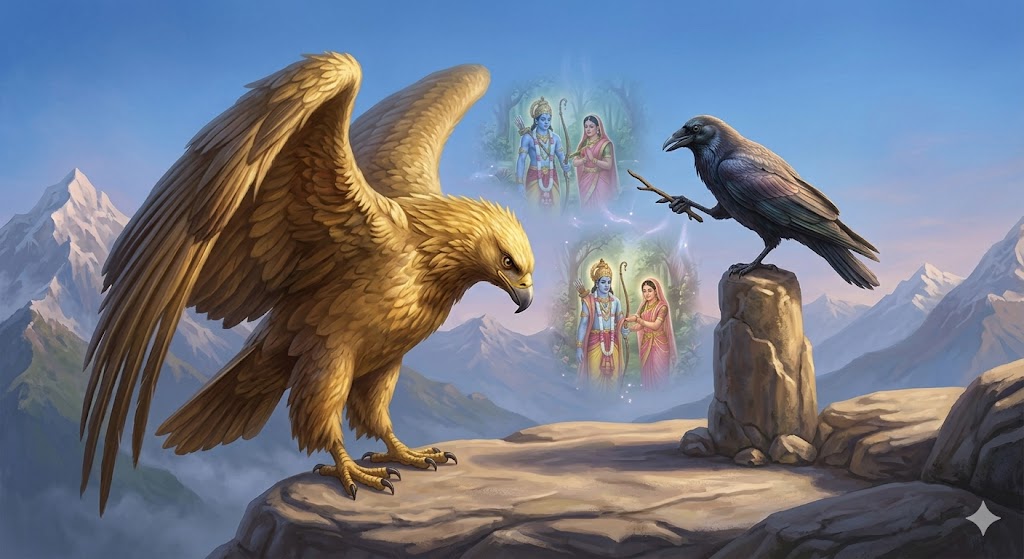
This image illustrates the crucial meeting detailed in the article, where Garuda (the ego/intellect) seeks wisdom from Kakbhushundi (bhakti/devotion)
During this samvad (dialogue), Kakbhushundi revealed his extraordinary lifespan and experiences. He explained how he had lived through multiple kalpas (cosmic cycles) and witnessed the divine drama of Rama's incarnation repeatedly. This narration not only dispelled Garuda's doubts but also highlighted bhakti as the ultimate path beyond intellectual pride.
Kakbhushundi described traveling to Ayodhya in every Treta Yuga, staying for years to behold the childhood leelas of Lord Rama as a playful child. In one touching vision, young Rama opened his mouth, revealing countless universes within, including versions of Kakbhushundi himself witnessing the same scene—illustrating the infinite, fractal nature of reality.
Witness to Multiple Ramayanas and Mahabharatas
Kakbhushundi's most astonishing claim is that he has observed the Ramayana 11 times and the Mahabharata 16 times. In each cycle, the central characters—Rama, Sita, Lakshmana, Ravana, Krishna, Pandavas, Kauravas—remain the same, but the "moves" or sequences of events differ.
This does not imply contradictory endings in a moral sense but variations within the cosmic play (lila). Some interpretations suggest these occur across different kalpas or parallel brahamands (universes). The core dharma (righteousness) triumphs, yet the paths, challenges, and nuances shift, reflecting the dynamic nature of maya (illusion) and free will within divine order.
He shared this with Garuda and, in certain traditions linked to the Yoga Vasistha, with Sage Vasistha himself. These repetitions emphasize that history is not a one-time event but part of recurring cosmic rhythms. Kakbhushundi's memory remains intact across these cycles, making him a unique "time traveler" in mythological terms—able to pause, observe, and even move between timelines through yogic power and Rama's grace.
Insights on the Universe: Earth of Gold and Time Loops
Kakbhushundi's revelations extend beyond epics to the fabric of existence. In dialogues, he described witnessing worlds where the Earth appeared entirely made of gold, or where beings were formed of stone rather than flesh—highlighting the infinite variety within creation.
He spoke of time as cyclical rather than strictly linear. Universes undergo creation (srishti), sustenance, and dissolution (pralaya) repeatedly. Through pranayama and detachment, he survives these dissolutions, anchored in devotion. This aligns with concepts in Yoga Vasistha, where Vasistha explores similar ideas of reality as a dream-like projection of consciousness.
Kakbhushundi's "shooting chamatkar" (miraculous feats) include entering Rama's mouth and experiencing entire cosmic cycles in what seemed like moments, only to return to the exact same instant—echoing advanced notions of relativity and non-linear time.
His teachings stress that true understanding comes not from accumulating knowledge but from surrendering to the divine. He advises focusing on Rama nama (the name of Rama) as the anchor amid changing realities.
Kakbhushundi's Teachings and Spiritual Legacy
Beyond storytelling, Kakbhushundi imparts timeless lessons:
- Devotion Over Ritual: His journey from Shiva-centric rigidity to Rama bhakti shows the universality of love for God.
- Humility in Form: Remaining a crow teaches that wisdom and sanctity transcend physical appearance.
- Cosmic Perspective: By viewing multiple cycles, he encourages detachment from ego-driven attachments to a single "reality."
- Power of Rama Katha: Narrating or listening to Rama's story purifies the mind and grants liberation.
He continues to inspire devotees today. In some traditions, a sacred lake associated with him (Kagbhusundi Lake) is revered, where crows are said to gather in his honor.
Kakbhushundi also features in Ananda Ramayana and other regional texts, sometimes as the narrator of extended versions of Rama's leela. His "Kakbhushundi Ramayan" represents an intimate, devotional retelling emphasizing hidden spiritual dimensions.
Relevance in Modern Times
In an era fascinated by multiverses, quantum realities, and time perception, Kakbhushundi's story feels remarkably contemporary. It reminds us that ancient Indian rishis contemplated infinite worlds and looping time long before modern physics.
Yet, its core message remains spiritual: Amid uncertainty and change, unwavering devotion provides stability. Whether time loops or universes multiply, the divine presence is constant.
Scholars and storytellers continue to explore his character through books, discourses, and adaptations, keeping the wisdom alive.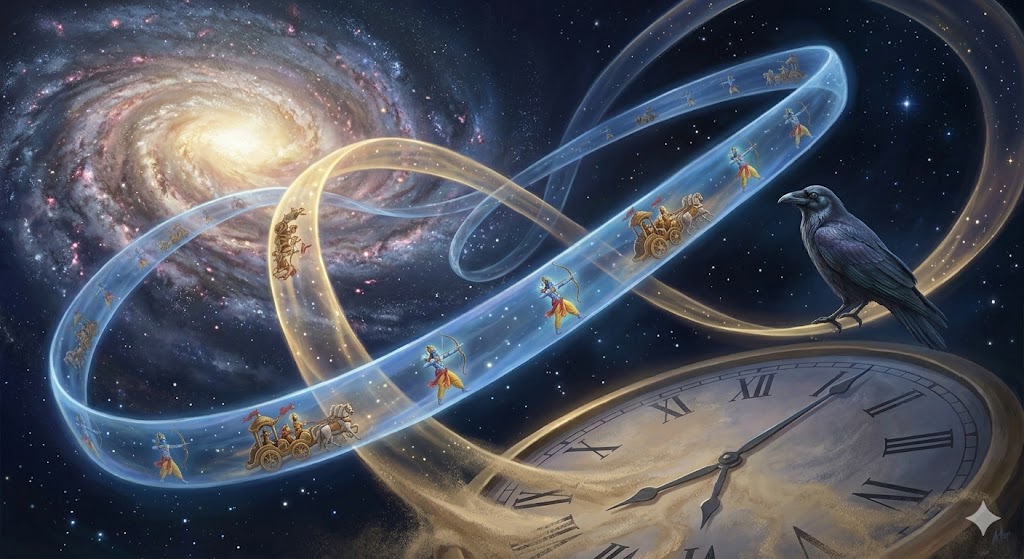
This image visually interprets the metaphysical concepts discussed—the time loops, multiple Ramayanas, and the fractal universe.
Conclusion: The Eternal Messenger of Bhakti
Kakbhushundi, the crow sage who watched Ramayana 11 times and Mahabharata 16 times with varying sequences, embodies the profound depth of Hindu cosmology. His life—from cursed mortal to immortal witness—illustrates transformation through devotion.
By sharing his experiences with Garuda and insights on cosmic cycles with figures like Vasistha, he invites us all to look beyond the apparent and embrace the eternal. In his words and presence, we find encouragement to chant Rama's name, cultivate humility, and trust in the divine play that unfolds across time and space.
For those seeking deeper spiritual growth, the story of Kakbhushundi serves as both inspiration and gentle reminder: The universe may be vast and cyclical, but a pure heart finds its home in the divine.