"Sauptika Parva: The Night Massacre in Mahabharata"
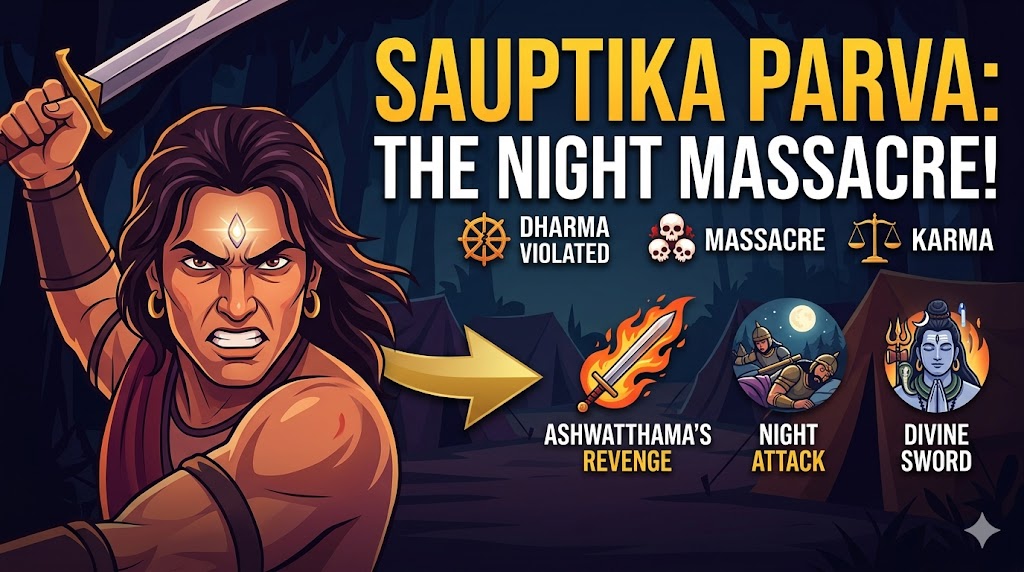
The Mahabharata, one of the greatest epics of ancient India, unfolds across 18 parvas that chronicle the conflict between the Pandavas and Kauravas. Among these, the Sauptika Parva stands out as one of the most intense and morally complex sections. Known as the "Book of the Sleeping Warriors," this tenth parva narrates the harrowing events immediately following the 18th and final day of the Kurukshetra war.
After Duryodhana's fall, three surviving Kaurava warriors—Ashwatthama, Kripa, and Kritavarma—embark on a path of vengeance that violates the very codes of warfare they once upheld. The parva explores themes of grief-driven rage, the boundaries of dharma, and the inescapable consequences of adharma. It serves as a stark reminder that victory in battle does not erase the human cost or moral dilemmas that linger.
In this detailed exploration, we delve into the structure, key incidents, characters, and philosophical underpinnings of the Sauptika Parva. Whether you are revisiting the epic through the popular Mahabharat serial or studying the real Mahabharata book, this parva offers profound insights into the darker facets of war and human nature.
The Mahabharata comprises 18 major parvas, each marking a distinct phase of the narrative. The Sauptika Parva is the tenth in this sequence, positioned right after the Shalya Parva, which concludes the main battlefield actions with the mace duel between Bhima and Duryodhana.
Traditionally, the Sauptika Parva consists of two upa-parvas (sub-sections):
Sauptika Parva(chapters 1–9): Focuses on the planning and execution of the night raid.
Aishika Parva (chapters 10–18): Covers the aftermath, pursuit of Ashwatthama, and the invocation of divine weapons.
With only 18 chapters in total, it is relatively concise compared to longer parvas like the Bhishma or Shanti Parva. Yet, its emotional and ethical weight is immense. The narrative is delivered through Sanjaya's report to the grieving Dhritarashtra, blending vivid descriptions of violence with reflective dialogues on duty and fate.
This placement is significant. The war has technically ended with the Pandavas' victory, but the Sauptika Parva shows that conflict's ripples extend far beyond the battlefield, blurring lines between victor and vanquished.
By the 18th day, the Kaurava army lies decimated. Duryodhana, mortally wounded after his mace fight with Bhima, lies dying on the battlefield. Only a handful of warriors remain: on the Kaurava side, Ashwatthama (son of Drona), Kripa (the guru), and Kritavarma (a Yadava warrior). On the Pandava side, the five brothers, Krishna, Satyaki, and Yuyutsu survive, though their camp still houses thousands of soldiers, including the sons of Draupadi (Upapandavas), Dhrishtadyumna (Pandava commander), Shikhandi, and other allies.
Ashwatthama, devastated by his father Drona's death—engineered through a strategic deception involving Yudhishthira—seeks retribution. Seeing Duryodhana in his final moments fuels his resolve. The trio retreats to a forest near the Pandava camp as night falls.
This moment captures the epic's recurring tension: even in defeat, the desire for revenge persists, often leading to acts that defy established rules of engagement.
Key Events in Sauptika Parva: The Night of Slaughter
The parva opens with Ashwatthama, unable to sleep, witnessing an owl silently killing sleeping crows in a tree. This sight inspires his plan: attack the Pandava camp while the warriors rest, exhausted from the day's battle.
Kripa and Kritavarma strongly object, reminding Ashwatthama that attacking sleeping enemies is against kshatriya dharma. They argue it brings infamy and sin. Ashwatthama acknowledges the moral breach but remains adamant, driven by grief over his father and Duryodhana. Reluctantly, the other two agree to support him.
As they approach the camp, Ashwatthama encounters a terrifying figure guarding the entrance—revealed as a manifestation of Lord Shiva (Mahadeva). After a fierce but futile combat, Shiva blesses Ashwatthama, granting him an invincible sword and divine energy to accomplish his mission. Empowered, Ashwatthama enters the camp like a force of destruction.
He begins with Dhrishtadyumna, the man who beheaded Drona. Waking the sleeping commander with a kick, Ashwatthama refuses him a warrior's death by weapon and instead kills him brutally by trampling and striking vital points. The cries awaken the camp, leading to chaos.
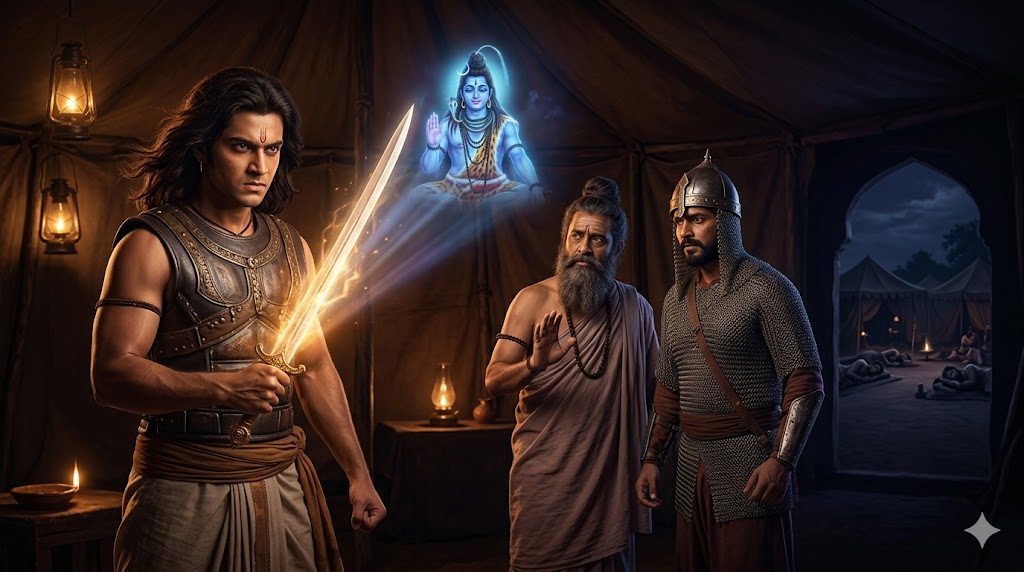
Legacies of Dharma and Wrath. Inside a rustic tent at night, Kripa and Kritavarma look on with conflicting emotions as Ashwatthama, now armed with Shiva's invincible sword, prepares to attack the sleeping Pandava camp, symbolizing the clash between personal bonds, warrior dharma, and grief-driven revenge.
Ashwatthama slaughters hundreds, including the five sons of Draupadi, Shikhandi, Uttamaujas, Yudhamanyu, and countless Panchala and Somaka warriors. He sets parts of the camp ablaze, heightening the panic. The warriors, disoriented and weaponless, fall easily. Only those absent from the main camp—the five Pandavas, Krishna, and Satyaki—escape the carnage.
By dawn, the once-victorious Pandava army is reduced to a skeleton force. Ashwatthama, his divine energy spent, rejoins his companions and reports the deed to the dying Duryodhana, who finds solace before breathing his last.
Aishika Parva: Aftermath, Pursuit, and the Brahmastra Crisis
The second part shifts to the Pandavas' camp. News of the massacre reaches Yudhishthira, who collapses in grief upon learning of his sons' deaths. Draupadi, inconsolable, demands justice and vows to fast unto death unless Ashwatthama is punished.
The Pandavas pursue the fugitives. They track Ashwatthama to the banks of the Ganges (Bhagirathi), where he sits with sages including Vyasa. Cornered, Ashwatthama invokes the Brahmastra, a devastating celestial weapon. Arjuna counters with his own Brahmastra.
Krishna warns that the collision could annihilate the world. Arjuna withdraws his weapon, but Ashwatthama, unable or unwilling to recall his, redirects it toward Uttara's womb, aiming to kill the unborn Parikshit—the future heir of the Pandava line.
Krishna intervenes, protecting the child and cursing Ashwatthama with immortality and eternal suffering: he must roam the earth alone, with a festering wound on his forehead, until the end of the Kali Yuga. Ashwatthama hands over the divine gem (mani) from his forehead as a symbol of surrender.
This sequence underscores the parva's exploration of weapon ethics and the limits of vengeance.
Character Analysis: Ashwatthama and Supporting Figures
Ashwatthama emerges as the central, tragic figure. A skilled warrior and partial avatar of Shiva, he is torn between dharma and filial loyalty. His act, though born of profound loss, marks a descent into adharma. The epic portrays him not as a mere villain but as a complex soul whose unchecked rage leads to self-inflicted torment. His curse cements his role as one of the Chiranjivis (immortals) in Hindu tradition.
Kripa and Kritavarma represent reluctant participants. As elders and respected figures, they voice ethical concerns yet join the raid, highlighting how personal bonds and loyalty can compromise moral judgment.
Dhrishtadyumna and the Upapandavas symbolize the innocent victims of this cycle of revenge. Their deaths amplify the tragedy, showing how war's violence spills into the next generation.
Krishna acts as the voice of higher dharma, guiding the Pandavas and enforcing cosmic balance through his interventions and curse.
The parva also touches upon Karna indirectly through the broader context of unresolved grudges from earlier parvas like the Sabha and Dyuta, where insults fueled the war's origins.
Themes and Philosophical Insights
Sauptika Parva delves deeply into several timeless themes:
Dharma and Adharma in War: The night attack violates rules against striking the unarmed or sleeping, raising questions about when revenge overrides ethics.
Cycle of Violence: The massacre illustrates how hatred begets more hatred, extending the war's suffering beyond the declared end.
Karma and Consequences: Ashwatthama's curse emphasizes that no act escapes repercussions, even for the powerful.
Grief and Human Frailty: Characters grapple with overwhelming sorrow, showing vulnerability even among heroes.
Divine Intervention:The roles of Shiva and Krishna highlight the interplay between human agency and cosmic will.
These elements make the parva relevant for modern readers reflecting on conflict, justice, and moral ambiguity.
Relevance in Popular Culture and Today
The Sauptika Parva has inspired numerous retellings in the Mahabharat serial, theatrical adaptations, and literature. Its graphic violence and ethical debates continue to spark discussions in group sessions, academic studies, and online forums about the "real Mahabharata book" versus simplified versions.
In contemporary times, it offers lessons on the perils of unchecked retaliation, the importance of ethical conduct in crises, and the long shadow of war on societies.
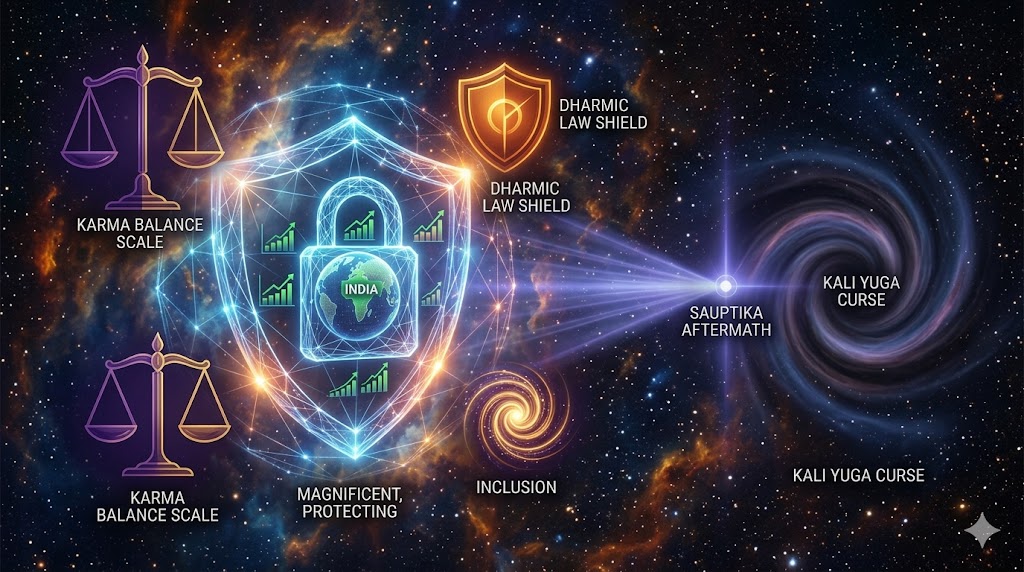
Pursuit, Brahmastra, and Cosmic Justice. A majestic cosmic visualization depicting the collision and containment of two Brahmastras (Arjuna's and Ashwatthama's). Below, a transparent shield of light protects India, symbolizing how karma, divine intervention by Krishna, and immutable cosmic law contain destruction, redirecting the ultimate weapon toward Parikshit.
Conclusion
The Sauptika Parva is more than a tale of massacre; it is a profound meditation on the costs of war and the fragility of dharma. Through Ashwatthama's night of fury and its repercussions, Vyasa reminds us that true victory lies not in destruction but in upholding righteousness, even amid profound loss.
As the epic transitions to the Stri Parva and beyond, the events of this parva linger, shaping the Pandavas' path toward renunciation and peace. For anyone exploring Mahabharata stories or seeking deeper understanding of its warriors and incidents, the Sauptika Parva remains an essential, haunting chapter that reveals the epic's enduring wisdom.